Data Structures using C PlusPlus: Chapter 5: Linked Lists
Doubly Linked List
C++ Programing
Questions: 1. Explain various operations performed on the doubly linked list. 2. Explain the insertion and deletion operation in doubly linked list.
Doubly
Linked List
•
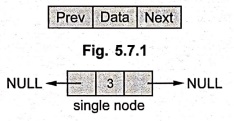
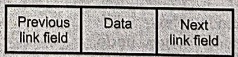
The doubly linked list has two link fields. One link field is previous pointer
and the other link field is that next pointer. The typical structure of each
node in doubly linked list is like this.
'C++'
structure of doubly linked list:
typedef struct node
{
int Data;
struct node *prev;
struct node *next;
}

•
The linked representation of a doubly linked list is
•
Thus the doubly linked list can traverse in both the directions, forward as
well as backwards.
•
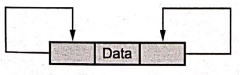
Now, there may be one question in your mind that how do the empty doubly
circular linked lists look? Here is the representation.
That
means the prev and next pointers are pointing to the self node.
Logic for doubly linked list
In
doubly linked list there are following operations
1.
Create
2.
Display
3.
Insert
4.
Delete
The
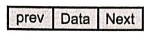
node in Doubly Linked List (DLL) will look like this
1. Creation of node
Initially
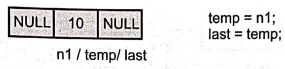
set new node as
For
the first time flag = 0
Now
set flag = 1, if we want to create more node then ‒
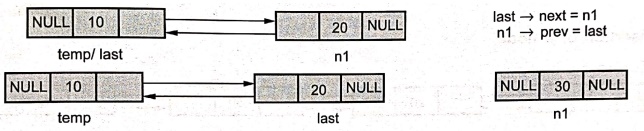
If
we want to attach node 30 then

This
we can continue to create a doubly linked list.
2. Display of doubly linked list
We
assign head node address to temp node.

while (temp → next!= NULL)
{
// display data at temp node.
temp = temp →next;
}
This
will display 10 20
30 as a doubly linked.
3. Deletion of a node in doubly linked list
Consider,
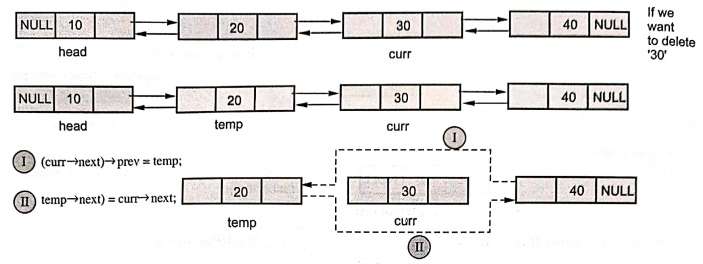
I)
(curr→next)→prev = temp;
II)
temp→ next) = curr→next;
Then
delete curr.
4. Insertion of a node
Consider
a list

Suppose
we want to insert 31 after 30 then first search for node 30 call it as temp node. Then create a node containing
value 31.
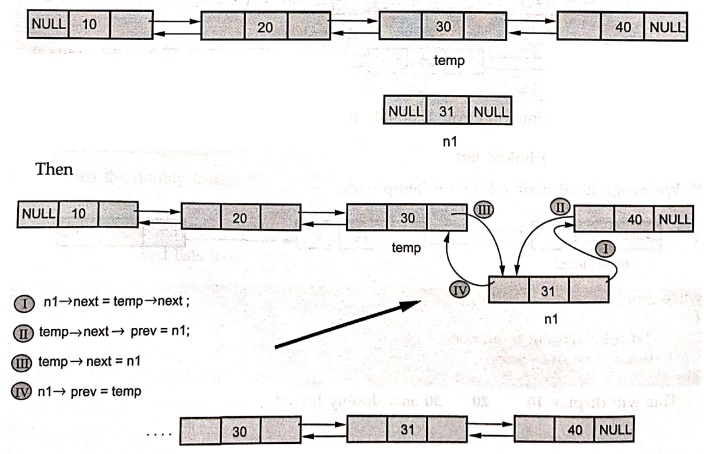
(I)
n1→next = temp→>next;
(II)
temp→next→ prev = n1;
(III)
temp→ next = n1
(IV)
n1→ prev = temp
Thus
"Node inserted".
/**************************************************************************
Demonstration Program to perform various operations such as
insertion, deletion, finding the lenghth of the doublly linked list.
**************************************************************************/
// List of include files
#include<iostream>
using namespace std;
// class defination
class dll
{
private:
struct node
{
int Data;
structnode *next;
structnode *prev;
}*head;
public:
dll();
void create();
void print();
void insert _beg();
void insert_ after();
void insert_ end();
void del();
int length();
~dll();
};
/*
‒‒‒‒‒‒‒‒‒‒‒‒‒‒‒‒‒‒‒‒‒‒‒‒‒‒‒‒‒‒‒‒‒‒‒‒‒‒‒‒‒‒‒‒‒‒‒‒‒‒‒‒‒‒‒‒‒‒‒‒‒‒‒‒‒‒‒‒‒‒‒‒‒‒‒
The Constructor defined
‒‒‒‒‒‒‒‒‒‒‒‒‒‒‒‒‒‒‒‒‒‒‒‒‒‒‒‒‒‒‒‒‒‒‒‒‒‒‒‒‒‒‒‒‒‒‒‒‒‒‒‒‒‒‒‒‒‒‒‒‒‒‒‒‒‒‒‒‒‒‒‒‒‒‒
*/
dll::dll()
{
head=NULL;
}
/*
‒‒‒‒‒‒‒‒‒‒‒‒‒‒‒‒‒‒‒‒‒‒‒‒‒‒‒‒‒‒‒‒‒‒‒‒‒‒‒‒‒‒‒‒‒‒‒‒‒‒‒‒‒‒‒‒‒‒‒‒‒‒‒‒‒‒‒‒‒‒‒‒
The destructor defined
‒‒‒‒‒‒‒‒‒‒‒‒‒‒‒‒‒‒‒‒‒‒‒‒‒‒‒‒‒‒‒‒‒‒‒‒‒‒‒‒‒‒‒‒‒‒‒‒‒‒‒‒‒‒‒‒‒‒‒‒‒‒‒‒‒‒‒‒‒‒‒‒‒
*/
dll::~dll()
{
node *temp, *temp1;
//free the memory
temp=head;
while(templ=NULL)
{
templ=temp‒>next;
delete temp;
temp=temp1;
}
}
/ *
‒‒‒‒‒‒‒‒‒‒‒‒‒‒‒‒‒‒‒‒‒‒‒‒‒‒‒‒‒‒‒‒‒‒‒‒‒‒‒‒‒‒‒‒‒‒‒‒‒‒‒‒‒‒‒‒‒‒‒‒
The Create function
‒‒‒‒‒‒‒‒‒‒‒‒‒‒‒‒‒‒‒‒‒‒‒‒‒‒‒‒‒‒‒‒‒‒‒‒‒‒‒‒‒‒‒‒‒‒‒‒‒‒‒‒‒‒‒‒‒‒‒‒
*/
void dll::create():
{
// Local declarations
here
node *n1,*last, *temp;
char ans ='y';
int flag=0;
int val;
do
{
cout<<"\nEnter
the data:";
cin>>val;
// allocate new node
n1 = new node;
if (n1 = = NULL)
cout<<"Unable
to allocate memory\n";
n1 ‒> Data = val
n1‒>next = NULL;
n1 ‒> prev =
NULL;
if (flag= =0) //
Executed only for the first time
{
temp=n1;
last=temp;
flag=1;
}
else
{
// last keeps
track of the most recently created node
last‒>next=n1;
n1‒>prev=last;
last=n1;
}
cout<<"\n\nEnter more?";
ans = getche();
}while(ans= ='y' || ans = ='Y');
cout<<"\nThe List is created\n";
head=temp;
getch();
}
/*
‒‒‒‒‒‒‒‒‒‒‒‒‒‒‒‒‒‒‒‒‒‒‒‒‒‒‒‒‒‒‒‒‒‒‒‒‒‒‒‒‒‒‒‒‒‒‒‒‒‒‒‒‒‒‒‒‒‒‒‒‒‒‒‒‒
The length function
‒‒‒‒‒‒‒‒‒‒‒‒‒‒‒‒‒‒‒‒‒‒‒‒‒‒‒‒‒‒‒‒‒‒‒‒‒‒‒‒‒‒‒‒‒‒‒‒‒‒‒‒‒‒‒‒‒‒‒‒‒‒‒‒‒
*/
int dll::length()
{
node *curr
int count;
count = 0;
curr= head;
if ( curr = = NULL )
{
cout<<"The
list is empty\n",
getch();
return 0;
}
while (curr != NULL)
{
count++;
curr = curr‒>next;
// traverse till end
}
getch();
return count;
}
/*
‒‒‒‒‒‒‒‒‒‒‒‒‒‒‒‒‒‒‒‒‒‒‒‒‒‒‒‒‒‒‒‒‒‒‒‒‒‒‒‒‒‒‒‒‒‒‒‒‒‒‒‒‒‒‒‒‒‒‒‒
The print function
‒‒‒‒‒‒‒‒‒‒‒‒‒‒‒‒‒‒‒‒‒‒‒‒‒‒‒‒‒‒‒‒‒‒‒‒‒‒‒‒‒‒‒‒‒‒‒‒‒‒‒‒‒‒‒‒‒‒‒‒‒
*/
void dll ::print()
{
node *temp;
temp = head;
if ( temp = = NULL)
{
cout<<"\nThe
list is empty\n";
getch(); clrscr();
return;
}
else
{
cout<<"\nThe
list is:";
while(temp ! = NULL)
{
cout<<temp‒>Data<<"
";
temp = temp ‒>next;
}
}
getch();
}
/*
‒‒‒‒‒‒‒‒‒‒‒‒‒‒‒‒‒‒‒‒‒‒‒‒‒‒‒‒‒‒‒‒‒‒‒‒‒‒‒‒‒‒‒‒‒‒‒‒‒‒‒‒‒‒‒‒‒‒
The del function
‒‒‒‒‒‒‒‒‒‒‒‒‒‒‒‒‒‒‒‒‒‒‒‒‒‒‒‒‒‒‒‒‒‒‒‒‒‒‒‒‒‒‒‒‒‒‒‒‒‒‒‒‒‒‒‒‒‒
*/
void dll:: del()
{
node *curr, *temp;
int data;
curr = head;
cout<<"\nEnter the data of the node you want to
delete: ";
cin>>data;
while(curr!= NULL)
{
if(curr‒>Data= =data)
//traverse till the required node to delete
break; //is found
curr=curr‒>next;
}
if(curr= =NULL)
cout<<"\nNode
not found";
else
{
if(curr= =head)
{
if(head‒>next= =NULL&&head‒>prev=
= NULL)//only one node
head=NULL;
else
{
head=curr‒>next;//
first node
head‒>prev=NULL;
}
}
else
{
temp=curr‒>prev; //intermediate
or end node
if(curr‒>next!=NULL)
(curr‒>next)‒>prev=temp;
temp‒>next=curr‒>next;
}
delete curr; //free memory
cout<<"\nThe item is deleted\n";
}
getch();
}
/*‒‒‒‒‒‒‒‒‒‒‒‒‒‒‒‒‒‒‒‒‒‒‒‒‒‒‒‒‒‒‒‒‒‒‒‒‒‒‒‒‒‒‒‒‒‒‒‒‒‒‒‒‒‒‒‒‒‒
Function to insert at end
‒‒‒‒‒‒‒‒‒‒‒‒‒‒‒‒‒‒‒‒‒‒‒‒‒‒‒‒‒‒‒‒‒‒‒‒‒‒‒‒‒‒‒‒‒‒‒‒‒‒‒‒‒‒‒‒‒‒‒‒‒‒*/
void dll::insert_end()
{
node *temp, *n1;
int val,flag=0;
cout<<"\nEnter the data of the new node to
insert";
cin>>val;
temp=head;
if(temp= = NULL)
flag=1;
else
{
while(temp‒>next!=
NULL) // traverse till end
temp=temp‒>next;
}
// allocate new node
n1 = new node;
if (n1 = = NULL )
cout<<"\nUnable to allocate memory\n";
n1‒> Data = val;
n1 ‒> next =NULL;
n1 ‒> prev = NULL;
if(flag= =0)
{
temp‒>next=n1; //
attach at end
n1‒>prev=temp;
}
else
head=n1; //if list empty make this node as head
node
cout<<"\nNode inserted";
}
/*‒‒‒‒‒‒‒‒‒‒‒‒‒‒‒‒‒‒‒‒‒‒‒‒‒‒‒‒‒‒‒‒‒‒‒‒‒‒‒‒‒‒‒‒‒‒‒‒‒‒‒‒‒
Function to insert after a node
‒‒‒‒‒‒‒‒‒‒‒‒‒‒‒‒‒‒‒‒‒‒‒‒‒‒‒‒‒‒‒‒‒‒‒‒‒‒‒‒‒‒‒‒‒‒‒‒‒‒‒‒‒‒‒*/
void dll:: insert_after()
{
node *temp, *nl;
int val,val1;
cout<<"\nEnter the data of the new node to
insert";
cin>>val;
cout<<"\nEnter the data of the node after which to
insert";
cin>>val1;
temp=head;
while(temp!= NULL)
{
if(temp‒>Data= =val1)
//traverse till the required node after which to insert
break;
temp=temp‒>next;
}
if(temp! =NULL)
{
/* allocate new node */
n1 = new node;
if (n1= = NULL)
cout<<"Unable
to allocate memory\n";
n1‒> Data = val;
n1‒> next = NULL;
n1‒> prev = NULL;
/* after temp attach*/
n1‒>next= temp‒>next;
temp‒>next‒>prev=n1;
temp‒>next=n1;
n1‒>prev=temp;
cout<<"\nNode
inserted";
}
else
cout<<"\nNode
after which to insert not found";
}
/*‒‒‒‒‒‒‒‒‒‒‒‒‒‒‒‒‒‒‒‒‒‒‒‒‒‒‒‒‒‒‒‒‒‒‒‒‒‒‒‒‒‒‒‒‒‒‒‒‒‒‒‒‒‒‒‒‒‒‒‒‒‒‒‒‒‒
Function to insert at the beginning
‒‒‒‒‒‒‒‒‒‒‒‒‒‒‒‒‒‒‒‒‒‒‒‒‒‒‒‒‒‒‒‒‒‒‒‒‒‒‒‒‒‒‒‒‒‒‒‒‒‒‒‒‒‒‒‒‒‒‒‒‒‒‒‒‒‒‒‒‒*/
void dll:: insert_beg()
{
node *temp, *n1;
int data;
cout<<"\nEnter the data of the new node to
insert";
cin>>data;
/* allocate new node */
n1= new node;
if (n1 = = NULL)
cout<<"Unable
to allocate memory\n";
n1 ‒> Data = data;
n1‒>next = NULL;
n1‒> prev = NULL;
if(head)
{
n1‒>next=head;
//attach before head
head‒>prev=n1;
}
head=n1; //make this node as head
cout<<"\nNode inserted";
}
/*
‒‒‒‒‒‒‒‒‒‒‒‒‒‒‒‒‒‒‒‒‒‒‒‒‒‒‒‒‒‒‒‒‒‒‒‒‒‒‒‒‒‒‒‒‒‒‒‒‒‒‒‒‒‒‒‒‒‒‒‒‒
The main function
‒‒‒‒‒‒‒‒‒‒‒‒‒‒‒‒‒‒‒‒‒‒‒‒‒‒‒‒‒‒‒‒‒‒‒‒‒‒‒‒‒‒‒‒‒‒‒‒‒‒‒‒‒‒‒‒‒‒‒‒‒‒‒‒
*/
void main()
{
dll d;
int ch,ch1,cnt;
char ans = 'y';
do
{
clrscr();
cout<<"\n"<<<"MENU";
cout<<"\n1.Create\n2.Display\n3.Insert\n4.Delete\n5.Length";
cout<<"\nEnter
ur choice:";
cin>>ch;
switch(ch)
{
case 1: d.create();
break;
case 2: d.print();
break;
case 3: clrscr();
d.print();
cout<<"\nMenu";
cout<<"\n1.Insert at
beginning\n2.Insert after";
cout<<"\n3.Insert at
end";
cout<<"\nEnter your
choice";
cin>>ch1;
switch(chl)
{
case 1: d.insert_beg();
d.print();
break;
case 2:
d.insert_after();
d.print();
break;
case 3:
d.insert_end();
d.print();
break;
default:cout<<"\nInvalid
choice";
}
break;
case 4: d.print();
d.del();
d.print();
break;
case 5: cnt=d.length();
cout<<"The length is:
"<<cnt;
break;
default:
cout<<"\nInvalid choice";
}
cout<<"\n Do You Want To Continue?";
cin>>ans;
}while(ans= ='y'||ans= ='Y');
getch();
return;
}
Output
MENU
1.Create
2.Display
3.Insert
4.Delete
5.Length
Enter ur choice:1
Enter the data :1
Enter more?y
Enter the data :2
Enter more?y
Enter the data :3
Enter more?y
Enter the data :4
Enter more?y
Enter the data :5
Enter more?n
The List is created
Do You Want To
Continue?
MENU
1.Create
2.Display
3.Insert
4.Delete
5.Length
Enter ur choice:2
The list is:1 2 3 4 5
Difference between Singly and Doubly Linked List
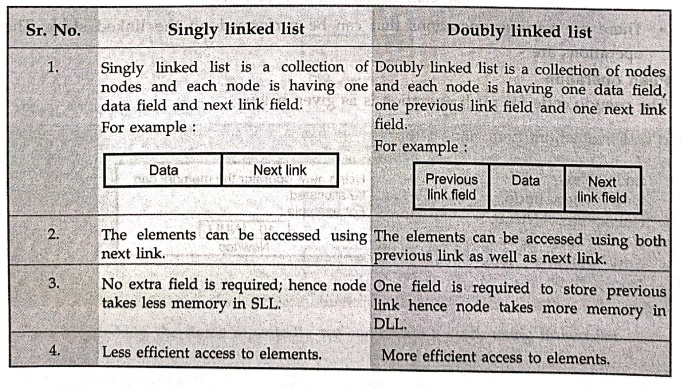
Singly linked list
1.
Singly linked list is a collection of nodes and each node is having one data
field and next link field.
For
example:

2.
The elements can be accessed using next link.
3.
No extra field is required; hence node takes less memory in SLL.
4.
Less efficient access to elements.
Doubly linked list
1.
Doubly linked list is a collection of nodes and each node is having one data
field, one previous link field and one next link field
For
example:
2.
The elements can be accessed using both previous link as well as next link.
3.
One field is required to store previous link hence node takes more memory in
DLL.
4.
More efficient access to elements.
Review Questions
1. Explain various
operations performed on the doubly linked list.
2. Explain the
insertion and deletion operation in doubly linked list.
Data Structures using C PlusPlus: Chapter 5: Linked Lists : Tag: Data Structure, C++ Programing : C++ Programing - Doubly Linked List
Data Structures using C PlusPlus: Chapter 5: Linked Lists
Under Subject
Data Structures using CPlusPlus
CS25C05 2nd Semester ECE Dept | 2025 Regulation | 2nd Semester 2025 Regulation
Related Subjects

English Essentials II
EN25C02 2nd Semester | 2025 Regulation | 2nd Semester 2025 Regulation

Tamils and Technology தமிழர்களும் தொழில்நுட்பமும்
UC25H02 2nd Semester | 2025 Regulation | 2nd Semester 2025 Regulation
Linear Algebra
MA25C02 2nd Semester | 2025 Regulation

Electron Devices
EC25C01 2nd Semester ECE Dept | 2025 Regulation | 2nd Semester 2025 Regulation
Data Structures using CPlusPlus
CS25C05 2nd Semester ECE Dept | 2025 Regulation | 2nd Semester 2025 Regulation

Circuits and Network Analysis
EC25C02 2nd Semester ECE Dept | 2025 Regulation | 2nd Semester 2025 Regulation

Re-Engineering for Innovation
ME25C05 2nd Semester | 2025 Regulation | 2nd Semester 2025 Regulation
Engineering Drawing - Laboratory
ME25C01 2nd Semester | 2025 Regulation | 2nd Semester 2025 Regulation
Data Structures using CPlusPlus - Laboratory
CS25C05 2nd Semester ECE Dept | 2025 Regulation | 2nd Semester 2025 Regulation
Devices and Circuits Laboratory
EC25C03 2nd Semester ECE Dept | 2025 Regulation | 2nd Semester 2025 Regulation