Data Structures using C PlusPlus: Chapter 5: Linked Lists
Implementation of linked list
Questions: 1. Give the algorithm for inserting an element and deleting an element in a linked list. 2. Give syntax to insert X in linked list.
Implementation
•
The linked list is created using dynamic memory allocation. That means while
creating the list we are not using arrays at all. Hence the main advantage of this kind of implementation is that we can
create a list of nodes as per our needs and requirements. Hence there won't be
any wastage or lack of memory. Various operations of linked list are ‒
1.
Creation of linked list.
2.
Display of linked list.
3.
Insertion of any element in the linked list.
4.
Deletion of any element from the linked list.
5.
Searching of desired element in the linked list. We will discuss each operation
one by one ‒
1. Creation of linked list
void sll:: create()
{
node *temp, *New;
int val,flag;
char ans ='y';
flag=TRUE;
do
{
cout<<"\nEnter
the data :";
cin>>val;
// allocate memory to
new node
New = new node;
if (New= = NULL)
cout<<"Unable
to allocate memory\n";
New‒> data = val;
New‒>next = NULL;
if( flag= =TRUE) //
Executed only for the first time
{
head= New;
temp = head;
flag=FALSE;
}
else
{
/*temp last keeps track
of the most recently created node*/
temp‒>next = New;
temp = New;
}
cout<<"\n Do you want to enter more
elements?(y/n)";
ans = getche();
}while(ans= ='y' || ans= ='Y');
cout<<"\nThe Singly Linked List is created\n";
getch();
clrscr();
}
Creation of linked list (logic explanation part) :
•
Initially one variable flag is taken whose value is initialized to TRUE (i.e.
1). The purpose of flag is for making a check on creation of first node. That
means if flag is TRUE then we have to create head node or first node of linked
list. Naturally after creation of first node we will reset the flag (i.e.
assign FALSE to flag) Consider that we have entered the element value 10
initially then,
Step 1:
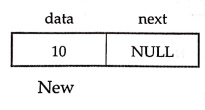
New = new node;
/* memory gets allocated for New node */
New →data = Val;
/* value 10 will be put in data field of New */
Step 2:
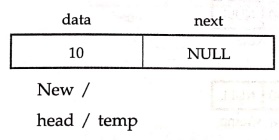
if (flag = = TRUE)
{
head = New
temp = head;
/* We have also called this node as temp because head's address
will be preserved in 'head' and we
can change 'temp' node as per requirement */
flag = FALSE;
/* After creation of first node flag is reset */
Step 3:
If
head node of linked list is created
we can further create a linked list by attaching the subsequent nodes. Suppose
we want to insert a node with value 20 then,
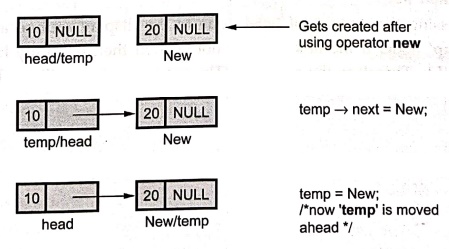
Step 4:
If
user wants to enter more elements then let say for value 30 the scenario will
be,
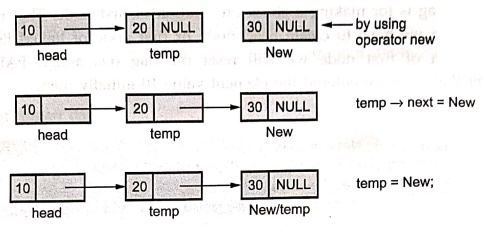
Then
for value 40 ‒
Step 5:
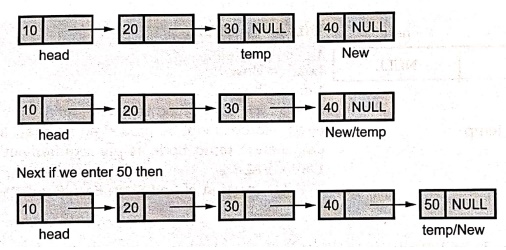
is
the final linked list.
2. Display of linked list
•
We are passing the address of head
node to the display routine and calling head as the 'temp' node. If the linked list is not created then naturally
head=temp node will be NULL.
Therefore the message "The list is empty" will be displayed.
void sll ::display()
{
node *temp;
temp = head;
if ( temp = = NULL)
{
cout<<"\nThe
list is empty\n";
getch(); clrscr();
return;
}
while (temp != NULL
{
cout<<temp‒>data<<"
";
temp = temp‒>next;
}
getch();
}
If
we have created some linked list like this then ‒
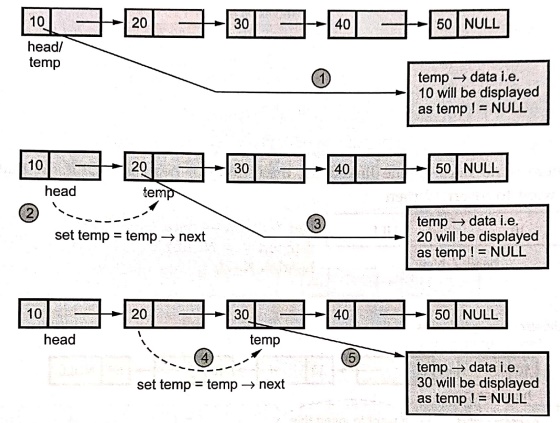
Continuing
in this fashion we can display remaining nodes 40, 50. When

As
now value of temp becomes NULL we will come out of while loop. As a result of such display routine we will get,
10
→ 20 → 30 → 40 → 50 → NULL
will
be printed on console.
3. Insertion of any element at anywhere in the linked list
•
There are three possible cases when we want to insert an element in the linked
list ‒
a)
Insertion of a node as a head node
b)
Insertion of a node as a last node
c)
Insertion of a node after some node.
We
will see the case a) first ‒
void sll:: insert head()
{
node *New,*temp;
New new node;
cout<<"\n
Enter The element which you want to insert";
cin>>New‒>data;
// There is
no node in the linked list. That means the linked list is empty
if(head= NULL)
head=New;
else
{
temp=head;
New‒>next = temp;
head=New;
}
}
If
there is no node in the linked list then value of head is NULL. At that time if
we want to insert 10 then
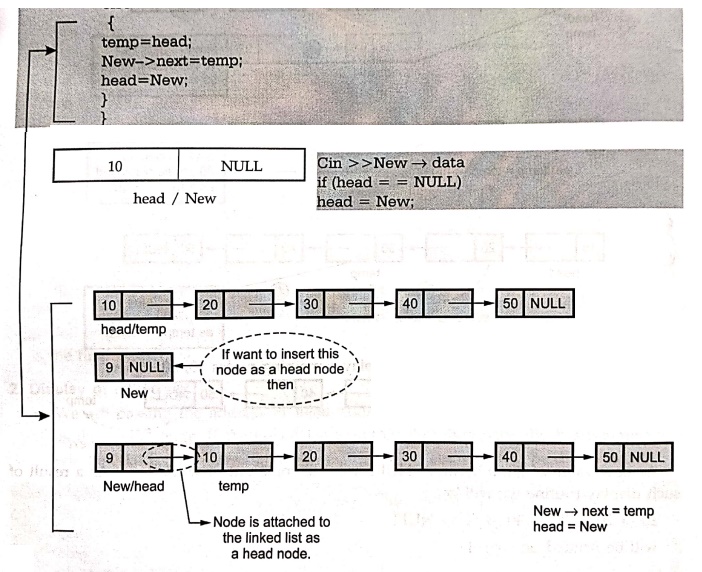
Otherwise
suppose linked list is already created like this
Now
we will insert a node at the end ‒
void sll::insert_last()
{
node *New,*temp;
cout<<"\nEnter
The element which you want to insert";
cin>>New‒>data;
if(head= =NULL)
head=New;
else
{
temp=head;
while(temp‒>next!=
NULL) //Finding the end of the
linked list.Then temp will be a last
bode.
temp=temp‒>next;
temp‒>next=New;
New‒>next=NULL;
}
}
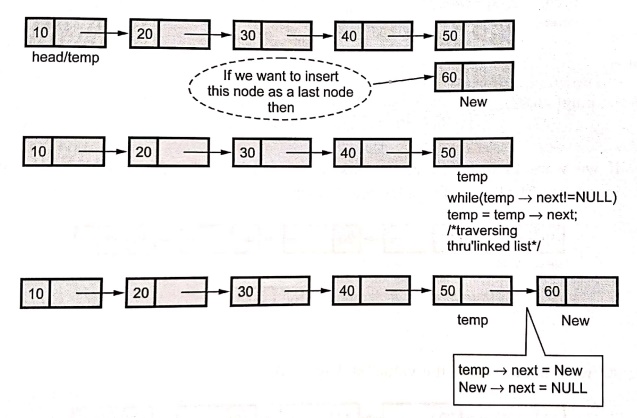
•
To attach a node at the end of linked list assume that we have already created
a linked list like this ‒
•
Now we will insert a new node after some node at intermediate position
void sll:: insert_after()
{
int key;
node *temp, *New;
New = new node;
cout<<"\n
Enter The element which you want to insert";
cin>>New‒>data;
if(head = = NULL)
{
head=New;
}
else
{
cout<<"\n
Enter The element after which you want to insert the node";
cin>>key;
temp = head;
do
{
if(temp‒>data= =key)
{
New‒>next‒temp‒>next;
temp‒>next=New;
break;
}
else
temp = temp‒>next;
}while(temp!= NULL);
}
}
•
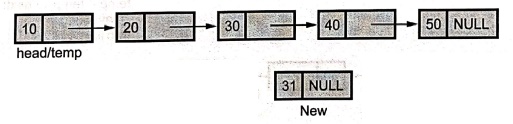
If we want to insert 31 in the linked list which is already created. We want to
insert this 31 after node containing 30 then
•As
we will search for the value 30, key = 30.
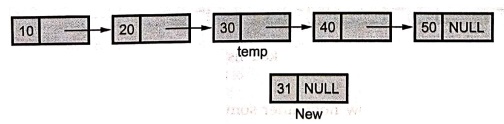
Then,
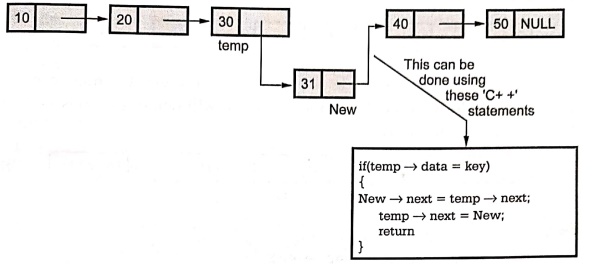
if(temp
→ data =
{
New
→ next = temp → next;
temp→
next = New;
return
}
Thus
desired node gets inserted at desired position.
4. Deletion of any element from the linked list
void sll:: dele()
{
node *temp, *prev;
int key:
temp = head;
clrscr();
cout<<"\nEnter
the data of the node you want to delete: ";
cin>>key;
while(temp!=NULL)
{
if(temp‒>data= = key)
//
Firstly Node to be deleted is searched in the linked list
break;
prev=temp; // Once the node to be
deleted is found then get the previous node of that node in variable prev
temp=temp‒>next;
}
if(temp==NULL)
cout<<"\nNode
not found";
else
{
if(temp= =head)
//first node // If we want to delete the head node then set its adjacent node
as a new head node and then release the memory
head = temp‒>next;
else
prev‒>next =temp‒>next;
//intermediate or end node
delete temp;
cout<<"\nThe
Element is deleted\n";
}
getch();
}
•
Suppose we have,

•
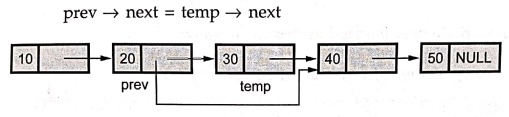
Suppose we want to delete node 30. Then we will search the node containing 30. Mark
the node to be deleted as temp. Then
we will obtain previous node of temp Mark previous node as prev

•
Then,
prev
→next = temp→ next
•
Now we will delete the temp node. Then the linked list will be

•
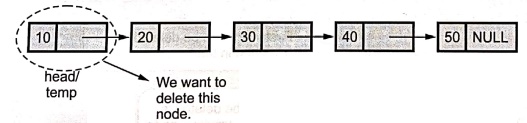
Another case is, if we want to delete a head node then ‒
•
This can be done using following statements

head
= temp → next;
delete
temp;
5. Searching of desired element in the linked list
•
The search function is for searching the node containing desired value. We pass
the head of the linked list to this routine so that the complete linked list
can be searched from the beginning.
void sll::search(int key)
{
node *temp;
int found;
temp = head;
if ( temp = = NULL )
{
cout<<"The
Linked List is empty\n";
getch();
clrscr();
}
found = FALSE;
while (temp != NULL
&& found == FALSE)
{
if (temp‒>data !=
key) //
Compare data at each node with the key
value. If not matching then move to the next node
temp = temp ‒>
next;
else
found =TRUE; // If node containing
desired data is obtained in the linked list then set found variable to TRUE
}
if (found = =TRUE
)
{
cout<<"\nThe
Element is present in the list\n";
getch();
}
else
{
cout<<"The
Element is not present in the list\n";
getch();
}
}
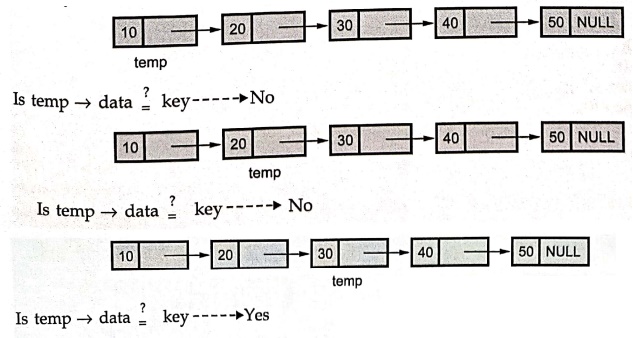
Consider
that we have created a linked list as

Suppose
key = 30 i.e. we want a node conaining value 30 then compare temp → data and key value. If there is no match then we will mark next node as temp.
•
Hence print the message "The
Element is present in the list"
•
Thus in search operation the entire list can be scanned in search of desired
node. And still, if required node is not obtained then we have to print the
message.
• "The Element is
not present in the list"
Let
us see the complete program for it ‒
'C++' Program
/**********************************************************************
Demonstration Program to perform various operations on singly
link lists.
*********************************************************************/
// List of include files
#include<iostream>
using namespace std;
#define TRUE 1
#define FALSE 0
// class defination
class sll
{
private:
struct node
{
int data;
structnode *next;
}*head;
public:
sll();
void create();
void display();
void search(int key);
void insert _head();
void insert_ after();
void insert_last();
void dele();
_sll();
};
/*
‒‒‒‒‒‒‒‒‒‒‒‒‒‒‒‒‒‒‒‒‒‒‒‒‒‒‒‒‒‒‒‒‒‒‒‒‒‒‒‒‒‒‒‒‒‒‒‒‒‒‒‒‒‒‒‒‒‒‒‒‒‒‒‒‒‒‒‒‒‒‒‒‒‒‒‒‒‒
The Constructor defined
‒‒‒‒‒‒‒‒‒‒‒‒‒‒‒‒‒‒‒‒‒‒‒‒‒‒‒‒‒‒‒‒‒‒‒‒‒‒‒‒‒‒‒‒‒‒‒‒‒‒‒‒‒‒‒‒‒‒‒‒‒‒‒‒‒‒‒‒‒‒‒‒‒‒‒‒‒‒‒
*/
sll::sll()
{
head=NULL;//initialize head to NULL
}
/*
‒‒‒‒‒‒‒‒‒‒‒‒‒‒‒‒‒‒‒‒‒‒‒‒‒‒‒‒‒‒‒‒‒‒‒‒‒‒‒‒‒‒‒‒‒‒‒‒‒‒‒‒‒‒‒‒‒‒‒‒‒‒‒‒‒‒‒‒‒‒‒‒‒‒‒‒‒‒‒‒‒
The Destructor defined
‒‒‒‒‒‒‒‒‒‒‒‒‒‒‒‒‒‒‒‒‒‒‒‒‒‒‒‒‒‒‒‒‒‒‒‒‒‒‒‒‒‒‒‒‒‒‒‒‒‒‒‒‒‒‒‒‒‒‒‒‒‒‒‒‒‒‒‒‒‒‒‒‒‒‒‒‒‒‒
*/
sll::~sll()
{
node *temp, *temp1;
temp = head‒>next;
delete head;
while(temp!= NULL)
//free the memory allocated
{
temp1=temp‒>next;
delete temp;
temp = temp1;
}
}
/*
‒‒‒‒‒‒‒‒‒‒‒‒‒‒‒‒‒‒‒‒‒‒‒‒‒‒‒‒‒‒‒‒‒‒‒‒‒‒‒‒‒‒‒‒‒‒‒‒‒‒‒‒‒‒‒‒‒‒‒‒‒‒‒‒‒‒‒‒‒‒‒‒‒‒‒‒‒‒‒‒‒
The Create function
‒‒‒‒‒‒‒‒‒‒‒‒‒‒‒‒‒‒‒‒‒‒‒‒‒‒‒‒‒‒‒‒‒‒‒‒‒‒‒‒‒‒‒‒‒‒‒‒‒‒‒‒‒‒‒‒‒‒‒‒‒‒‒‒‒‒‒‒‒‒‒‒‒‒‒‒‒‒‒‒‒
*/
void sll create()
{
node *temp, *New;
int val,flag;
char ans ='y';
flag=TRUE;
do
{
cout<<"\nEnter
the data:";
cin>>val;
// allocate memory
to new node
New = new node;
if ( New = = NULL )
cout<<"Unable
to allocate memory\n";
New‒> data = val;
New‒> next = NULL;
if( flag= =TRUE) //
Executed only for the first time
{
head = New;
temp = head;
flag = FALSE;
}
else
{
/*temp last keeps
track of the most recently created node*/
temp‒>next = New;
temp = New;
}
cout<<"\n Do
you want to enter more elements?(y/n)";
ans = getche();
}while(ans= ='y' || ans
= = 'Y');
cout<<"\nThe
Singly Linked List is created\n";
getch();
clrscr();
}
/*
‒‒‒‒‒‒‒‒‒‒‒‒‒‒‒‒‒‒‒‒‒‒‒‒‒‒‒‒‒‒‒‒‒‒‒‒‒‒‒‒‒‒‒‒‒‒‒‒‒‒‒‒‒‒‒‒‒‒‒‒‒‒‒‒‒‒‒‒‒‒‒‒‒‒‒‒‒‒‒‒‒‒‒‒‒‒‒
The display function
‒‒‒‒‒‒‒‒‒‒‒‒‒‒‒‒‒‒‒‒‒‒‒‒‒‒‒‒‒‒‒‒‒‒‒‒‒‒‒‒‒‒‒‒‒‒‒‒‒‒‒‒‒‒‒‒‒‒‒‒‒‒‒‒‒‒‒‒‒‒‒‒‒‒‒‒‒‒‒‒‒‒‒‒‒‒‒‒
*/
void sll ::display()
{
node *temp;
temp = head;
if (temp = = NULL )
{
cout<<"\nThe
list is empty\n";
getch(); clrscr();
return;
}
while (temp != NULL)
{
cout<<temp‒>data<<"
",
temp = temp ‒> next;
}
getch();
}
void sll::search(int key)
{
node *temp;
int found;
temp = head;
if (temp = = NULL )
{
cout<<"The
Linked List is empty\n";
getch();
clrscr();
}
found = FALSE;
while (temp != NULL
&& found = = FALSE)
{
if (temp‒>data !=
key)
temp = temp ‒>
next;
else
found = TRUE;
}
if (found = =TRUE)
{
cout<<"\nThe
Element is present in the list\n";
getch();
}
else
{
cout<<"The
Element is not present in the list\n";
getch();
}
}
/*
‒‒‒‒‒‒‒‒‒‒‒‒‒‒‒‒‒‒‒‒‒‒‒‒‒‒‒‒‒‒‒‒‒‒‒‒‒‒‒‒‒‒‒‒‒‒‒‒‒‒‒‒‒‒‒‒‒‒‒‒‒‒‒‒‒‒‒‒‒‒‒‒‒‒‒‒‒‒‒
The dele function
‒‒‒‒‒‒‒‒‒‒‒‒‒‒‒‒‒‒‒‒‒‒‒‒‒‒‒‒‒‒‒‒‒‒‒‒‒‒‒‒‒‒‒‒‒‒‒‒‒‒‒‒‒‒‒‒‒‒‒‒‒‒‒‒‒‒‒‒‒‒‒‒‒‒‒‒‒‒‒
*/
void sll:: dele()
{
node *temp, *prev;
int key;
temp = head;
clrscr();
cout<<"\nEnter
the data of the node you want to delete: ";
cin>>key;
while(temp!= NULL)
{
if(temp‒>data= =key)//traverse
till required node to delete
break; //is found
prev = temp;
temp = temp‒>next;
}
if(temp = =NULL)
cout<<"\nNode
not found";
else
{
if(temp = = head)
//first node
head = temp‒>next;
else
prev‒>next=temp‒>next;
//intermediate or end node
delete temp;
cout<<"\nThe Element is deleted\n";
}
getch();
}
/*
‒‒‒‒‒‒‒‒‒‒‒‒‒‒‒‒‒‒‒‒‒‒‒‒‒‒‒‒‒‒‒‒‒‒‒‒‒‒‒‒‒‒‒‒‒‒‒‒‒‒‒‒‒‒‒‒‒‒‒‒‒‒‒‒‒‒‒‒‒‒‒‒‒‒‒‒‒‒‒‒‒‒‒‒‒‒‒‒‒‒‒‒
Function to insert at end
‒‒‒‒‒‒‒‒‒‒‒‒‒‒‒‒‒‒‒‒‒‒‒‒‒‒‒‒‒‒‒‒‒‒‒‒‒‒‒‒‒‒‒‒‒‒‒‒‒‒‒‒‒‒‒‒‒‒‒‒‒‒‒‒‒‒‒‒‒‒‒‒‒‒‒‒‒‒‒‒‒‒‒‒‒‒‒‒‒‒‒
*/
void sll::insert last()
node *New*temp;
cout<<"\nEnter The element which you want to
insert";
cin>>New‒>data;
if(head = NULL)
head = New,
else
{
temp = head;
while(temp‒>next!=NULL)
temp = temp‒>next;
temp‒>next=New;
New‒>next = NULL;
}
}
*/
‒‒‒‒‒‒‒‒‒‒‒‒‒‒‒‒‒‒‒‒‒‒‒‒‒‒‒‒‒‒‒‒‒‒‒‒‒‒‒‒‒‒‒‒‒‒‒‒‒‒‒‒‒‒‒‒‒‒‒‒‒‒‒‒‒‒‒‒‒‒‒‒‒‒‒‒‒‒‒‒‒‒‒‒‒‒
Function to insert after a node
‒‒‒‒‒‒‒‒‒‒‒‒‒‒‒‒‒‒‒‒‒‒‒‒‒‒‒‒‒‒‒‒‒‒‒‒‒‒‒‒‒‒‒‒‒‒‒‒‒‒‒‒‒‒‒‒‒‒‒‒‒‒‒‒‒‒‒‒‒‒‒‒‒‒‒‒‒‒‒‒‒‒‒‒‒
*/
void sll:: insert_after()
{
int key;
node *temp, *New;
New = new node;
cout<<"\n
Enter The element which you want to insert";
cin>>New‒>data;
if(head = = NULL)
{
head =New;
}
else
{
cout<<"\n
Enter The element after which you want to insert the node";
cin>>key;
temp = head;
do
{
if(temp‒>data = = key)
{
New‒>next = temp‒>next;
temp‒>next=New;
break;
}
else
temp = temp‒>next;
}while(temp!= NULL);
}
}
/*
‒‒‒‒‒‒‒‒‒‒‒‒‒‒‒‒‒‒‒‒‒‒‒‒‒‒‒‒‒‒‒‒‒‒‒‒‒‒‒‒‒‒‒‒‒‒‒‒‒‒‒‒‒‒‒‒‒‒‒‒‒‒‒‒‒‒‒‒‒‒‒‒‒‒‒‒‒‒‒‒‒‒
Function to insert at the beginning
‒‒‒‒‒‒‒‒‒‒‒‒‒‒‒‒‒‒‒‒‒‒‒‒‒‒‒‒‒‒‒‒‒‒‒‒‒‒‒‒‒‒‒‒‒‒‒‒‒‒‒‒‒‒‒‒‒‒‒‒‒‒‒‒‒‒‒‒‒‒‒‒‒‒‒‒‒‒‒‒‒‒
*/
void sll:: insert_head()
{
node *New,*temp;
New = new node;
cout<<"\n Enter The element which you want to
insert";
cin>>New‒>data;
if(head = = NULL)
head=New;
else
{
temp = head;
New‒>next = temp;
head=New;
}
}
/*
‒‒‒‒‒‒‒‒‒‒‒‒‒‒‒‒‒‒‒‒‒‒‒‒‒‒‒‒‒‒‒‒‒‒‒‒‒‒‒‒‒‒‒‒‒‒‒‒‒‒‒‒‒‒‒‒‒‒‒‒‒‒‒‒‒‒‒‒‒‒‒‒‒
The main function
Input: None
Output: None
Parameter Passing Method: None
‒‒‒‒‒‒‒‒‒‒‒‒‒‒‒‒‒‒‒‒‒‒‒‒‒‒‒‒‒‒‒‒‒‒‒‒‒‒‒‒‒‒‒‒‒‒‒‒‒‒‒‒‒‒‒‒‒‒‒‒‒‒‒‒‒‒‒‒‒‒‒‒‒‒‒‒‒
*/
void main()
{
sll s;
int choice,val,ch1;
char ans = 'y';
do
{
clrscr();
cout<<"\nProgram
to Perform Various operations on Linked List";
cout<<"\n1.Create";
cout<<"\n2.Display";
cout<<"\n3.Search";
cout<<"\n4.Insert
an element in a list":
cout<<"\n5.Delete
an element from list";
cout<<"\n6.Quit";
cout<<"\nEnter
Your Choice (1‒6) ";
cin>>choice;
switch( choice)
{
case 1: s.create();
break;
case 2: s.display();
break;
case 3: cout<<"Enter the element you
want to search";
cin>>val;
s.search(val);
break;
case 4: clrscr();
cout<<"\nThe list
is:\n";
s.display();
cout<<"\nMenu";
cout<<"\n1.Insert at
beginning\n2.Insert after";
cout<<"\n3.Insert at
end";
cout<<"\nEnter your
choice";
cin>>ch1;
switch(chl)
{
case 1:s.insert_head();
break;
case 2:s.insert_after();
break;
case 3:s.insert_last();
break;
default:cout<<"\nInvalid
choice";
}
break;
case 5: s.dele();
break;
default:
cout<<"\nInvalid choice";
}
cout<<"\nContinue?";
cin>>ans;
}while(ans = ='y'||ans = ='Y');
getch();
return;
}
Output
Program to Perform
Various operations on Linked List
1.Create
2.Display
3.Search
4.Insert an element in
a list
5.Delete an element
from list
6.Quit
Enter Your Choice ( 1‒6)
1
Enter the data :10
Do you want to enter
more elements?(y/n)y
Enter the data :20
Do you want to enter
more elements?(y/n)y
Enter the data :30
Do you want to enter
more elements?(y/n)y
Enter the data :40
Do you want to enter
more elements?(y/n)y
Enter the data :50
Do you want to enter
more elements?(y/n)n
The Singly Linked List
is created
Continue?
Program to Perform
Various operations on Linked List
1.Create
2.Display
3.Search
4.Insert an element in
a list
5.Delete an element
from list
6.Quit
Enter Your Choice (1‒6)
2
10 20 30 40 50
Review Questions
1. Give the algorithm
for inserting an element and deleting an element in a linked list.
2. Give syntax to
insert X in linked list.
Data Structures using C PlusPlus: Chapter 5: Linked Lists : Tag: Data Structure, C++ Programing : - Implementation of linked list
Data Structures using C PlusPlus: Chapter 5: Linked Lists
Under Subject
Data Structures using CPlusPlus
CS25C05 2nd Semester ECE Dept | 2025 Regulation | 2nd Semester 2025 Regulation
Related Subjects

English Essentials II
EN25C02 2nd Semester | 2025 Regulation | 2nd Semester 2025 Regulation

Tamils and Technology தமிழர்களும் தொழில்நுட்பமும்
UC25H02 2nd Semester | 2025 Regulation | 2nd Semester 2025 Regulation
Linear Algebra
MA25C02 2nd Semester | 2025 Regulation

Electron Devices
EC25C01 2nd Semester ECE Dept | 2025 Regulation | 2nd Semester 2025 Regulation
Data Structures using CPlusPlus
CS25C05 2nd Semester ECE Dept | 2025 Regulation | 2nd Semester 2025 Regulation

Circuits and Network Analysis
EC25C02 2nd Semester ECE Dept | 2025 Regulation | 2nd Semester 2025 Regulation

Re-Engineering for Innovation
ME25C05 2nd Semester | 2025 Regulation | 2nd Semester 2025 Regulation
Engineering Drawing - Laboratory
ME25C01 2nd Semester | 2025 Regulation | 2nd Semester 2025 Regulation
Data Structures using CPlusPlus - Laboratory
CS25C05 2nd Semester ECE Dept | 2025 Regulation | 2nd Semester 2025 Regulation
Devices and Circuits Laboratory
EC25C03 2nd Semester ECE Dept | 2025 Regulation | 2nd Semester 2025 Regulation