Data Structures using C PlusPlus: Chapter 5: Linked Lists
Linked Lists Polynomial Manipulation
Questions: 1. Write a C++ code to perform addition of two polynomials using link list form of queue. 2. Discuss about addition of two polynomials using linked list with necessary ADT.
Polynomial
Manipulation
•
As we know a polynomial has the main fields as coefficient, exponent in linked
list, it will have one more field called 'next' field to point to next term in
the polynomial. If there are n terms in the polynomial then n such nodes has to
be created.
•
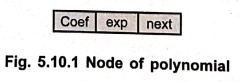
The typical node will look like this,
• For example : To
represent 3x2+5x+7 the
link list will be,

•
In each node, the exponent field will store exponent corresponding to that
term, the coefficient field will store coefficient corresponding to that term
and the next field will point to next term in the polynomial. Again for
simplifying the algorithms such as addition of two polynomials we will assume
that the polynomial terms are stored in descending order of exponents.
The
node structure for a singly linked
list for representing a term of polynomial can be defined as follows:
typedef struct Pnode
{
float coef;
int exp;
struct node *next;
}P;
Advantages of linked representation over arrays:
1.
Only one pointer will be needed to point to first term of the polynomial.
2.
No prior estimation on number of terms in the polynomial is required. This
results in flexible and more space efficient representation.
3.
The insertion and deletion operations can be carried out very easily without
movement of data.
Disadvantage of linked representation over arrays:
1.
We can not access any term randomly or directly we have to go from start node
always.
Addition of Two Polynomials Represented using Singly Linear Link List
Logic for polynomial addition by linked list :
Step 1 :
First of all we create
two linked polynomials.
For example
P1
= 3x3 +2x2+1x
P2
= 5x5 +3x2+7
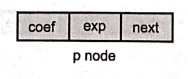
Each
node in the polynomial will look like this,
The
linked list for P1 will be,

Similarly
the P2 will be,

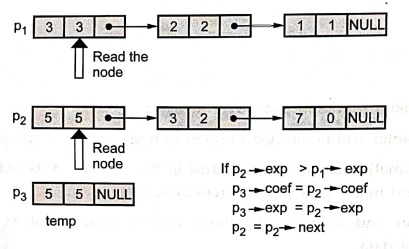
Step 2 :
For
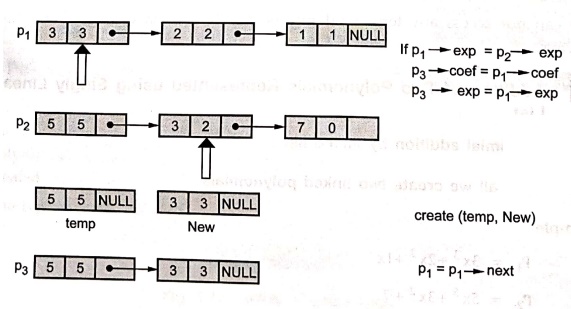
addition of two polynomials if exponents of both the polynomials are same then
we add the coefs. For storing the result we will create the third linked list
say p3. The processing will be as follows:
Step 3 :
Step 4:
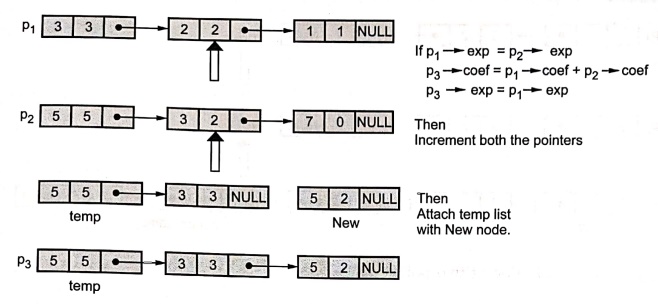
Step 5 :
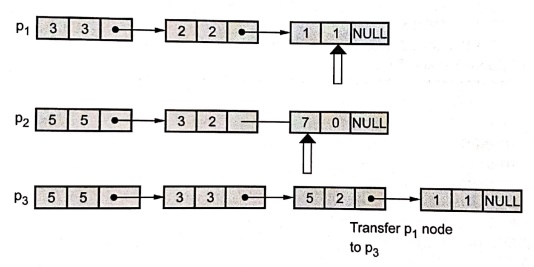
Step 6 :
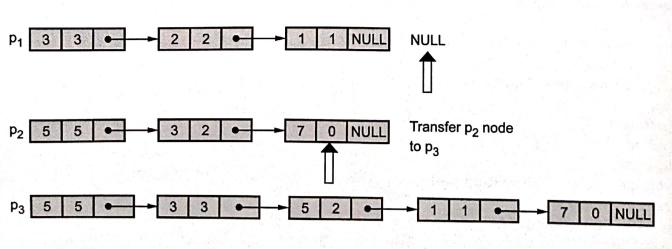
Finally
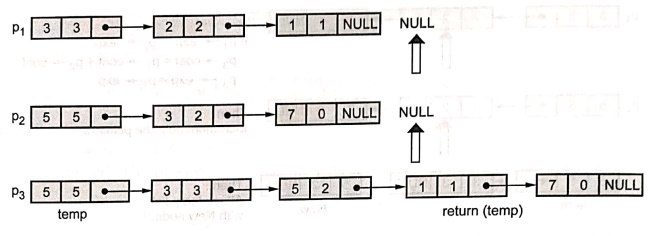
P3
list is the addition of two polynomials.
'C++'
Program
/*
**********************************************************
Program To Perform Addition Of Two Polynomials Using Singly
Linear Linked List
***********************************************************
*/
#include<iostream>
#include<cstdlib>
using namespace std;
#define TRUE 1
#define FALSE 0
class Lpadd
{
private:
typedef struct pnode
{
float coef;
int exp;
structpnode *next;
}p;
p *head;
public:
Lpadd();
void get_poly(),add(Lpadd,Lpadd);
void display();
p *Attach(int,float,p *);
~Lpadd();
};
/*
‒‒‒‒‒‒‒‒‒‒‒‒‒‒‒‒‒‒‒‒‒‒‒‒‒‒‒‒‒‒‒‒‒‒‒‒‒‒‒‒‒‒‒‒‒‒‒‒‒‒‒‒‒‒‒‒‒
The constructor defined
‒‒‒‒‒‒‒‒‒‒‒‒‒‒‒‒‒‒‒‒‒‒‒‒‒‒‒‒‒‒‒‒‒‒‒‒‒‒‒‒‒‒‒‒‒‒‒‒‒‒‒‒‒‒‒‒‒
*/
Lpadd::Lpadd()
{
head = NULL;
}
void Lpadd::get_poly()
{
p *New, *last;
int Exp,flag;
float Coef;
char ans='y';
flag = TRUE; // flag to
indicate whether a new node
// is created for the
first time or not
cout<<"\nEnter
the polynomial in desending order of exponent\n";
do
{
cout<<"\nEnter
the Coefficient and Exponent of a term :";
cin>>Coef>>Exp;
// allocate new node
New = new p;
New‒>next=NULL;
if ( New = = NULL )
cout<<"\nMemory
can not be allocated";
New‒˃ coef = Coef;
//putting coef,exp
values in the node
New ‒> exp = Exp
;
if (flag= =TRUE) //
Executed only for the first time
//for creating the first node
{
head = New;
last = head;
flag = FALSE;
}
else
{
// last keeps
track of the most recently
// created node
last ‒>next =
New;
last = New;
}
cout<<"\n
Do you Want To Add more Terms?(y/n)";
ans=getch();
while(ans= ='y');
return;
}
void Lpadd::display()
{
p *temp;
temp=head;
if ( temp = = NULL)
{
cout<<"The
polynomial is empty\n";
getch();
return;
}
cout<<endl;
while (temp‒>next =
NULL)
{
cout<<temp‒>coef<<"
x^ "<<temp‒>exp<<"+ ";
temp = temp −>
next;
}
cout<<temp ‒>coef<<<"
x^ "<<temp ‒>exp;
getch();
}
void Lpadd::add(Lpadd p1,Lpadd p2)
{
p *temp1,
*temp2,*dummy;
float Coef;
temp1 =p1.head;
temp2 =p2.head;
head = new p;
if (head = = NULL)
cout<<"\nMemory
can not be allocated";
dummy = head;//dummy is
a start node
while (temp1 |= NULL
&& temp2 |= NULL)
{
if(temp1‒>exp= =temp2‒>exp)
{
Coef =temp1‒>coef
+ temp2‒>coef;
head = Attach(temp1‒>exp,Coef,head);
temp1 = temp1‒>next;
temp2 = temp2‒>next;
}
else if(temp1‒>exp<temp2‒>exp)
{
Coef = temp2 ‒>
coef;
head = Attach(temp2‒>exp,
Coef,head);
temp2 = temp2 ‒>
next ;
}
else if(temp1‒>exp>temp2‒>exp)
{
Coef = temp1‒>
coef;
head = Attach(temp1‒>exp,
Coef,head);
temp1 = temp1‒>
next ;
}
}
//copying the contents from first polynomial to the resultant
//poly
while (temp1 != NULL)
{
head = Attach(temp1‒>exp,temp1‒>coef,head);
temp1 = temp1 ‒>
next;
}
//copying the contents from second polynomial to the resultant
poly.
while (temp2 != NULL )
{
head =Attach(temp2‒>exp,temp2‒>coef,head);
temp2 =temp2 ‒>
next;
}
head ‒>next = NULL;
head = dummy ‒>next;//Now set temp as starting node
delete dummy;
return;
}
p *Lpadd::Attach( int Exp, float Coef, p *temp)
{
p *New, *dummy;
New = new p;
if (New = = NULL )
cout<<"\n
Memory can not be allocated \n";
New‒>exp = Exp;
New‒>coef = Coef;
New‒>next = NULL;
dummy = temp;
dummy‒>next = New;
dummy = New;
return(dummy);
}
Lpadd::~Lpadd()
{
p *temp;
temp = head;
while(head!= NULL)
{
temp = temp‒>next;
delete head;
head=temp;
}
}
void main()
{
Lpadd p1,p2,p3;
clrscr();
cout<<"\n
Enter the first polynomial\n\n";
p1.get_poly();
clrscr();
cout<<"\nEnter
the Second polynomial\n\n";
p2.get_poly();
clrscr();
cout<<"\nThe
first polynomial is \n";
p1.display();
cout<<"\nThe
second polynomial is\n";
p2.display();
p3.add(p1,p2);
cout<<"\nThe
Addition of the Two polynomials is...\n";
p3.display();
exit(0);
}
Output
Enter the first
polynomial
Enter the polynomial
in desending order of exponent
Enter the Coefficient
and Exponent of a term :3 3
Do you Want To Add
more Terms?(y/n)
Enter the Coefficient
and Exponent of a term :2 2
Do you Want To Add
more Terms?(y/n)
Enter the Coefficient
and Exponent of a term :1 1
Do you Want To Add
more Terms?(y/n)
Enter the Coefficient
and Exponent of a term :5 0
Do you Want To Add
more Terms?(y/n)n
Enter the Second
polynomial
Enter the polynomial
in desending order of exponent
Enter the Coefficient
and Exponent of a term :5 1
Do you Want To Add
more Terms?(y/n)
Enter the Coefficient
and Exponent of a term :7 0
Do you Want To Add
more Terms?(y/n)
The first polynomial
is
3 x ^3+ 2 x^ 2+ 1 x^
1+ 5 x^ 0
The second polynomial
is
5 x ^1+7 x^ 0
The Addition of the
Two polynomials is...
3 x ^3+2 x ^2+ 6 x^ 1+
12 x^ 0
Review Questions
1. Write a C++ code to
perform addition of two polynomials using link list form of queue.
2. Discuss about
addition of two polynomials using linked list with necessary ADT.
Data Structures using C PlusPlus: Chapter 5: Linked Lists : Tag: Data Structure, C++ Programing : - Linked Lists Polynomial Manipulation
Data Structures using C PlusPlus: Chapter 5: Linked Lists
Under Subject
Data Structures using CPlusPlus
CS25C05 2nd Semester ECE Dept | 2025 Regulation | 2nd Semester 2025 Regulation
Related Subjects

English Essentials II
EN25C02 2nd Semester | 2025 Regulation | 2nd Semester 2025 Regulation

Tamils and Technology தமிழர்களும் தொழில்நுட்பமும்
UC25H02 2nd Semester | 2025 Regulation | 2nd Semester 2025 Regulation
Linear Algebra
MA25C02 2nd Semester | 2025 Regulation

Electron Devices
EC25C01 2nd Semester ECE Dept | 2025 Regulation | 2nd Semester 2025 Regulation
Data Structures using CPlusPlus
CS25C05 2nd Semester ECE Dept | 2025 Regulation | 2nd Semester 2025 Regulation

Circuits and Network Analysis
EC25C02 2nd Semester ECE Dept | 2025 Regulation | 2nd Semester 2025 Regulation

Re-Engineering for Innovation
ME25C05 2nd Semester | 2025 Regulation | 2nd Semester 2025 Regulation
Engineering Drawing - Laboratory
ME25C01 2nd Semester | 2025 Regulation | 2nd Semester 2025 Regulation
Data Structures using CPlusPlus - Laboratory
CS25C05 2nd Semester ECE Dept | 2025 Regulation | 2nd Semester 2025 Regulation
Devices and Circuits Laboratory
EC25C03 2nd Semester ECE Dept | 2025 Regulation | 2nd Semester 2025 Regulation