Applied Physics I: Chapter 7: Quantum Mechanics
Quantum Mechanics: Important part-A 2 marks Short Questions and Answers
Applied Physics I: Chapter 7: Quantum Mechanics : Important part-A 2 marks Short Questions and Answers
ANNA UNIVERSITY PART A
QUESTIONS AND ANSWERS
1. State Kirchoff's law
of radiation
Kirchoff's
law: Ratio of emissive power to the coefficient of absorption, of any given
wavelength is the same for all bodies at a given temperature and is equal to
the emissive power of the black body at that temperature.
i.e.,
eλ / aλ = E
2. Explain Planck's
hypothesis (or) What are the postulates of Plancks quantum theory? (or) What
are the assumptions of quantum theory of black body radiation?
(i)
The electrons in the black body are assumed as simple harmonic oscillators.
(ii)
The oscillators will not emit energy continuously.
(iii)
They emit radiation in terms of quantas of magnitude 'hv', discretly.
i.e.
E=nhv
where
n = 1, 2, 3, 4...
3. State de‒Broglie's
hypo thesis (or) Explain the concept of wave nature. (or) What is meant by
matter waves? Give the origin of this concept.
We
know that, nature loves symmetry, since the light exhibits the dual nature (ie)
it can behave both as a particle and a wave, debroglic suggested that an
electron, which is particle can also behave as a wave and exhibits the dual
nature.
Thus,
the wave associated with a material particle (electron) are called matter
waves.
If
v is the velocity and m is the mass of the particle then
de
Broglie wavelength λ = h / mv
4. What is the physical
significance of a wave function?
1.
The probability of finding a particle in space, at any given instant of time is
characterised by a function ᴪ(x, y, z), called wave function.
2.
It relates the particle and the wave statistically.
3.
It gives the information about the particle behaviour.
4.
It is a complex quantity.
5.
|ᴪ|2 represents the probability density of the particle, which is
real and positive.
5. What is a black body
and What are its characteristics?
A
perfect black body is the one which absorbs and also emits the radiations Completely.
In
practice, no body is perfectly black. We have to coat the black colour over the
surface to make a black body.
Black
body is said to be a perfect absorber, since it absorbs all the wavelengths of
the incident radiation. The black body is a perfect radiator, because it
radiates all the wavelength absorbed by it. This phenomenon is also called
black body radiation.
6. Define Rayleigh‒Jeans
law. Give its limitation.
It
is defined as, "The energy is directly proportional to the absolute
temperature and is inversely proportional to the fourth power of the
wavelength"
(ie)
Eλ ∝
T/λ4
(or)
Eλ
= 8πKBT / λ4
where
KB → Boltzmann constant,
Limitation:
It holds good only for longer wavelengths.
(ie)
E=nhv
where
n=0,1,2, 3,4,….
7. Define Wien's
displacement law. Give its limitation.
It
is defined as, “The product of the wavelength (λm) of maximum energy
emitted and the absolute temperature (T) is a constant".
(ie)
λmT = constant
Also
the Emaximum ∝
T5.
(or)
Em = constant . T5
Limitation:
It holds good only for shorter wavelength.
8. For a free particle
moving within a one dimensional potential box, the ground state energy cannot
be zero, Why?
For
a free particle moving within a one dimensional potential box, when n=0 the
wave function is zero for all values of x
i.e., it is zero even within the potential box. This would mean that the
particle is not present within the box. Therefore the state with n=0 is not allowed. As energy is
proportional to n2 the ground state energy cannot be zero since n=0
is not allowed.
9. What is quantum
tunneling? Give its significance.
Quantum
Tunneling
Quantum
tunneling is a phenomenon in which the particles penetrate through a potential
energy barrier with a height greater than the total energy of the particles. In
quantum tunneling, the particles will have a finite probability to cross an
energy barrier, so that as the energy needed to break a bond with another particle
is attained, even though the particle's energy is less than the energy barrier.
Example:
The emission of alpha rays in radioactive decay is an example for quantum
tunneling.
10. Define
normalisation process and write down the normalised wave function for an
electron in a one dimensional potential well of length 'a' metre.
Normalisation
is the process by which the probability of finding a particle inside any
potential well can be done.
For
a one dimensional potential well of length 'a'
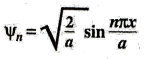
metre, the normalised wave function is given by
ᴪn
= √(2/a) sin(nπx / a)
11. Define Eigen value
and Eigen function.
Eigen
value is defined as energy of the particle and is denoted by the letter (En)
Eigen
function is defined as the wave function of the particle and is denoted by the
letter (ᴪn).
ADDITIONAL
PART 'A' QUESTIONS AND ANSWERS
1. What is meant by
energy spectrum of a black body? What do you infer from it?
The
distribution of energy for various wavelengths at various temperatures is known
as energy spectrum of a black body.
Inference:
(i)
The energy distribution will not be uniform for any particular temperature.
(ii)
When temperature increases, the wavelength decreases.
(iii)
The total energy emitted at any particular temperature can be found with the
help of the area traced by the curve.
2. Define Stefen‒Boltzmann's
law.
It
is defined as "The radiant energy (E) of the body is directly proportional
to the fourth power of the temperature (T) of the body"
(ie)
E ∝ T4
(or)
E = σT4.
where
σ → Stefan constant.
3. What is meant by
photon? Give any two properties.
Definition:
Photons are discrete energy values in the form of small quantas of definite
frequency (or) wavelength.
Properties:
1.
They do not have any charge and they will not ionise.
2.
The energy and momentum of the photon is given by
E
= hv and p = mc
where
v→
frequency
m→
mass of photon
c→
velocity of photon
h→
Planck's Constant
4. What are the
properties of matter waves?
(i)
Matter waves are not electromagnetic waves.
(ii)
Matter waves are new kind of waves in which due to the motion of the charged
particles, electromagnetic waves are produced.
(iii)
Lighter particles will have high wavelength.
(iv)
Particles moving with less velocity will have high wavelength.
(v)
The velocity of matter wave is greater than the velocity of light.
5. What do you
understand by the term 'wave function'.
Wave
function (ᴪ) is a variable quantity that is associated with a moving particle
at any position (x, y, z) and at any time 't'. It relates the probability of
finding the particle at that point and at that time.
Since
ᴪ is a complex quantity, it has no meaning and hence the probability function |ᴪ|2
= ᴪ*ᴪ is found, which is real and positive and has physical meaning, which is a
measurable quantity too.
6. Write down the
schroedinger wave equation and give any two applications of it.
There
are two types of schroedinger wave equations, viz.
(i)
Schroedinger time dependent wave equation, given by
Eᴪ
= Hᴪ
where
E→
Total energy of the particle
H→
Hamiltonian operator
ᴪ→wave
function
(ii)
Schroedinger time independent wave equation, given by
∇2ᴪ
+ 2m/ḧ2 = [E‒v]ᴪ = 0 [3‒dimensional]
Where
E
→ Total energy of the particle
V→
Potential energy of the particle
m→
mass of the particle
ḧ-→ h/2π (h→ Planck's constant)
Applications
1.
It is used to find the electrons in metals.
2.
It is used to find the energy levels of an electron in an infinite deep
potential well.
7. Write down the one
dimensional schroedinger time independent equation and write the same for a
free particle.
The
one dimensional (along x axis) schroedinger time independent equation is given
by
d2ᴪ/dx2 + 2m/ḧ2.[E‒V]ᴪ =
0

For
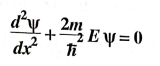
a free particle, the potential energy is zero i.e., V=0, Therefore the
schroedinger equation becomes
d2ᴪ/dx2 + 2m/ḧ2.Eᴪ = 0
8. Define Work
Function.
In
metals, there are large number of free electrons. These free electrons can more
freely to a highest energy level, so called Fermi energy level EF.
No electron at EF can escape from the metal because of the presence
of an energy barrier at the surface of the metal. If an electron has to escape
beyond the Fermi energy level, we have to supply some additional energy in
order to overcome the energy barrier (EB) of the metal. This additional energy required to make an
electron to escape from the metal surface is called work function, denoted
by ϕ.
ϕ = EB‒EF
9. Obtain Einstein's
Photo‒electric equation.
Einstein
proposed a quantum theory on the basis that, "when a photon collides with an electron in a metal, it transfers the
energy to the electron in an "all (or) none" process", i.e.,
either the photon gives out its total energy (hv) to the electron (or) no energy is transferred to the electron.
According
to Einstein, the total energy of the photon, which is completely given to the
electron is used in two ways viz,
1.
A part of energy is used to eject the electron from the surface of the metal.
This energy is known as Photo‒electric
work function (ϕ).
2.
The other part of energy is supplied to the electron as the kinetic energy ( ½ mv2) for it to move with the
velocity 'v'.
∴ Total energy of the
photon (E) = ϕ + ½mv2
Since E=hv, we can
write, hv = ϕ + ½mv2 ……....(1)
Equation
(1) is called Einstein's photo‒electric
equation.
10. What do you
understand by the term "Probability of finding the particle”? Give
examples.
•
|ᴪ|2 represents the probability density (or) probability of finding
the particle per unit volume (or) Normalization
of the wave function.
•
For a given volume dτ, the probability of finding the particle is given by
Probability
(P) = ∫∫∫ |ᴪ|2 dτ
where
dτ = dx . dy . dz
•
The probability will have any value between zero to one. (i.e.,)
(i)
If P=0 then there is no chance for finding the particle (i.e.,) there is no
particle, within the given limits.
(ii)
If P=1 then there is 100% chance for finding the particle (i.e.,) the particle
is definitely present, within the given limits.
(iii)
If P=0.7, then there is 70% chance for finding the particle and 30% there is no
chance for finding the particle, within the given limits.
Example:
If a particle is definitely present within a one dimensional box (x‒direction) of length 'l', then the probability of finding the
particle can be written as
P = 0∫1
|ᴪ|2 dx = 1
11. What is meant by
degenerate and non‒degenerate states.
(i)
Degeneracy: It is seen from equation (28) and
equation (29), for several combination of quantum numbers we have same energy
eigen value but different eigen functions. Such states and energy levels are
called Degenerate State.
The
three combination of quantum numbers (112), (121) and (211), which gives same
eigen value but different eigen functions are called 3 fold degenerate state.
(ii)
Non‒Degeneracy: For various combinations of quantum
number if we have same energy eigen value and same (one) eigen function then
such states and energy levels are called Non‒Degenerate
State.
Example
For
nx = 2ny = 2nz = 2 we have E222 = 12h2
/ 8ma2 and
ᴪ222=
√(8/a3) . sin(2πx/a).sin(2πy/a).sin(2πz/a)
12. What is meant by
quantum tunnelling (or) tunnelling effect?
In
quantum mechanics a particle having lesser energy (E) than the barrier
potential (V) can easily cross over the potential barrier having a finite width
'l' even without climbing over the
barrier by tunnelling through the barrier. This process is called Tunnelling.
13. Mention any four
occurrences of tunnelling effect.
1.
The tunnelling effect is observed in Josephson junction, in which electron pairs
in the super conductors tunnel through the barrier layer, giving rise to
Josephson current.
2.
This effect is also observed in the case of emission of alpha particles by
radioactive nuclei.
Here,
though the 'α' particle has very less kinetic energy they are able to escape
from the nucleus whose potential wall is around 25 MeV high.
3.
Tunnelling also occurs in certain semiconductor diodes called resonant
tunnelling diodes.
4.
Electron tunnels through insulating layer and act as a switch by tunnelling
effect.
14. What do you
understand by the term Transmission and reflection co‒efficient?
Transmission
Co‒efficient
We
know that the probability density is the square of the amplitude of that
function. Therefore the barrier transmission co‒efficient (T) is the ratio
between the square of the amplitudes of the transmitted wave |C|2
and the incident wave |A|2.
The
transmission co‒efficient T = |C|2 / |A|2 …………....(1)
The
above equation is also called as the "Penetrability"
of the barrier.
Reflection
Coefficient
The
reflection co‒efficient (R) for the barrier surface at x=0 is the ratio between the square of the amplitude of the
reflected wave |B|2 and the square of the amplitude of the incident
wave |A|2.
The
reflection co‒efficient R = |B|2 / |A|2 …………....(2)
Applied Physics I: Chapter 7: Quantum Mechanics : Tag: Applied Physics : - Quantum Mechanics: Important part-A 2 marks Short Questions and Answers
Applied Physics I: Chapter 7: Quantum Mechanics
Under Subject
Applied Physics I
PH25C01 1st Semester | 2025 Regulation | 1st Semester 2025 Regulation
Related Subjects

English Essentials I
EN25C01 1st Semester | 2025 Regulation | 1st Semester 2025 Regulation

தமிழர் மரபு - Heritage of Tamils
UC25H01 1st Semester | 2025 Regulation | 1st Semester 2025 Regulation

Applied Calculus
MA25C01 Maths 1 M1 - 1st Semester | 2025 Regulation | 1st Semester 2025 Regulation
Applied Physics I
PH25C01 1st Semester | 2025 Regulation | 1st Semester 2025 Regulation

Applied Chemistry I
CY25C01 1st Semester | 2025 Regulation | 1st Semester 2025 Regulation

Makerspace
ME25C04 1st Semester | 2025 Regulation | 1st Semester 2025 Regulation

Computer Programming C
CS25C01 1st Semester | 2025 Regulation | 1st Semester 2025 Regulation

Computer Programming Python
CS25C02 1st Semester | 2025 Regulation | 1st Semester 2025 Regulation

Fundamentals of Electrical and Electronics Engineering
EE25C03 1st Semester | 2025 Regulation | 1st Semester 2025 Regulation

Introduction to Mechanical Engineering
ME25C03 1st Semester | 2025 Regulation | 1st Semester 2025 Regulation

Introduction to Civil Engineering
CE25C01 1st Semester Civil Department | 2025 Regulation | 1st Semester 2025 Regulation

Essentials of Computing
CS25C03 1st Semester - AID CSE IT Department | 2025 Regulation | 1st Semester 2025 Regulation

Applied Physics I Laboratory
PH25C01 1st Semester practical Laboratory Manual | 2025 Regulation | 1st Semester Laboratory 2025 Regulation

Applied Chemistry I Laboratory
CY25C01 1st Semester practical Laboratory Manual | 2025 Regulation | 1st Semester Laboratory 2025 Regulation

Computer Programming C Laboratory
CS25C01 1st Semester practical Laboratory Manual | 2025 Regulation | 1st Semester Laboratory 2025 Regulation

Computer Programming Python Laboratory
CS25C02 1st Semester practical Laboratory Manual | 2025 Regulation | 1st Semester Laboratory 2025 Regulation
Engineering Drawing
ME25C01 EEE Mech Dept | 2025 Regulation | 2nd Semester 2025 Regulation

Basic Electronics and Electrical Engineering
EE25C04 1st Semester ECE Dept | 2025 Regulation | 2nd Semester 2025 Regulation