Applied Physics I: Chapter 7: Quantum Mechanics
Quantum Mechanics: Important Solved Problems
Anna University Solved Problems, Additional Solved Problems, Assignment Problems - Questions with solved Solution and Answer - Applied Physics I: Chapter 7: Quantum Mechanics
ANNA UNIVERSITY SOLVED PROBLEMS
1. An electron is
accelerated by a potential difference of 150 V. What is the wave length of that
electron wave?
Solution
Given:
Accelerated voltage of the electron (V) = 150 V
Formula:
de Broglie wavelength λ = h / √(2meV)
λ = [ 6.625 × 10‒34 ] / √[2 × 9.11
× 10‒31 × 1.6 × 10‒19 × 150]
(or)
λ = [ 6.625 × 10‒34 ] / √[4.3728 × 10‒47]
(or)
λ = 6.625 × 10‒34 / 6.6127 × 10‒24
λ=
1.0018 × 10⁻¹⁰ metres
. The de‒Broglie wavelength λ=1Å
2. An electron at rest
is accelerated through a potential of 5000 V. Calculate the de Broglie
wavelength of matter wave associated with it.
Solution
Given:
V = 5000 V
Formula:
de‒Broglie wavelength λ = h / √(2meV)
λ
= [ 6.625 × 10‒34 ] / √[2 × 9.11 × 10‒31 × 1.6 × 10‒19
× 5000]
(or)
λ = [ 6.625 × 10‒34 ] / √[1.4576 × 10‒45]
(or)
λ = 6.625×10‒34 / 3.8178×10⁻²³
λ=
0.17353 × 10‒10 m (or) 0.17353 Å
∴ de‒Broglie wavelength
of electron λ= 0.17353 Å
3. Calculate the de‒Broglie
wave length of an electron of energy 100 eV
Solution
Given:
Energy of electron (E) = 100 eV
E
= 100 × 1.6 × 10‒19 Joules
E
= 1.6 × 10‒17 Joules
Formula:
We know that de‒Broglie wavelength λ= h / √(2mE)
Substituting the given values, we have
λ
= [ 6.625 × 10‒34 ] / √[2 × 9.11 × 10‒31 × 1.6 × 10‒17]
λ
= 6.625 × 10‒34 / 5.3993× 10-47
λ=
1.227× 10‒10 m (or) 1.227Å
:.
de‒Broglie wavelength λ= 1.227 Å
4. Calculate the de‒Broglie
wave length associated with a proton moving with a velocity equal to 1/20 th of
the velocity of light.
Mass of proton = 1.675 ×
10‒27 kg
Solution
Given: Mass
of the proton m=1.675 × 10‒27 kg
Velocity
of proton v = 1/20 × velocity of
light
v=
1/20 × 3 × 108
Velocity
(v) = 15 × 106 m/s
Formula:
de‒Broglie wavelength λ = h / mv
Substituting
the given values
we
have λ = [ 6.625 × 10⁻³⁴ ] / [
1.675 × 10−27 × 1.5 × 107 ]
=
2.6447 × 10‒14 m
∴ de‒Broglie
wavelength λ= 2.6447 × 10‒14 m
5. A neutron of mass
1.675 × 10‒27 kg is moving with a kinetic energy 10 KeV. Calculate
the de‒Broglie wavelength associated with it.
Solution
Given:
Energy of neutron = 10 KeV
E=10×
103 × 1.6 × 10‒19 Joules
E=1.6×10‒15
Joules
Formula:
de‒Broglie wavelength λ= h / √(2mE)
λ
= [ 6.625 × 10‒34 ] / √[2 × 1.675 × 10‒27 × 1.6 × 10‒15]
λ
= 6.625 × 10‒34 / 2.3156× 10⁻²¹
λ=
2.861 × 10‒13 m
∴ de‒Broglie
wavelength of neutron = 2.861 × 10‒13 m
6. Calculate the
minimum energy an electron can possess in an infinitely deep potential well of
width 4 nm.
Solution
Given:
l= 4 nm = 4 × 10‒9m
We
know for minimum energy n = 1
Formula:
Energy of an electron in an infinitely deep potential well

E = n2h2 / 8ml2
E=
[ l2 × (6.625 × 10‒34)2
] / [ 8 × 9.11 × 10‒31 × (4 × 10‒9)2 ]
(or)
E= 4.3891×10‒67 / 1.16608×10‒46
E
= 3.7639 × 10‒21 J
(or)
E = 3.7639×10‒21 / 1.6×10‒19 eV
E=0.02352 eV
Minimum energy of an
electron (E) = 0.0235 eV
7. An electron is
trapped in a one dimensional box of length 0.1 nm. Calculate the energy
required to excite the electron from its ground state to the fifth excited
state.
Solution
Given:
l = 0.1 nm = 0.1 × 10‒9 m
Formula:
Energy of an electron in one dimensional box E = n2h2
/ 8ml2
We
know for ground state n=1
Eg=
[ 12 × (6.625 × 10‒34)2 ] / [ 8 × 9.11 × 10‒31
× (0.1 × 10‒9)2 ]
(or)
Eg= 4.3891×10‒67 / 7.288×10‒50
(or)
Eg= 6.0223×10‒18 J
(or)
Eg= 6.0223×10‒18 / 1.6×10‒19 eV
Eg
= 37.64 eV
For
fifth excited state n=6
E=
[ 62 × (6.625 × 10‒34)2 ] / [ 8 × 9.11 × 10‒31
× (0.1 × 10‒9)2 ]
= 1.58007×10‒65 / 7.288×10‒50
Ee
= 2.16805 × 10‒16 J (or)
Ee
= 2.16805×10‒16 / 1.6×10‒19 eV
Ee=1355.03
eV
The
energy required to excite the electron from its ground state to the fifth
excited state is E=Ee‒Eg
E
= 1355.03‒37.64 eV
(or)
E=1317.39 eV
Energy required to excite an electron from fifth excited state
to ground state = 1317.39 eV
8. Find the energy of
an electron moving in one dimension in an infinitely high potential box of
width 0.1 nm.
Solution
Given:
Length (or) width of one dimension box l
= 10 nm = 0.1×0.1‒9 m
Formula:
The energy of an electron is E = n2h2 / 8ml2
For
Lowest energy n = 1.
E
= n2h2 / 8ml2
Eg=
[ 12 × (6.625 × 10‒34)2 ] / [ 8 × 9.11 × 10‒31
× (0.1 × 10‒9)2 ]
(or)
Eg= 4.3891×10‒67 / 7.288×10‒50
(or)
Eg= 6.0223×10‒18 J
(or)
Eg= 6.0223×10‒18 / 1.6×10‒19 eV
Eg
= 37.639 eV
Energy of the electron E = 37.639 eV
9. Calculate the least
energy that an electron can possess in a one‒dimensinal potential box of width
0.5 nm and infinite height. (m=9.11 ×
10‒31 kg)
Solution
Formula:
The energy of an electron is E = n2h2 / 8ml2
The
energy of an electron in a one dimensional potential box is given by E = n2h2 / 8ml2
For
Lowest energy n = 1.
E
= n2h2 / 8ml2
E1=
[ 12 × (6.625 × 10‒34)2 ] / [ 8 × 9.11 × 10‒31
× (0.5 × 10‒9)2 ]
(or)
E1= 4.3891×10‒67 / 1.822×10‒48
(or)
E1= 2.405 × 10‒19 Joules
(or)
E1= 2.405×10‒19 /
1.6×10‒19 eV
(or)
E1 = 1.5055 eV
The least energy of the electron (E1) = 1.5055 eV
10. Calculate the de‒Broglie
wavelength of an electron which has been accelerated from rest on application
of potential of 400 volts.
Solution
Given
Data:
V
= 400 Volts
Formula:
(i)
de‒Broglie wavelength λ = h / √(2meV)
= 6.625×10‒34 / √[2×9.11×10‒31×
1.6×10‒19 × 400]
λ=
6.625×10‒34 × 1.07985×10‒23
λ=
6.135 × 10‒11
(or)
λ=0.6138 Å
The de‒Broglie wavelength = 0.6135 Å
11. The de‒Broglie
wavelength of an electron is 1.226 Å. What is the value of accelerating
potential?
Solution
Given
Data:
λ= 1.226 Å (or) 1.226 × 10‒10 m
Formula:
The
de‒Broglie wave length λ = h / √(2meV)
λ2
= h2 / 2meV
V
= h2 / 2meλ2
Accelerating
Potential
V
= h2 / 2meλ2
V
= [6.625×10⁻³⁴]2 / [2× 9.11×10‒31 × 1.6×10‒19
× (1.226 × 10‒10)2]
V=
4.3891×10‒67 / 4.3818×10‒69
V= 100.16 Volts
Accelerating Voltage = 100 Volts
12. Calculate the
equivalent wavlength of electron moving with a velocity of 3 × 10⁷ m/s.
Solution
Given
Data:
Velocity
(V) = 3 × 10⁷ m/s
Formula:
de‒Broglie
wavelength λ = h / mv
λ = [6.625×10‒34] / [9.11 × 10−31
× 3 × 107]
λ = 6.625×10‒34 / 2.733×10‒23
λ = 2.424 × 10‒11 meters
or
λ=0.2424
Å
The de‒Broglie wavelength of electron = 0.2424 Å
13. An electron is
confined to a one dimensional box of side 10‒10 m. Obtain the first four Eigen values of the electron.
Solution
Formula:
Energy eigen value En = n2h2 / 8ml2
1st
Eigen value E1 = [ 12 × (6.625 × 10‒34)2
] / [ 8 × 9.11 × 10‒31 × (10‒10)2 ]
(or)
E1= 4.38906×10‒67 / 7.288×10‒50
(or)
E1= 6.0223×10‒18 J
(or)
E1= 6.0223×10‒18 / 1.6×10‒19 eV
E1
= 37.6375 eV
2nd
Eigen value E2=22
E1 = 2.4089 × 10‒17 J (or) 150 eV
3rd
Eigen value E3=32
E1 = 5.4198 × 10‒17 J (or) 338 eV
4th
Eigen value E4=42
E1 = 9.6352 × 10‒17 J (or) 602 eV
14. Calculate the
energy in eV of a photon of wavlength 1.2 Å (Planck's constant = 6.62 × 10‒34
Js; speed of light = 3 × 10⁸ m/s)
Solution
Given
data:
λ=1.2
× 10‒10m
h=6.62
× 10‒34 Js
c=3×10⁸
m/s
Formula:
E
= hv
E
= hc/λ
E
= 6.625×10‒34×3×108
/ 1.2×10‒10
E
= 1.986×10‒25 / 1.2×10‒10
E=
1.655 × 10⁻¹⁵ Joules
E=
1.655×10⁻¹⁵ / 1.6×10‒19
eV
E=10343.75
eV
Energy of the photon = 10343.75 eV
15. Calculate the
energy of an electron moving in one‒dimension in an infinitely high potential
box of width 0.3 nm, if the mass of the electron is 9.11 × 10‒31 kg
and Planck's constant is 6.625 × 10‒31 Js.
Solution
Given
data:
l = 0.3 × 10‒9
m
m = 9.11
× 10‒31 kg
h =
6.625 × 10‒34 Js
n = 1
Formula:
E
= n2h2 / 8ml2
E
= [ 12 × (6.625 × 10‒34)2 ] / [ 8 × 9.11 × 10‒31
× (0.3×10‒9)2 ]
(or)
E= 4.38906×10‒67 / 6.5592×10‒49
(or)
E= 6.6914×10‒19 J
(or)
E= 6.6914×10‒19 / 1.6×10‒19
eV
E1
= 4.182 eV
Energy of electron moving in one dimensional box = 4.182 eV
16. Calculate de
Broglie wavelength of an electron accelerated to a potential of 100 Volts.
Solution
Given
data:
V=100
volts
Formula: de‒Broglie
wavelength λ = h / √(2meV)
λ
= h / √(2meV)
= 6.625×10‒34 / √[2×9.11×10‒31×
1.6×10‒19 × 100]
λ=
6.625×10‒34 × 5.399×10‒24
λ=
1.227 × 10‒10 m
(or)
λ=1.227 Å
The de‒Broglie wavelength of electron = 1.227 Å
17. Find the lowest
energy of an electron confined in a box of length 0.2 nm.
Solution
Given
data:
l = 0.2 × 10‒9
m
n=1
h
= 6.625 × 10‒34 Js
Formula:
The energy of an electron is E = n2h2 / 8ml2
For
Lowest energy n = 1.
E
= n2h2 / 8ml2
E=
[ 12 × (6.625 × 10‒34)2 ] / [ 8 × 9.11 × 10‒31
× (0.2 × 10‒9)2 ]
E=
4.3891×10‒67 / 2.9152×10‒49
E=
1.5056 × 10‒18 Joules
E=
1.5056×10‒18 / 1.6×10‒19 eV
(or)
E = 9.41 eV
Lowest energy of an electron = 9.41 eV
ADDITIONAL SOLVED PROBLEMS
1. Calculate the number
of photons emitted by a 100 watts sodium vapour lamp. [Give λ= 5893 Å].
Solution
Formula: Energy
= hv = hc/λ
E
= hc/λ
E
= 6.625×10‒34×3×108
/ 5893×10‒10
E=
3.3726 × 10⁻¹⁹ Joules
∴ Number of photons
emitted = Power / Energy
=
100J/S / 3.3726×10‒19joules
=
2.965 × 10²⁰ per second
Number of photons emitted = 2.965 × 10²⁰
2. Calculate the de‒Broglie
wavelength of an electron accelerated to a potential of 2 KV.
Solution
Formula: de‒Broglie
wavelength λ = h / √(2meV)
λ
= h / √(2meV)
= 6.625×10‒34 / √[2×9.11×10‒31×
1.6×10‒19 × 2× 103]
(or) λ = 0.2744 Å
The de‒Broglie wavelength λ = 0.2744 Å
3. Calculate the de‒Broglie
wavelength corresponding to the root mean square velocity of hydrogen molecules
at 27°C.
Solution
Formula: de‒Broglie wavelength λ= h / √(3mKBT)
Mass
of hydrogen = mass of proton = 1.678 × 10‒27 kg
Boltzmann
constant KB = 1.38 × 10‒23
Temperature
(T) = 300 K
λ
= 6.625×10‒34 / [3×1.678 × 10‒27 × 1.38 × 10‒23
× 300]
λ
= 1.451 Å
de‒Broglie wavelength (λ) = 1.451 Ä
4. Calculate the energy
in eV of an electron wave of wavelength 3× 10‒2 m.
Solution
Formula:
Energy E = h2 / 2mλ2
E
= h2 / 2mλ2
E
= [6.625×10⁻³⁴]2 / [2× 9.11×10‒31 × (3 × 10‒2)2]
E
= 2.6765 × 10‒34 Joules
E
= 2.6765×10‒34 / 1.6×10‒19
eV
E
= 1.6728 eV
∴ Energy of the electron 'E' = 1.6728 eV
5. Calculate the lowest
energy of the system containing two electrons confined to a box of length 1 Å.
Solution
Formula:
Energy of the system having two electrons E = 2( n2h2
/ 8ml2 )
E
= 2( n2h2 / 8ml2 )
E
= 2 [ 12 × (6.625 × 10‒34)2 ] / [ 8 × 9.11 ×
10‒31 × (1 × 10‒10)2 ]
E=
1.2044× 10‒17 Joules
E=
1.2044×10‒17 / 1.6×10‒19 eV
(or)
E = 75.275 eV
Energy of the system having two electrons = 75.275 eV
6. Calculate the
reflection and transmission co‒efficient of an electron of energy 15 eV
incident on a potential barrier of height 10 eV.
Solution
E
= 15 eV
V
= 10 eV
Given
data
Formula
(i)
Reflection co‒efficient R = [ √E‒√(E‒V)
/ [√E+√(E –V) ]2
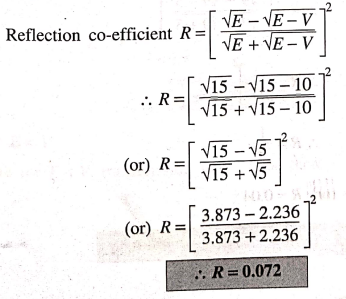
∴ R = 0.072
(ii)
Transmission co‒efficient T = 1‒R
∴ T = 1 − 0.072
∴ T=0.928
The
Reflection co‒efficient R= 0.072
&
The transmission co‒efficient T=0.928
7. Calculate the
reflection co‒efficient for a particle of kinetic energy 9 eV incident on a
potential step of height 5 eV.
Solution
Given
data
E
= 9 eV
V
= 5 eV
Formula
Reflection
co‒efficient R = [ √E‒√(E‒V) / [√E+√(E –V) ]2

∴ R = [ 1/5 ]2
∴ R = 1/25
(or)
R= 0.04
Reflection co‒efficient R= 0.04
8. Show that the sum of
reflection and transmission co‒efficient is one for a particle scattered by a
potential step.
Solution

R+T=1
(ii) For E<V
Here
for E<V, transmission will not be there
∴ T=0
R+T=1+0
R+T=1
ASSIGNMENT PROBLEMS
1.
Calculate the energy of the photon having the same momentum as that of 10 MeV
proton. (Ans: E=13.69 × 10⁷
eV)
2.
What is the energy of neutrons whose de‒Broglie wavelength is 1 Å. [Given: Mass
of neutron = 1.6747 × 10‒27 kg] (Ans:
E=1.3104 × 10‒20 J)
3.
Find the de‒Broglie wavelength for an electron, accelerated through a potential
difference of 28.8 V. (Ans: λ = 2.4 Å)
4.
What is the momentum of the proton having kinetic energy of 1 BeV. (Ans: p =7.31 × 10‒19 kg ms‒1)
5.
Calculate the lowest energy of the system consisting of three electrons in a
one dimension potential box of length 1 Å. (Ans:
E=225.93 eV)
6.
Calculate the probability of transmission that a 1 eV electron will penetrate a
potential barrier of 4 eV, when the width of the barrier is 2 Å. (Ans: T=0.084 (or) T=8.4%)
7.
A particle of energy E is incident on a potential step of barrier height V.
What should be the ratio E/V so that the probability of transmission is 50%? (Ans: E/V=1.03)
Applied Physics I: Chapter 7: Quantum Mechanics : Tag: Applied Physics : - Quantum Mechanics: Important Solved Problems
Applied Physics I: Chapter 7: Quantum Mechanics
Under Subject
Applied Physics I
PH25C01 1st Semester | 2025 Regulation | 1st Semester 2025 Regulation
Related Subjects

English Essentials I
EN25C01 1st Semester | 2025 Regulation | 1st Semester 2025 Regulation

தமிழர் மரபு - Heritage of Tamils
UC25H01 1st Semester | 2025 Regulation | 1st Semester 2025 Regulation
Applied Calculus
MA25C01 Maths 1 M1 - 1st Semester | 2025 Regulation | 1st Semester 2025 Regulation
Applied Physics I
PH25C01 1st Semester | 2025 Regulation | 1st Semester 2025 Regulation

Applied Chemistry I
CY25C01 1st Semester | 2025 Regulation | 1st Semester 2025 Regulation

Makerspace
ME25C04 1st Semester | 2025 Regulation | 1st Semester 2025 Regulation

Computer Programming C
CS25C01 1st Semester | 2025 Regulation | 1st Semester 2025 Regulation

Computer Programming Python
CS25C02 1st Semester | 2025 Regulation | 1st Semester 2025 Regulation
Fundamentals of Electrical and Electronics Engineering
EE25C03 1st Semester | 2025 Regulation | 1st Semester 2025 Regulation

Introduction to Mechanical Engineering
ME25C03 1st Semester | 2025 Regulation | 1st Semester 2025 Regulation

Introduction to Civil Engineering
CE25C01 1st Semester Civil Department | 2025 Regulation | 1st Semester 2025 Regulation

Essentials of Computing
CS25C03 1st Semester - AID CSE IT Department | 2025 Regulation | 1st Semester 2025 Regulation

Applied Physics I Laboratory
PH25C01 1st Semester practical Laboratory Manual | 2025 Regulation | 1st Semester Laboratory 2025 Regulation

Applied Chemistry I Laboratory
CY25C01 1st Semester practical Laboratory Manual | 2025 Regulation | 1st Semester Laboratory 2025 Regulation

Computer Programming C Laboratory
CS25C01 1st Semester practical Laboratory Manual | 2025 Regulation | 1st Semester Laboratory 2025 Regulation

Computer Programming Python Laboratory
CS25C02 1st Semester practical Laboratory Manual | 2025 Regulation | 1st Semester Laboratory 2025 Regulation
Engineering Drawing
ME25C01 EEE Mech Dept | 2025 Regulation | 2nd Semester 2025 Regulation

Basic Electronics and Electrical Engineering
EE25C04 1st Semester ECE Dept | 2025 Regulation | 2nd Semester 2025 Regulation