Applied Physics I: Chapter 2: Properties of Matter - Viscosity and Surface Tension
Viscocity Stokes' Method
Principle, Stokes' formula, Terminal velocity
When a spherical object, like steel ball moves through a high viscous liquid, when the viscous force is equal to the buoyout force it attains the terminal velocity. By finding the termial velocity, the co‒efficient of viscosity shall be determined.
VISCOCITY
‒ STOKES' METHOD
Liquids
such as castor oil, honey, glycerine etc., are termed as high viscous liquids.
These high viscous liquids will have greater resistance.
Let
us discuss about stokes' method to determine the viscosity for a high viscous
liquid.
Principle
When
a spherical object, like steel ball moves through a high viscous liquid, when
the viscous force is equal to the buoyout force it attains the terminal
velocity. By finding the termial velocity, the co‒efficient of viscosity shall
be determined.
Stokes'
formula
Let
us consider a high viscous liquid taken in a tall jar as shown in Fig. 2.3. If
a steel ball is dropped into the liquid, it begins to move down with
acceleration due to gravitational force.
Here,
the motion of the ball in the liquid is opposed by the viscous force of the
liquid.
However,
at one stage, a velocity called terminal velocity is attained, when the
apparent weight of the ball is equal to the opposing viscous force acting on
the ball.
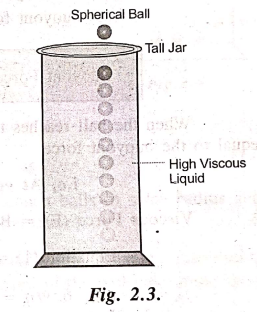
At
this stage, the resultant force on the ball is almost zero. Therefore, the ball
will move down continuosly with the same velocity i.e, terminal velocity.
The
viscous force (F) depends on the following factors, viz.,
(i)
The terminal velocity of the ball (v).
(ii)
Radius of the ball (r).
(iii)
Co‒efficient of viscosity (η)
The
viscous force F ∝
vrη
(or)
F= k vrη
Where
k is the proportionality constant and is equal to 6π.
The
viscous force
F
= 6πvrη …………..(1)
Equation
(1) is called Stokes' formula.
Terminal
velocity
If
ρ is the density of the spherical ball and ρ' is the density of the liquid and
if the volume of the sphere is 4/3 πr3, then we can write,
The
weight of the ball = 4/3 πr3ρg
Similarly,
The weight of the liquid = 4/3 πr3ρ'g
The
apparent weight of the ball (or) buoyont force (Fb) = 4/3 πr3ρg
‒ 4/3 πr3ρ'g
Buoyont
Force Fb = 4/3 πr3g (ρ‒ρ') ....... (2)
When
the ball reaches the terminal velocity, the viscous force will be equal to the
buoyont force.
i.e,
At equilibrium,
Viscous Force (F) = Buoyont Force (Fb)
∴ Equation (1) = Equation
(2)
i.e.,
6πvrη = 4/3 πr3 g(ρ‒ρ')
Terminal
velocity v = [ 4 πr3 g(ρ‒ρ') ] / [ 3×6πrη ]
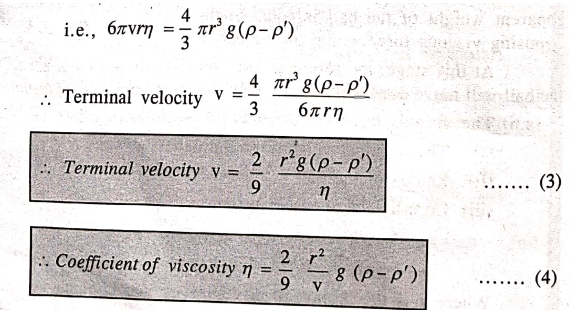
Thus,
by finding the terminal velocity 'v', the co‒efficient of viscosity of the
liquid shall be determined.
Applied Physics I: Chapter 2: Properties of Matter - Viscosity and Surface Tension : Tag: Applied Physics : Principle, Stokes' formula, Terminal velocity - Viscocity Stokes' Method
Applied Physics I: Chapter 2: Properties of Matter - Viscosity and Surface Tension
Under Subject
Applied Physics I
PH25C01 1st Semester | 2025 Regulation | 1st Semester 2025 Regulation
Related Subjects

English Essentials I
EN25C01 1st Semester | 2025 Regulation | 1st Semester 2025 Regulation

தமிழர் மரபு - Heritage of Tamils
UC25H01 1st Semester | 2025 Regulation | 1st Semester 2025 Regulation

Applied Calculus
MA25C01 Maths 1 M1 - 1st Semester | 2025 Regulation | 1st Semester 2025 Regulation
Applied Physics I
PH25C01 1st Semester | 2025 Regulation | 1st Semester 2025 Regulation

Applied Chemistry I
CY25C01 1st Semester | 2025 Regulation | 1st Semester 2025 Regulation

Makerspace
ME25C04 1st Semester | 2025 Regulation | 1st Semester 2025 Regulation

Computer Programming C
CS25C01 1st Semester | 2025 Regulation | 1st Semester 2025 Regulation

Computer Programming Python
CS25C02 1st Semester | 2025 Regulation | 1st Semester 2025 Regulation

Fundamentals of Electrical and Electronics Engineering
EE25C03 1st Semester | 2025 Regulation | 1st Semester 2025 Regulation

Introduction to Mechanical Engineering
ME25C03 1st Semester | 2025 Regulation | 1st Semester 2025 Regulation

Introduction to Civil Engineering
CE25C01 1st Semester Civil Department | 2025 Regulation | 1st Semester 2025 Regulation
Essentials of Computing
CS25C03 1st Semester - AID CSE IT Department | 2025 Regulation | 1st Semester 2025 Regulation

Applied Physics I Laboratory
PH25C01 1st Semester practical Laboratory Manual | 2025 Regulation | 1st Semester Laboratory 2025 Regulation

Applied Chemistry I Laboratory
CY25C01 1st Semester practical Laboratory Manual | 2025 Regulation | 1st Semester Laboratory 2025 Regulation

Computer Programming C Laboratory
CS25C01 1st Semester practical Laboratory Manual | 2025 Regulation | 1st Semester Laboratory 2025 Regulation

Computer Programming Python Laboratory
CS25C02 1st Semester practical Laboratory Manual | 2025 Regulation | 1st Semester Laboratory 2025 Regulation
Engineering Drawing
ME25C01 EEE Mech Dept | 2025 Regulation | 2nd Semester 2025 Regulation

Basic Electronics and Electrical Engineering
EE25C04 1st Semester ECE Dept | 2025 Regulation | 2nd Semester 2025 Regulation