Computer Programming C: UNIT II: Arrays and Strings
Arrays and Strings of C Program: 2 Marks Definitions Answers
Computer Programming C
Computer Programming C: Arrays and Strings: 2 Marks Definitions Answers, Multiple Choice Questions
2 Marks Definitions Answers
•
An array is a collection of similar data items, that are stored under a common
name. A value in an array is identified by index or subscript enclosed in
square brackets with array name.
•
Arrays can be classified into
•
One‒Dimensional • Two‒Dimensional • Multi‒Dimensional
•
One‒Dimensional arrays: The
collection of data items can be stored under a one variable name using only one
subscript, such a variable is called the one‒dimensional array.
•
The array can be initialized in the following two ways i) At compile time ii) At run time char
•
Two dimensional arrays are used in
situation where a table of values needs to be stored in an array. These can be
defined in the same fashion as in one dimensional arrays, except a separate
pair of square brackets are required for each subscript.
•
A String is a collection of
characters. A string constant is a one dimensional array of characters
terminated by a null ('\0') character.
•
'C' language allows multidimensional
arrays. The dimension with three or more called multi dimensional arrays.
•
In 'C' language the group of character, digits, and symbols enclosed within
quotation marks are called as string otherwise strings are array of characters.
Null character ('\0') is used to mark the end of the string.
•
The '%s' control string can be used
in scanf() statement to read a string from the terminal and the same may be
used to write string to the terminal in printf() statement.
•
The strlen() function: This function
is used to count and return the number of characters present in a string.
•
The strcpy() function: This function
is used to copy the contents of one string to another and it almost works like
string assignment operator.
•
The strcat() function: The strcat()
function is used to concatenate or combine, two strings together and forms a
new concatenated string.
•
The strcmp() function: This is a
function which compares two strings to find out whether they are same or
different.
•
The strrev() function: The strrev()
function is used to reverse a string.
•
Enumerated data types: The
programmers can create their own data type and define what values the variables
of these data types can hold.
•
Matrices can be multiplied only when column of matrix A is equal to row of
matrix B, otherwise multiplication is not possible.
•
The inverse matrix of A can be denoted by A‒1.
•
Transport of a matrix can be defined as the rows of a matrix A can be written
as column of transport matrix and columns of matrix A can be written on rows of
transport matrix, it can be denoted as AT.
•
An array is a collection of similar
data items, that are stored under a common name. A value in an array is
identified by index or subscript enclosed in square brackets with array name.
•
Sequential Search is a search for
data that compares each item in a list, one after the other.
•
Binary Search: The desired key is
compared to the data in the middle of a sequential index or in the middle of a
sequential file. The half that contains the data is then compared in the
middle, and so on, until the key is located or the key is not found.
•
Selection Sort starts by comparing
the entire list for the lowest item and moves it to the #1 position. It then
compares the rest of the list for the next‒ lowest item and places it in the #2
position and so on until all items are in the required order. Selection sorts
perform numerous comparisons, but fewer data movements than other methods.
•
Insertion Sort scans the sorted
list, starting at the beginning, for the correct insertion point for each of
the items from the unsorted list. Similar to the way people manually sort
items, an insertion sort is not efficient for large lists, but is relatively
fast for adding a small number of new items periodically.
• Merge Sort
sequences data by continuously merging items in the list. Every single item in
the original unordered list is merged with another, creating groups of two.
Every two item group is merged, creating groups of four and so on until there
is one ordered list.
• Quick Sort:
One element, x of the list to be sorted is chosen and the other elements are
split into those elements less than x and those greater than or equal to x.
These two lists are then sorted recursively using the same algorithm until
there is only one element in each list, at which point the sublists are
recursively recombined in order yielding the sorted list.
• Bubble Sort
starts by comparing the first item to the second, the second to the third and
so on until it finds one item out of order. It then swaps the two items and
starts over. The sort may alternate from the top of the list to the bottom and
then from the bottom to the top. The name comes from the notion that items are
raised or "bubbled up" to the top.
MULTIPLE CHOICE
QUESTIONS
1. In C, if you pass an array as an
argument to a function, what actually gets passed?
A.
Value of elements in array
B.
First element of the array
C.
Base address of the array
D.
Address of the last element of array
2. Which of the following function
sets first n characters of a string to a given character?
A.
strinit()
B.
strnset()
C.
strset()
D.
strcset()
3. If the two strings are
identical, then strcmp() function returns
B.
1
C.
0
D.
Yes
4. How will you print \n on the
screen?
A.
printf("\n");
B.
echo "\\n";
C.
printf('\n');
D.
printf("\\n");
5. The library function used to
find the last occurrence of a char in a string is
A.
strnstr()
B.
laststr()
C.
strrchr()
D.
strstr()
6. Which of the following function
is used to find the first occurrence of a given string in another string?
A.
strchr()
B.
strrchr()
C.
strstr()
D.
strnset()
7. Comment on the following
statement: int(*a)[7];
A.
An array "a" of pointers.
B.
A pointer “a” to an array.
C.
A ragged array.
D.
None of the mentioned
8. Which of the following is not
possible statically in C?
A.
Jagged Array
B.
Rectangular Array
C.
Cuboidal Array
D.
Multidimensional Array
9. What will happen if in a C
program you assign a value to an array element whose subscript exceeds the size
of array?
A.
The compiler would report an error.
B.
The program may crash if some important data gets overwritten.
C.
The array size would appropriately grow.
D.
The element will be set to 0.
10. What does the following
declaration mean? int (*ptr)[10];
A.
ptr is a pointer to an array of 10 integers
B.
ptr is array of pointers to 10 integers
C.
ptr is an array of 10 integers
D.
ptr is an pointer to array
11. The index or subscript value
for an array of size n ranges from
A.
1 to n‒1
B.
0 to n‒1
C.
1 to n
D.
0 to n
12. Two dimensional array elements
are stored.
A.
System dependent
B.
In row major dependent.
C.
Compiler dependent
D.
In column major dependent.
13. Array elements are stored in
A.
Sequential memory locations
B.
Scattered memory locations.
C.
Direct memory locations
D.
Random memory locations.
14. Identify the incorrect
declaration of arrays from the following
A.
int a[50];
B.
float values[10][20];
C.
double a[50];
D.
int score[10,15];
15. Array is used to represent the
following
A.
A list of data items of different data types.
B.
A list of data items of real data type.
C.
A list of data items of same data type.
D.
A list of data items of integer data type.
16. Arrays are passed to a function
arguments by
A.
Value
B.
Reference
C.
both value & reference
D.
none of the above
17. An array a[8] will store how
many values?
A.
8
B.
7.
C.
9
D.0
18. If an array is declared as
a[10], then its elements will be stored as
A.
a[1] to a[10]
B.
a[1] to a[9]
C.
a[0] to a[9]
D.
a[0] to a[10]
19. If an array is declared as int
a[4]= {3, 0, 1, 2};
Then
values assigned to a[0] & a[4] will be
A.
3, 2
B.
0, 2
B.
3,0
D.
0, 4
20. Set of values of the same type,
which has a single name followed by an index is called
A.
Function
B.
Structure
C.
Array
D.
Union
21. An array of pointers is same as
A.
Pointer to array
B.
Pointers to pointers
C.
Pointer to function
D.
Pointer to structure
22. If an array is used as function
argument, the array is passed
A.
By value
B.
By reference
C.
By name
D.
The array cannot be used as a function argument.
23. Which of the following function
is more appropriate for reading in a multi‒word string?
A.
printf();
B.
scanf();
C.
gets0;
D.
puts();
TRUE FALSE
1.
A pointer to a block of memory is effectively same as an array
True/False
2.
Does this mentioning array name gives the base address in all the contexts?
True/False
3.
Is there any difference in tthe following declarations?
int
fun(int arr[]);
int
fun(int arr[2]);
True/False
4.
Are the expressions arr and &arr same for an array of 10 integers?
True/False
5.
For the following statements will arr[3] and ptr[3] fetch the same character?
char
arr[] = "VRB";
char
*ptr = "VRB";
True/False
6.
Is there any difference between the two statements?
char
*ch = "VRB";
char
ch = "VRB";
True/False
7.
Will the program compile successfully?
#include
<stdio.h>
int
main()
{
char
all = "VRB";
char
*p = "MUNI";
a
= "VRB";
P
= "PUBLISHERS";
printf("%s
%s\n", a, p);
}
True/False
8.
When an array is partially initialized, the rest of its elements will
automatically be set to zero.
True/False
9.
The whole array can be passed to a function. However, it can't be changed by
the code in that function.
True/False
10.
A two‒dimensional array represents data in the form of table with rows and columns.
True/False
Computer Programming C: UNIT II: Arrays and Strings : Tag: Computer Science : Computer Programming C - Arrays and Strings of C Program: 2 Marks Definitions Answers
Computer Programming C: UNIT II: Arrays and Strings
Under Subject
Computer Programming C
CS25C01 1st Semester | 2025 Regulation | 1st Semester 2025 Regulation
Related Subjects

English Essentials I
EN25C01 1st Semester | 2025 Regulation | 1st Semester 2025 Regulation

தமிழர் மரபு - Heritage of Tamils
UC25H01 1st Semester | 2025 Regulation | 1st Semester 2025 Regulation
Applied Calculus
MA25C01 Maths 1 M1 - 1st Semester | 2025 Regulation | 1st Semester 2025 Regulation
Applied Physics I
PH25C01 1st Semester | 2025 Regulation | 1st Semester 2025 Regulation

Applied Chemistry I
CY25C01 1st Semester | 2025 Regulation | 1st Semester 2025 Regulation
Makerspace
ME25C04 1st Semester | 2025 Regulation | 1st Semester 2025 Regulation
Computer Programming C
CS25C01 1st Semester | 2025 Regulation | 1st Semester 2025 Regulation
Computer Programming Python
CS25C02 1st Semester | 2025 Regulation | 1st Semester 2025 Regulation
Fundamentals of Electrical and Electronics Engineering
EE25C03 1st Semester EEE Depart | 2025 Regulation | 1st Semester 2025 Regulation
Introduction to Mechanical Engineering
ME25C03 1st Semester Mechanical Dept | 2025 Regulation | 1st Semester 2025 Regulation

Introduction to Civil Engineering
CE25C01 1st Semester Civil, Agri Departments | 2025 Regulation | 1st Semester 2025 Regulation
Essentials of Computing
CS25C03 1st Semester - AIDS, CSE, CSE(CY), IT Department | 2025 Regulation | 1st Semester 2025 Regulation

Applied Physics I Laboratory
PH25C01 1st Semester practical Laboratory Manual | 2025 Regulation | 1st Semester Laboratory 2025 Regulation

Applied Chemistry I Laboratory
CY25C01 1st Semester practical Laboratory Manual | 2025 Regulation | 1st Semester Laboratory 2025 Regulation

Computer Programming C Laboratory
CS25C01 1st Semester EEE, ECE, CSE, CSE(CY), AIDS, IT practical Laboratory Manual | 2025 Regulation | 1st Semester Laboratory 2025 Regulation

Computer Programming Python Laboratory
CS25C02 1st Semester practical Laboratory Manual | 2025 Regulation | 1st Semester Laboratory 2025 Regulation
Engineering Drawing
ME25C01 EEE, Mech, Agri, EEE Depts | 2025 Regulation | 2nd Semester 2025 Regulation

Basic Electronics and Electrical Engineering
EE25C04 1st Semester ECE Dept | 2025 Regulation | 1st Semester 2025 Regulation
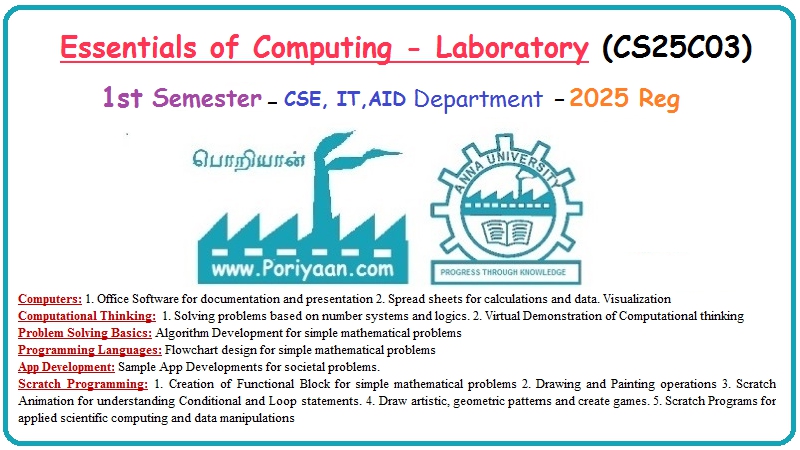
Essentials of Computing - Laboratory
CS25C03 1st Semester AIDS, CSE, CSE(CY), IT Depts | practical Laboratory Manual | 2025 Regulation | 1st Semester 2025 Regulation