Computer Programming C: UNIT II: Arrays and Strings
Simple C Programs Using Sorting and Searching
1. To sort an array of elements 2. Bubble Sort 3. Insertion sort 4. Selection Sort
SIMPLE C PROGRAMS USING SORTING
& SEARCHING
1. To sort an array of elements
Sorting
is the process of arranging elements either in ascending or in descending
order. Sorting can be done on numbers, characters, strings and records. Sorting
reduces time, for example, it is relatively easy to look up the required book
from library from the catalogue, because the names in the catalogue have been
sorted into alphabetical order.
Consider
an array a[0], a[1], …………. a[n‒1]. This is said to be in ascending order, if
a[i] <= a[j] for all i<=j,
If
this condition is not satisfied for a value of 'i' and a value of ‘j', the
number in a[i] and a[j] must be interchanged to achieve ascending order.
/* Program to sort an array of elements */
#include <stdio.h>
void main()
{
int i,n,t,j,a[10];
printf("\nEnter Upper limit....");
scanf("%d", &n);
printf("\nEnter elements....");
for(i=0;i<n;i++)
scanf("%d",
&a[i]);
for(i=0;i<n‒1;i++)
{
for(j=i;j<=n‒1;j++)
{
if(a[i]>a[j])
{
t=a[i];
a[i]=a[j];
a[j]=t;
} /* for */
} /* for */
} /* for */
printf("\nNumbers in Ascending order\n");
for(i=0;i<n;i++)
printf("%d\t",
a[i]);
} /* main */
OUTPUT
Enter Upper limit....6
Enter elements....5 1
4 6 2 3
Numbers in Ascending
order 1 2 3 4 5 6
EXPLANATION:
The above program refers to the sorting of elements. The program reads the
upper limit value 'n' from the keyboard. The variable a[] reads the value from
keyboard according to upper limit n through for loop structure. The i and j for
loop checks the given number and prints the number in ascending order through
another for loop i as mentioned above as output.
2. Bubble Sort
Bubble
sort is the one of the easiest sorting methods. In this method, each data item
is compared with its neighbor and if it is a descend sorting, then the bigger
number is moved to the top of all, the smaller numbers are slowly moved to the
bottom position, hence it is also called as the exchange sort.
This
can be compared to the way the small bubbles moves upwards through soda water,
they become bigger and bigger until they reach the surface, that is why, this
method is called bubble sorting.
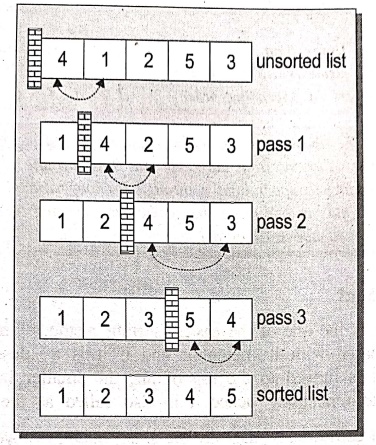
If
you are sorting the data in Increasing/Ascending order, using Bubble sorting
method, first A(1) and A(2) are compared, if A(1) is bigger than A(2) then both
the numbers are interchanged. Otherwise next A(2) and A(3) are compared.
This
comparing and interchanging will go on until all the elements are compared and
interchanged.
/* Bubble sort using function */
#include <stdio.h>
void bubble (int n, int x[ ]);
void main()
{
int i,n,a[10]; /* Local definitions */
/* Statements */
printf("Enter upper limit \n");
scanf("%d", &n);
for(i=0; i<n; i++)
scanf("%d",
& a[i]);
bubble (n,a);
printf ("After sorting");
for (i=0; i<n;i++)
printf
("%d\t", a[i]);
} /* main */
void bubble (int n, int x[])
{
int i, item, temp;
for (item = 0; item
<n‒1; ++item)
{
for (i =item
+1; i< n; ++i)
{
if(x[i]
< x[item])
{
temp
= x[item];
x[item]=x[i];
x[i]
= temp;
} /*
if */
} /* for */
} /* for */
return;
} /* bubble */
OUTPUT
Enter upperlimit : 5
1 5 3 4 2
After Sorting 1 2 3 4
5
EXPLANATION:
Program reads n elements to the array and sort the array of elements using
bubbles sort method.
3. Insertion sort
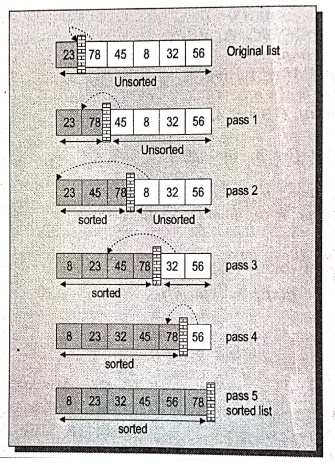
The
principal of Insertion sort is quite simple. Each successive element in the
array to be sorted and inserted into its proper place with respect to the other
already sorted element. We start with the second element and put it in its
correct place, so that the first and second elements of the array are in order.
This process continues until all the elements have been sorted.
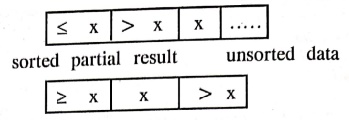
Every
repetition of insertion sort removes and element from the input data inserting
into correct position in the already sorted list, until no input elements remain.
/* Program to sort an element using Insertion sort */
#include <stdio.h>
#include <conio.h>
main()
{
int i,j,k,x,a[100]; /*
Local definitions */
printf("Element to be inserted");
scanf("%d", &x);
i=0;
while(x!=‒99)
{
k=i‒1;
while((x<a[k])&&(k>
=0))
{
a[k+1]=a[k];
‒ ‒k;
} /* while */
a[k+1]=x;
printf("Array after inserting %d\n",x);
for(j=0;j<=i;j++)
printf("%5d",a[j]);
printf("\n");
printf("\n Element to be inserted (‒99 to stop)?");
scanf("%d", &x);
printf("\n");
++i;
} /* while */
printf("The final sorted array\n");
for(j=0;j<i;j++)
printf("%5d\n",a[j]);
} /* main */
OUTPUT
Element to be inserted 5
Array after inserting 5:
Element to be inserted(‒99 to stop)? 3
Array after inserting 3:
3 5
Element to be inserted(‒99 to stop)? 4
Array after inserting 4:
3 4 5
Element to be inserted(‒99 to stop)? 2
Array after inserting 2:
2 3 4 5
Element to be inserted(‒99 to stop)? 1
Array after inserting 1:
1 2 3
4 5
Element to be inserted(‒99 to terminate)? ‒99
EXPLANATION: Program
reads an element into an array, whenever the value entered into an array it
compares the corresponding array element and the value will be moved to its
appropriate position in an array.
4. Selection Sort
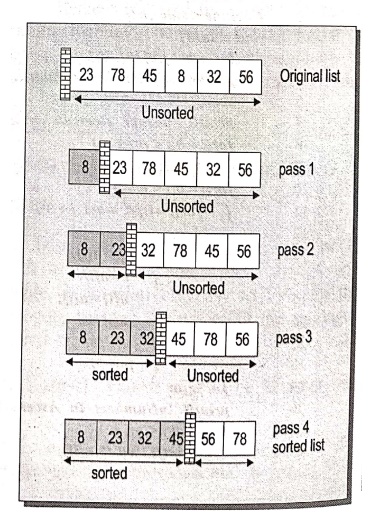
The
idea of Selection Sort is rather simple. It basically determines the minimum or
maximum of the list and swaps it with
the element at the index where it is supposed to be. The process is repeated in
such a way that the nth minimum or maximum element is swapped with the element
at the n‒1th index of the list. The below is an implementation of
the algorithm in C.
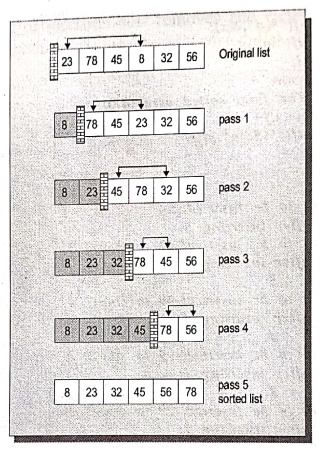
The
principle of selection sort is different. If the array contains 'n' elements to
be sorted in their correct sequence, the first element is compared with the
remaining (n‒1) elements and which is the lower element, place that element in
first position. Then the second element from the array is taken and compared
with the remaining (n‒2) elements. If an element with a value less than that of
the second element is found in the (n‒2) elements, it is swapped with the
second element of the array and so on. Continue this process until all the
elements in an array are sorted.
/* Program to sort an element
using selection sort */
#include <stdio.h>
void main()
{
int i,j,k,n,min, a[100]; /* Local definitions */
printf(' "Enter Number of elements in array... ");
scanf("%d", &n);
printf("Enter Elements... ",n);
for(i=0;i<n;i++)
scanf("%d",
&a[i]);
for(i=0;i<n‒1;i++)
{
min=i;
for(j=i+1;j<n;j++)
{
if(a[min]>a[j])
min=j;
} /* for */*
if(i!=min)
{
k=a[i];
a[i]=a[min];
a[min]=k;
} /* if */
} /* for */
printf("\nSorted Array (Selection Sort) is...\n");
for(i=0;i<n;i++)
printf("%5d",
a[i]);
printf("\n");
} /* main */
OUTPUT:
Enter Number of
elements in array... 9
Enter Elements... 56
326 85 42 156 845 66 1 55
Sorted Array
(Selection Sort) is...
1 42 55 56 66 85 156
326 845
EXPLANATION:
Program reads n values from input, and sorts accordingly to the election sort
criteria as mentioned in introduction and prints the elements in sorted eria as
mentioned in introducent an the elements in order.
Computer Programming C: UNIT II: Arrays and Strings : Tag: Computer Science : - Simple C Programs Using Sorting and Searching
Computer Programming C: UNIT II: Arrays and Strings
Under Subject
Computer Programming C
CS25C01 1st Semester | 2025 Regulation | 1st Semester 2025 Regulation
Related Subjects

English Essentials I
EN25C01 1st Semester | 2025 Regulation | 1st Semester 2025 Regulation

தமிழர் மரபு - Heritage of Tamils
UC25H01 1st Semester | 2025 Regulation | 1st Semester 2025 Regulation
Applied Calculus
MA25C01 Maths 1 M1 - 1st Semester | 2025 Regulation | 1st Semester 2025 Regulation

Applied Physics I
PH25C01 1st Semester | 2025 Regulation | 1st Semester 2025 Regulation

Applied Chemistry I
CY25C01 1st Semester | 2025 Regulation | 1st Semester 2025 Regulation

Makerspace
ME25C04 1st Semester | 2025 Regulation | 1st Semester 2025 Regulation
Computer Programming C
CS25C01 1st Semester | 2025 Regulation | 1st Semester 2025 Regulation
Computer Programming Python
CS25C02 1st Semester | 2025 Regulation | 1st Semester 2025 Regulation

Fundamentals of Electrical and Electronics Engineering
EE25C03 1st Semester EEE Depart | 2025 Regulation | 1st Semester 2025 Regulation

Introduction to Mechanical Engineering
ME25C03 1st Semester Mechanical Dept | 2025 Regulation | 1st Semester 2025 Regulation

Introduction to Civil Engineering
CE25C01 1st Semester Civil, Agri Departments | 2025 Regulation | 1st Semester 2025 Regulation
Essentials of Computing
CS25C03 1st Semester - AIDS, CSE, CSE(CY), IT Department | 2025 Regulation | 1st Semester 2025 Regulation

Applied Physics I Laboratory
PH25C01 1st Semester practical Laboratory Manual | 2025 Regulation | 1st Semester Laboratory 2025 Regulation

Applied Chemistry I Laboratory
CY25C01 1st Semester practical Laboratory Manual | 2025 Regulation | 1st Semester Laboratory 2025 Regulation

Computer Programming C Laboratory
CS25C01 1st Semester EEE, ECE, CSE, CSE(CY), AIDS, IT practical Laboratory Manual | 2025 Regulation | 1st Semester Laboratory 2025 Regulation

Computer Programming Python Laboratory
CS25C02 1st Semester practical Laboratory Manual | 2025 Regulation | 1st Semester Laboratory 2025 Regulation

Engineering Drawing
ME25C01 EEE, Mech, Agri, EEE Depts | 2025 Regulation | 2nd Semester 2025 Regulation

Basic Electronics and Electrical Engineering
EE25C04 1st Semester ECE Dept | 2025 Regulation | 1st Semester 2025 Regulation
Essentials of Computing - Laboratory
CS25C03 1st Semester AIDS, CSE, CSE(CY), IT Depts | practical Laboratory Manual | 2025 Regulation | 1st Semester 2025 Regulation