Computer Programming C: UNIT II: Arrays and Strings
Finding Data Item - Searching
C Programming
Example: Search an array for an index where the key is located, if key is not present, print a message. Repeat until an end of file is entered for the key.
FINDING DATA ITEM - SEARCHING
Suppose
we have a collection of data items of some specific type and we wish to
determine if a particular data item is in that collection. The particular data
item we want to find is called the key and our task is to search the records in
the data base to find one which matches the key.
The
first decision we must make is how to represent the collection of data items.
We know that the data structure, which could hold a collection of similar data
items called the array. So we can consider our database of integer values to be
stored in an array.
Example: Search an array for an
index where the key is located, if key is not present, print a message. Repeat
until an end of file is entered for the key.
In
this task, we choose to return the index where the key is located because this
index will allow us to retrieve the entire record in the case where our array
is part of a database. The simplest approach to determine if a key is present in
an array is to make an exhaustive search of the array. Start with the first
element, if the key matches, we are done; otherwise move on to the next element
and compare the key, and so on.
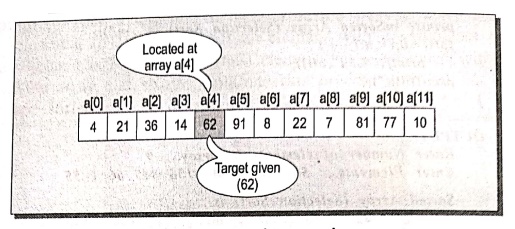
We
simply traverse the array in sequence from the first element to the last as
shown in figure below. Each element is compared to the key. If the key is found
in the array, the corresponding array index is returned. If the item is not
found in the array, an invalid index, say ‒1, is returned. This type of search
is called Sequential Search or Linear Search because we sequentially examine
the elements of the array. In the worst case, the number of elements that must
be compared with the key is linearly proportional to the size of the array.
1. Linear Search or Sequential Search
This
is the simplest known technique for searching an array for a particular record
or data element. In LINEAR search, we start with the first available element,
that is the element that comes first. If this is the required element then our
search is over, else we take up the second element and see if this is the
element that we need. If this too is not the required element, then we pick up
the third element. This process of considering the next record will go on till
we find the required element or all the elements in the table are exhausted.
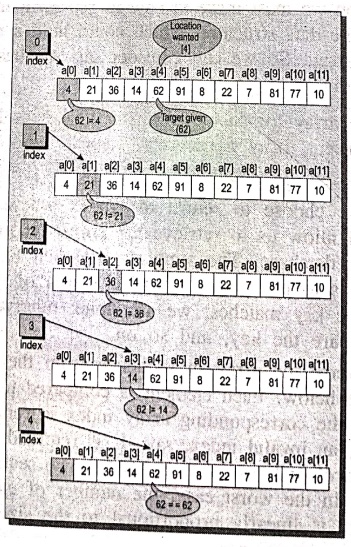
Illustration
to find the 62 from the given list.
/* Program to find the specified element from the array using
Linear searching */
#include <stdio.h>
#include<conio.h>
main()
{
/* Local definitions */
int i,j,k, no,a[100], f=1;.
char c='y',ch;
/* Statements */
clrscr();
while(c == 'y'||c== 'Y')
{
printf("\nEnter
the size of sorting");
scanf("%d",
&no);
printf("\nEnter the elements of the
array");
for(i=0;i<no;i++)
scanf("%d",&a[i]);
printf("\nEnter
the element to be searched");
scanf("%d",
&k);
for(i=0;i<no;i++)
{
if(k==a[i])
{
printf("\nElement
%d is in the position %d",k,i+1);
f=2;
break;
} /*
if */
} /* for */
if(f==1)
printf("\nThe
entered element is not in the array");
printf("\nIf
you want to continue y/n");
ch=getch();
c=ch;
} /* while */
getch();
} /* main */
OUTPUT
Enter the size of
sorting 5
Enter the elements of
the array 3 2 1 4 5
Enter the element to
be searched 4
Element 4 is in the
position 4
If you want to
continue y/n
EXPLANATION :
The above program reads the entered number of element through for loop. The
program checks the specified element and position in the array according to the
user entered number. Then the program prints the specified element and their
position.
2. Binary Search
Binary
Search is simpler and faster than the Linear Search. Binary search is called so
because, on each search the array to be searched is divided into two parts, one
of which is ignored as it will not contain the required element. One essential
condition for the binary search is that the array which is to be searched
should be arranged in order. This is absolute for this method to work.
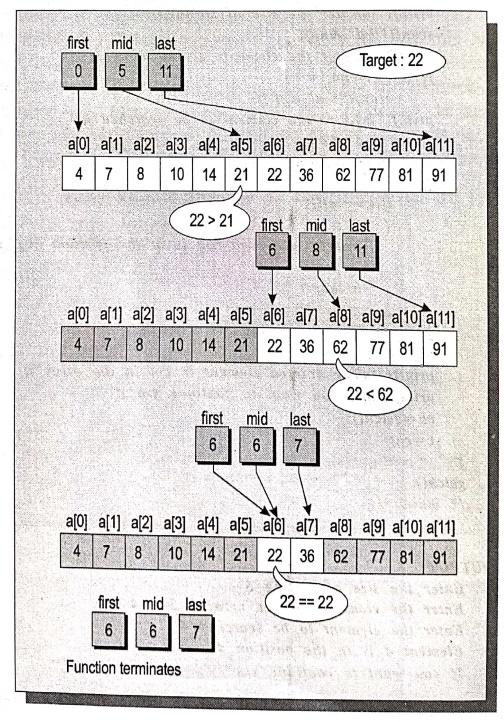
In
Binary search, we start, by taking a look at the approximate middle element. If
the number of elements in an array is odd, then the middle element is
considered. In case the table has even number of elements, then the last
element of the first half is taken into consideration

Then,
we compare the middle element with the one we wish to search in an array. If
the value of middle element is greater than the element to be searched then we
discard the first half of the array and start all over again by taking the
second half of the array. If the value of middle element is smaller than the
element to be searched, then we discard the second half of the array.
We
keep on looking for the middle element of the table and keep on discarding either
the first or second half of the array depending on the result of the comparison
of the middle element and the element to be searched, till we find the required
element when the array cannot be further subdivided.
/* Program to find the
specified element from array using Binary search */
#include <stdio.h>
#include <conio.h>
void main()
{
int a[100],i,no,l,h,m,t,f=1; /* Local definitions */
/* Statements */
clrscr();
printf("Enter the size of the array \n");
scanf("%d", &no);
printf("Enter the elements in ascending order");
for(i=0;i<no;i++)
scanf("%d",
&a[i]);
printf("Enter the elements to be searched");
scanf("%d", &t);
l=0;
h=no‒1;
while(l<=h)
{
m=(1+h)/2;
if(t<a[m])
h=m‒1;
else if(t>a[m])
l=m+1;
else
{
printf("\n
Entered %d is in position %d",t,m+1);
f=2;
break;
}/* if else */
} /* while */
if(f==1)
printf("\n Entered element is not in the array");
getch();
} /* main */
OUTPUT
Enter the size of the
array 5
Enter the elements in
ascending order 1 3 4 5 6
Enter the elements to
be seareched 3
Entered 3 is in
position 2
EXPLANATION:
The above program gets the last number no from the terminal then reads the
ascending order number through for loop. The while loop statement executes the
block of statement then prints the position of the entered number as output.
This program refers the binary searching.
Computer Programming C: UNIT II: Arrays and Strings : Tag: Computer Science : C Programming - Finding Data Item - Searching
Computer Programming C: UNIT II: Arrays and Strings
Under Subject
Computer Programming C
CS25C01 1st Semester | 2025 Regulation | 1st Semester 2025 Regulation
Related Subjects

English Essentials I
EN25C01 1st Semester | 2025 Regulation | 1st Semester 2025 Regulation

தமிழர் மரபு - Heritage of Tamils
UC25H01 1st Semester | 2025 Regulation | 1st Semester 2025 Regulation
Applied Calculus
MA25C01 Maths 1 M1 - 1st Semester | 2025 Regulation | 1st Semester 2025 Regulation

Applied Physics I
PH25C01 1st Semester | 2025 Regulation | 1st Semester 2025 Regulation

Applied Chemistry I
CY25C01 1st Semester | 2025 Regulation | 1st Semester 2025 Regulation
Makerspace
ME25C04 1st Semester | 2025 Regulation | 1st Semester 2025 Regulation
Computer Programming C
CS25C01 1st Semester | 2025 Regulation | 1st Semester 2025 Regulation
Computer Programming Python
CS25C02 1st Semester | 2025 Regulation | 1st Semester 2025 Regulation

Fundamentals of Electrical and Electronics Engineering
EE25C03 1st Semester EEE Depart | 2025 Regulation | 1st Semester 2025 Regulation

Introduction to Mechanical Engineering
ME25C03 1st Semester Mechanical Dept | 2025 Regulation | 1st Semester 2025 Regulation

Introduction to Civil Engineering
CE25C01 1st Semester Civil, Agri Departments | 2025 Regulation | 1st Semester 2025 Regulation
Essentials of Computing
CS25C03 1st Semester - AIDS, CSE, CSE(CY), IT Department | 2025 Regulation | 1st Semester 2025 Regulation

Applied Physics I Laboratory
PH25C01 1st Semester practical Laboratory Manual | 2025 Regulation | 1st Semester Laboratory 2025 Regulation

Applied Chemistry I Laboratory
CY25C01 1st Semester practical Laboratory Manual | 2025 Regulation | 1st Semester Laboratory 2025 Regulation

Computer Programming C Laboratory
CS25C01 1st Semester EEE, ECE, CSE, CSE(CY), AIDS, IT practical Laboratory Manual | 2025 Regulation | 1st Semester Laboratory 2025 Regulation

Computer Programming Python Laboratory
CS25C02 1st Semester practical Laboratory Manual | 2025 Regulation | 1st Semester Laboratory 2025 Regulation
Engineering Drawing
ME25C01 EEE, Mech, Agri, EEE Depts | 2025 Regulation | 2nd Semester 2025 Regulation

Basic Electronics and Electrical Engineering
EE25C04 1st Semester ECE Dept | 2025 Regulation | 1st Semester 2025 Regulation
Essentials of Computing - Laboratory
CS25C03 1st Semester AIDS, CSE, CSE(CY), IT Depts | practical Laboratory Manual | 2025 Regulation | 1st Semester 2025 Regulation