Computer Programming C: UNIT II: Arrays and Strings
Two Dimensional Array
C Programming
Two dimensional arrays are used in situation where a table of values need to be stored in an array.
TWO DIMENSIONAL ARRAY
1. INTRODUCTION
Two
dimensional arrays are used in situation where a table of values need to be
stored in an array.
These
can be defined in the same fashion as in one dimensional arrays, except a
separate pair of square brackets are required for each subscript. Two pairs of
square brackets required for two dimensional array and three pairs required for
three dimensional arrays and so on.
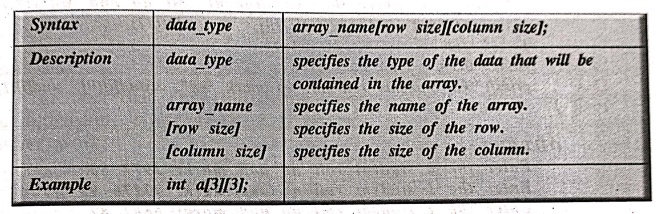
Example: int a[3][3];
Two
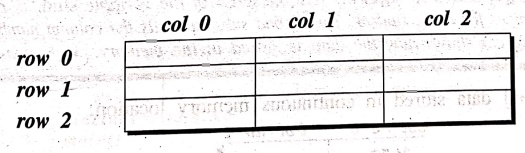
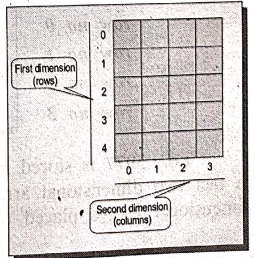
dimensional arrays are stored in a row‒column matrix, where the left index
indicates the row and the right indicates the column.
Example:
int
a[3][3];
Where
'a' is the array name and it reserves 3 rows and 3 columns of memory as shown
below.
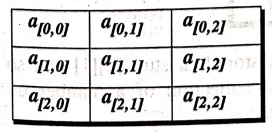
The
individual elements are identified by index or subscript of an array, from the
above example.
Example: Program to
specify two dimension array.
/*Program using two dimension array */
#include <stdio.h>
main()
{
/* Local definitions
*/
int stud[4][2]; /*An
array name with 4 rows and 2 columns */
int i;
/* Statements */
for(i=0;i<=3;i++)
{
printf("\n
Enter the %d Student roll no and Mark:",i);
scanf("%d
%d", &stud[i][0], &stud[i][1]);
} /* for */
for(i=0;i<=
3;i++)
printf("%d
Students roll no %d mark %d", i, stud[i][0], stud[i][1]);
} /* main */
OUTPUT
Enter
the 0 student roll no and mark: 3977 80
Enter
the 1 student roll no and mark: 17776 95
Enter
the 2 student roll no and mark: 6682 82
Enter
the 3 student roll no and mark: 6683 85
0
student roll no 3977 mark 80
1
student roll no 17776 mark 95
2
student roll no 6682 mark 82
3
student roll no 6683 mark 85
EXPLANATION:
Look at the scanf() statement used in the first for loop in the above example.
In stud[i][1] and stud [i][1] the first subscript of the variable stud, is row
number which changes for every student. The second subscript tells the column
number. The following diagram shows how the data is stored in the memory.
Note
that all data stored in continuous memory location.
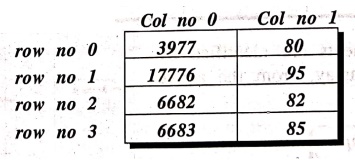
i.e.,
3977 is stored in stud [0][0], 80 is stored in stud [0][1] and so on. In fact
two dimensional array is nothing but a collection of a number of one dimensional
arrays placed one below the other.
2. INITIALISING A TWO DIMENSIONAL ARRAY
Like
one dimensional array, the values can be initialised to the two dimensional
arrays at the time of declaration
Syntax:
data type
array_name[row_size][column_size] = {List of values};
Description:
{List of
variables} specifies the list of elements.
Example
int stud [4][2] =
{
{6680, 80},
{6681, 95},
{6682, 82},
{6683, 85},
};
Remember
that while initialising an array it is necessary to mention the second dimension,
where as the first dimensions is optional. So the following will never work;
int arr[2] [] = {1,2,3,4,5,6};
int arr[][] =
{1,2,3,4,5,6};
We
must mention the column size then only the compiler knows where the first row
ends. The row size is optional if we initialise the array in the declaration
part itself.
Representation
of 2 x 2 array Eg:‒ 2 x 2 Matrix view 
int a = [2][2] {1,2,3,4}
Example 1: Program to
illustrate Matrix Multiplication
* Program for matrix multiplication */
#include <stdio.h>
main()
{
int a[5][5],
b[5][5],c[5][5],r1, r2, c1, c2, i,j,k;
Step 1 :
printf("\nEnter the size of the matrix
A....");
scanf("%d
%d", &rl, & cl);
printf("\nEnter
the size of the matrix B....");
scanf("%d
%d", &r2, & c2);
if(c1= =r2)
goto
step2;
else
printf("\nMultiplication
is not possible");
goto
stepl;
Step2 :
printf("\nEnter
matrix A elements...\n");
for(i=0;i<r1;i++)
{
for(j=0;j<cl;j++)
scanf("%d",
&a[i][j]);
} /* for */
printf("\nEnter
matrix B elements...\n");
for(i=0;i<r2;i++)
{
scanf("%d",
&b[i][j]);
} /* for */
for(i=0;i<rl;i++)
{
for(j=0;j<c1;j++)
{
c[i][j]=0;
for(k=0;k<c1;k++)
c[i][j]=c[i][j]+a[i][k]*b[k][j];
} /* for
*/
printf("\nThe
resultant matrix is ....\n");
for(i=0;i<rl;i++)
for(j=0;j<c1;j++)
printf("%d\t",c[i][j]);
printf("\n");
} /* for
*/
} /* main */
OUTPUT:
Enter the size of the
matrix A....3 3
Enter the size of the
matrix B....2 2
Multiplication is not
possible
Enter the size of the
matrix A....3 3
Enter the size of the
matrix B....3 3
Enter matrix A
elements...
2 2 2 2 2 2 2 2 2
Enter matrix B
elements...
3 3 3 3 3 3 3 3 3
The resultant matrix
is
18 18 18
18 18 18
18 18 18
EXPLANATION:
The program reads size of the matrix, then checks rows and column are equal or
not. If rows and columns are equal further execution starts, else it prints
multiplication is not possible. The i and j for loop is used to get both A and
B matrix. The another i and j for loop is used to calculate the matrix
multiplication and final i and j for loop is used to print the resultant
matrix.
Computer Programming C: UNIT II: Arrays and Strings : Tag: Computer Science : C Programming - Two Dimensional Array
Computer Programming C: UNIT II: Arrays and Strings
Under Subject
Computer Programming C
CS25C01 1st Semester | 2025 Regulation | 1st Semester 2025 Regulation
Related Subjects

English Essentials I
EN25C01 1st Semester | 2025 Regulation | 1st Semester 2025 Regulation

தமிழர் மரபு - Heritage of Tamils
UC25H01 1st Semester | 2025 Regulation | 1st Semester 2025 Regulation
Applied Calculus
MA25C01 Maths 1 M1 - 1st Semester | 2025 Regulation | 1st Semester 2025 Regulation

Applied Physics I
PH25C01 1st Semester | 2025 Regulation | 1st Semester 2025 Regulation

Applied Chemistry I
CY25C01 1st Semester | 2025 Regulation | 1st Semester 2025 Regulation
Makerspace
ME25C04 1st Semester | 2025 Regulation | 1st Semester 2025 Regulation
Computer Programming C
CS25C01 1st Semester | 2025 Regulation | 1st Semester 2025 Regulation
Computer Programming Python
CS25C02 1st Semester | 2025 Regulation | 1st Semester 2025 Regulation
Fundamentals of Electrical and Electronics Engineering
EE25C03 1st Semester EEE Depart | 2025 Regulation | 1st Semester 2025 Regulation
Introduction to Mechanical Engineering
ME25C03 1st Semester Mechanical Dept | 2025 Regulation | 1st Semester 2025 Regulation

Introduction to Civil Engineering
CE25C01 1st Semester Civil, Agri Departments | 2025 Regulation | 1st Semester 2025 Regulation
Essentials of Computing
CS25C03 1st Semester - AIDS, CSE, CSE(CY), IT Department | 2025 Regulation | 1st Semester 2025 Regulation

Applied Physics I Laboratory
PH25C01 1st Semester practical Laboratory Manual | 2025 Regulation | 1st Semester Laboratory 2025 Regulation

Applied Chemistry I Laboratory
CY25C01 1st Semester practical Laboratory Manual | 2025 Regulation | 1st Semester Laboratory 2025 Regulation

Computer Programming C Laboratory
CS25C01 1st Semester EEE, ECE, CSE, CSE(CY), AIDS, IT practical Laboratory Manual | 2025 Regulation | 1st Semester Laboratory 2025 Regulation

Computer Programming Python Laboratory
CS25C02 1st Semester practical Laboratory Manual | 2025 Regulation | 1st Semester Laboratory 2025 Regulation
Engineering Drawing
ME25C01 EEE, Mech, Agri, EEE Depts | 2025 Regulation | 2nd Semester 2025 Regulation

Basic Electronics and Electrical Engineering
EE25C04 1st Semester ECE Dept | 2025 Regulation | 1st Semester 2025 Regulation
Essentials of Computing - Laboratory
CS25C03 1st Semester AIDS, CSE, CSE(CY), IT Depts | practical Laboratory Manual | 2025 Regulation | 1st Semester 2025 Regulation