Computer Programming C: UNIT II: Arrays and Strings
String Operations
C Programming
In general a string is a sequence of characters treated as one unit. Virtually all strings treated as a variable length piece of data.
STRING OPERATIONS
1. Introduction
2. String Manipulation
3. Reading and Writing string
4. Character Operations
5. Strings standard functions
i. The strlen() function
ii. The strcpy() function
iii. The strcat() function
iv. The strcmp() function
v. The strrev() function
vi. The strchr() Function
vii. The strlwr() function
viii. The strupr() function
1. INTRODUCTION
In
general a string is a sequence of characters treated as one unit. Virtually all
strings treated as a variable length piece of data.
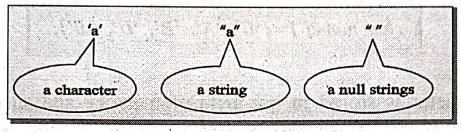
For
example one of the most common of all strings is a name. Names. vary by nature,
by length and it makes no difference. Given that we have the data that can vary
in size, how we accommodate them in our programs.
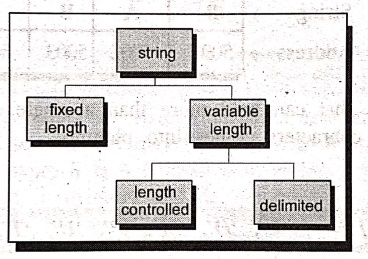
The
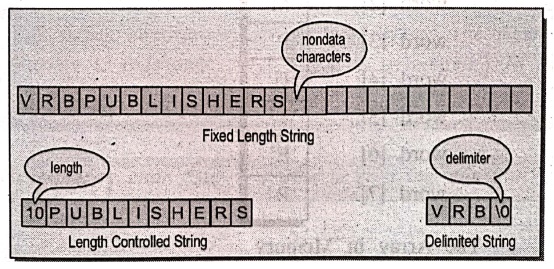
fixed length string can be stored easily as we know the length of the string.
Variable
length strings can contain non‒data characters such as spaces and end of the
line etc., so these can be accommodated as well in see,
Length
controlled strings add a count that specifies the number of characters in the
strings.
Another
technique used to identify the end of the string is the delimiter.
2. STRING MANIPULATION
In
'C' language, the group of character, digits, and symbols enclosed within
quotation marks are called as string otherwise strings are array of characters.
Null
character ('\0') is used to mark the end of the string.
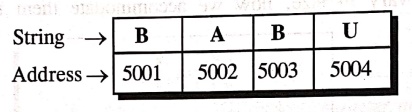
Example: char name[]={'B', 'A',
'B', 'U', '\0'};
Each
character is stored in one byte of memory and successive characters of the
string are stored in successive byte.
Memory
map of string
The
variables that can hold more than a single character, is precisely where the
array of characters comes into picture.
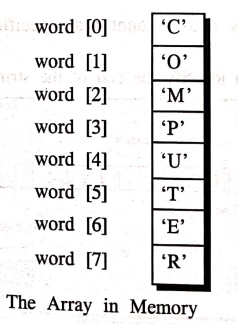
Example:
char word[] = { 'C',
'0', 'M', 'P', 'U', 'T', 'E', 'R' };
Remembering
that in the nonappearance of an array size, the C compiler automatically
computes the number of elements in the array based upon the number of
characters initialised, this statement reserves space in memory for exactly
eight characters, as shown below.
Character
arrays are special. They have certain initialisation properties not shared with
other array types because of their relationship with strings. Of course,
character arrays can be initialised in the normal way using an initialiser
list.
char letters] = {'a',
'b', 'c', 'd', 'e' };
But
they may also be initialised using a string constant, as follows.
char letters [] = "abcde";
The
string initialisation automatically appends a \0 character, so the above array
is of size 6, not 5. It is equivalent to writing,
char letters[] = { 'a', 'b', 'c', 'd', 'e',
'\0' };
Thus,
writing
char letters[5] = "abcde"; /* OK
but bad style. */
An
important property of string constants is that they are allocated memory; they
have an address and may be referred to by a char * pointer. For constants of
any other type, it is not possible to assign a pointer because these constants
are not stored in memory and do not have an address.
However,
it is perfectly valid for a character pointer to be assigned to a string
constant.
char *str =
"Hello World!\n";
This
is because a string constant has static extent memory which is allocated for
the array before the program begins execution, and exists until program
termination and a string constant expression returns a pointer to the beginning
of this array.
NOTE:
A string constant is a constant array; the memory of the array is read‒only.
The result of attempting to change the value of an element of a string constant
is undefined.
Example:
char *str
= "This is a string constant";
3. READING AND WRITING STRING
The
"%s' control string can be used in scanf()
statement to read a from the terminal and the same may be used to write string
to the terminal in printf()
statement.
Example:
char name[10];
scanf("%s", name);
printf("%s", name);
There
is no address (&) operator used in scanf() statement.
Example 1: Reading a line
of text.
/* Program to reading a line of text */
#include <stdio.h>
main()
{
char line[100], ch;
int n=0;
printf("Enter
text press RETURN to end \n");
do
{
ch=getchar();
line(n) = ch;
n++;
} /* do..while */
while (ch!= '\n');
n=n‒1;
line(n) = '\0';
printf("%s",
line);
} /* main */d
OUTPUT
Enter text press
RETURN to end
C language is very
easy to learn.
EXPLANATION:
In the above program, the variable line[] is declared as character array type.
A do‒while loop get the character from keyboard until the condition satisfied
ch!='\n'. Then the variable n decrement by 1 and assigned line(n)='\0' then
print
Example 2: Program to
illustrate string function.
* Program to illustrate string function */
#include <stdio.h>
#include <conio.h>
void main()
{
char ch;
int cnt = 0;
char s1[6]= "Hello";
char s2[6]= { 'H', 'e', 'l', 'l', 'o'};
printf ("%s\n", s1);
printf("%s\n", s2);
while((ch=getchar() != '\0') && (cnt <6‒1))
s1[cnt++] ch;
s1[cnt] = '\0';
getch();
} /* main */ d
OUTPUT
Hello
Hello
EXPLANATION:
This program aims on the concept of the strings. Here the string is assigned to
different arrays in different ways and the contents of these arrays can be
printed using while loop.
'C'
Language supports a wide range of string handling functions, that can be used
to carry out various string manipulations.
4. CHARACTER OPERATIONS
Character
variables and constants are frequently used in relational and arithmetic expressions.
To properly use characters in such situations, it is necessary for you to
understand how they are handled by the C compiler.
Whenever
a character constant or variable is used in an expression in C, it is
automatically converted to, and subsequently treated as, an integer value.
Example:
c >=
'a' && c <= '7'
Could
be used to determine if the character variable 'c' contained a lowercase
letter. As mentioned there, such an expression could be used on systems that
used an ASCII character representation because the lowercase letters are
represented sequentially in ASCII, with no other characters in between.
The
first part of the preceding expression, which compares the value of 'c' against
the value of the character constant 'a', is actually comparing the value of 'c'
against the internal representation of the character 'a'. In ASCII, the
character 'a' has the value 97, the character 'b' has the value 98, and so on.
Therefore,
the expression c> = 'a' is TRUE (nonzero) for any lowercase character
contained in "c' because it has a value that is greater than or equal to
97.
However,
because there are characters other than the lowercase letters whose ASCII
values are greater than 97, the test must be bounded on the other end to ensure
that the result of the expression is TRUE for lowercase characters only. For
this reason, 'c' is compared against the character 'z', which, in ASCII, has
the value 122. Because comparing the value of 'c' against the characters ‘a'
and 'z' in the preceding expression actually compares 'c' to the numerical
representations of 'a' and 'z'.
Example 1: Program to
find the string is palindrome or not.
#include <stdio.h>
#include <string.h>
int main()
{
char a[100], b[100];
printf("Enter the string to check if it is a palindrome
\n");
gets(a);
strcpy(b,a);
strrev(b);
if( strcmp(a,b) == 0.)
printf(“Entered
string is a palindrome. \n");
else
printf("Entered
string is not a palindrome. \n");
}
OUTPUT
Try with below
palindrome words
Max exam
Malayalam
A Santa at Nasa
Ma is a madam, as I am
Madam, I'm Adam
EXPLANATION:
First, copy the entered string into a new string, and then reverse the new
string and compare it with original string. If both of them have the same
sequence of characters i.e. they are identical, then the entered string is a
palindrome otherwise not.
Example 2: To sort
names (strings) in ascending order.
#include <stdio.h>
#include <string.h>
#include <conio.h>
void main()
{
int num,i,j, result, index;
char name[25][25]; /*declaring array of strings */
char temp[25];
printf("Number of names to be sorted in ascending
order\n");
scanf("%d", &num);
printf("Enter %d names to be sorted\n", num);
for(i=0;i<num;i++)
scanf("%s",
name[i]); /*input the names*/
for(i=0;i<num;i++)
{
index=i;
for(j=i+1;j<num;j++)
{
result =
strcmp(name[index], name[j]);
if(result
> 0)
index=j;
}
}
strcpy(temp, name[index]);
strcpy(name[index], name[i]);
strcpy(name[i], temp);
}
printf("\nNames Sorted in Ascending Order\n");
for(i=0;i<num;i++)
printf("\t%s",
name[i]);
}
OUTPUT
Number of names to be
sorted in ascending order 4
Enter 4 Names to be
sorted
Basker
Aravind
Damu
Chinni
Names sorted in
Ascending order
Aravind
Baskar
Chinni
Damu
EXPLANATION:
The main logic to sort numbers in ascending order remains same over here,
however the only difference is that we have to use string functions to compare
two strings and also for swapping two strings we have to use string functions.
5. STRINGS STANDARD FUNCTIONS
The
'C' compiler provides the following string handling functions.
Function:
Purpose
strlen():
Used to find the length of the string.
strcpy():
Used to copy one string to another.
strcat():
Used to combine two strings.
strcmp():
Used to compare characters of two strings (difference between small and capital
letters).
strlwr():
Used to convert strings into lower case.
strupr():
Used to convert strings into upper case.
strdup():
Used to duplicate a string.
strrev():
Used to reverse a string.
strncpy():
Used to copy first 'n' characters of one string into another.
strncmp():
Used to compare first 'n' characters of two strings.
strcmpi():
Used to compare two strings without regarding the case.
strnicmp():
Used to compare first 'n' characters of two strings without regarding the case.
stricmp():Compares
two strings (Not difference between small and capital letters).
strchr():Determines
first occurrence of a given character in a string.
strrchr():Determines
last occurrence of a given character in a string.
strstr():Determines
first occurrence of a given string in another string.
strncat():Appends
source string to destination string upto specified length.
strnset():Sets
specified number of characters of string with a given argument or symbol.
strspn():Finds
up to what length two strings are identical.
strpbrk():
Searches the first occurrence of the character in a given string and then it
displays the string starting from that character.
The
commonly used string manipulation functions are as follows:
5.1. The strlen() function
This
function is used to count and return the number of characters present in a
string.
Syntax:
var =
strlen(string);
Description:
var - Is the integer
variable, which accepts the length of the string.
String - Is the string constant
or string variable, in which the length is going to be found. The counting ends
with first null (\0)char.
Example: Program using strlen()
function.
/* Program using strlen() function */
#include <stdio.h>
#include <conio.h>
main()
{
char name[] =
"MUNI";
int len1,len2;
len1 =
strlen(name); /* To find the length of the string */
len2 =
strlen("VRB");
printf("\n
string length of %s is %d",name,len1);
printf("\n_string
length of %s is %d,", "VRB",len2);
} /* main */
OUTPUT
String length of MUNI
is 4
String length of VRB
is 3
EXPLANATION:
The above program refers to check the length of the string. Here the character
type name[] holds the element 'Muni', it is passed to variable len1. The len2 variable
holds the elements of 'VRB' 'strlen' function detect the length of string len1
and len2 and print the result as above mentioned.
Here,
while calculating the length of the string by using the strlen() the '\0' null
character is not taken into consideration.
5.2. The strcpy() function
This
function is used to copy the contents of one string to another and it almost
works like string assignment operator.
Syntax:
strepy
(string1, string2);
Description:
String1 is the
destination string
String2 is the source
string
The
contents of string2 is assigned to the contents of string1. Where string2 may
be character array variable or string constant.
Example:
char
str[]="MUNI";
char str2[]=
"LAK";
strcpy(str1, str2);
Where
the contents of str2 are copied into the strl and the contents of strl is
replaced with new one.
Example
char str1[10];
strcpy(str1,
"LAK");
Here,
the string constants are copied to the string variable strl.
Example: Program
using strcpy() function
/* Program using strcpy() function */
#include <stdio.h>
main ()
{
char source =
"MUNI"; *Local definitions */
char target[10];
strcpy(target,source); /* string copy */
printf("\n
Source string is %s", source);
printf("\n
Target string is %s", target);
} /* main */
OUTPUT
Source string is MUNI'
Target string is MUNI
EXPLANATION:
In the program the character type variable source contain a string
"MUNI". The variable target[] is declared as a character type. Here
the strcpy() function copy the source string "MUNI" into target
string. Now the variable target also contain the string "MUNI" and
print the variable source and target.
5.3. The strcat() function
The
strcat() function is used to concatenate or combine, two strings together and
forms a new concatenated string.
Syntax:
strcat(string1,
string2);
Description:
string1
and string2 are character type arrays or string constants.
When
the above strcat() function is
executed, string2 is combined with
string1 and it removes the null character (\0) of string1 and places string2
from there.
Example:
strcat("MUNI”, “LAK”)
Yields MUNILAK
char strl="MUNI”
char str2="LAK"
strcat(str1, str2)
Yields MUNILAK.
Example: Program
using strcat() function
/* Program using strcat() function */
#include <stdio.h>
main()
{
/* Local
definitions */
char
source[]="Ramesh";
char target[10]=
"Babu";
/* Statements */
strcat(source,
target); /* string concatenate function */
printf("\nSource
string is %d", source);
printf("\nTarget
string is %s", target);
} /* main */
OUTPUT
Source string is
Ramesh Babu
Target string is Babu
EXPLANATION:
In the program source[] is a character variable which holds the data
"Ramesh" similarly target[] is a character variable which holds the
data "Babu", The strcat() combines both strings and stores in the
variable "source" finally print the variable "source" and
"target" as mentioned above.
5.4. The strcmp() function
This
is a function which compares two strings to find out whether they are same or
different. The two strings are compared character by character until the end of
one of the string is reached. If the two strings are identical, strcmp()
returns a value zero. If they are not equal, it returns the numeric difference
between the first non‒matching characters.
Syntax:
strcmp(string1, string2);
Description:
string1 and string2 are character type arrays or string constants.
Example: Program
using strcmp() function.
/* Program using strcmp() function */
#include <stdio.h>
#include <conio.h>
main()
{
* Local definitions */
char name[] = "Kalai",
char name[] = "Malai";
int i,j,k;
/* Statements */
i= strcmp(name, "Kalai"); /* string compare function
*/
j= strcmp(namel, name);
k=strcmp(name, "Kalai mani");
printf("\n %d %d %d", i, j, k );
} /* main */
OUTPUT
0 1 6
EXPLANATION:
In the first strcmp(,) the two strings are same, so it returns zero value. In
the second, the first character of the two string is unmatched. So the
difference between ASCII value is printed. In the third one, the strings are
unmatched. The blank space is unmatched with '\0' character. So the ASCII value
difference between '\0' and 'space' is printed.
5.5. The strrev() function
The
strrev() function is used to reverse a string. This function takes only one
argument and return one argument.
The
general form of strrev() function is,
Syntax:
strrev(string);
Description:
string
are characters type arrays or string constants.
Example: Program
using strrev() function
/* Program using strrev() function */
#include <stdio.h>
main()
{
char y[30]; /*
Local definition */
printf
("Enter the string :");
gets(y);
printf ("The
string reversed is :%s", strrev(y));
} /* main */
INPUT: Enter the string : book
OUTPUT: The string reversed is: koob
EXPLANATION:
The function strrev() is used to print the string in reverse order. The program
gets the input book then reverse that string as koob and prints the result as
output.
5.6. The strchr() Function
The
strchr() function returns a pointer to the first occurrence of the low‒ order
byte of ch in the string pointed to by str. If no match is found, a null
pointer is returned.
Syntax:
char
*strchr(const char *str, int ch);
Description:
Where
Char is string, ch is character
Example: Program
prints the string is a test
#include <stdio.h>
#include <string.h>
int main(void)
{
char *p; c='g'
p =
strchr("C Language", ");
printf(p);
printf("%d",c);
return 0;
}
OUTPUT
C Language
5
5.7. The strlwr() function
The
strlwr() function converts all the uppercase characters in that string to
lowercase characters. The resultant from strtwr() is stored in the same string.
Syntax:
strlwr(string
name);
Description:
Where
string name is string
Example: Program
using strlwr() function
#include <stdio.h>
#include <string.h>
int main()
{
char strl]="LOWER CASE";
puts(strlwr(strl)); //converts to lowercase and displays it.
return 0;
}
OUTPUT
lower case
5.8. The strupr() function
The
strupr() function converts all the lowercase characters in that string to
uppercase characters. The resultant from strupr() is stored in the same string.
Syntax:
strlwr(string
_name);
Description:
Where
string_name is string
Example: Program
using strupro function
#include <stdio.h>
#include <string.h>
int main()
{
char str[]="upper
case";
puts(strupr(str1));
//converts to lowercase and displays it.
return 0;
}
OUTPUT
UPPER CASE
Computer Programming C: UNIT II: Arrays and Strings : Tag: Computer Science : C Programming - String Operations
Computer Programming C: UNIT II: Arrays and Strings
Under Subject
Computer Programming C
CS25C01 1st Semester | 2025 Regulation | 1st Semester 2025 Regulation
Related Subjects

English Essentials I
EN25C01 1st Semester | 2025 Regulation | 1st Semester 2025 Regulation

தமிழர் மரபு - Heritage of Tamils
UC25H01 1st Semester | 2025 Regulation | 1st Semester 2025 Regulation
Applied Calculus
MA25C01 Maths 1 M1 - 1st Semester | 2025 Regulation | 1st Semester 2025 Regulation

Applied Physics I
PH25C01 1st Semester | 2025 Regulation | 1st Semester 2025 Regulation

Applied Chemistry I
CY25C01 1st Semester | 2025 Regulation | 1st Semester 2025 Regulation

Makerspace
ME25C04 1st Semester | 2025 Regulation | 1st Semester 2025 Regulation
Computer Programming C
CS25C01 1st Semester | 2025 Regulation | 1st Semester 2025 Regulation
Computer Programming Python
CS25C02 1st Semester | 2025 Regulation | 1st Semester 2025 Regulation

Fundamentals of Electrical and Electronics Engineering
EE25C03 1st Semester EEE Depart | 2025 Regulation | 1st Semester 2025 Regulation
Introduction to Mechanical Engineering
ME25C03 1st Semester Mechanical Dept | 2025 Regulation | 1st Semester 2025 Regulation

Introduction to Civil Engineering
CE25C01 1st Semester Civil, Agri Departments | 2025 Regulation | 1st Semester 2025 Regulation
Essentials of Computing
CS25C03 1st Semester - AIDS, CSE, CSE(CY), IT Department | 2025 Regulation | 1st Semester 2025 Regulation

Applied Physics I Laboratory
PH25C01 1st Semester practical Laboratory Manual | 2025 Regulation | 1st Semester Laboratory 2025 Regulation

Applied Chemistry I Laboratory
CY25C01 1st Semester practical Laboratory Manual | 2025 Regulation | 1st Semester Laboratory 2025 Regulation

Computer Programming C Laboratory
CS25C01 1st Semester EEE, ECE, CSE, CSE(CY), AIDS, IT practical Laboratory Manual | 2025 Regulation | 1st Semester Laboratory 2025 Regulation

Computer Programming Python Laboratory
CS25C02 1st Semester practical Laboratory Manual | 2025 Regulation | 1st Semester Laboratory 2025 Regulation
Engineering Drawing
ME25C01 EEE, Mech, Agri, EEE Depts | 2025 Regulation | 2nd Semester 2025 Regulation

Basic Electronics and Electrical Engineering
EE25C04 1st Semester ECE Dept | 2025 Regulation | 1st Semester 2025 Regulation
Essentials of Computing - Laboratory
CS25C03 1st Semester AIDS, CSE, CSE(CY), IT Depts | practical Laboratory Manual | 2025 Regulation | 1st Semester 2025 Regulation