Digital Principles and Computer Organization: Chapter 2: Boolean Algebra, Logic Gates and Minimization Techniques
Boolean Algebra, Logic Gates and Minimization Techniques: Two Marks Important Questions and Answers
Digital Principles and Computer Organization
Digital Principles and Computer Organization: Chapter 2: Boolean Algebra, Logic Gates and Minimization Techniques: Anna University Part A Two Marks Important Questions and Answers
Digital Principles and Computer Organization:
Chapter 2: Boolean Algebra, Logic Gates and Minimization
Techniques
Two Marks Questions
with Answers
1. What
do you mean by literal ?
Answer:
Definition:
In Boolean function, the total number of variables in complemented or
uncomplemented form are called literals.
For example :
The function F (A, B, C, D) = 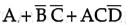 contains 4 literals.
2. Distinguish
between Boolean addition and binary addition.
Answer: Boolean addition refers
the logical ORing between two literals. On the other hand, in binary addition
the two binary bits are added mathematically.
Boolean addition Binary
addition
0
+ 0 → 0 0 + 0 →
0
0
+ 1 →1 0 + 1→
1
1
+ 0 → 1 1 + 0 →1
1
+ 1 → 1 1 + 1 = 10
3. What
are basic properties of Boolean algebra ?
Answer: The basic properties
of Boolean algebra are commutative property, associative property and distributive
property.
4. State
the associative law of Boolean algebra.
Answer: Associative laws are as follows :
1. Law 1 (The
associative law of addition) : In the Oring of
several variables, the result is the same regardless of the grouping of the
variables. For three variables, A ORed with B OR C is the same as A OR B ORed
with C.
i.e. A + (B + C) = (A + B) + C
2. Law 2 (The
associative law of multiplication) : It makes no difference
in what order the variables are grouped when ANDing several variables. For
three variables, A AND B ANDed with C is the same as A ANDed with B and C.
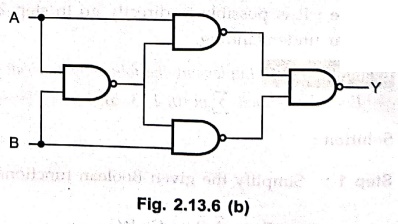
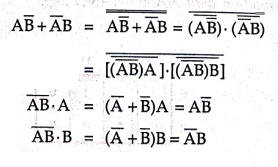
i.e.
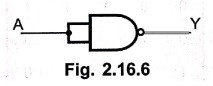
(AB) C = A(BC).
5. State
the commutative property of Boolean algebra.
Answer: The commutative
property states that the order in which the variables are ORed makes no
difference. The commutative property is :
A+B = B+A.
6. State
the distributive property of Boolean algebra or state distributive law.
Answer: The distributive
property states that ANDing several variables and ORing the result with a
single variable is equivalent to ORing the single variable with each of the
several variables and then ANDing the sums. The distributive property is :
A+BC = (A+B) (A+C)
7. Explain
the De Morgan's theorem in Boolean algebra.
DeMorgan suggested two theorems that form an important part of Boolean algebra. In the equation form, they are:
1.
2.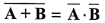
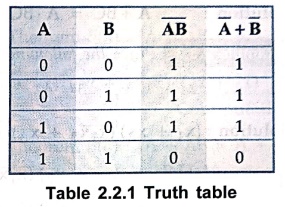
1. : The complement of a product is equal to the sum of the complements. This is illustrated by truth Table 2.2.1.
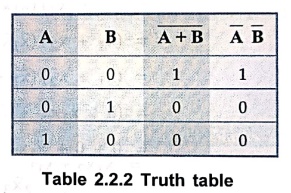
2. : The complement of a sum is equal to the product of the complements. The truth Table 2.2.2 illustrates this law.
8. State
two absorption properties of Boolean algebra.
Answer: 1. A+ AB = A and
2.
A (A + B) = A
9. Explain
the principle of duality with the help of example.
Answer: The duality theorem
says that, starting with a Boolean relation, you can derive another Boolean
relation by –
1.
Changing each OR sign to an AND sign
2.
Changing each AND sign to an OR sign and
3.
Complementing any 0 to 1 appearing in the expression.
For
example : A+ 0 = A. Using duality theorem, we can say that, A.1 = A.
10. State
and prove the consensus theorem in Boolean algebra.
Answer: Definition : In simplification of Boolean expression, the redundant
term in an expression can be eliminated to form the equivalent expression. The
theorem used for this simplification is called consensus theorem. For example, in expression of the AB+ĀC+BC, the
term BC is redundant and can be eliminated using consensus theorem.
Proof :
AB+
ĀC+BC = AB+ ĀC+ (A+Ā) BC = AB+ ĀC+ AB+ ĀC = AB+ ĀC
11.
Define binary logic.
Answer: Binary logic consists
of binary variables and logical operations. The variables are designated by the
alphabets such as A, B, C, x, y, z, etc., with each variable having only two
distinct values: 1 and 0. There are three basic logic operations: AND, OR and
NOT.
12. What
is a logic gate ?
Answer: The logic gate is an
electronic circuit that has one or more input binary variables but only one
output. It is called logic gate because of it ability to operate on a number of
binary inputs to perform a logical function, i.e. its output is a logical
function of inputs.
13. What
are the basic digital logic gates?
Answer: The three basic logic
gates are
•
AND gate
•
OR gate
•
NOT gate.
14. Which
gate is equal to AND–inverter gate ?
Answer: NAND gate.
15. Which
gate is equal to OR–inverter gate?
Answer: NOR gate.
16. Bubbled
OR gate is equal to –––––––––––––.
Answer: NAND gate.
17.
Bubbled AND gate is equal to –––––––––––––––.
Answer: NOR gate.
18. Draw
the logic symbol and construct the truth table of the following gates :
a) Three
input OR gate b) Three input EX–NOR gate
Answer:
a) Three input OR gate :
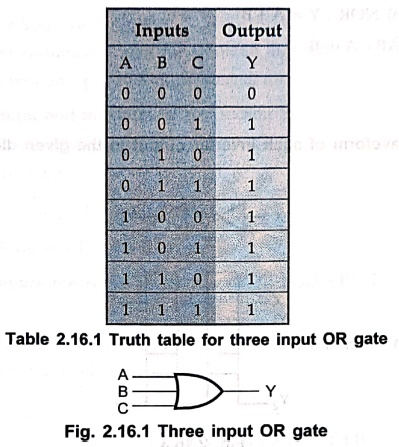
b) Three input EX–NOR
gate :
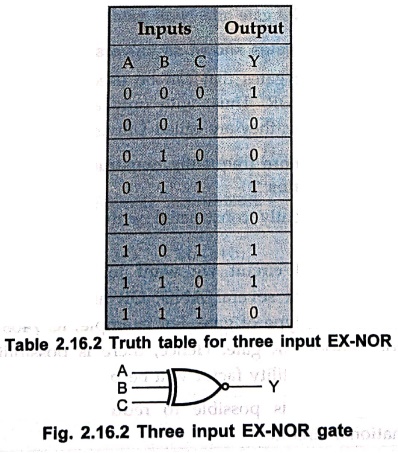
[Hint :
For even number of ones output is one]
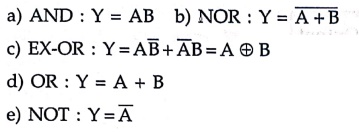
19. Give
the Boolean expression used for following gates
a) AND b)
NOR c) EX–OR d) OR e) NOT
Answer:
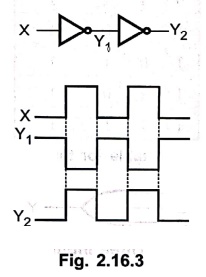
20.
Sketch the waveform of each inverter output in the given diagram.
Answer:
21. Write
the names of universal gates.
Answer:
Universal
gates are : NAND gate and NOR gate.
22. Why
are NAND and NOR gates known as universal gates ?
Answer: NAND and NOR are the
gates that can be used alone to generate remaining gates such as NOT, AND and
OR. Thus, with only any of the two gates, we can implement the logic circuit.
Hence, they are called Universal gates.
23. Why
digital circuits are more frequently constructed with NAND or NOR gates than
with AND and OR gates ?
Answer: Digital circuits are
frequently constructed with NAND or NOR gates due to following reasons,
•
If any simple combinational circuit we want to build and we are not using
universal gates then we want several AND, OR and NOT gates. This demands number
of ICs, one for each type of gate. For example, IC 7408 is for 2–input AND
gate, IC 7432 is for 2–input OR gate. Hence, there is possibility that all
gates in each IC are not used and IC utility factor will be poor.
•
By using universal gates it is possible to reduce number of ICs required to
implement combinational circuit.
24. Name
the two basic types of Boolean expressions.
Answer:
The
two basic types of Boolean expressions are :
•
Sum of Product form (SOP) and
•
Product of Sum form (POS)
25. Name
the two canonical forms for Boolean algebra.
Answer:
Sum
of minterms and product of maxterms forms.
26. Define
: minterm and maxterm.
Each
individual term in canonical SOP form is called minterm and each individual
term in canonical POS form is called maxterm.
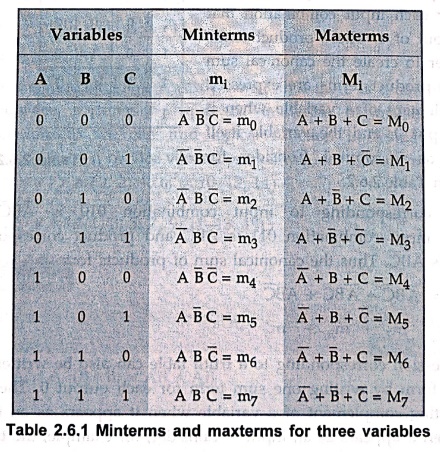
The concept of minterms and maxterms allows us to introduce a very convenient
shorthand notations to express logical functions. Table 2.6.1 gives the
minterms and maxterms for a three literal/variable logical function where the
number of minterms as well as maxterms is 23 = 8. In general, for an
n–variable logical function there are 2n minterms and an equal
number of maxterms.
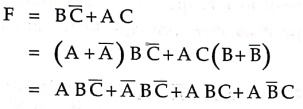
27. Express
F = BC' + AC in a canonical SOP form.
Answer:
28. How
many inputs are required for  ?
?
Answer:
6
– inputs.
29.
Simplify the following Boolean expressions to a minimum number of literals :

Answer:
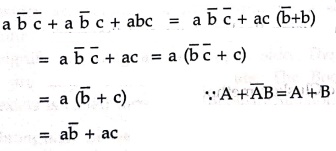
30.
Simplify the following Boolean expression.

Answer:
31.
Simplify: x + x'y.
Answer:
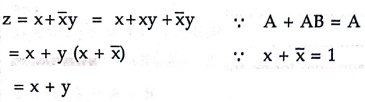
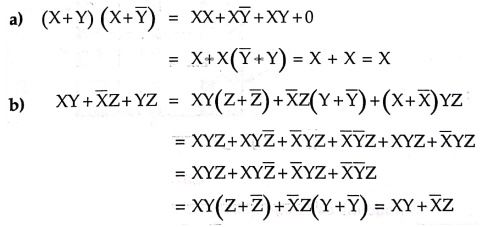
32. Show
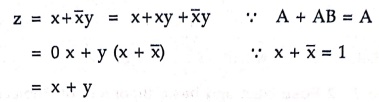
that
a) x + x'y.
b) x'y' z
+ x' yz + xy' = x'z + xy'.
Answer:
a)

33.
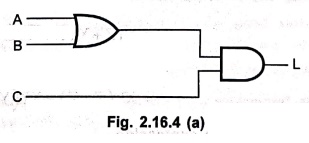
Express the following switching circuit in binary logic notation.
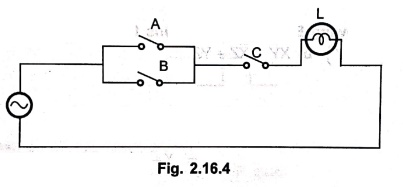
Answer:
34. What
are the methods adopted to reduce Boolean function ?
Answer: i) Boolean function simplification using Boolean
laws and theorems
ii)
Karnaug map
iii)
Tabular method or Quine Mc–Cluskey method
iv)
Variable entered map technique.
35. What
is variable mapping ?
Answer: Representing the
minterms of the sum of of product expression in the Karnaugh–map of appropriate
variables is known as variable mapping.
36. What
code is used to label the row headings and column heading of K–map and why ?
Answer: • Gray code is used to
label the rows and columns of K–map.
•
In case of Gray code, only one variable changes between two consecutive number.
This is useful in grouping pair, quad or octets in k–maps and thus eliminating
variables in the final expression. Hence, Gray code is used to label the rows
and columns of K–map.
37. What
is a Karnaugh map ?
Answer: A Karnaugh map or K–map
is a pictorial form of truth table, in which the map diagram is made up of
squares, with each squares representing one minterm of the function.
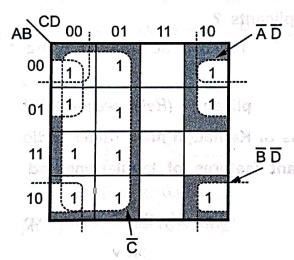
38. Show
the Karnaugh map with the encircled groups for the Boolean function, 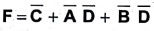 .
.
Answer:
39. What
are don't care conditions and incompletely specified functions ?
Answer:
Sometimes,
while designing a digital circuit, certain conditions of input are of no use.
Consider an example of BCD input for a seven segment display. In this case,
inputs from 0 through 9 are valid inputs. Thus, rest of the inputs from 10
through 15 do not signify anything at the output side. The outputs for which
inputs are not specified are called don't
care outputs. The Boolean function in which don't care outputs exists is
called incomplete Boolean function or incompletely specified functions.
40. Distinguish
between completely specified function and incompletely specified function.
Answer:
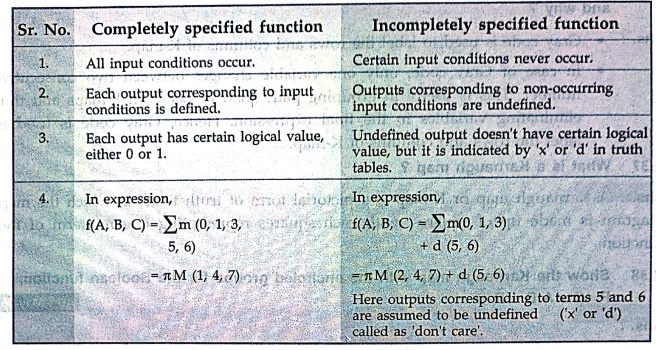
Completely specified
function
1.
All input conditions occur.
2.
Each output corresponding to input conditions is defined,
3.
Each output has certain logical value, either 0 or 1.
4.
In expression,
f(A,
B, C) = Σ m (0, 1, 3,5, 6)
= π M (1, 4, 7)
Incompletely specified
function
1.
Certain input conditions never occur.
2.
Outputs corresponding to non–occurring input conditions are undefined.
3.
Undefined output doesn't have certain logical value, but it is indicated by 'x'
or 'd' in truth tables.
4.
In expression,
f(A,
B, C) = Σ m(0, 1, 3) + d (5, 6)
= πM (2, 4, 7) + d (5, 6)
Here
outputs corresponding to terms 5 and 6 are assumed to be undefined ('x' or 'd')
called as 'don't care'.
41. What
are prime implicants ?
Answer: All the implicants of a function determined
using a Karnaugh map are called prime implicants.
42. What
is an essential implicant?
After
grouping the cells, the sum terms which appear in the K–map are called prime implicants
groups. It is observed that some cells may appear in only one prime implicants
group; while other cells may appear in more than one prime implicants group. In
Fig. 2.9.4 (b), cells 1, 6, 11 and 12 appear in only one prime implicants
group. These cells are called essential
cells and corresponding prime implicants are called essential prime implicants.
43. State
the limitations of Karnaugh map.
The
map method of simplification is convenient as long as the number of variables
does not exceed five or six. As the number of variables increases it is
difficult to make judgements about which combinations form the minimum
expression. In case of complex problem with 7, 8 or even 10 variables it is
almost an impossible task to simplify expression by the mapping method. Another
important point is that the K–map simplification is manual technique and
simplification process is heavily depends on the human abilities. To meet this
need, W. V. Quine and E. J. McCluskey developed an exact tabular method to
simplify the Boolean expression. This method is called the Quine McCluskey or tabular
method.
44. State
two significant features of tabular method of minimization of Boolean
functions.
Answer: 1. It is an exact
method to simplify the Boolean expression.
2.
It can be used to simplify expression with 7, 8 or even 10 variables.
45. Why
we go in for tabulation method?
Answer:
This
method can be applied to problems with many variables and has the advantage of
being suitable for machine computation.
46. Explain
or list out the advantages and disadvantages of K–map method.
Answer: The advantages of the
K–map method are :
i.
It is a fast method for simplifying expression up to four variables.
ii.
It gives a visual method of logic simplification.
iii.
Prime implicants and essential prime implicants are identified fast.
iv.
Suitable for both SOP and POS forms of reduction.
v.
It is more suitable for class room teachings on logic simplification.
For
the disadvantages of the K–map method:
The
map method of simplification is convenient as long as the number of variables
does not exceed five or six. As the number of variables increases it is
difficult to make judgements about which combinations form the minimum
expression. In case of complex problem with 7, 8 or even 10 variables it is
almost an impossible task to simplify expression by the mapping method. Another
important point is that the K–map simplification is manual technique and
simplification process is heavily depends on the human abilities. To meet this
need, W. V. Quine and E. J. McCluskey developed an exact tabular method to
simplify the Boolean expression. This method is called the Quine McCluskey or tabular
method.
47. What
theorem is used when two terms in adjacent squares of K–map are combined?
Once
the Boolean function is plotted on the Karnaugh map we have to use grouping
technique to simplify the Boolean function. The grouping is nothing but
combining terms in adjacent cells. Two cells are said to be adjacent if they
conform the single change rule. i.e. there is only one variable difference
between co–ordinates of two cells.
48. What
is meant by map method ?
Answer: The map method
provides a simple straightforward procedure for minimizing Boolean function.
49. What
is meant by two variable map ?
Answer: Two variable map have
four minterms for two variables, hence the map consists of four squares, one
for each minterm.
50. What
is meant by three variable map?
Answer: Three variable map
have 8 minterms for three variables, hence the map consists of 8 squares, one
for each minterm.
51. What
is tabulation method ?
Answer: A method involving an
exhaustive tabular search method for the minimum expression to solve a Boolean
equation is called a tabulation method.
52.
Implement EX–OR gate using only NAND gate.
The
Boolean expression for EX–OR gate is : A +
+ B. We can
implement AND–OR logic by using NAND–NAND logic as shown in Fig. 2.13.6 (b).
B. We can
implement AND–OR logic by using NAND–NAND logic as shown in Fig. 2.13.6 (b).
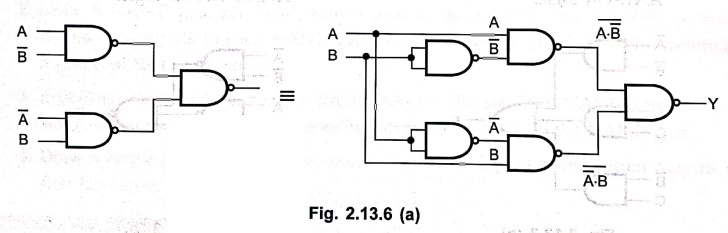
Another
way of implementing EX–OR gate using NAND gates is as shown in Fig. 2.13.6 (b).
It needs only four NAND gates.
53. How can a NAND gate be used as an inverter ?
Answer:
54.
Realize the function 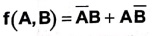 by using only
NAND gates.
by using only
NAND gates.
55. How
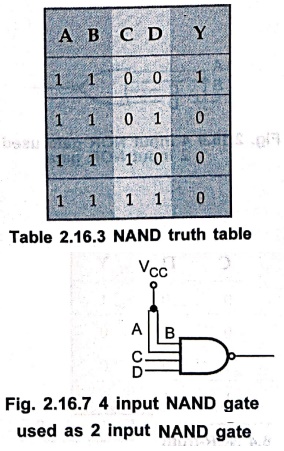
will you use a 4 input NAND gate as a 2 input NAND gate ?
Answer:
56.
Implement AND gate and OR gate using NAND gate.
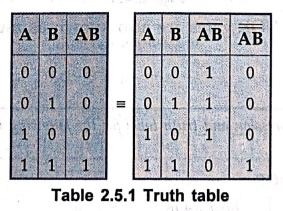
AND function :
An
AND function can be generated using only NAND gates. It is generated by simply
inverting output of NAND gate i.e.  = AB. Fig. 2.5.2 shows the
two input AND gate using NAND gates.
= AB. Fig. 2.5.2 shows the
two input AND gate using NAND gates.

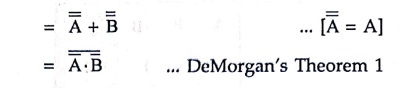
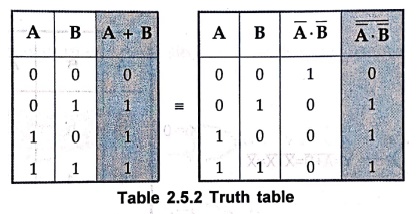
OR function :
OR
function is generated using only NAND gates as follows: We know that Boolean
expression for OR gate is
Y
= A + B
The
above equation is implemented using only NAND gates as shown in Fig. 2.5.3.
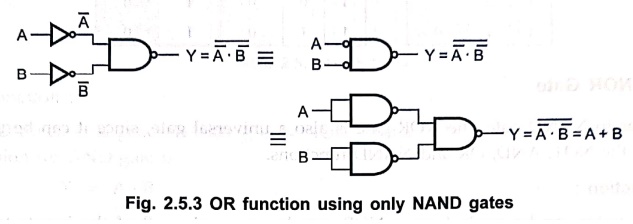
Note :
Bubble at the input of NAND gate indicates inverted input.
57. Show that the NAND connection is not associative.
Answer:
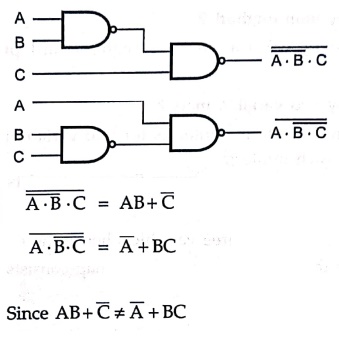
NAND connection is not associative.
58. Show
that a bubbled AND gate works like a NOR gate.
Answer:
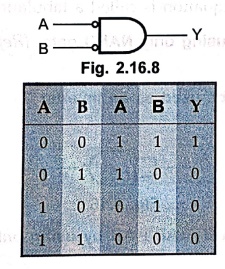
Here,
output Y presents the output of NOR gate.
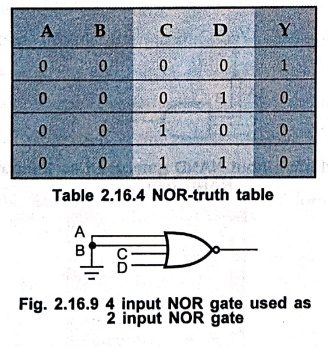
59. How
will you use a 4 input NOR gate as a 2 input NOR gate ?
Answer:
60. What
is an Integrated Circuit (IC) ?
Answer: An Integrated Circuit
(IC) is a tiny electronic circuit in which many components like transistors,
resistors and capacitors are fabricated on a small silicon chip. It integrates
complete circuits on a single wafer using processes like photolithography,
enabling compact size and high performance.
61. What
are the main types of integrated circuits based on function ?
Answer: ICs are classified
into :
•
Digital ICs – Work on binary logic
(0 and 1), e.g., microprocessors, memory chips.
• Analog ICs –
Process continuous signals, e.g., amplifiers and sensors.
• Mixed–signal ICs – Combine
analog and digital circuits on one chip,
e.g., used in smartphones.
62. What
are SSI, MSI, LSI, VLSI, and ULSI ?
Answer:
These
are classifications of ICs based on the number of components on a chip :
• SSI :
1 – 100 components
• MSI :
100 – 1,000 components
• LSI :
1,000 – 10,000 components
• VLSI :
10,000 – 1,000,000 components
• ULSI :
Above 1 million components.
63. State
any two advantages of integrated circuits.
Answer:
• Miniaturization :
Devices become smaller and portable.
• High performance :
Short distances between components increase speed.
64. What
is Moore's law ?
Answer: Moore's Law states
that the number of transistors on an IC doubles approximately every two years,
leading to continuous improvement in performance and reduction in size.
Digital Principles and Computer Organization: Chapter 2: Boolean Algebra, Logic Gates and Minimization Techniques : Tag: : Digital Principles and Computer Organization - Boolean Algebra, Logic Gates and Minimization Techniques: Two Marks Important Questions and Answers
Digital Principles and Computer Organization: Chapter 2: Boolean Algebra, Logic Gates and Minimization Techniques
Under Subject

Digital Principles and Computer Organization
CS25C06 2nd Semester AIDS, CSE, IT, CSE(CY) Dept | 2025 Regulation | 2nd Semester 2025 Regulation
Related Subjects

English Essentials II
EN25C02 2nd Semester | 2025 Regulation | 2nd Semester 2025 Regulation

Tamils and Technology தமிழர்களும் தொழில்நுட்பமும்
UC25H02 2nd Semester | 2025 Regulation | 2nd Semester 2025 Regulation
Linear Algebra
MA25C02 2nd Semester | 2025 Regulation
Applied Physics (CSIE) II
PH25C03 2nd Semester AIDS, CSE, IT, CSE(CY) Dept | 2025 Regulation | 2nd Semester 2025 Regulation
Digital Principles and Computer Organization
CS25C06 2nd Semester AIDS, CSE, IT, CSE(CY) Dept | 2025 Regulation | 2nd Semester 2025 Regulation

Basic Electrical and Electronics Engineering
EE25C01 2nd Semester | 2025 Regulation | 2nd Semester 2025 Regulation
Python for Data Science
AD25201 2nd Semester AIDS Dept | 2025 Regulation | 2nd Semester 2025 Regulation

Re-Engineering for Innovation
ME25C05 2nd Semester | 2025 Regulation | 2nd Semester 2025 Regulation
Python for Data Science - Laboratory
AD25201 2nd Semester AIDS Dept | 2025 Regulation | 2nd Semester 2025 Regulation