Digital Principles and Computer Organization: Chapter 2: Boolean Algebra, Logic Gates and Minimization Techniques
NOR-NOR Implementation
The NOR function is a dual of the NAND function. For this reason, the implementation procedures and rules for NOR-NOR logic are the duals of the corresponding procedures and rules developed for NAND-NAND logic.
NOR–NOR Implementation
The
NOR function is a dual of the NAND function. For this reason, the
implementation procedures and rules for NOR–NOR logic are the duals of the
corresponding procedures and rules developed for NAND–NAND logic.
The
implementation of a Boolean function with NOR–NOR logic requires that the
function be simplified in the product of sum form. In product of sum form, we
implement all sum terms using OR gates. This constitutes the first level. In
the second level all sum terms are logically ANDed using AND gate. The
relationship between OR–AND logic and NOR–NOR is explained using following
example.
Consider
the Boolean function : Y = (A + B + C) (D + E) F
This
Boolean function can be implemented using OR–AND logic, as shown in Fig. 2.14.1
(a). Fig. 2.14.1 (b) shows the OR gates are replaced by NOR gates and the AND gate
is replaced by a bubbled AND gate. The implementation shown in Fig. 2.14.1 (b)
is equivalent to implementation shown in Fig. 2.14.1 (a), because two bubbled
on the same line represent double inversion (complementation) which is
equivalent to having no bubble on the line. In case of single variable, F, the
complemented variable again complemented by bubble to produce the normal value
of F.
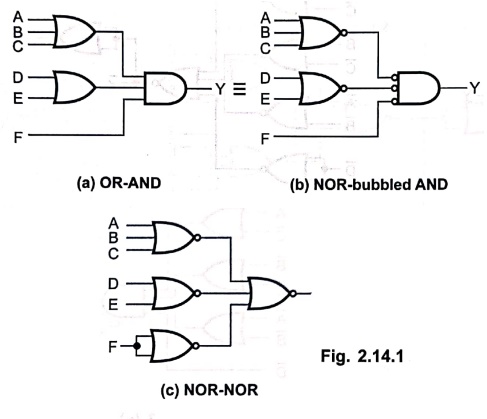
In
Fig. 2.14.1 (c), the output NOR gate is redrawn with the conventional symbol.
The NOR gate with same inputs gives complemented result, therefore,  is replaced by NOR gate with F input to its both inputs. Thus all the three
implementations of Boolean function are equivalent.
is replaced by NOR gate with F input to its both inputs. Thus all the three
implementations of Boolean function are equivalent.
From
the above example we can summarize the rules for obtaining the NOR–NOR logic
diagram from a Boolean function as follows :
1.
Simplify the given Boolean function and express it in product of sum form (POS
form).
2.
Draw a NOR gate for each sum term of the function that has two or more
literals. The inputs to each NOR gate are the literals of the term. This
constitute a group of first level gates.
3.
If Boolean function includes any single literal or literals, draw NOR gate for
each single literal and connect corresponding literal as an input to the NOR
gate.
4.
Draw a single NOR gate in the second level, with inputs coming from outputs of
first level gates.
Illustrative Examples
Example: 1
Implement the following
Boolean function with NOR–NOR logic
Y=AC + B C+ A B + D.
Solution :
Step 1:
Express Boolean function in POS form.
Using
duality theorem we get,

Step 2 :
Implement Boolean function with OR–AND logic.
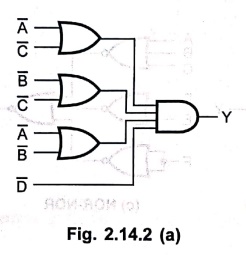
Step 3 :
Convert OR–AND logic to NOR–NOR logic.
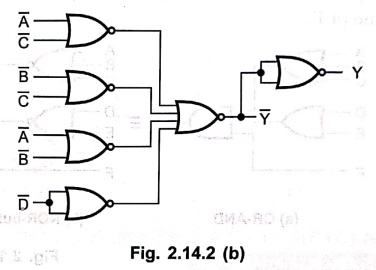
Example: 2
Implement the following
Boolean function with NOR–NOR logic.
F= (A, B, C) = II M (0,
2, 4, 5, 6)
Solution :
Step 1:
Simplify the given Boolean function.
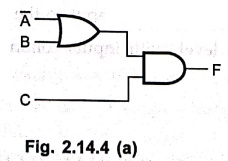
F
= (Ā + B) C
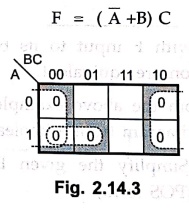
Step 2 :
Implement Boolean function with OR–AND logic.
Step 3 :
Convert OR–AND logic to NOR–NOR logic.
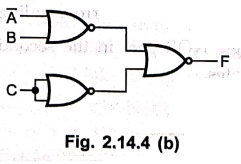
Note :
It is possible to directly go to step 3 skipping step 2. Here, step 2 is
included for clear understanding.
Example: 3
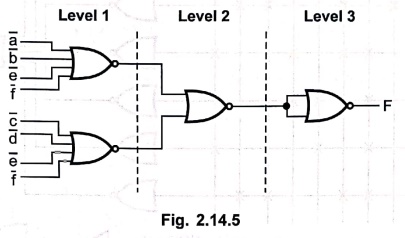
Obtain 3–level NOR–NOR
implementation of f(a, b, c, d, e, f)
= [ab + cd]ef.
Solution :
f
(a, b, c, d, e, f) = [ab + cd] ef
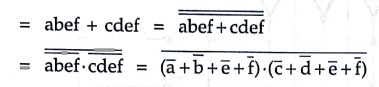
OR–AND
function can be implemented using NOR–NOR logic as shown in Fig. 2.14.5.
Example: 4
Minimize the following
using Karnaugh map. Implement the resultant function using NOR gates only.
F (A, B, C, D, E) = II
M (2, 4, 7, 9, 26, 28, 29, 31)
Solution :
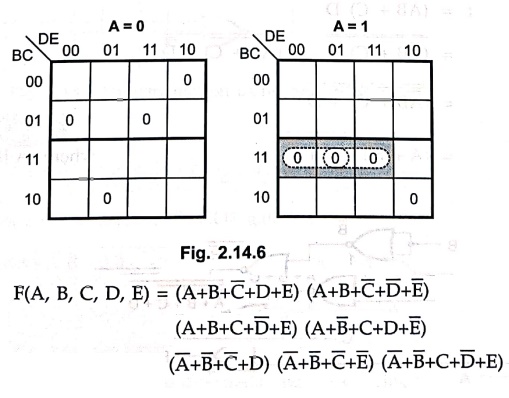
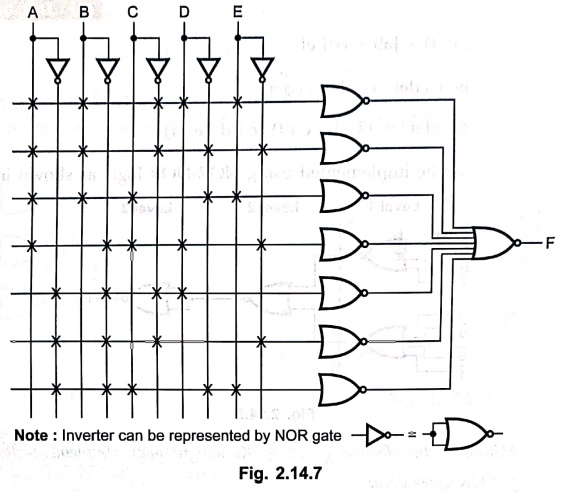
OR–AND
implementation can be replaced by NOR–NOR implementation.
Logic diagram using NOR
gates
Example: 5
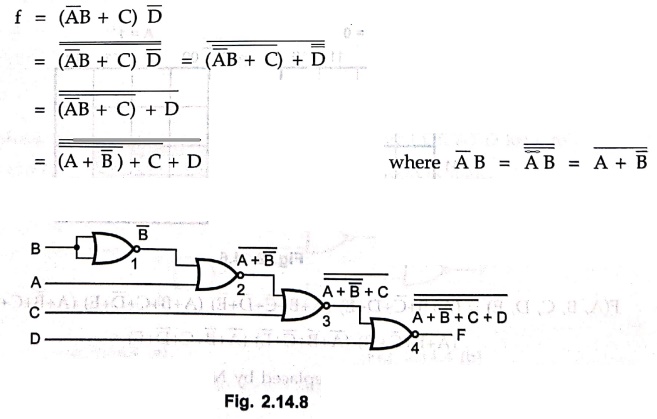
Implement the following
function using a quad 2–input NOR gates
ƒ = ( B + C)
 .
.
Solution :
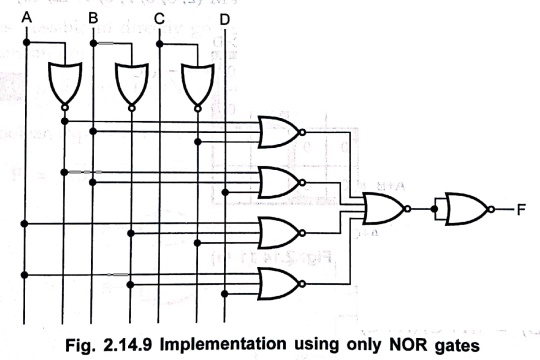
Example: 6
Implement F = (AB' +
A'B) (C + D') with only NOR gates.
Solution :
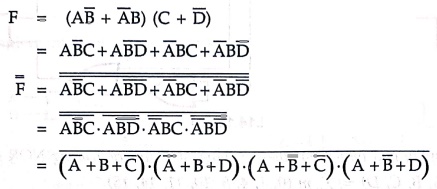
This
product of sum (POS) expression can be implemented by NOR–NOR logic as shown in
Fig. 2.14.9.
Examples with Solutions
Example: 7
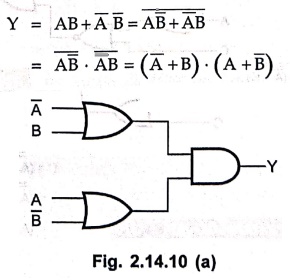
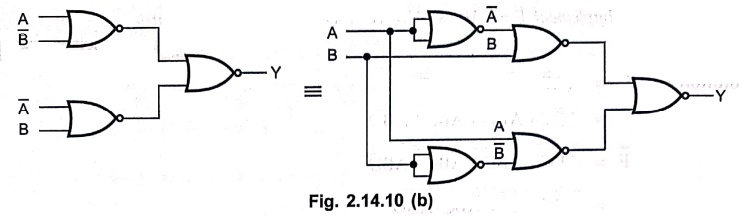
Implement EX–NOR gate
using only NOR gates.
Solution :
The Boolean expression for EX–NOR gate is :
We
can implement OR–AND logic by using NOR–NOR logic, as shown in Fig. 2.14.10
(b).
Example: 8
Simplify and implement
the following SOP function using NOR gates.
f(A, B, C, D) =Σ m (0,
1, 4, 5, 10, 11, 14, 15)
Solution :
Step 1:
Convert Convert SOP function into its equivalent POS function.
Σ
m (0, 1, 4, 5, 10, 11, 14, 15) = II
M (2, 3, 6, 7, 8, 9, 12, 13)
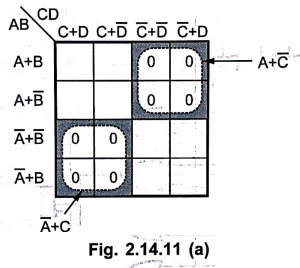
Step 2 : K–map
simplification:
f
(A, B, C, D) = (A+  ) (+C)
2006
HOM vino grizu noitetnemolqmi 2.AS Q
Step 3: Implementation
:
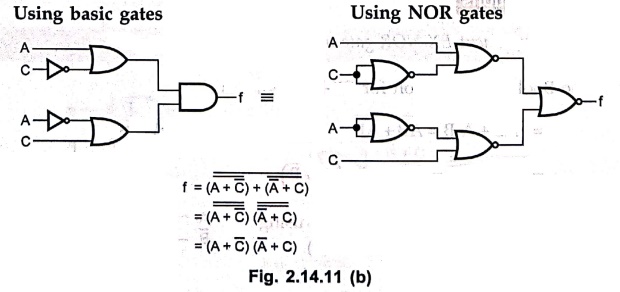
Note :
We can convert OR–AND logic into NOR–NOR logic.
Example: 9
Implement the following
Boolean function with NOR–NOR logic
F = (Ā + B) C
Solution:
Step 1 :
Implement Boolean function with OR–AND logic.
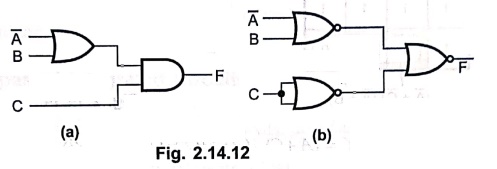
Step 2 : Convert
OR–AND logic to NOR–NOR logic.
Note :
It is possible to directly go to step 2 skipping step 1. Here, step 1 is
included for clear understanding.
Example: 10
Implement EX–OR gate
using only NOR gates.
Solution :
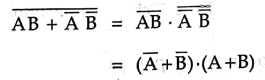
Boolean
expression of EX–OR gate
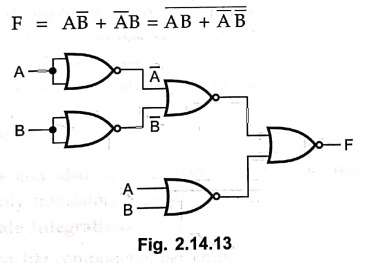
Note :
Complement of EX–NOR gate is EX–OR gate.
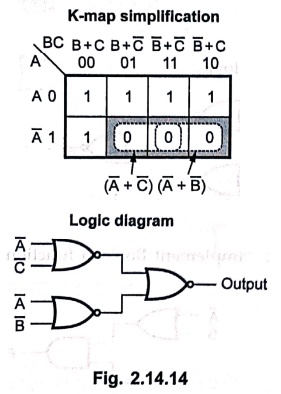
Example: 11
Implement the following
function using NOR gates.
Output = 1 when the
inputs are Σ m (0, 1, 2, 3, 4)
= 0 when the inputs are Σ m (5, 6,
7).
Solution :
Example: 12
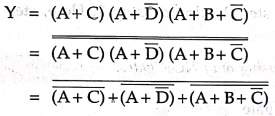
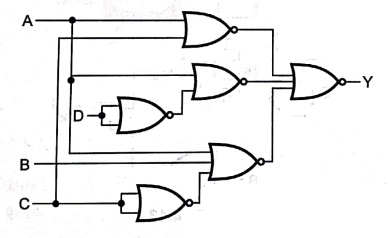
Implement  using NOR gates only.
Solution :
NOR implementation
Digital Principles and Computer Organization: Chapter 2: Boolean Algebra, Logic Gates and Minimization Techniques : Tag: : - NOR-NOR Implementation
Digital Principles and Computer Organization: Chapter 2: Boolean Algebra, Logic Gates and Minimization Techniques
Under Subject

Digital Principles and Computer Organization
CS25C06 2nd Semester AIDS, CSE, IT, CSE(CY) Dept | 2025 Regulation | 2nd Semester 2025 Regulation
Related Subjects

English Essentials II
EN25C02 2nd Semester | 2025 Regulation | 2nd Semester 2025 Regulation

Tamils and Technology தமிழர்களும் தொழில்நுட்பமும்
UC25H02 2nd Semester | 2025 Regulation | 2nd Semester 2025 Regulation
Linear Algebra
MA25C02 2nd Semester | 2025 Regulation

Applied Physics (CSIE) II
PH25C03 2nd Semester AIDS, CSE, IT, CSE(CY) Dept | 2025 Regulation | 2nd Semester 2025 Regulation
Digital Principles and Computer Organization
CS25C06 2nd Semester AIDS, CSE, IT, CSE(CY) Dept | 2025 Regulation | 2nd Semester 2025 Regulation

Basic Electrical and Electronics Engineering
EE25C01 2nd Semester | 2025 Regulation | 2nd Semester 2025 Regulation

Python for Data Science
AD25201 2nd Semester AIDS Dept | 2025 Regulation | 2nd Semester 2025 Regulation

Re-Engineering for Innovation
ME25C05 2nd Semester | 2025 Regulation | 2nd Semester 2025 Regulation

Python for Data Science - Laboratory
AD25201 2nd Semester AIDS Dept | 2025 Regulation | 2nd Semester 2025 Regulation