Digital Principles and Computer Organization: Chapter 2: Boolean Algebra, Logic Gates and Minimization Techniques
Simplification of POS Expressions
Question: 1. Give the steps for simplification of POS expression.
Simplification of POS
Expressions
In
the above discussion, we have considered the Boolean expression in sum of
products form and grouped 2, 4 and 8 adjacent ones to get the simplified
Boolean expression in the same form. In practice, the designer should examine
both the sum of products and product of sums reductions to ascertain which is
more simplified. We have already seen the representation of product of sums on
the Karnaugh map. Once the expression is plotted on the K–map instead of making
the groups of ones, we have to make groups of zeros. Each group of zero results
a sum term and it is nothing but the prime
implicate. The technique for using maps for POS reductions is a simple step
by ate. The techniq step process and it is similar to the one used earlier.
1.
Plot the K–map and place Os in those cells corresponding to the 0s in the truth
table or maxterms in the product of sums expression.
2.
Check the K–map for adjacent 0s and encircle those 0s which are not adjacent to
any other 0s. These are called isolated 0s.
3.
Check for those 0s which are adjacent to only one other 0 and encircle such
pairs.
4.
Check for quads and octets of adjacent 0s even if it contains some 0s that have
already been encircled. While doing this make sure that there are minimum
number of groups.
5.
Combine any pairs necessary to include any 0s that have not yet been grouped.
6.
Form the simplified POS expression for F by taking product of sum terms of all
the groups.
To
get familiar with these steps we will solve some examples.
Examples for Understanding
Example: 1
Minimize the
expression.

Solution :

Step 1:
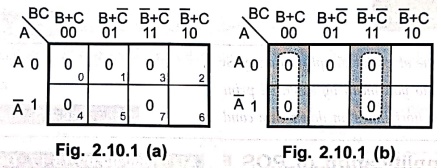
Fig. 2.10.1 (a) shows the K–map for three variable and it is plotted according
to given maxterms.
Step 2 :
There are no isolated 0s.
Step 3 :
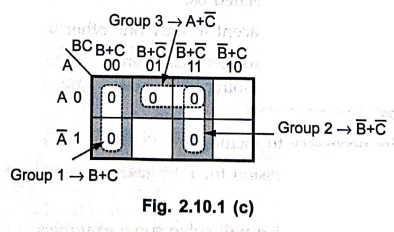
0 in the cell 4 is adjacent only to 0 in the cell 0 and 0 in the cell 7 is
adjacent only to 0 in the cell 3. These two pairs are combined and referred to
as group 1 and group 2 respectively.
Step 4:
There are no quads and octets.
Step 5 :
The 0 in the cell 1 can be combined with 0 in the cell 3 to form a pair. This pair
is referred to as group 3.
Step 6 :
In group 1 and in group 2, A is eliminated, whereas in group 3 variable B is
eliminated and we get,
Y
= (B+C) ( +
+ ) (A +)
Example: 2
Minimize the following
expression in the POS form

Solution :

Step 1 :
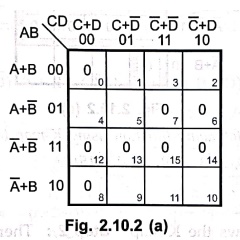
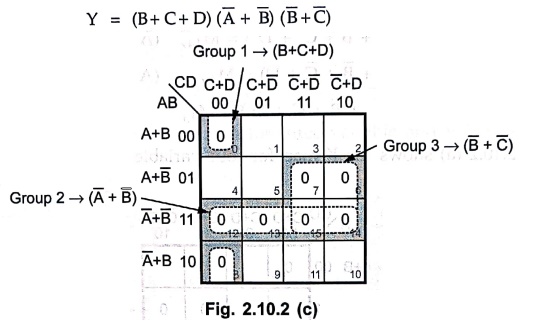
Fig. 2.10.2 (a) shows the K–map for four variable and it is plotted according
to given maxterms.
Step 2 :
There are no isolated 0s.
Step 3 :
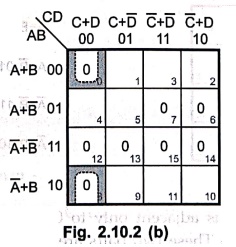
0 in the cell 0 is adjacent only to 0 in the cell 8. This pair is combined and
referred to as group 1.
Step 4 :
There are two quads. Cells 12, 13, 14 and 15 forms a quad 1 and cells 6, 7, 14,
15 forms a quad 2. These two quads are referred to as group 2 and group 3,
respectively.
Step 5 :
All 0s have already been grouped.
Step 6 : In group 1, variable A is eliminated. In group 2, variable C and D are eliminated and in group 3 variables A and D are eliminated. Therefore we get simplified POS expression as,
Example: 3
Reduce the following
function using K–map technique
ƒ ( A, B, C, D ) = II M
(0, 2, 3, 8, 9, 12, 13, 15)
Solution :
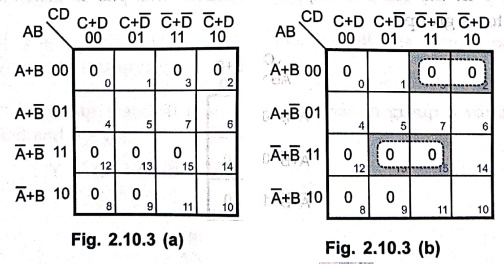
Step 1 : Fig. 2.10.3 (a) shows the K–map for four variables and it is plotted according to given maxterms.
Step 2 :
There are no isolated 0s.
Step 3 :
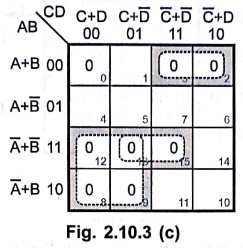
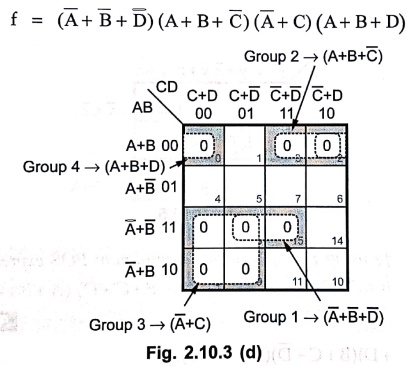
The 0 in the cell 15 is adjacent only to 0 in the cell 13 and 0 in the cell 3
is adjacent only to 0 in the cell 2. These two pairs are combined and referred
to as group1 and group 2, respectively.
Step 4 :
The cells 8, 9, 12 and 13 form a quad which is referred to as group 3.
Step 5 :
The remaining 0 in the cell 0 is combined with the 0 in the cell 2 to form a
pair, which is referred to as group 4.
Step 6 : In group 1 and in group 4 variable C is eliminated. In group 2 variable D is eliminated and in group 3 variables B and D are eliminated. Therefore, we get simplified expression in POS form as,
Examples with Solution
Example :
4
Simplify the given
Boolean function into product of sum form
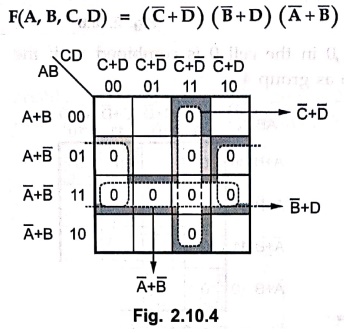
F(A, B, C, D) = Σ (0,
1, 2, 5, 8, 9, 10)
Solution Product of sum
form –
F
(A, B, C, D) = Σ (0, 1, 2, 5, 8, 9, 10)
= л (3, 4, 6, 7, 11,
12, 13, 14, 15)
Example: 5
Simplify the following
expression using Boolean algebra.
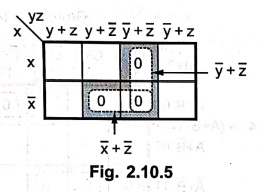
f(x,
y, z) = π M (3, 5, 7)
Solution :
Example:
6
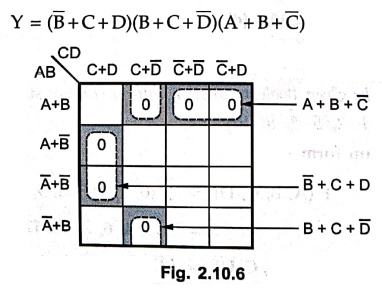
Simplify using K–map to
obtain a minimum POS expression :

Solution :
Example: 7
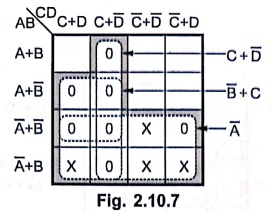
Obtain the minimal
product of sums for F= Σ (0, 2, 3, 6, 7) + d (8, 10, 11, 15)
Solution :
F
= Σ (0, 2, 3, 6, 7) + d (8, 10, 11, 15)
=
л (1, 4, 5, 9, 12, 13, 14) + d (8, 10, 11, 15)

Example: 8
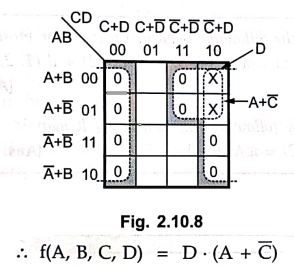
Reduce the following
function using K–map technique.
f(A, B, C, D) = л (0,
3, 4, 7, 8, 10, 12, 14) + d (2, 6)
Solution :
Example: 9
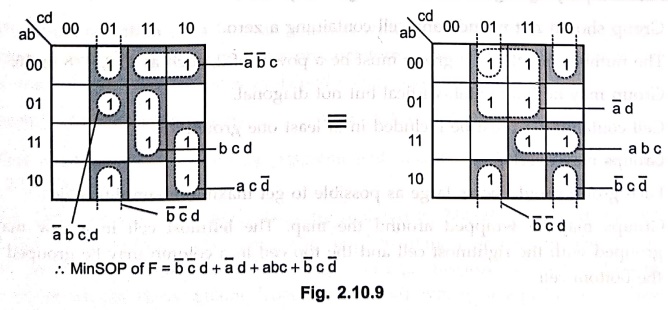
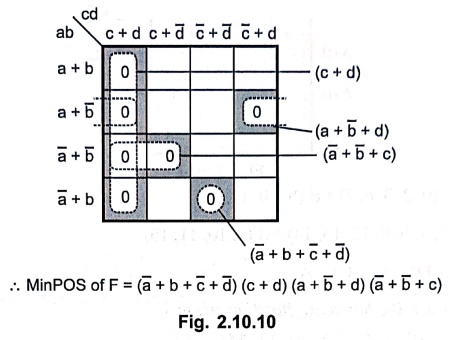
Find a MinSOP and MinPOS
for 
Solution : Min SOP
Min POS
Examples for Practice
Example: 10
Simplify the following
Boolean function for minimal POS form
F(w, x, y, z) = л M (4,
5, 6, 7, 8, 12) + d (1, 2, 3, 9, 11, 14)

Example:
11
Reduce the following
function using K–map
F (A, B, C) = л M (0,
1, 2, 3, 4, 7)

Review Question
1. Give the steps for
simplification of POS expression.
Digital Principles and Computer Organization: Chapter 2: Boolean Algebra, Logic Gates and Minimization Techniques : Tag: Digital, Computer : - Simplification of POS Expressions
Digital Principles and Computer Organization: Chapter 2: Boolean Algebra, Logic Gates and Minimization Techniques
Under Subject

Digital Principles and Computer Organization
CS25C06 2nd Semester AIDS, CSE, IT, CSE(CY) Dept | 2025 Regulation | 2nd Semester 2025 Regulation
Related Subjects

English Essentials II
EN25C02 2nd Semester | 2025 Regulation | 2nd Semester 2025 Regulation

Tamils and Technology தமிழர்களும் தொழில்நுட்பமும்
UC25H02 2nd Semester | 2025 Regulation | 2nd Semester 2025 Regulation
Linear Algebra
MA25C02 2nd Semester | 2025 Regulation
Applied Physics (CSIE) II
PH25C03 2nd Semester AIDS, CSE, IT, CSE(CY) Dept | 2025 Regulation | 2nd Semester 2025 Regulation
Digital Principles and Computer Organization
CS25C06 2nd Semester AIDS, CSE, IT, CSE(CY) Dept | 2025 Regulation | 2nd Semester 2025 Regulation

Basic Electrical and Electronics Engineering
EE25C01 2nd Semester | 2025 Regulation | 2nd Semester 2025 Regulation
Python for Data Science
AD25201 2nd Semester AIDS Dept | 2025 Regulation | 2nd Semester 2025 Regulation

Re-Engineering for Innovation
ME25C05 2nd Semester | 2025 Regulation | 2nd Semester 2025 Regulation
Python for Data Science - Laboratory
AD25201 2nd Semester AIDS Dept | 2025 Regulation | 2nd Semester 2025 Regulation