Digital Principles and Computer Organization: Chapter 2: Boolean Algebra, Logic Gates and Minimization Techniques
Boolean Postulates and Laws
1. Boolean Algebra Terminology 2. Fundamental Postulates and Laws of Boolean Algebra 3. Basic Theorems
Chapter 2:
Boolean Algebra, Logic Gates and Minimization Techniques
Boolean Postulates and
Laws
In
1854, George Boole introduced a systematic treatment of logic and developed for
this purpose an algebraic system now called Boolean algebra.
Boolean
algebra is a system of mathematical logic. It differs from both ordinary
algebra and the binary number system.
1. Boolean Algebra Terminology
Variable :
The symbol which represent an arbitrary elements of an Boolean algebra is known
as variable. Any single variable or
a function of several variables can have either a 1 or 0 value. For example, in
expression Y = A + BC, variables A, B and C can have either a 1 or 0 value and
function Y also can have either a 1 or 0 value; however its value depends on
the value of Boolean expression.
Constant :
In expression Y = A + 1, the first term A is a variable and have value either a
1 or 0. The second term has a fixed value 1. So 1 is a constant here. The
constant term may be 0 or 1.
Complement :
A complement of a variable is represented by a "bar" over the letter.
For example, the complement of a variable A will be denoted by Ā. So if A = 1,
Ā = 0 and if A = 0, Ā = 1. Sometimes a prime symbol (') is used to denote the
complement. For example, the complement of A can be written as A'.
Literal :
Each occurrence of a variable in Boolean function either in a complemented or
an uncomplemented form is called a literal.
Boolean function :
Boolean expressions are constructed by connecting the Boolean constants and
variables with the Boolean operations. These Boolean expressions are also known
as Boolean formulas. We use Boolean
expressions to describe Boolean
functions. For example, if the Boolean expression (A +  ) C
is used to describe the function f, then Boolean function is written as
) C
is used to describe the function f, then Boolean function is written as
f(A,
B, C) = (A +) C or f = (A
+ ) C
2. Fundamental Postulates and Laws of Boolean Algebra
The
postulates of a mathematical system form the basic assumption from which it is
possible to deduce the theorems, laws and properties of the system. Boolean
algebra is formulated by a defined set of elements, together with two binary
operators, + and • , provided that the given postulates are satisfied.
•
Closure (a) : Closure with respect
to the operator + : When two binary elements are operated by operator + the
result is a unique binary element.
•
Closure (b) : Closure with respect
to the operator • (dot): When two binary elements are operated by operator • (dot),
the result is a unique binary element.
•
An identity element with respect to +, designated by 0 : A+ 0 = 0 + A = A
•
An identity element with respect to • , designated by 1: A • 1 = 1 • A = A
•
Commutative with respect to + : A + B = B+ A
•
Commutative with respect to • : A • B = B • A
•
Distributive property of over + : A • (B + C) = (A • B) + (A • C)
•
Distributive property of + over • : A + (B • C) = (A + B) • (A + C)
•
Associative property of + : A + (B + C) = (A + B) + C
•
Associative property of • : (A • B) • C = A • (B • C)
•
For every binary element, there exists complement element. For example, if A is
an element, we have Ā is a complement of A. i.e. if A = 0, Ā = 1
and if A = 1, Ā = 0.
•
There exists at least two elements, say A and B in the set of binary elements
such that A # B.
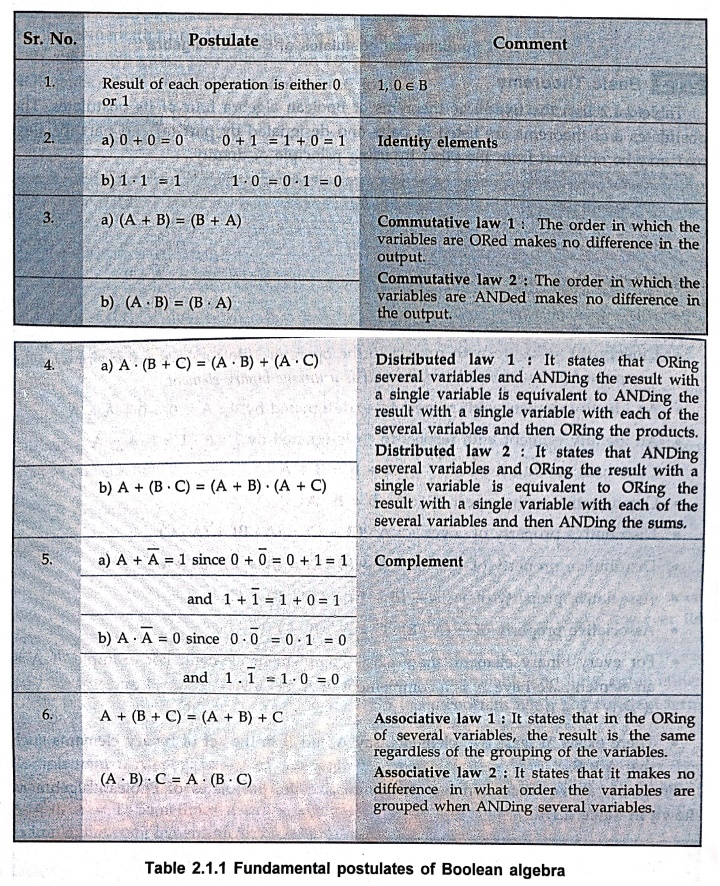
From
the above discussion we can summarize the postulates of Boolean algebra as shown
in Table. 2.1.1.
3. Basic Theorems
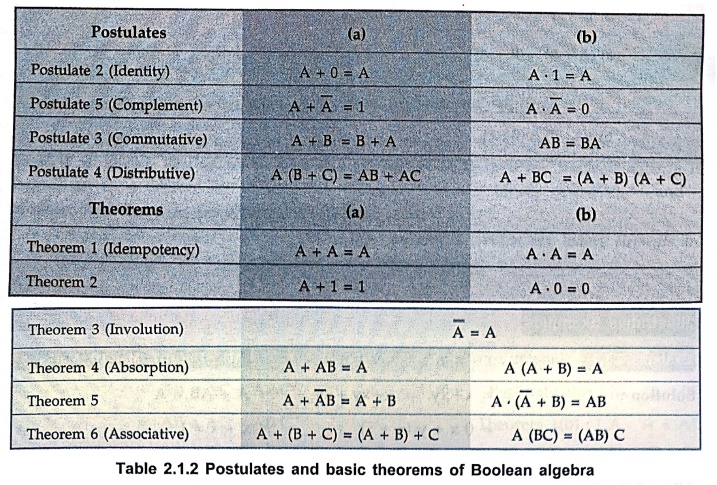
Table
2.1.2 lists the five basic theorems of Boolean algebra four of its postulates.
The postulates and theorems are listed in pairs and designated by part (a) and
part (b). One part may be obtained from the other by using principle of
duality.
Digital Principles and Computer Organization: Chapter 2: Boolean Algebra, Logic Gates and Minimization Techniques : Tag: Digital, Computer : - Boolean Postulates and Laws
Digital Principles and Computer Organization: Chapter 2: Boolean Algebra, Logic Gates and Minimization Techniques
Under Subject
Digital Principles and Computer Organization
CS25C06 2nd Semester AIDS, CSE, IT, CSE(CY) Dept | 2025 Regulation | 2nd Semester 2025 Regulation
Related Subjects

English Essentials II
EN25C02 2nd Semester | 2025 Regulation | 2nd Semester 2025 Regulation

Tamils and Technology தமிழர்களும் தொழில்நுட்பமும்
UC25H02 2nd Semester | 2025 Regulation | 2nd Semester 2025 Regulation
Linear Algebra
MA25C02 2nd Semester | 2025 Regulation
Applied Physics (CSIE) II
PH25C03 2nd Semester AIDS, CSE, IT, CSE(CY) Dept | 2025 Regulation | 2nd Semester 2025 Regulation
Digital Principles and Computer Organization
CS25C06 2nd Semester AIDS, CSE, IT, CSE(CY) Dept | 2025 Regulation | 2nd Semester 2025 Regulation

Basic Electrical and Electronics Engineering
EE25C01 2nd Semester | 2025 Regulation | 2nd Semester 2025 Regulation
Python for Data Science
AD25201 2nd Semester AIDS Dept | 2025 Regulation | 2nd Semester 2025 Regulation

Re-Engineering for Innovation
ME25C05 2nd Semester | 2025 Regulation | 2nd Semester 2025 Regulation
Python for Data Science - Laboratory
AD25201 2nd Semester AIDS Dept | 2025 Regulation | 2nd Semester 2025 Regulation