Digital Principles and Computer Organization: Chapter 2: Boolean Algebra, Logic Gates and Minimization Techniques
Boolean Expressions
1. Sum of Product Form 2. Product of Sum Form 3. Canonical SOP and Canonical POS Forms 4. Converting Expressions in Canonical SOP or POS Form: Steps to Convert SOP to Canonical SOP Form , Steps to Convert POS to Canonical POS Form 5. M Notations: Minterms and Maxterms 6. Complements of Standard Forms. Questions: 1. Define switching function. 2. Define literal, product term and sum term. 3. Explain sum of product form. 4. Define SOP and POS terms 5. What do you mean by standard SOP and POS forms? 6. Explain how to convert SOP or POS expressions in their standard forms. 7. What do you mean by minterms and maxterms ? 8. Differentiate between min term and max term.
Boolean Expressions
Boolean
expressions are constructed by connecting the Boolean constants and variables
with the Boolean operations. These Boolean expressions are also known as Boolean formulas. We use Boolean
expressions to describe switching function or Boolean functions. For example, if the Boolean expression (A +  ) C is used to
describe the function f, then Boolean function is written as
) C is used to
describe the function f, then Boolean function is written as
f(A, B, C) = (A + B) C or f = (A + ) C
Based
on the structure of Boolean expression, it can be categorized in different
formulas. One such categorization are the normal formulas. Let us consider the
four–variable Boolean function.
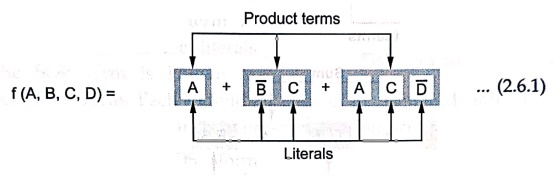
In
this Boolean function the variables are appeared either in a complemented or an
uncomplemented form. Each occurrence of a variable in either a complemented or
an uncomplemented form is called a literal.
Thus, the above Boolean function 2.6.1 consists of six literals. They appear in
the product terms. A product term is
defined as either a literal or a product (also called conjunction) of literals.
Function
2.6.1 contains three product terms, namely, A, C and A C  . Let us Cand AC consider another four variable Boolean function.
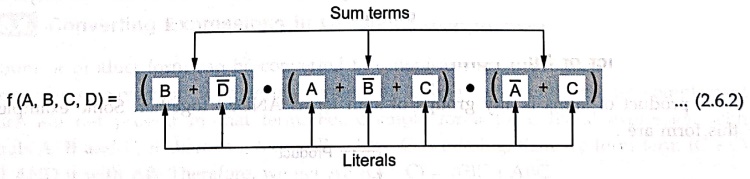
The
above Boolean function consists of seven literals. Here, they appear in the sum
terms. A sum term is defined as
either a literal or a sum (also called disjunction) of literals. Function 2.6.2
contains three sum terms, namely, (B + ), (A + + C) and ( + C). The literals and terms are arranged in one of the two
standard forms:
+ C). The literals and terms are arranged in one of the two
standard forms:
•
Sum of product form (SOP) and
•
Product of sum form (POS).
In
these standard forms, the terms that form the function may contains one, two or
any number of literals.
1. Sum of Product Form
The
words sum and product are derived from the symbolic representations of the OR
and AND functions by + and (addition and multiplication), respectively. But we
realize that these are not arithmetic operators in the usual sense. A product
term is any group of literals that are ANDed together. For example, ABC, XY and
so on. A sum term is any group of literals that are ORed together such as A+ B+
C, X + Y and so on. A Sum of Products (SOP) is a group of product terms ORed
together. Some examples of this form are :
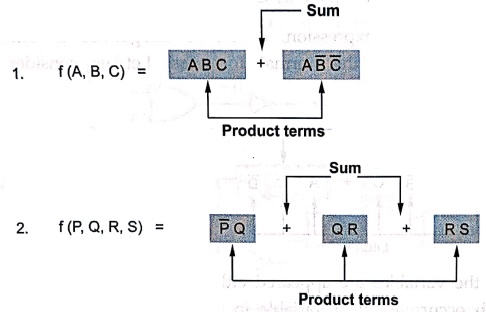
Each of these sum of products expressions
consist of two or more product terms (AND) that are ORed together. Each product
term consists of one or more literals appearing in either complemented or
uncomplemented form. For example, in the sum of products expression ABC+ A , the first product term contains literals A, B and C in their
uncomplemented form. The second product term contains B and C in their
complemented (inverted) form. The sum of product form is also known as disjunctive normal form or disjunctive normal formula.
, the first product term contains literals A, B and C in their
uncomplemented form. The second product term contains B and C in their
complemented (inverted) form. The sum of product form is also known as disjunctive normal form or disjunctive normal formula.
2. Product of Sum Form
A
product of sums is any groups of sum terms ANDed together. Some examples of
this form are :
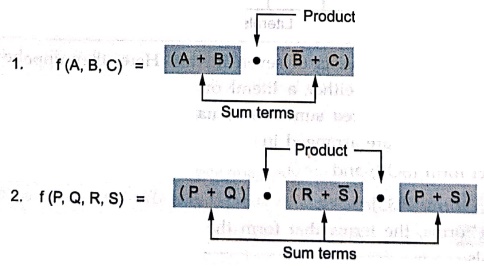
Each
of these product of sums expressions consist of two or more sum terms (OR) that
are ANDed together. Each sum term consists of one or more literals appearing in
either complemented or uncomplemented form. The product of sum form is also
known as conjunctive normal form or conjunctive normal formula.
3. Canonical SOP and Canonical POS Forms
We
can realize that in the SOP form, all the individual terms do not involve all
literals. For example, in expression AB + AB the first
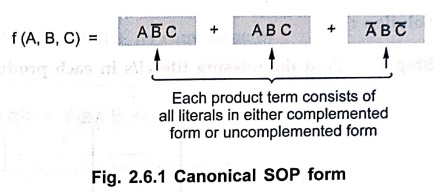
product term do not contain literal C. If each term in SOP form contains all
the literals then the SOP form is known as canonical
SOP form. Each individual term in the standard SOP form is called minterm. One canonical sum of products
expression is as shown in Fig. 2.6.1.
If
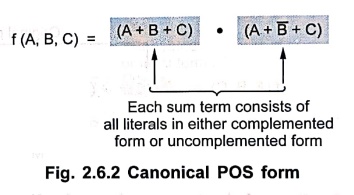
each term in POS form contains all the literals then the POS form is known as canonical POS form. Each individual
term in the canonical POS form is called maxterm.
One canonical product of sums expression is as shown in Fig. 2.6.2.
4. Converting Expressions in Canonical SOP or POS Form
Sum
of product form can be converted to canonical sum of products by ANDing the
terms in the expression with terms formed by ORing the literal and its
complement which are not present in that term. For example for a three literal
expression with literals A, B and C, if there is a term AB, where C is missing,
then we form term (C + ) and
AND it with AB. Therefore, we get AB (C + ) = ABC + AB.
1. Steps to Convert SOP to Canonical SOP Form
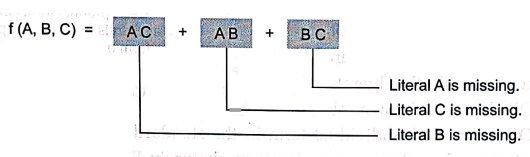
Step 1 : Find the missing literal in each product term if any.
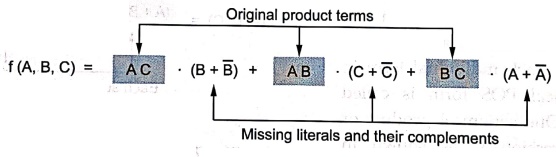
Step 2 : AND each product term having missing literal/s with term/s form by ORing the literal and its complement.
Step 3 : Expand the terms by applying distributive law and reorder the literals in the product terms.
Step 4 : Reduce the expression by omitting repeated product terms if any. Because A+ A = A.
Examples for Understanding
Example: 1
Convert the given
expression in canonical SOP form. ƒ (A, B, C) = AC + AB + BC
Solution :
Step 1 : Find the missing literal/s in each product term.
Step 2 : AND product term with (missing literal + its complement).
Step 3 :
Expand the terms and
reorder literals.
Expand :
f (A, B, C) = ACB+ AC + ABC + AB + BCA + B C
Reorder :
f (A, B, C) = ABC + AC + ABC + AB + ABC + BC
Note :
After having sufficient practice student should expand product term and reorder
literals in it in a single step.
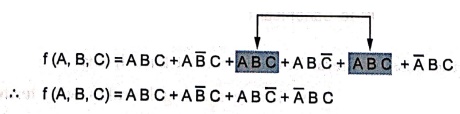
Step 4 :
Omit repeated product
terms.
Example: 2
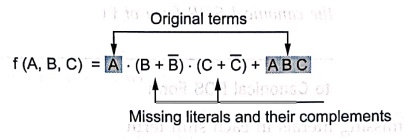
Convert the given
expression in canonical SOP form. f (A, B, C) = A + ABC
Solution :
Step 1: Find the
missing literal/s in each product term.
f
(A, B, C) = A + ABC

Step 2 :
AND product term with
(missing literal + its complement)
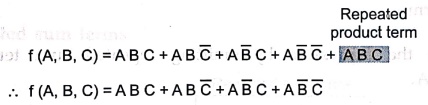
Step 3 :
Expand the terms and
reorder literals.

Step 4 :
Omit repeated product
term
Examples with Solutions
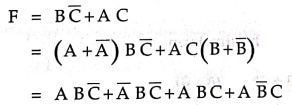
Example: 3
Define canonical form.
Express F = BC' + AC in a canonical SOP form.
Solution :
Example: 4
Convert the Boolean
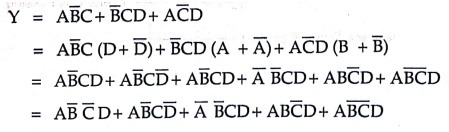
expression AB'C+B'CD + AC'D to canonical SOP form.
Solution :
Examples for Practice
Example: 5
Express the following function in canonical SOP form

Example: 6
Determine the canonical SOP form of

2. Steps
to Convert POS to Canonical POS Form
Step 1 : Find
the missing literals in each sum term if any.
Step 2 : OR
each sum term having missing literal/s with term/s form by ANDing the literal
and its complement.
Step 3 : Expand
the terms by applying distributive law and reorder the literals in the sum terms.
Step 4 : Reduce
the expression by omitting repeated sum terms if any. Because A . A = A.
Examples for Understanding
Example: 7
Convert the given
expression in canonical POS form.
f (A, B, C) = (A + B)
(B + C) (A + C)
Solution :
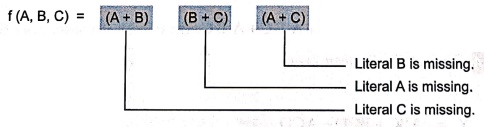
Step 1: Find the missing
literal/s in each sum term
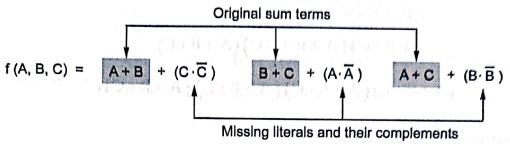
Step 2 : OR sum term
with (missing literal • its complement)
Step 3 : Expand the terms and reorder literals
Expand :
Since
A + BC = (A + B) (A + C) we have,
f (A, B, C) = (A+B+C) (A + B + )
(B + C + A) (B + C + ) (A + C + B) (A +
C + )
Reorder :
f
(A, B, C) = (A + B + C) (A + B + ) (A + B + C) (Ā + B + C) ( +
B + C) (A + + C)
Step 4 : Omit repeated
sum terms

f
(A, B, C) (A + B + C) (A + B + C) (Ā + B + ) ( + + C)
Example: 8
Convert the given
expression in canonical POS form. Y=A . (A+B+C)
Solution :
Step 1: Find the
missing literal/s in each sum term

Step 2 : OR sum term
with (missing literal • its complement)

Step 3 : Expand the terms and reorder literals
Since
A + BC = (A + B) (A + C) we have,

Step 4 : Omit repeated
sum terms

Examples
with Solutions
Example: 9
Convert the given
expression in canonical POS form.
f(A, B, C) = (A + B) •
(B + C)
Solution :

Example: 10
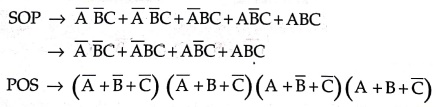
Convert SOP to
equivalent POS.
A'B'C + A'B'C +A'BC
+AB'C +ABC
Solution :
Example: 11
Convert (A + B) (A + C)
(B +) into canonical POS form.
Solution :
Step 1:
OR sum term of missing literal
f(A,
B, C) = [(A+B) + (C • )] [(A+ C) + (B• )] [(B + ) +
(A • )]
Step 2 :
Expand the terms and reorder literals.
f(A, B, C) = (A+B+C)
(A+B+) (A+B+C) (A++C) (A+B+) (+B+)
Step 3 : f(A, B, C) = (A+B+C) (A+B+) (A++C)
(+B+)
Example: 12
Obtain the canonical
POS for F(A, B, C) = (A+B') (B+C) (A+C')
Solution :

Example
for Practice
Example: 13
Convert the given
expression in canonical POS form

5. M Notations : minterms and maxterms
Each
individual term in canonical SOP form is called minterm and each individual
term in canonical POS form is called maxterm.
The concept of minterms and maxterms allows us to introduce a very convenient
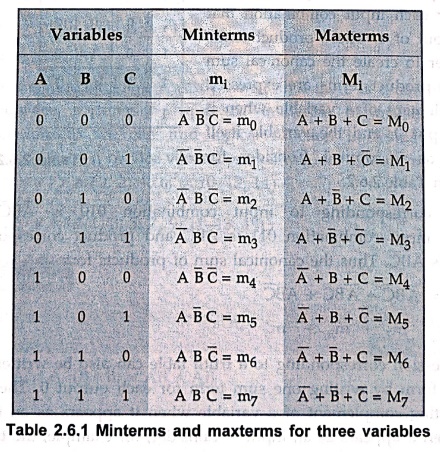
shorthand notations to express logical functions. Table 2.6.1 gives the
minterms and maxterms for a three literal/variable logical function where the
number of minterms as well as maxterms is 23 = 8. In general, for an
n–variable logical function there are 2n minterms and an equal
number of maxterms.
As
shown in Table 2.6.1 each minterm is represented by mi and each maxterm
is represented by Mi where the subscript i is the decimal number
equivalent of the natural binary number. With these shorthand notations logical
function can be represented as follows :
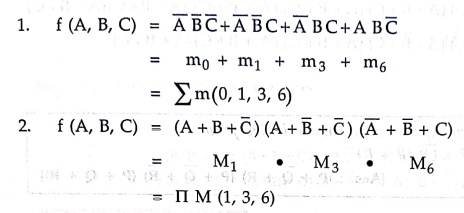
= П M (1, 3, 6)
where
Σ denotes sum of product while II
denotes product of sum.
We
know that logical expression can be represented in the truth table form. It is
possible to write logic expression in canonical SOP or POS form corresponding
to a given truth table. The logic expression corresponding to a given truth
table can be written in a standard sum of products form by writing one product
term for each input combination that produces an output of 1. These product
terms are ORed together to create the canonical sum of products. The product terms
are expressed by writing complement of a variable when it appears as an input
0, and the variable itself when it appears as an input 1. Consider, for
example, the truth Table 2.6.2.
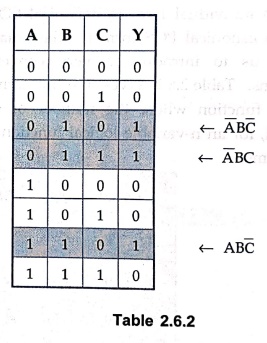
The
product corresponding to input combination 010 is B, the
product corresponding to input combination 011 is ĀBC and product corresponding
to input combination 110 is BC. Thus the canonical sum
of products form is

= m2
+ m3 + m6
The
logic expression corresponding to a truth table can also be written in a
canonical product of sums form by writing one sum term for each output 0. The
sum terms are expressed by writing complement of a variable when it appears as
an input 1 and the variable itself when it appears as an input 0. Consider, for
example, the truth Table 2.6.3.
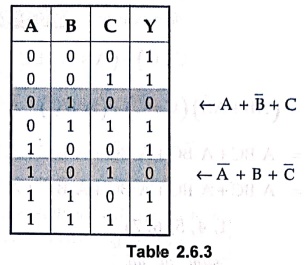
The
sum corresponding to input combinations 010 is A + + C, and the sum corresponding to
input 101 is + B + . Thus,
the canonical product of sum form is
f
(A, B, C) = (A + + C) ( + B + )
= M2 • M5
6. Complements of Standard Forms
The
POS and SOP functions derived from the same truth table are logically
equivalent. In terms of minterms and maxterms we can then write
f
(A, B, C) = m0 + m1 + m3
+ m4 + m6 + m7
= M2 + M5
f
(A, B, C) = Σm (0, 1, 3, 4, 6, 7)
= π M (2,5)
From
the above expressions we can easily notice that there is a complementary type
of relationship between a function expressed in terms of maxterms. Using this
complementary relationship we can find logical function in terms of maxterms if
function in minterms is known or vice–versa. For example, for a four variables
if
f (A, B, C, D) = Σ m (0, 2, 4, 6, 8,
10, 12, 14)
then
f (A, B, C, D) = л M(1, 3, 5, 7, 9, 11, 13, 15)
Examples with Solutions
Example: 14
Express the switching
function f(BA) = A in terms of minterms.
Solution :
f(BA)
= A = A (B+) = AB+ A
Example: 15
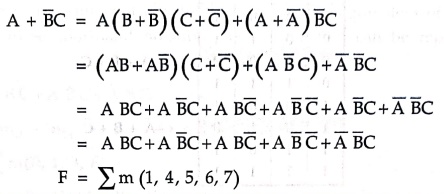
Express F = A + B'C as
sum of minterms.
Solution :
F
= Σ m (1, 4, 5, 6, 7)
Example: 16
Prove that the logical
sum of all minterms of a Boolean function of 2 variables is 1.
Solution :
For
two variables A and B minterms are :
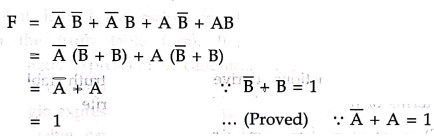
= 1
Example: 17
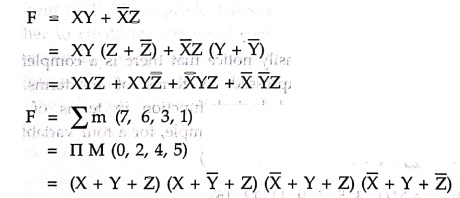
Express the Boolean
function F = XY +  Z in product of maxterm.
Solution :
Example: 18
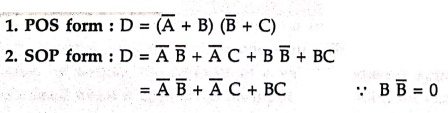
Express the Boolean
function as
1) POS form 2) SOP form
D= (A'+B) (B' + C)
Solution :
Review Questions
1. Define switching
function.
2. Define literal,
product term and sum term.
3. Explain sum of
product form.
4. Define SOP and POS
terms
5. What do you mean by
standard SOP and POS forms?
6. Explain how to
convert SOP or POS expressions in their standard forms.
7. What do you mean by
minterms and maxterms ?
8. Differentiate
between min term and max term.
Digital Principles and Computer Organization: Chapter 2: Boolean Algebra, Logic Gates and Minimization Techniques : Tag: Digital, Computer : - Boolean Expressions
Digital Principles and Computer Organization: Chapter 2: Boolean Algebra, Logic Gates and Minimization Techniques
Under Subject

Digital Principles and Computer Organization
CS25C06 2nd Semester AIDS, CSE, IT, CSE(CY) Dept | 2025 Regulation | 2nd Semester 2025 Regulation
Related Subjects

English Essentials II
EN25C02 2nd Semester | 2025 Regulation | 2nd Semester 2025 Regulation

Tamils and Technology தமிழர்களும் தொழில்நுட்பமும்
UC25H02 2nd Semester | 2025 Regulation | 2nd Semester 2025 Regulation
Linear Algebra
MA25C02 2nd Semester | 2025 Regulation
Applied Physics (CSIE) II
PH25C03 2nd Semester AIDS, CSE, IT, CSE(CY) Dept | 2025 Regulation | 2nd Semester 2025 Regulation
Digital Principles and Computer Organization
CS25C06 2nd Semester AIDS, CSE, IT, CSE(CY) Dept | 2025 Regulation | 2nd Semester 2025 Regulation

Basic Electrical and Electronics Engineering
EE25C01 2nd Semester | 2025 Regulation | 2nd Semester 2025 Regulation

Python for Data Science
AD25201 2nd Semester AIDS Dept | 2025 Regulation | 2nd Semester 2025 Regulation

Re-Engineering for Innovation
ME25C05 2nd Semester | 2025 Regulation | 2nd Semester 2025 Regulation
Python for Data Science - Laboratory
AD25201 2nd Semester AIDS Dept | 2025 Regulation | 2nd Semester 2025 Regulation