Digital Principles and Computer Organization: Chapter 2: Boolean Algebra, Logic Gates and Minimization Techniques
Simplification of SOP Expression
1. Essential Prime Implicants 2. Incompletely Specified Functions (Don't Care Terms): Describing Incomplete Boolean Function., Don't Care Conditions in Logic Design, Minimization of Incompletely Specified Functions. Questions: 1. Give the steps for simplification of SOP expression. 2. What do you mean by essential prime implicants? 3. Write short notes on don't care conditions.
Simplification of SOP
Expression
We
have seen how combination of pairs, quads and octets on a Karnaugh map can be
used to obtain a simplified expression. A pair of 1s eliminates one variable, a
quad of 1s eliminates two variables and an octet of 1s eliminates three
variables. In general, when a variable appears in both complemented and
uncomplemented form within a group, that variable is eliminated from the
resultant expression. Variables that are same in all with the group must appear
in the final expression.
Each
group gives us a product term and summation of all product term gives us a
Boolean expression. Therefore, we can say that, each product term implies the
function and, hence is an implicant of the function. All the implicants of a
function determined using a Karnaugh map are the prime implicants.
From
the above discussion we can outline generalized procedure to simplify Boolean
expressions as follows:
1.
Plot the K–map and place 1s in those cells corresponding to the 1s in the truth
table or sum of product expression. Place Os in other cells.
2.
Check the K–map for adjacent 1s and encircle those 1s which are not adjacent to
Step any other 1s. These are called isolated 1s.
3.
Check for those 1s which are adjacent to only one other 1 and encircle such
pairs.
4.
Check for quads and octets of adjacent 1s even if it contains some 1s that have
already been encircled. While doing this make sure that there are minimum
number of groups.
5.
Combine any pairs necessary to include any 1s that have not yet been grouped.
6.
Form the simplified expression by summing product terms of all the groups.
Examples
for Understanding
Example: 1
Minimize the expression

Solution:
Step 1: Fig
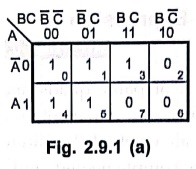
2.9.1 (a) shows the K–map for three variables and it is plotted according to
the given expression.
Step 2 :
There are no isolated 1s.
Step 3 :
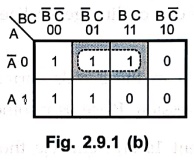
1 in the cell 3 is adjacent only to 1 in the cell 1. This pair is combined and
referred to as group 1.
Step 4 :
There is no octet, but there is a quad. Cells 0, 1, 4 and 5 form a quad. This
quad is combined and referred to as group 2.
Step 5 :
All 1s have already been grouped.
Step 6 :
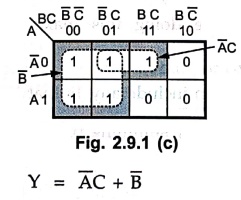
Each group generates a term in the expression for Y. In group 1 B variable is
eliminated and in group 2 variables A and C are eliminated and we get,
Example: 2
Minimize the expression

Solution :
Step 1:
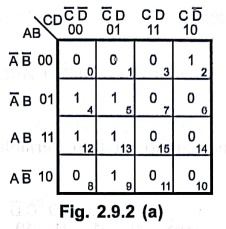
Fig. 2.9.2 (a) shows the K–map for four variables and it is plotted according
to the given expression.
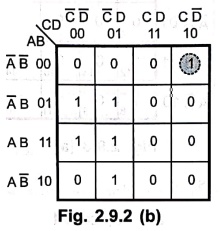
Step 2 : Cell
2 is the only cell containing a 1 that is not adjacent to any other 1. It is
referred to separately as group 1.
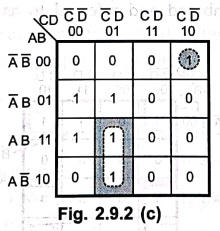
Step 3 :
1 in the cell 9 is adjacent only to 1 in the cell 13. This pair is combined and
referred to as group 2.
Step 4:
There is no octet, but there is quad cells 4, 5, 12 and 13 form a quad. This
quad is combined and referred to as group 3.
Step 5 :
All 1s have already grouped.
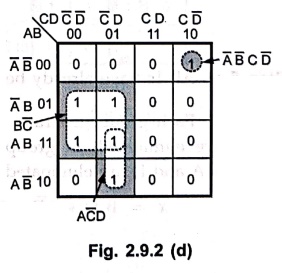
Step 6 :
Each group generates a term in the expression for Y. In group 1 variable is not
eliminated. In group 2 variable B is eliminated and in group 3 variables A and
D are eliminated and we get,

Example: 3
Reduce the following
four variable function to its minimum sum of products form:

Solution :
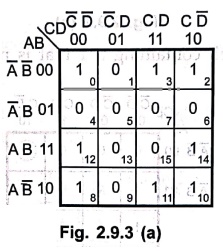
Step 1:
Fig. 2.9.3 (a) shows the K–map for four variables and it is plotted according
to the given expression.
Step 2 :
There are no isolated 1s.
Step 3 :
There are no such 1s which are adjacent to only one other 1.
Step 4 :
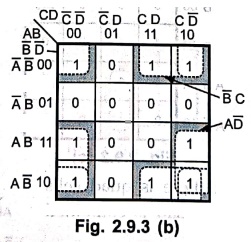
There are three quads formed by cells 0, 2, 8, 10, cells 8, 10, 12, 14 and
cells 2, 3, 10, 11. These quads are combined and referred to as group 1, group
2 and group 3 respectively.cop
Step 5 :
All 1s have already been grouped.
Step 6 :
Each group generates a term in the expression for Y. In group 1 variables A and
C are eliminated, in group 2 variables B and C are eliminated and in group 3
variables A and D are eliminated and we get,

Example: 4
Reduce the following
function to its minimum sum of products form:

Solution :
Step 1 :
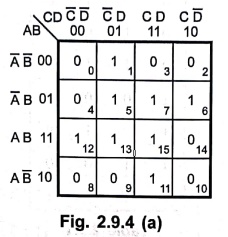
Fig. 2.9.4 (a) shows the K–map for four variables and it is plotted according
to the given expression.
Step 2 : There
are no isolated 1s.
Step 3 : The
1 in the cell 1 is adjacent only to 1 in the cell 5, the 1 in the cell 6 is
adjacent only to the 1 in the cell 7, the 1 in the cell 12 is adjacent only to
the 1 in the cell 13 and the 1 in the cell 11 is adjacent only to the 1 in the
cell 15. These pairs are combined and referred to as group 1 – 4 respectively.
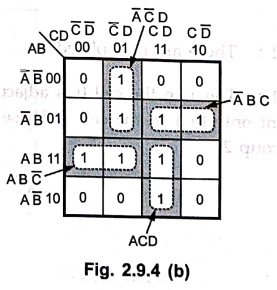
Step 4 : There
is no octet, but there is a quad. However, all 1s in the quad have already been
grouped. Therefore this quad is ignored.
Step 5 :
All 1s have already been grouped.
Step 6 :
Each group generates a term in expression for Y. In group 1 variable B is
eliminated. Similarly, in group 2 – 4 variables D, D and B are eliminated one
in each group. We finally get minimum sum of products form as,

Example: 5
Simplify the logic
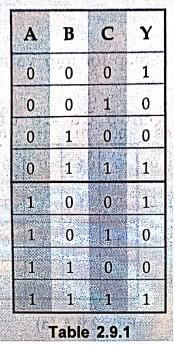
function specified by the truth table 2.9.1 using the Karnaugh map method. Y is
the output variable and A, B and C are the input variables.
Solution :
Step 1:
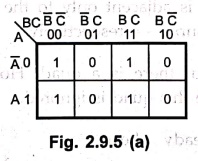
Fig. 2.9.5 (a) shows the K–map for three variables and it is plotted according
to given truth table.
Step 2 :
There are no isolated 1s.
Step 3 :
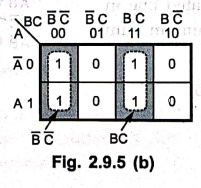
The 1 in the cell 0 is adjacent only to 1 in the cell 4 and the 1 in the cell 3
is adjacent only to 1 in the cell 7. These two pairs are grouped and referred
to as group and group 2.
Step 4 :
There is no octet and quad.
Step 5 :
All 1s have already been grouped.
Step 6 :
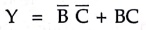
In group 1 and group 2 variable A is eliminated and we get,
Example:
6
Reduce the following
function using Karnaugh map technique and implement using basic gates

Solution :
The
given function is not in the standard sum of products form. It is converted
into standard SOP form as given below.
Step 1:
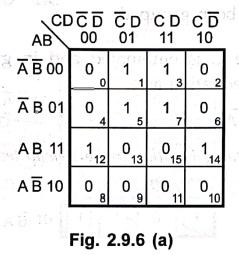
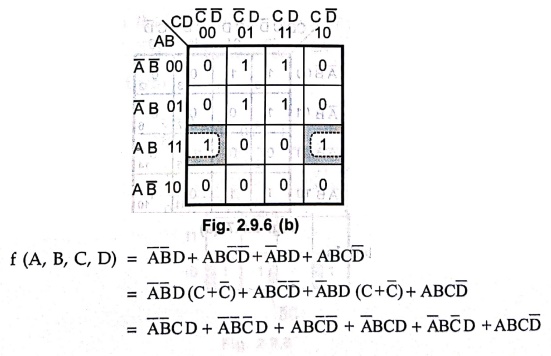
Fig. 2.9.6 (a) shows the K–map for four variables and it is plotted according
to expression in standard SOP form.
Step 2 :
There are no isolated 1s.
Step 3 :
The 1 in the cell 12 is adjacent only to the 1 in the cell 14. This pair is
combined and referred to as group 1.
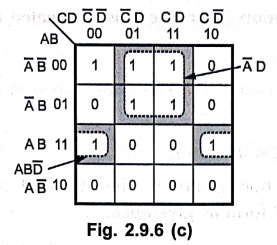
Step 4 :
There is a quad. Cells 1, 3, 5 and 7 form a quad. This quad is referred to as
group 2.
Step 5 :
All 1s have already been grouped.
Step 6 :
In group 1 variable C is eliminated and in group 2 variables B and C are
eliminated. We get simplified equation as,
Y
= AB +
+  D
D
Example: 7
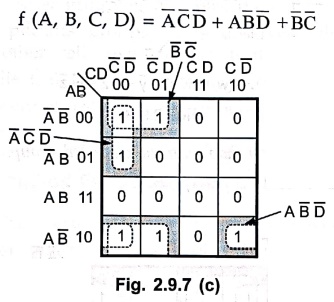
Reduce the following
function using K–map technique.
ƒ (A, B, C, D) = Σ m
(0, 1, 4, 8, 9, 10).
Solution:
Step 1:
Fig. 2.9.7 (a) shows the K–map for four variables and it is plotted according
to given minterms.
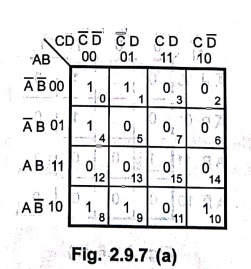
Step 2 :
There are no isolated 1s.
Step 3 :
Cell 4 is adjacent only to cell 0 and cell 10 is adjacent only to cell 8. These
two pairs are combined and referred to as group 1 and group 2 respectively.
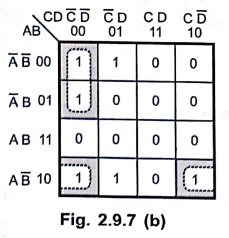
Step 4 : There
is a quad. Cells 0, 1, 8 and 9 form a quad. This quad is referred to as group
3.
Step 5 :
All 1s have already been grouped.
Step 6 :
In group 1, B and in group 2, C are eliminated respectively. In group 3, A and
D are eliminated and finally we get
Examples with Solutions
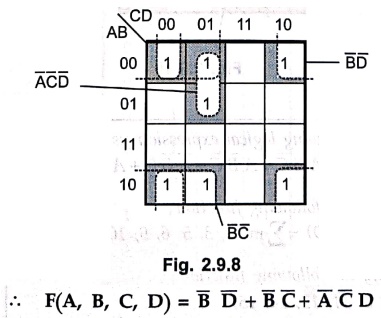
Example: 8
Simplify the given
Boolean function into sum of products form
F(A, B, C, D) =
Σ(0,1,2,5,8,9,10)
Solution :
Sum of products form –
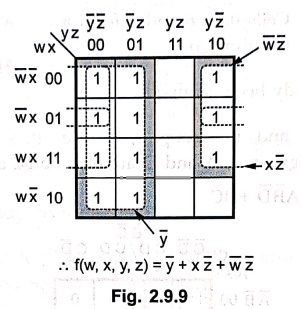
Example: 9
Plot the following
Boolean function on a Karnaugh map and simplify it.
F(w,x,y,z) =
(0,1,2,4,5,6,8,9,12,13,14)
Solution :
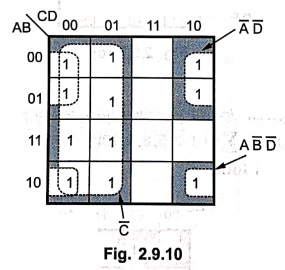
Example: 10
Show the Karnaugh map
with the encircled groups for the Boolean function,

Solution :
Examples
for Practice
Example: 11
Simplify following
logical expression using Karnaugh maps

Example: 12
Simplify the following
function
f1 (A, B, C, D) =Σm (0,
3, 5, 6, 9, 10, 12, 15)

Example: 13
Simplify the following
function
f3 (A, B, C, D) = Σm
(0, 1, 2, 3, 11, 12, 14, 15)
[ Answer:  + AB + ACD]
Example: 14
Simplify the following
using K–map.
X = A'B + A'B'C + ABC'
+ AB'C'
[ Answer:
X = ĀC + B]
Example: 15
Simplify the following
function using K–map technique.
ƒ(A, B, C, D) = Σ(0, 2,
3, 6, 7, 8, 10, 12, 13)
( Answer: AB ++C]
++C]
Example: 16
Simplify the following
Boolean function using 4–variable map
f(w, x, y, z) = Σ (2,
3, 10, 11, 12, 13, 14, 15)
[ Answer: wx +  y]
y]
1. Essential Prime Implicants
After
grouping the cells, the sum terms which appear in the K–map are called prime
implicants groups. It is observed that some cells may appear in only one prime
implicants group; while other cells may appear in more than one prime
implicants group. In Fig. 2.9.4 (b), cells 1, 6, 11 and 12 appear in only one
prime implicants group. These cells are called essential cells and corresponding prime implicants are called essential prime implicants.
2. Incompletely Specified Functions (Don't Care Terms)
In
some logic circuits, certain input conditions never occur, therefore the corresponding
output never appears. In such cases the output level is not defined, it can be
either HIGH or LOW. These output levels are indicated by 'X' or 'd' in the
truth tables and are called don't care
outputs or don't care conditions or
incompletely specified functions.
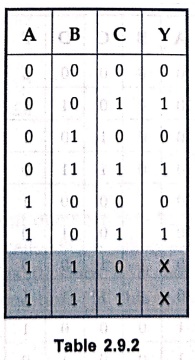
Let us see the output levels in the truth table as shown in Table 2.9.2. Here
outputs are defined for input conditions from 00 0 to 1 0 1. For remaining two
conditions of input, output is not defined, hence these are called don't care conditions
for this truth table.
A
circuit designer is free to make the output for any "don't care"
condition either a '0' or a '1' in order to produce the simplest output
expression.
1. Describing Incomplete Boolean Function
We
know that we describe the Boolean function using either a minterm canonical
formula or a maxterm canonical formula. In order to obtain similar–type
expressions for incomplete Boolean functions we use additional term to specify
don't care conditions in the original expression. This is illustrated in the
following examples.
In
expression,
f(A,
B, C) = Σm (0, 2, 4) + d (1, 5)
Minterms
are 0, 2 and 4. The additional term d(1, 5) is introduced to specify the don't
care conditions. This terms specifies that outputs for minterms 1 and 5 are not
specified and hence these are don't care conditions. Letter d is used to
indicate don't care conditions in the expression.
The
above expression indicates how to represent don't care conditions in the
minterm canonical formula. In the similar manner, we can specify the don't care
conditions in the maxterm canonical formula. For example,
f(A,
B, C) = II M (2, 5, 7) + d(1, 3)
2. Don't Care Conditions in Logic Design
In
this section, we see the example of incompletely specified Boolean function.
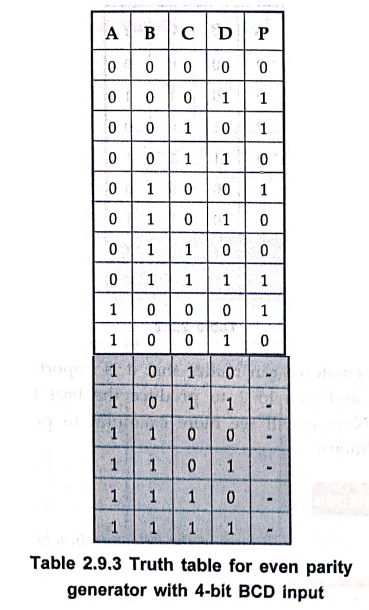
Let us see the logic circuit for an even parity generator for 4–bit BCD number.
Table 2.9.3 shows the truth table for even–parity generator. The truth table
shows that the output for last six input conditions cannot be specified,
because such input conditions does not occur when input is in the BCD form.
The
Boolean function for even parity generator with 4–bit BCD input can be
expressed in minterm canonical formula as,
f(A,
B, C, D) = Σ m (1, 2, 4, 7, 8) + d(10, 11, 12, 13, 14, 15)
3. Minimization of Incompletely Specified Functions
A
circuit designer is free to make the output for any don't care condition either
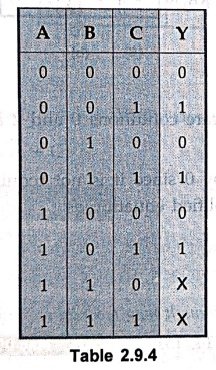
a '0' or '1' in order to produce the simplest output expression. Consider a
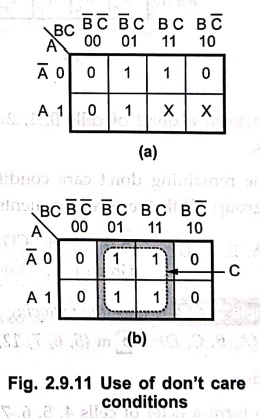
truth table shown in Table 2.9.4. The K–map for this truth table is shown in
Fig. 2.9.11 (a) with x placed in the AB and ABC cells.
It
is not always advisable to put don't cares as 1s. This is illustrated in Fig.
2.9.11 (b). Here, the don't care output for cell ABC is taken as 1 to form a
quad and don't care output for cell AB is taken as 0, since it is
not helping any way to reduce an expression. Using don't care conditions in
this way we get the simplified Boolean expression as
Y
= C
From
the above discussion we can realize that it is important to decide which don't
cares to change to 0 and which to 1 to produce the best K–map grouping (i.e.
the simplest expression). Now, we will see more examples to provide practice in
dealing with "don't care" conditions.
Examples for Understanding
Example: 17
Find the reduced SOP
form of the following function.
f(A,
B, C, D) = Σ m (1, 3, 7, 11, 15) + Σ d (0, 2, 4).
Solution :
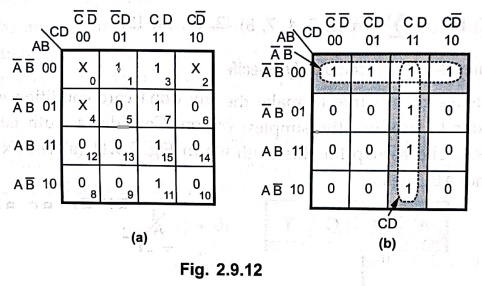
To
form a quad of cells 0, 1, 2 and 3 the don't care conditions 0 and 2 are
replaced by 1s.
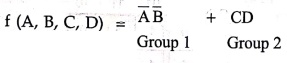
The
remaining don't care condition is replaced by 0 since it is not required to
form any group. With these replacements we get the simplified equation as
Example: 18
Reduce the following
function using Karnaugh map technique.
f (A, B, C, D) = Σ m
(5, 6, 7, 12, 13) + Σ d (4, 9, 14, 15)
Solution:
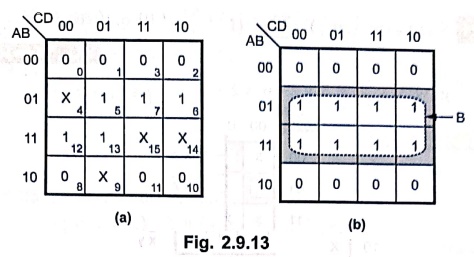
To
form a octet of cells 4, 5, 6, 7, 12, 13, 14 and 15 the don't care conditions
4, 14 and 15 are replaced by 1s. The remaining don't care condition 9 is
replaced by 0 to get simplified function as,
f
(A, B, C, D) = B
Example: 19
Reduce the following
function using Karnaugh map technique.
ƒ(A, B, C) = Σ m (0, 1, 3, 7) + Σ d (2, 5)
Solution :
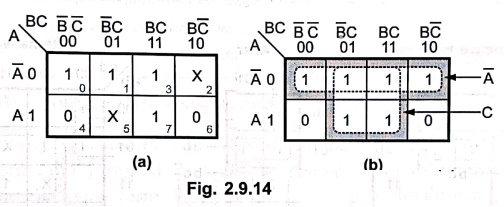
To
form two quads both the don't care conditions are replaced by 1s and we get,
f
(A, B, C) = + C
Examples with Solution
Example: 20
Reduce the following
function using Karnaugh map technique.
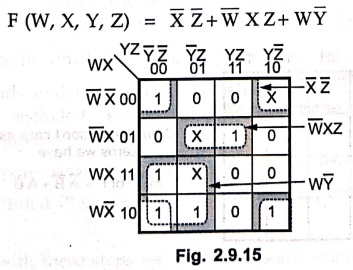
F (W, X, Y, Z) = Σ m
(0, 7, 8, 9, 10, 12) + Σ d (2, 5, 13).
Solution :
In
this example all don't cares are considered as 1s and we get,
Example: 21
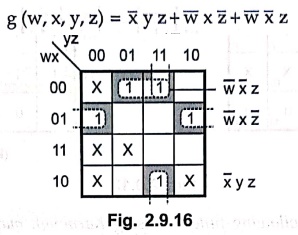
Solve g (w, x, y, z) = Σ
m (1,3,4,6,11) + Σ d (0,8,10,12,13)
Solution :
Example: 22
Express the following
function as the minimal sum of products using a K–map.
f(a,b,c,d)
= Σ (0,2,4,5,6,8,10,15) +Σ ɸ (7,13,14)
Solution :
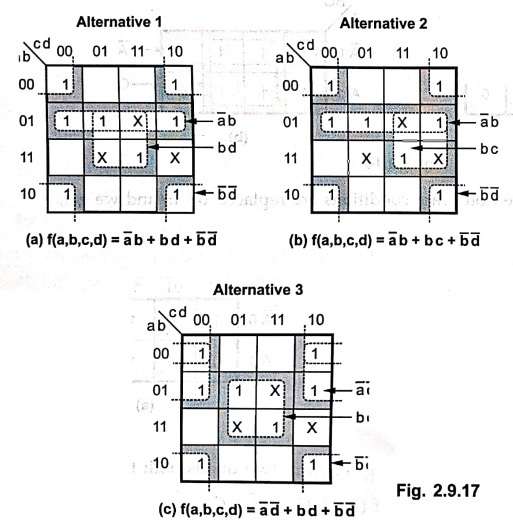
As
shown in Fig. 2.9.17 the given example has three solutions and all are correct.
Students are expected to give any one solution.
Example: 23
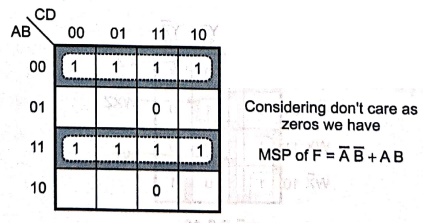
A using K map find the
MSP form of F = (0 – 3, 12 – 15) + d (7, 11)
Solution :
Examples for Practice
Example: 24
Simplify the following
switching function using Karnaugh map
F(A,B,C,D) = Σ
(0,5,7,8,9,10,11,14,15) + ɸ(1,4,13).

Example: 25
Determine the minimal
sum of product form of
F(w,x,y,z) = Σm
(4,5,7,12,14,15) + d (3,8,10).

Review Questions
1. Give the steps for
simplification of SOP expression.
2. What do you mean by
essential prime implicants?
3. Write short notes
on don't care conditions.
Digital Principles and Computer Organization: Chapter 2: Boolean Algebra, Logic Gates and Minimization Techniques : Tag: Digital, Computer : - Simplification of SOP Expression
Digital Principles and Computer Organization: Chapter 2: Boolean Algebra, Logic Gates and Minimization Techniques
Under Subject

Digital Principles and Computer Organization
CS25C06 2nd Semester AIDS, CSE, IT, CSE(CY) Dept | 2025 Regulation | 2nd Semester 2025 Regulation
Related Subjects

English Essentials II
EN25C02 2nd Semester | 2025 Regulation | 2nd Semester 2025 Regulation

Tamils and Technology தமிழர்களும் தொழில்நுட்பமும்
UC25H02 2nd Semester | 2025 Regulation | 2nd Semester 2025 Regulation

Linear Algebra
MA25C02 2nd Semester | 2025 Regulation

Applied Physics (CSIE) II
PH25C03 2nd Semester AIDS, CSE, IT, CSE(CY) Dept | 2025 Regulation | 2nd Semester 2025 Regulation
Digital Principles and Computer Organization
CS25C06 2nd Semester AIDS, CSE, IT, CSE(CY) Dept | 2025 Regulation | 2nd Semester 2025 Regulation

Basic Electrical and Electronics Engineering
EE25C01 2nd Semester | 2025 Regulation | 2nd Semester 2025 Regulation

Python for Data Science
AD25201 2nd Semester AIDS Dept | 2025 Regulation | 2nd Semester 2025 Regulation

Re-Engineering for Innovation
ME25C05 2nd Semester | 2025 Regulation | 2nd Semester 2025 Regulation

Python for Data Science - Laboratory
AD25201 2nd Semester AIDS Dept | 2025 Regulation | 2nd Semester 2025 Regulation