Object Oriented Programming: Chapter 1: Principles of Object Oriented Programming
Characteristics of Object Oriented Languages
Various characteristics of object oriented programming language are 1. Data encapsulation 2. Inheritance 3. Polymorphism 4. Dynamic binding 5. Data abstraction 6. Message passing
Characteristics
of Object‒Oriented Languages
•
Various characteristics of object oriented programming language are
1.
Data encapsulation
2.
Inheritance
3.
Polymorphism
4.
Dynamic binding
5.
Data abstraction
6.
Message passing
•
We will understand these characteristics by understanding the basic concepts of
object oriented programming
1. Objects
•
Object is an instance of a class.
•
Objects
are basic run‒time entities in object oriented programming.
•
In C++ the class variables are called objects. Using objects we can access the
member variable and member function of a class.
•
Object represent a person, place or any
item that a program handles.
•
For example ‒ If the class is country
then the objects can be India, China, Japan, U.S.A and so on.
•
A single class can create any number of objects.
• Declaring objects ‒
The
syntax for declaring object is‒
Class
_Name Object _Name;
• Example
Fruit
fl;
For
the class Fruit the object f1 can be created.
2. Classes
•
A
class can be defined as an entity in which data and functions are put together.
•
The concept of class is similar to the concept of structure in C.
• Syntax of class
is as given below
class name_ of _class
{
private :
variables
declarations;
function declarations;
public:
variable declarations;
function declarations;
};← do not forget semicolon
•
Example
class rectangle
{
private :
int len, br;
public:
void get_data();
void area();
void print_data ();
};
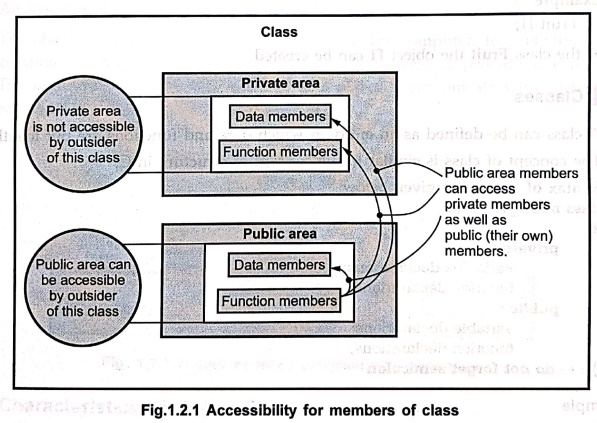
• Explanation
*
The class declared in above example is rectangle.
*
The class name must be preceded by the keyword class.
*
Inside the body of the class there are two keywords used private and public.
These are called access specifiers.
*
By default the data and function declaration is of type of private. When data and functions are declared as private then only
members of same class can access them. This achieves the data hiding property.
*
The public access specifier allows
the function declared outside the class to access the data and functions
declared under it.
*
Hence the functions get_data(), print_data () and area() can be accessed by any other function (even though the
outside functions). But the data members len
and br cannot be accessible by
the functions that are outside the class
rectangle.
• Rules for declaring
class name
1.
The class name must begin with the letters, it may be followed by letters or
digits or underscore.
2.
The name of the class must not be same as the keyword or reserved word.
3.
The class name must not contain any special character such as ~! @ # $ % ^
&* () { } []+ ‒
3. Encapsulation
•
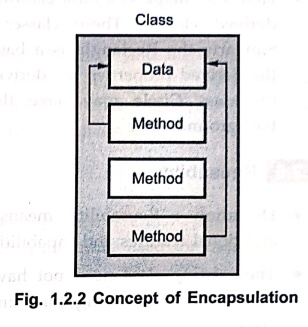
Encapsulation means the detailed implementation of a component which can be
hidden from rest of the system.
•
In C++ the data is encapsulated.
• Definition :
Encapsulation means binding of data and method together in a single entity
called class.
•
The data inside that class is accessible by the function in the same class. It
is normally not accessible from the outside of the component.
Concept of Encapsulation
4. Inheritance
•
Definition: Inheritance is a
property by which the new classes are
created using the old classes. In other words the new classes can be
developed using some of the properties of old classes.
•
Example :
•
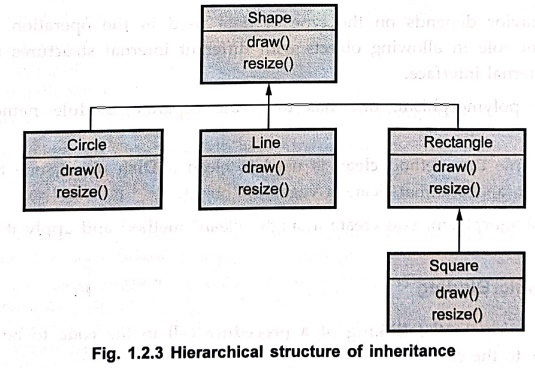
Inheritance support hierarchical
structure.
•
The old classes are referred as base
classes and the new classes are referred as derived classes. That means the
derived classes inherit the properties (data and functions) of base class.
•
Here the Shape is a base class from
which the Circle, Line and Rectangle are
the derived classes. These classes inherit the functionality draw() and resize(). Similarly the Rectangle
is a base class for the derived class Square.
Along with the derived properties the derived class can have its own
properties. For example the class Circle
may have the function like backgrcolor()
for defining the background color.
5. Reusability
•
Defintion : Reusability means making use of existing class by adding the
additional features and capabilities within it.
•
The existing class need not have to modify. This is possible by deriving a new class from the existing class and adding the
desired functionalities to this new class.
•
Inheritance provides the facility of reusability.
6. Polymorphism
• Polymorphism means many structures.
•
Definition: Polymorphism is the
ability to take more than one form
and refers to an operation exhibiting different behavior in different instances
(situations).
•
The behavior depends on the type of data used in the operation. It plays an
important role in allowing objects with different internal structures to share
the same external interface.
•
Without polymorphism, one has to create separate module names for each method.
•
For example the method clean is used
to clean a Dish object, one that
cleans a Car object, and one that
cleans a vegetable object.
•
With polymorphism, you create a single "clean" method and apply it
for different objects.
7. Dynamic Binding
•
Binding refers to the linking of a
procedure call to the code to be executed in response to the call.
•
In Static binding which function is to be called for a particular object is
determined at the compile time. Selection of particular function for call is
based on the type of formal parameters.
• Definition:
Dynamic binding is the runtime
determination of which function to call for a particular object of
descendant class based on the type of argument.
•
In dynamic binding the code associated with a given procedure call is not known
until the time of the call at run‒time.
•
Example: Suppose you declared two
classes: Rectangle and then Square. In both these classes there is a
function draw(point1,point2). Then,
each time a call is made to MyObject.draw(point1,point2),
then version of draw that is called will depend on whether My Object is for a Rectangle class or for a Square class.
8. Data Abstraction
•
Definition: Data abstraction means
representing only essential features by hiding all the implementation details.
In C++, class is an entity used for data abstraction purpose.
•
Example
class Student
{
int roll;
char name [10];
public;
void input ( );
void display ( );
}
In
main function we can access the functionalities using object. For instance
Student
obj;
obj.input
( );
obj.display
( );
Thus
only abstract representation can be presented, using class.
Difference between Encapsulation and Abstraction
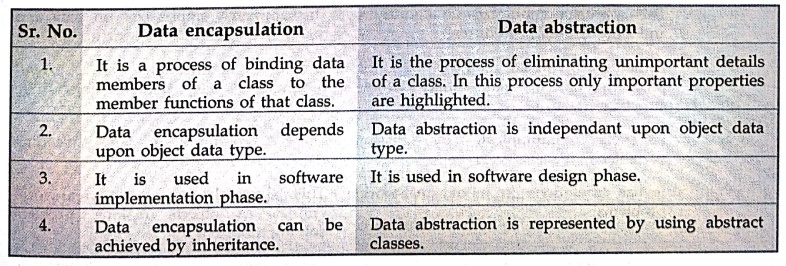
Data encapsulation
1.
It is a process of binding data members of a a class to to the member functions
of that class.
2.
Data encapsulation depends upon object data type.
3.
It is used in software implementation phase.
4.
Data encapsulation can be achieved by inheritance.
Data abstraction
1.
It is the process of eliminating unimportant details of a class. In this
process only important properties are highlighted.
2.
Data abstraction is independent upon object data type.
3.
It is used in software design phase.
4.
Data abstraction is represented by using abstract classes.
Review Questions
1. Explain in detail
about various object oriented concepts.
2. Explain the
characteristics of OOPs in detail.
3. List out the
features of object oriented programming.
4. Distinguish between
abstraction and encapsulation.
5. Explain the
following concepts of object oriented programming in detail with an example
i) Data encapsulation ii) Inheritance
6. Explain briefly
about various object oriented programming concepts and show how C++ supports
them.
7. Explain the major
principles of object oriented programming with illustrations and neat diagram.
8. Explain the
characteristics of OOPs.
Object Oriented Programming: Chapter 1: Principles of Object Oriented Programming : Tag: Oops, Computer Programming : - Characteristics of Object Oriented Languages
Object Oriented Programming: Chapter 1: Principles of Object Oriented Programming
Under Subject
Object Oriented Programming (OOPs)
CS25C07 2nd Semester CSE, CSE(CY) Depts | 2025 Regulation | 2nd Semester 2025 Regulation
Related Subjects

English Essentials II
EN25C02 2nd Semester | 2025 Regulation | 2nd Semester 2025 Regulation

Tamils and Technology தமிழர்களும் தொழில்நுட்பமும்
UC25H02 2nd Semester | 2025 Regulation | 2nd Semester 2025 Regulation
Linear Algebra
MA25C02 2nd Semester | 2025 Regulation
Applied Physics (CSIE) II
PH25C03 2nd Semester AIDS, CSE, IT, CSE(CY) Dept | 2025 Regulation | 2nd Semester 2025 Regulation
Digital Principles and Computer Organization
CS25C06 2nd Semester AIDS, CSE, IT, CSE(CY) Dept | 2025 Regulation | 2nd Semester 2025 Regulation

Basic Electrical and Electronics Engineering
EE25C01 2nd Semester | 2025 Regulation | 2nd Semester 2025 Regulation
Object Oriented Programming (OOPs)
CS25C07 2nd Semester CSE, CSE(CY) Depts | 2025 Regulation | 2nd Semester 2025 Regulation

Re-Engineering for Innovation
ME25C05 2nd Semester | 2025 Regulation | 2nd Semester 2025 Regulation
Object Oriented Programming (OOPs) - Laboratory
CS25C07 2nd Semester CSE, CSE(CY) Depts | 2025 Regulation | 2nd Semester 2025 Regulation