Object Oriented Programming: Chapter 1: Principles of Object Oriented Programming
Principles of Object Oriented Programming: Two Marks Important Questions and Answers
Object Oriented Programming
Object Oriented Programming: Chapter 1: Principles of Object Oriented Programming: Anna University Part A Two Marks Important Questions and Answers
Object Oriented Programming
Chapter 1: Principles of Object
Oriented Programming
Two Marks
Questions with Answers
1. Differentiate
(any two features) object oriented programming from procedure oriented
programming.
Answer: :
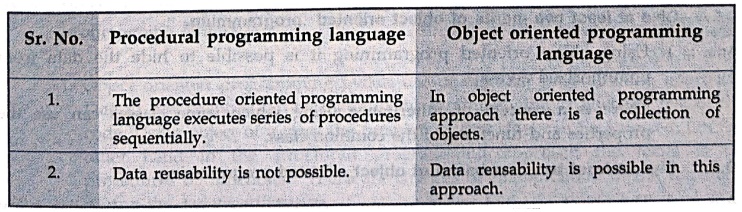
Procedural programming
language
1.The
procedure oriented programming language executes series of procedures
sequentially.
2.
Data reusability is not possible.
Object oriented
programming language
1.
In object oriented programming approach there is a collection of objects.
2.Data
reusability is possible in this approach.
2. With
respect to C++ distinguish 'object' from 'classes'.
Answer: :
A class is a definition which contains the code for an object. And object is an
instance of a class. For example ‒ River is the class and Ganga, Yamuna, Kaveri
are the objects.
3. Differentiate
between object and class.
Answer: :
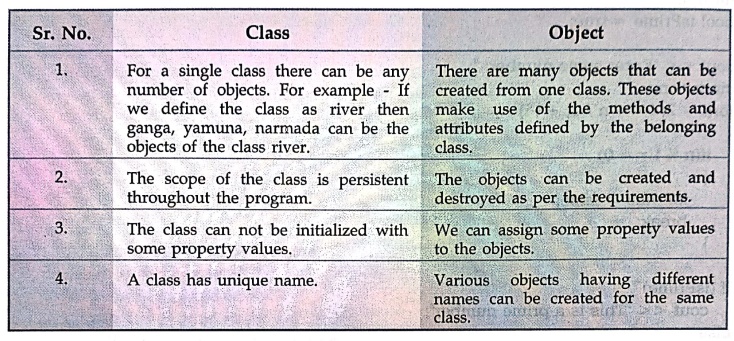
Class
1.
For a single class there can be any number of objects. For example ‒ If define
the class as river then ganga, la, narmada can be the objects of the class
river.
2.The
scope of the class is persistent throughout the program.
3.
The class can not be initialized with some property values.
4.
A class has unique name.
Object
1.There
are many objects that can be created from one class. These objects make use of
the
methods
and attributes defined by the belonging class.
2.The
objects can be created and destroyed as per the requirements.
3.We
can assign some property values to the objects.
4.Various
objects having different names can be created for the same class.
4. List
some applications of OOP.
Answer:
Following
are some areas in which the object oriented programming is used ‒
1.
For creating object oriented databases
2.
For implementing the real time systems
3.For
implementing the knowledge based systems.
4.
For neural networks and parallel programming
5.
In game programming
6.
For office automation and business logic implementation
7.
For CAD/CAM systems.
8.
For simulation and modeling.
5. Give
at least two merits of object oriented programming.
Answer:
1. Using object oriented programming it is
possible to hide the data from unauthorized access.
2.
There is a concept of inheritance using which some classes can use the
properties and functions of the common class.
6. Give
at least two drawbacks of object oriented programming.
Answer:
1.
The object oriented programming is complex
to implement, because every entity in it is an object.
2.
If some of the members are declared as private
then those members are not accessible by the object of another
class. In such a case you have to make use of inheritance property.
7. Enlist
the object oriented programming principles.
Answer:
Various principles of object oriented programming are ‒
1.
Encapsulation
2.
Inheritance
3.
Polymorphism
4.
Dynamic binding.
8. What
is object oriented programming ?
Answer:
Object oriented programming is a programming approach in which there is
collection of objects.
9. Define
data abstraction
OR
What is
meant by data abstraction.
Answer: Data
abstraction means representing only essential features by hiding all the
implementation details.
10. What
is OOP ?
Answer:
The OOP stands for object oriented programming. The object oriented programming
is an approach which makes use of objects for developing the systems.
11. What
is method ?
Answer:
Method is an object's behavior. It is represented by the functionality of a
class. These functions are used to operate on data.
12. State
how data encapsulation support reusability.
Answer: Data
encapsulation is a technique in object oriented programming by which the data
is tied with the methods that operate on data. This encapsulation forms an
entity called class. In object oriented programming, a new class can be derived
from some base class by inheriting the required features of it. Thus due to
encapsulation, the base class can be inherited and the data or methods of base
class can be reused by the derived class.
13. What
are the advantages of object oriented programming over structured programming
language?
Answer:
1.
Object oriented programming makes use of modular programming approach. Due to
this changes can be made in the modules without affecting rest of the code.
Using object of a class the function of that class can be accessed. On the other
hand in the structured programming approach the focus is on procedures or
functions. There are chances of manipulation of the functions during the code
modification.
2.
Object oriented programming allows data reusability by means of inheritance.
However, the concept of inheritance is not allowed in structured programming
languages.
14. Give
at least two differentiating factors between C and C++,
Answer: 1. C is a
procedure oriented language while C++ is a object oriented programming
language,
2.
C does not support inheritance, polymorphism, class and object concepts while
C++ support inheritance, polymorphism, class and object concepts.
15.
Explain the term polymorphism.
Answer: Polymorphism is
an ability to take more than one form and refers to the operation exhibiting
different behavior in different instances or situations.
16. What
is the use of dynamic binding?
Answer: Dynamic binding is a technique which
determines which function is to be called for particular object. It is
basically the association of code with given procedure call. This association
is done at runtime.
17. List
the operators used in C++ for handling memory.
Answer:
The new and delete are the two operators that are used in handling memory in
C++. The new operator is used to
allocate the memory and delete
operator is used to deallocate the memory.
18. What
is a keyword in C++?
Answer:
In C++, keyword is a special word which has some meaning associated with it.
For example ‒ if, for, while, do, cout, cin are some keywords used in C++. The
keywords cannot be used as the names of the identifiers.
19 .Explain
the use of enum in C++.
Answer: The enum is a
user defined data type, Using this the set of predefined constants can be
created and those values can be assigned to the variables.
20 .What
is conditional operator ?
Answer: The
conditional operator is ?. The syntax of this operator is
icondition?expression1:expression2.
For
example
a>b?true:false
That
means if a is greater than b then the value will be true otherwise it will be
false.
21. What
are escape sequences ?
Answer:
There are some non printing special characters which are called escape
sequences. For example ‒ \n, \b,\\
22.
Explain how comments can be specified in C++.
Answer:
In C++ there are two ways by which the comments can be specified. The single
line comment can be specified using the operator //. For example :
//This
is a commented line
Another
way is to use /* and */. These two notations are used to denote the beginning
and end of the comment statements respectively. For example ‒
/*This
is first line
Second
line
and
so on
All
are commented
*/
23. Define
‒ Type conversion.
Answer:
The type conversion is a process in which variable in one data type can be
converted to another data type.
24. Specify
the syntax for C++ style type conversion.
Answer: Datatype
(expression)
For
example
ans
= double (a);
25. What
are input and output operators in C++ ?
Answer: The <<<
(insertion operator) is for output operation and >> (extractor operator)
is for input operation in C++.
26. What
is ternary operator ?
Answer:
The ternary operator is also called as conditional operator. This operator is
called ternary operator because it takes three arguments. The syntax of ternary
operator is
condition?expression1:expression2
For
example
a<b?true:false
That
means if a is less than b then it will return true otherwise false.
Object Oriented Programming: Chapter 1: Principles of Object Oriented Programming : Tag: Oops, Computer Programming : Object Oriented Programming - Principles of Object Oriented Programming: Two Marks Important Questions and Answers
Object Oriented Programming: Chapter 1: Principles of Object Oriented Programming
Under Subject
Object Oriented Programming (OOPs)
CS25C07 2nd Semester CSE, CSE(CY) Depts | 2025 Regulation | 2nd Semester 2025 Regulation
Related Subjects

English Essentials II
EN25C02 2nd Semester | 2025 Regulation | 2nd Semester 2025 Regulation

Tamils and Technology தமிழர்களும் தொழில்நுட்பமும்
UC25H02 2nd Semester | 2025 Regulation | 2nd Semester 2025 Regulation
Linear Algebra
MA25C02 2nd Semester | 2025 Regulation
Applied Physics (CSIE) II
PH25C03 2nd Semester AIDS, CSE, IT, CSE(CY) Dept | 2025 Regulation | 2nd Semester 2025 Regulation
Digital Principles and Computer Organization
CS25C06 2nd Semester AIDS, CSE, IT, CSE(CY) Dept | 2025 Regulation | 2nd Semester 2025 Regulation

Basic Electrical and Electronics Engineering
EE25C01 2nd Semester | 2025 Regulation | 2nd Semester 2025 Regulation
Object Oriented Programming (OOPs)
CS25C07 2nd Semester CSE, CSE(CY) Depts | 2025 Regulation | 2nd Semester 2025 Regulation

Re-Engineering for Innovation
ME25C05 2nd Semester | 2025 Regulation | 2nd Semester 2025 Regulation
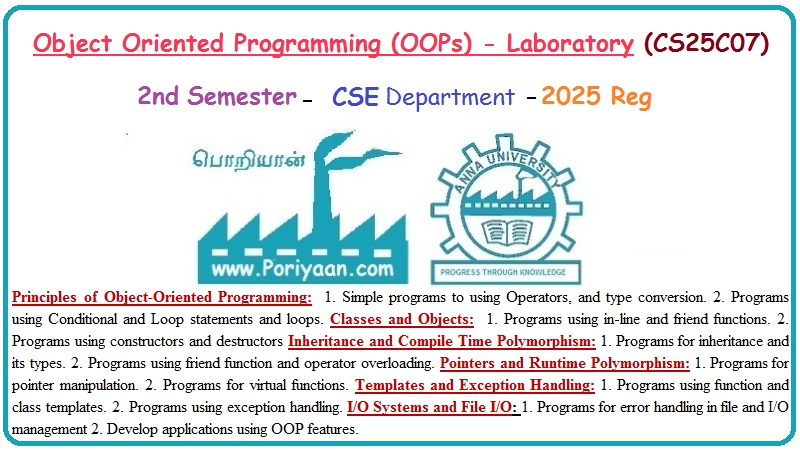
Object Oriented Programming (OOPs) - Laboratory
CS25C07 2nd Semester CSE, CSE(CY) Depts | 2025 Regulation | 2nd Semester 2025 Regulation