Object Oriented Programming: Chapter 1: Principles of Object Oriented Programming
Procedure Oriented Programming vs Object Oriented Programming
Questions: 1. What are the needs for object oriented paradigm 2. List out differences between procedure oriented programming and object oriented programming.
Procedure
Oriented Programming vs Object Oriented Programming
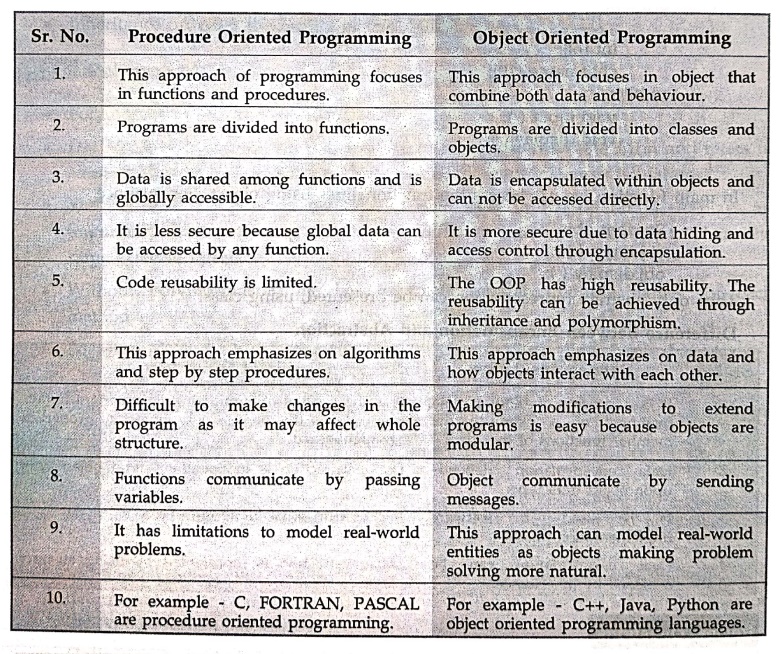
Procedure Oriented Programming
1.
This approach of programming focuses in functions and procedures.
2.
Programs are divided into functions,
3.
Data is shared among functions and is globally accessible.
4.
It is less secure because global data can be accessed by any function.
5
.Code reusability is limited.
6.
This approach emphasizes on algorithms and step by step procedures.
7.
Difficult to make changes in the program as it may affect whole structure.
8.
Functions communicate by passing variables.
9.
It has limitations to model real‒world problems.
10.For
example C, FORTRAN, PASCAL are procedure oriented programming.
Object Oriented Programming
1.
This approach focuses in object that combine both data and behaviour.
2.
Programs are divided into classes and objects.
3.
Data is encapsulated within objects and can not be accessed directly.
4.
It is more secure due to data hiding and access control through encapsulation.
5.
The OOP has high reusability. The reusability can be achieved through
inheritance and polymorphism.
6.
This approach emphasizes on data and how objects interact with each other.
7.
Making modifications to extend programs is easy because objects are modular.
8.
Object communicate by sending messages.
9.This
approach can model real‒world entities as objects making problem solving more
natural.
10.
For example C++, Java, Python are object oriented programming languages.
Need for Object Oriented Programming
•
Major motivation of object oriented
programming is to overcome the
limitations of procedural programming.
•
The object oriented programming is used in the applications in which ‒
1.
Emphasis is on data rather than procedures.
2.
Programs can be divided into known objects.
3.
Data needs to be hidden from the outside functions.
4.
New data needs to be added frequently for maintaining the code.
5.
Objects need to communicate with each other.
6.
Some common properties are used by various functions.
Review Questions
1. What are the needs
for object oriented paradigm
2. List out
differences between procedure oriented programming and object oriented
programming.
Object Oriented Programming: Chapter 1: Principles of Object Oriented Programming : Tag: Oops, Computer Programming : - Procedure Oriented Programming vs Object Oriented Programming
Object Oriented Programming: Chapter 1: Principles of Object Oriented Programming
Under Subject
Object Oriented Programming (OOPs)
CS25C07 2nd Semester CSE, CSE(CY) Depts | 2025 Regulation | 2nd Semester 2025 Regulation
Related Subjects
English Essentials II
EN25C02 2nd Semester | 2025 Regulation | 2nd Semester 2025 Regulation

Tamils and Technology தமிழர்களும் தொழில்நுட்பமும்
UC25H02 2nd Semester | 2025 Regulation | 2nd Semester 2025 Regulation
Linear Algebra
MA25C02 2nd Semester | 2025 Regulation
Applied Physics (CSIE) II
PH25C03 2nd Semester AIDS, CSE, IT, CSE(CY) Dept | 2025 Regulation | 2nd Semester 2025 Regulation
Digital Principles and Computer Organization
CS25C06 2nd Semester AIDS, CSE, IT, CSE(CY) Dept | 2025 Regulation | 2nd Semester 2025 Regulation

Basic Electrical and Electronics Engineering
EE25C01 2nd Semester | 2025 Regulation | 2nd Semester 2025 Regulation
Object Oriented Programming (OOPs)
CS25C07 2nd Semester CSE, CSE(CY) Depts | 2025 Regulation | 2nd Semester 2025 Regulation

Re-Engineering for Innovation
ME25C05 2nd Semester | 2025 Regulation | 2nd Semester 2025 Regulation
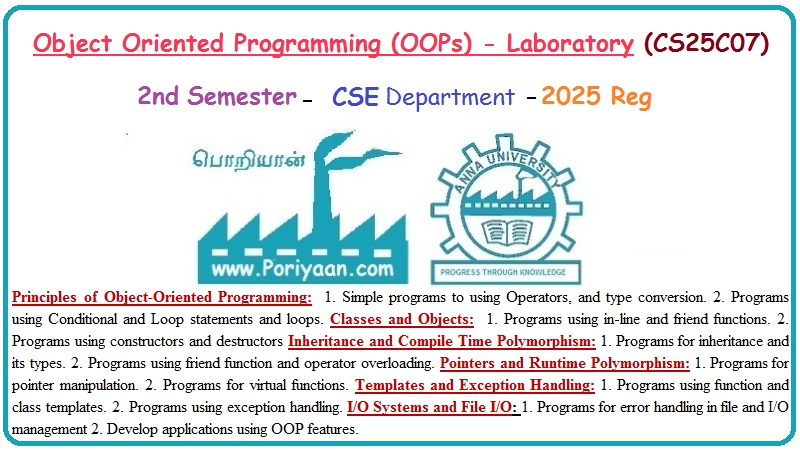
Object Oriented Programming (OOPs) - Laboratory
CS25C07 2nd Semester CSE, CSE(CY) Depts | 2025 Regulation | 2nd Semester 2025 Regulation