Object Oriented Programming: Chapter 1: Principles of Object Oriented Programming
Data types
C++ Programming
Questions: 1. Describe data types in C++ in detail. 2. What is user defined data types? What is the scope and life time of variable ? Explain using C++ program. 3. Describe the concept of enumerated data Type in C++ with a proper example.
Data‒types
• Definition:
Data types are used to define the type of data for particular variable. These
are specified using specific keyword.
There
are three types of data types ‒
1.
Fundamental or Primitive or Basic Data types
2.
Derived Data types
3.
User defined Data types
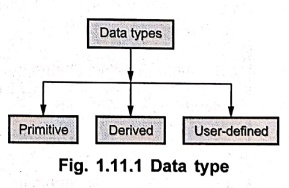
Data type
• Primitive
• Derived
• User‒defined
1.Basic Data Types
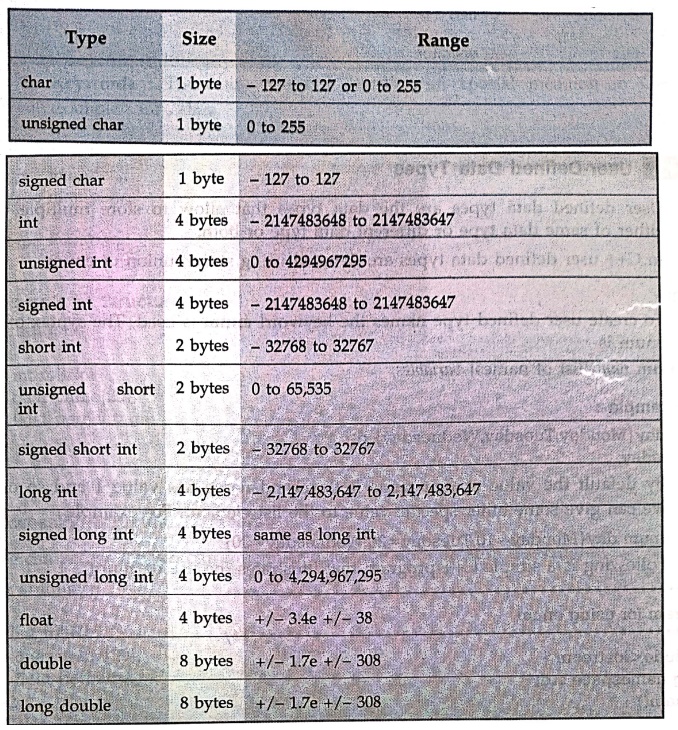
The
built‒in data types supported by C++ are enlisted in the following table.
2. Derived Data Types
• These
are the data types that are derived or created from the fundamental data types.
• In
C++ arrays and strings are considered as derived data types.
Syntax of Arrays
Data_type
array_name[size];
Example of Arrays
int
a[10];
Syntax of Strings
char
array_name[size];
Example of strings
char
msg[]=('h','e','l','l','o'};
3. User‒Defined Data Types
•
User defined data types are the data types that allow to store multiple values
either of same data type or different data type or both.
•
In C++ user defined data types are denoted using struct, union or enum.
Enum
•
To create user defined type names the keyword enum is used. The syntax of using enum is
enum
name{list of names) variables;
For example:
enum
day{Monday,Tuesday,Wednesday} d;
d=Tuesday;
•
By default the value of first name is 0, second name has value 1 and so on. But
we can give some other specific value to the list element. For example
enum
day{Monday=10,Tuesday=20,Wednesday=30};
•
Following is a simple C++ program that illustrates the use of enum
/***********************************
Program for using enum
**********************************/
#include<iostream>
using namespace std;
int main()
{
enum
mylist{small,middle=5,large} a,b;
a=middle;
b=large;
cout<<"a=
"<<a<" b= "<<b;
return 0;
}
Output
a= 5 b=6
Struct
•
Structure in C is a programming
construct that keeps together the variables that need to be in one entity.
•
Structure is a basically the collection
of the data members that belong to different data types.
•
The keyword struct is used to define the structure in C.
(1) Syntax of C
Structure
struct
name_of_structure
{
data type member1;
data type member2;
data type member3;
...
data type membern
};
(2) Example of
Structure
struct student
{
int rollNo;
char name[20];
float percentage;
}:
(3) Accessing Structure Members
We
can access the structure member using the dot operator. For example
struct student
{
int rollNo;
char name[20];
float percentage;
}s1,s2;
s1.rollNo=10;
strcpy(s1.name, "AAA");
Here
s1 and s2 are the variables of structure using which we can access the members
of structure with the help of dot operator.
Example 1: An unsigned int can be twice as large as the signed int.
Explain how?
Solution :
1)
The sign needs one bit, and the rest are used for the integer.
2)
Unsigned uses this bit also as part of the integer. And as one extra bit
available is equivalent to doubling the capacity.
3)
For instance: Let us assume that the machine is 32 bit wide. For a signed
integer, when 32 bits are allocated, 1 bit has to be used for storing the sign
information. So the actual number can only be 31 bit wide.
For
an unsigned integer, the whole 32 bits can be used.
So
the range of signed int will be ‒ 32768 to 32768 and the range of unsigned int
will be 0 to 65,535.
Review Questions
1. Describe data types
in C++ in detail.
2. What is user
defined data types? What is the scope and life time of variable ? Explain using
C++ program.
3. Describe the
concept of enumerated data Type in C++ with a proper example.
Object Oriented Programming: Chapter 1: Principles of Object Oriented Programming : Tag: Oops, Computer Programming : C++ Programming - Data types
Object Oriented Programming: Chapter 1: Principles of Object Oriented Programming
Under Subject
Object Oriented Programming (OOPs)
CS25C07 2nd Semester CSE, CSE(CY) Depts | 2025 Regulation | 2nd Semester 2025 Regulation
Related Subjects
English Essentials II
EN25C02 2nd Semester | 2025 Regulation | 2nd Semester 2025 Regulation
Tamils and Technology தமிழர்களும் தொழில்நுட்பமும்
UC25H02 2nd Semester | 2025 Regulation | 2nd Semester 2025 Regulation
Linear Algebra
MA25C02 2nd Semester | 2025 Regulation
Applied Physics (CSIE) II
PH25C03 2nd Semester AIDS, CSE, IT, CSE(CY) Dept | 2025 Regulation | 2nd Semester 2025 Regulation
Digital Principles and Computer Organization
CS25C06 2nd Semester AIDS, CSE, IT, CSE(CY) Dept | 2025 Regulation | 2nd Semester 2025 Regulation

Basic Electrical and Electronics Engineering
EE25C01 2nd Semester | 2025 Regulation | 2nd Semester 2025 Regulation
Object Oriented Programming (OOPs)
CS25C07 2nd Semester CSE, CSE(CY) Depts | 2025 Regulation | 2nd Semester 2025 Regulation

Re-Engineering for Innovation
ME25C05 2nd Semester | 2025 Regulation | 2nd Semester 2025 Regulation
Object Oriented Programming (OOPs) - Laboratory
CS25C07 2nd Semester CSE, CSE(CY) Depts | 2025 Regulation | 2nd Semester 2025 Regulation