Applied Physics CSIE II: UNIT I: Magnetic Materials
Classification of magnetic materials based on magnetic moments

Magnetic materials are classified according to the presence or absence of the permanent magnetic dipoles.
CLASSIFICATION OF
MAGNETIC MATERIALS BASED ON MAGNETIC MOMENTS
Magnetic
materials are classified according to the presence or absence of the permanent
magnetic dipoles. Generally, every two electrons in an energy state of an atom
will form a pair with opposite spins. Thus the resultant spin magnetic moment
is zero. Hence they don't have permanent magnetic moments and they are called
as diamagnetic materials. Examples. gold, germanium, silicon, etc.
But
in some magnetic materials like iron, cobalt, etc., there exists unpaired
electrons. The spin magnetic moment of these unpaired electrons interact with
the adjacent atom's unpaired electron spin magnetic moment in a parallel manner
resulting in enormous permanent spin magnetic moment. These materials are
classified into paramagnetic, ferromagnetic and ferrimagnetic materials with
respect to the electron spins.
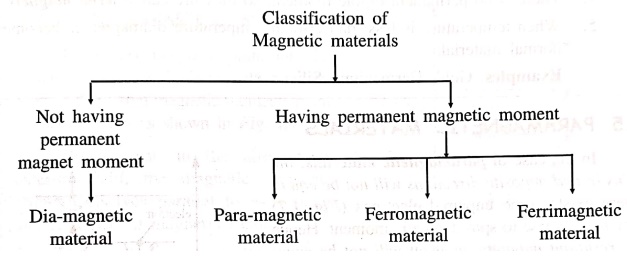
Classification
of Magnetic materials
1.
Not having permanent magnet moment: Dia‒magnetic material
2.
Having permanent magnetic moment: Para‒magnetic material, Ferromagnetic
material, Ferrimagnetic material
1. DIAMAGNETIC MATERIAL
In
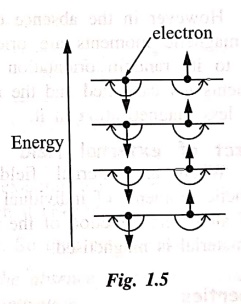
a diamagnetic material, the electron
orbits are more or less random, and mostly all the magnetic moments are
cancelled. Similarly all the spin moments are almost paired i.e., they have
even number of electrons and has equal number of electrons spinning in two
opposite directions as shown in Fig. 1.5. Hence the net magnetic moment in the
diamagnetic material is zero. Therefore most of these materials do not have
magnetism in the absence of magnetic field.
Effect of external field
When
an external magnetic field is applied, the electrons reorient in such a way
that they align perpendicular to the field direction and their magnetic moments
opposes the external magnetic field. This will reduce the magnetic induction
present in the specimen.
Properties
1.
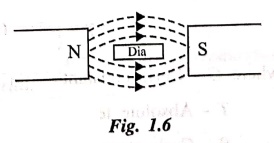
They repel the magnetic lines of force (Fig. 1.6)
2.
Susceptibility is negative and it is independent of temperature and applied
magnetic field strength.
3.
Permeability is less than 1.
4.
There is no permanent dipole moment, so they are called weak magnets.
5.
When temperature is less than critical temperature diamagnetics become normal
material.
Examples.
Gold, Germanium, Silicon etc.
2. PARAMAGNETIC MATERIALS
In
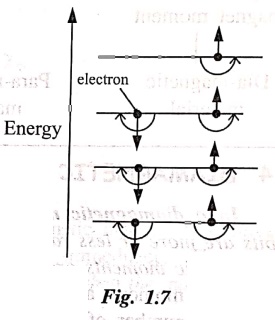
the case of paramagnetic materials,
the spins in two opposite directions will not be equal. There exists some
unpaired electrons (Fig. 1.7) which gives rise to spin magnetic moment. Hence
the resultant magnetic moment will not be equal to zero.
However
in the absence of external field the magnetic moments are oriented randomly.
Due to its random orientation some magnetic moments get cancelled and the
material possess very less magnetisation in it.
Effect of external field
When
an external field is applied, the magnetic moments of individual molecules
reorient itself along the direction of the magnetic field and the material is
magnetised.
Properties
1.
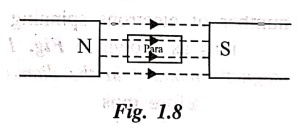
The magnetic lines of force pass through the material (Fig. 1.8)
2.
Magnetic susceptibility is positive and it is given by
χ= C / T‒θ

(also
called Curie‒Weiss law)
where
C‒Curie
constant
T‒
Absolute temperature
θ-Curie
temperature
3.
Permeability is greater than one.
4.
They possess permanent dipole moment.
5.
When the temperature is less than curie temperature, paramagnetic materials
becomes diamagnetic material.
Examples:
CuSO4, MnSO4, Platinum etc.
3. FERROMAGNETIC MATERIALS
In
a ferromagnetic material the number of unpaired electrons are more. Most of
these spin magnetic moments point in one direction as shown in Fig. 1.9.
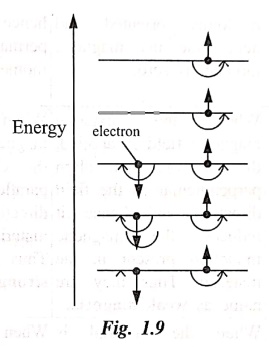
Hence
even in the absence of external field, the magnetic moments align themselves
parallel to each other and give rise to magnetic field.
Effect of magnetic field
To
these materials even if a small external magnetic field is applied, the
magnetic moments which are already aligned parallel, reorient itself along the
direction of the magnetic field and they become very strong magnets.
Properties
1.
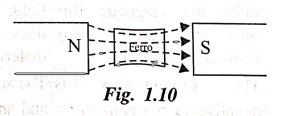
Since some magnetisation is already existing in these materials, all the
magnetic lines of force passes through it (Fig. 1.10).
2.
They have permanent dipole moment. So they act as strong magnets.
3.
They exhibit magnetisation even in the absence of external field. This property
is called Spontaneous magnetisation.
4.
It's susceptibility is positive and high and it is given by
χ=
C / T‒θ
5.
When the temperature is greater than curie temperature, ferromagnetic material
becomes paramagnetic material.
6.
Permeability is very much greater than 1.
Examples:
Ni, Co, Fe etc.,
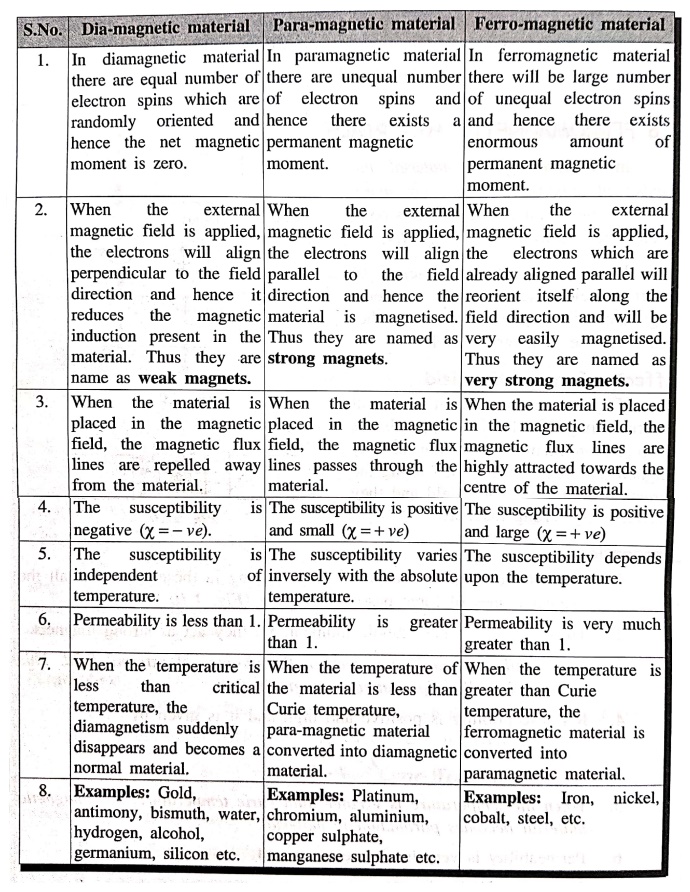
COMPARISON CHART FOR DIA, PARA AND FERRO‒MAGNETIC MATERIALS
Dia‒magnetic material
1.
In diamagnetic material there are equal number of electron spins which are randomly
oriented and hence the net magnetic moment is zero.
2.
When the external magnetic field is applied, the electrons will align perpendicular
to the field direction and hence it reduces the magnetic induction present in
the material. Thus they are name as weak magnets.
3.
When the material is placed in the magnetic field, the magnetic flux lines are
repelled away from the material.
4.
The susceptibility negative ( χ = ‒ve).
5.
The susceptibility is independent of temperature.
6.
Permeability is less than 1.
7.
When the temperature is less than critical temperature, the diamagnetism
suddenly disappears and becomes a normal material.
8.
Examples: Gold, antimony, bismuth, water, hydrogen, alcohol, germanium, silicon
etc.
Para‒magnetic material
1.
In paramagnetic material there are unequal number of electron spins and hence
there exists a permanent magnetic moment.
2.
When the external magnetic field is applied, the electrons will align parallel
to the field direction and hence the material is magnetised. Thus they are
named as strong magnets.
3.
When the material is placed in the magnetic field, the magnetic flux lines
passes through the material.
4.
The susceptibility is positive and small (χ =+ve)
5.
The susceptibility varies inversely with the absolute temperature.
6.
Permeability is greater than 1.
7.
When the temperature of the material is less than Curie temperature, para‒magnetic
material converted into diamagnetic material.
8.
Examples: Platinum, chromium, aluminium, copper sulphate, manganese sulphate
etc.
Ferro‒magnetic material
1.
In ferromagnetic material there will be large number of unequal electron spins and
hence there exists enormous amount of permanent magnetic moment.
2.
When the external magnetic field is applied, the electrons which are already
aligned parallel will reorient itself along the field direction and will be very
easily magnetised. Thus they are named as very strong magnets.
3.
When the material is placed in the magnetic field, the magnetic flux lines are
highly attracted towards the centre of the material.
4.
The susceptibility is positive and large (χ=+ve)
5.
The susceptibility depends upon the temperature.
6.
Permeability is very much greater than 1.
7.
When the temperature is greater than Curie temperature, the ferromagnetic
material is converted into paramagnetic material,
8.
Examples: Iron, nickel, cobalt, steel, etc.
4. FERRIMAGNETISM AND FERRITES
It
is a special case of magnetic material and it is composed of two sets of
different transition metal ions having different values of magnetic moment with
antiparallel alignment as shown in Fig. 1.12.
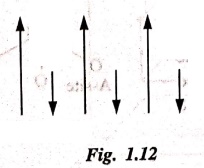
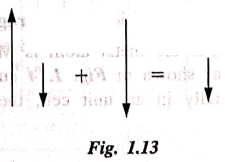
Hence
these material have antiparallel magnetic
moments of different magnitudes, giving rise to fairly large magnetic
moment in the presence of external magnetic field (Fig. 1.13).
Properties
1.
The susceptibility is very large and is positive represented by
χ = C /
T±0

when
T> TN
2.
Beyond the Neel temperature, χ decreases.
3.
These materials have low eddy current losses, and low hysteresis losses.
4.
They have hysteresis loop in the form of a square and hence will have low
coercivity.
Applied Physics CSIE II: UNIT I: Magnetic Materials : Tag: Applied Physics : - Classification of magnetic materials based on magnetic moments
Applied Physics CSIE II: UNIT I: Magnetic Materials
Under Subject
Applied Physics (CSIE) II
PH25C03 2nd Semester AIDS, CSE, IT, CSE(CY) Dept | 2025 Regulation | 2nd Semester 2025 Regulation
Related Subjects

English Essentials II
EN25C02 2nd Semester | 2025 Regulation | 2nd Semester 2025 Regulation

Tamils and Technology தமிழர்களும் தொழில்நுட்பமும்
UC25H02 2nd Semester | 2025 Regulation | 2nd Semester 2025 Regulation
Linear Algebra
MA25C02 2nd Semester | 2025 Regulation
Applied Physics (CSIE) II
PH25C03 2nd Semester AIDS, CSE, IT, CSE(CY) Dept | 2025 Regulation | 2nd Semester 2025 Regulation
Digital Principles and Computer Organization
CS25C06 2nd Semester AIDS, CSE, IT, CSE(CY) Dept | 2025 Regulation | 2nd Semester 2025 Regulation

Basic Electrical and Electronics Engineering
EE25C01 2nd Semester | 2025 Regulation | 2nd Semester 2025 Regulation
Python for Data Science
AD25201 2nd Semester AIDS Dept | 2025 Regulation | 2nd Semester 2025 Regulation

Re-Engineering for Innovation
ME25C05 2nd Semester | 2025 Regulation | 2nd Semester 2025 Regulation
Python for Data Science - Laboratory
AD25201 2nd Semester AIDS Dept | 2025 Regulation | 2nd Semester 2025 Regulation