Applied Physics CSIE II: UNIT I: Magnetic Materials
Comparison chart for Dia, Para and Ferro‒Magnetic materials
Dia‒magnetic material, Para‒magnetic material vs Ferro‒magnetic material
COMPARISON CHART FOR
DIA, PARA AND FERRO‒MAGNETIC MATERIALS
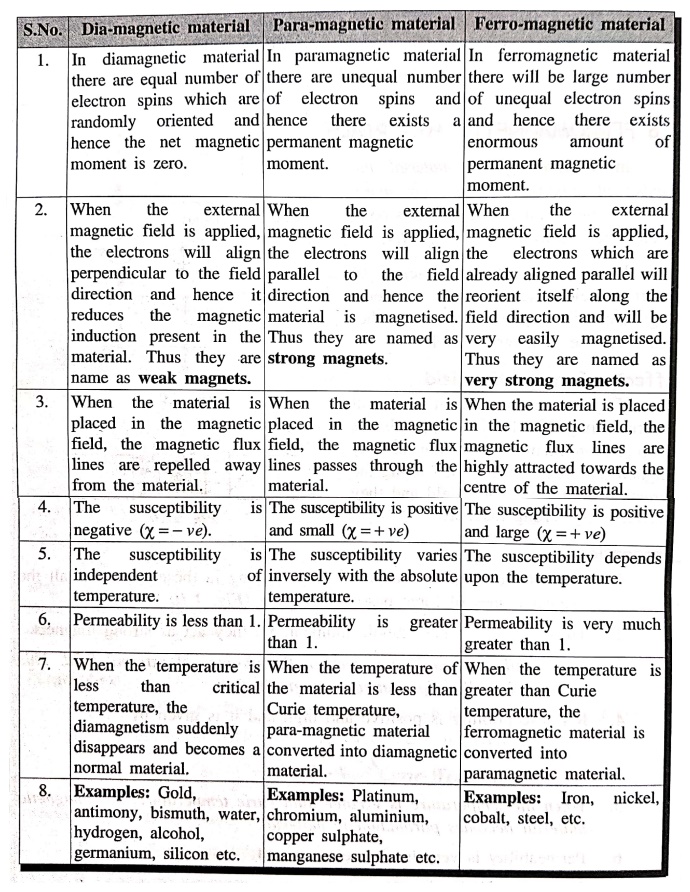
Dia‒magnetic material
1.
In diamagnetic material there are equal number of electron spins which are randomly
oriented and hence the net magnetic moment is zero.
2.
When the external magnetic field is applied, the electrons will align perpendicular
to the field direction and hence it reduces the magnetic induction present in
the material. Thus they are name as weak magnets.
3.
When the material is placed in the magnetic field, the magnetic flux lines are
repelled away from the material.
4.
The susceptibility negative ( χ = ‒ve).
5.
The susceptibility is independent of temperature.
6.
Permeability is less than 1.
7.
When the temperature is less than critical temperature, the diamagnetism
suddenly disappears and becomes a normal material.
8.
Examples: Gold, antimony, bismuth, water, hydrogen, alcohol, germanium, silicon
etc.
Para‒magnetic material
1.
In paramagnetic material there are unequal number of electron spins and hence
there exists a permanent magnetic moment.
2.
When the external magnetic field is applied, the electrons will align parallel
to the field direction and hence the material is magnetised. Thus they are
named as strong magnets.
3.
When the material is placed in the magnetic field, the magnetic flux lines
passes through the material.
4.
The susceptibility is positive and small (χ =+ve)
5.
The susceptibility varies inversely with the absolute temperature.
6.
Permeability is greater than 1.
7.
When the temperature of the material is less than Curie temperature, para‒magnetic
material converted into diamagnetic material.
8.
Examples: Platinum, chromium, aluminium, copper sulphate, manganese sulphate
etc.
Ferro‒magnetic material
1.
In ferromagnetic material there will be large number of unequal electron spins and
hence there exists enormous amount of permanent magnetic moment.
2.
When the external magnetic field is applied, the electrons which are already
aligned parallel will reorient itself along the field direction and will be very
easily magnetised. Thus they are named as very strong magnets.
3.
When the material is placed in the magnetic field, the magnetic flux lines are
highly attracted towards the centre of the material.
4.
The susceptibility is positive and large (χ=+ve)
5.
The susceptibility depends upon the temperature.
6.
Permeability is very much greater than 1.
7.
When the temperature is greater than Curie temperature, the ferromagnetic
material is converted into paramagnetic material,
8.
Examples: Iron, nickel, cobalt, steel, etc.
Applied Physics CSIE II: UNIT I: Magnetic Materials : Tag: Applied Physics : - Comparison chart for Dia, Para and Ferro‒Magnetic materials
Applied Physics CSIE II: UNIT I: Magnetic Materials
Under Subject
Applied Physics (CSIE) II
PH25C03 2nd Semester AIDS, CSE, IT, CSE(CY) Dept | 2025 Regulation | 2nd Semester 2025 Regulation
Related Subjects

English Essentials II
EN25C02 2nd Semester | 2025 Regulation | 2nd Semester 2025 Regulation

Tamils and Technology தமிழர்களும் தொழில்நுட்பமும்
UC25H02 2nd Semester | 2025 Regulation | 2nd Semester 2025 Regulation
Linear Algebra
MA25C02 2nd Semester | 2025 Regulation
Applied Physics (CSIE) II
PH25C03 2nd Semester AIDS, CSE, IT, CSE(CY) Dept | 2025 Regulation | 2nd Semester 2025 Regulation
Digital Principles and Computer Organization
CS25C06 2nd Semester AIDS, CSE, IT, CSE(CY) Dept | 2025 Regulation | 2nd Semester 2025 Regulation

Basic Electrical and Electronics Engineering
EE25C01 2nd Semester | 2025 Regulation | 2nd Semester 2025 Regulation
Python for Data Science
AD25201 2nd Semester AIDS Dept | 2025 Regulation | 2nd Semester 2025 Regulation

Re-Engineering for Innovation
ME25C05 2nd Semester | 2025 Regulation | 2nd Semester 2025 Regulation
Python for Data Science - Laboratory
AD25201 2nd Semester AIDS Dept | 2025 Regulation | 2nd Semester 2025 Regulation