Applied Physics CSIE II: UNIT I: Magnetic Materials
Parameters of Magnetic Materials
1. Magnetic dipole moment 2. Bohr Magneton 3. Magnetic field 4. Magnetic lines of force 5. Magnetic lines of induction 6. Forces between two poles 7. Magnetic induction (or) Magnetic flux density (B) 8. Magnetic field intensity (H) 9. Magnetisation (or) Intensity of magnetisation 10. Magnetic Susceptibility 11. Magnetic Permeability 12. Relative Permeability 13. Relation between μr and χm 14. Retentivity (or) Remanence 15. Coercivity
PARAMETERS OF MAGNETIC
MATERIALS
1. Magnetic dipole moment (Mμ)
A
system having two opposite magnetic poles separated by a distance 'd' is called
as a magnetic dipole. If 'm' is
magnetic pole strength and 'l' is the
length of the magnet, then its dipole moment is given by
Mμ = ml
Magnetic
moment can also be defined as Mμ=ia,
where i is the electric current that
flows through a circular wire of an area of cross section 'a'.
2. Bohr Magneton
The
orbital magnetic moment and the spin magnetic moment of an electron in an atom
can be expressed in terms of smallest atomic unit of magnetic moment called Bohr magneton.
1 Bohr Magneton = e /2m
/2m
⇒
μB = 9.27 × 10⁻²⁴ Am2
3. Magnetic field
The
space around the magnet (or) the current carrying conductor where the magnetic
effect is felt is called Magnetic field.
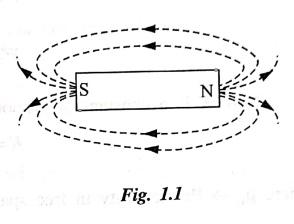
4. Magnetic lines of force
Magnetic
field is assumed to consist of lines of magnetic forces. These lines of forces
travels externally from north pole to south pole as shown in Fig. 1.1. Hence a magnetic line of force is defined as
the continuous curve in a magnetic field. The tangent drawn at any point on the
curve gives the direction of the resultant magnetic intensity at that point.
5. Magnetic lines of induction
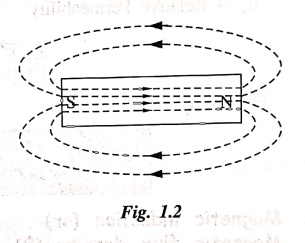
The
magnetic lines of force which originates from north pole to south pole doesn't
end there itself. They are supposed to continue through the magnet and reach
the north pole from where they started and forms a closed loop as shown in Fig.
1.2. Such imaginary lines are called magnetic
lines of induction.
6. Forces between two poles
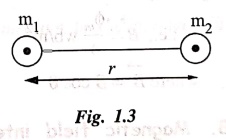
Let
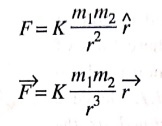
us consider two poles of pole strength m1 and m2 placed
at a distance 'r' apart as shown in Fig. 1.3.
From
the coulomb's law of forces, the force
of attraction (or) repulsion between the isolated point magnetic poles is
proportional to the product of pole strengths and is inversely proportional to
the square of the distance between them.
(i.e.,) 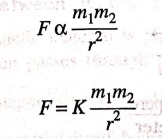
Interms
of unit vector  directed from m1 to m2
 =r/
=r/
Here
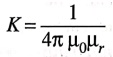
K is a constant of proportionality.
where
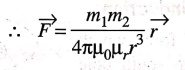
μ0 → Permeability in free space (4π × 10‒7 H/m.)
μr
→ Relative Permeability
For
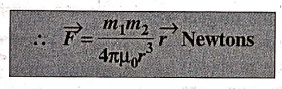
air μr = 1
7. Magnetic induction (or) Magnetic flux density (B)
It
is defined as the number of magnetic lines of force passing normally through
unit area of cross section A at that point as shown Fig. (1.4)
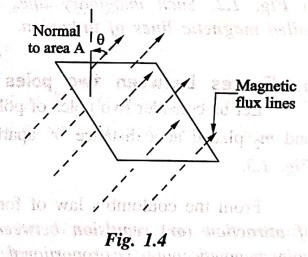
i.e., 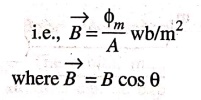
8. Magnetic field intensity (H)
It
is defined as the force experienced by a unit north pole placed at the given
point in a magnetic field.
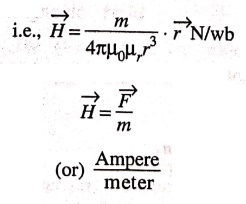
9. Magnetisation (or) Intensity of magnetisation [M (or) I]
The
term magnetisation is the process of converting a non magnetic material into a
magnetic material. It measures the magnetisation of the magnetised specimen.
It is also defined as the magnetic moment per unit volume.
M = Mμ / V =
m.l
/ l.a = m/a weber/m2
10. Magnetic Susceptibility (χm)
It
is the measure of the ease with which the specimen can be magnetised by the
magnetising force.
It
is defined as the ratio between intensity of magnetisation (I) and the magnetic
field intensity (H)
(i.e.,) χm = I / H
11. Magnetic Permeability (μ)
It
is defined as the ratio between the magnetic
flux density (B) and the magnetic
field intensity (H)
μ = μ0μr
= B / H
It
is the measure of degree at which the lines of force can penetrate through the
material.
12. Relative Permeability (μr)
It
is the ratio between the permeability of the medium to the permeability of free
space.
μr = μ/μ0
13. Relation between μr and χm
When
a magnetic material is placed in a magnetic field (H), then two types of lines
of induction passes through the material. viz.,
(i) Due to magnetising field (H)
(ii) Due to material itself being magnetised
by induction (I)
∴
Total flux density B = μ0 (H+I) ...(1)
We
know, μ = B/H ⇒
B = μH …….(2)
Equating
equation (1) and (2) we get
μH
= μ0 (H+ I)
Since
μ=μ0μr, we have
μ0μrН = μ0H(
1+ I/H )
Here
1/H = χm
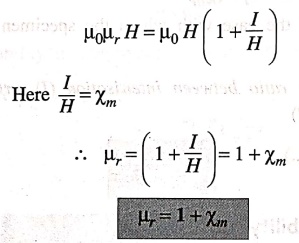
μr = ( 1+ 1/H ) = 1 + χm
μ = 1+χm
14. Retentivity (or) Remanence (Mr)
When
the external magnetic field applied to a magnetic material is removed, the
magnetic material will not loss its magnetic property immediately. There exits
some residual intensity of magnetisation in the specimen even when the magnetic
field is cut off. This is called residual
magnetism or retentivity.
15. Coercivity (‒HC)
The
residual magnetism can be completely removed from the malarial by applying a
reverse magnetic field. Hence Coercivity
of the magnetic material is the strength of reverse magnetic field (‒Hc)
which is used to completely demagnetise the material.
Applied Physics CSIE II: UNIT I: Magnetic Materials : Tag: Applied Physics : - Parameters of Magnetic Materials
Applied Physics CSIE II: UNIT I: Magnetic Materials
Under Subject

Applied Physics (CSIE) II
PH25C03 2nd Semester AIDS, CSE, IT, CSE(CY) Dept | 2025 Regulation | 2nd Semester 2025 Regulation
Related Subjects

English Essentials II
EN25C02 2nd Semester | 2025 Regulation | 2nd Semester 2025 Regulation

Tamils and Technology தமிழர்களும் தொழில்நுட்பமும்
UC25H02 2nd Semester | 2025 Regulation | 2nd Semester 2025 Regulation
Linear Algebra
MA25C02 2nd Semester | 2025 Regulation
Applied Physics (CSIE) II
PH25C03 2nd Semester AIDS, CSE, IT, CSE(CY) Dept | 2025 Regulation | 2nd Semester 2025 Regulation

Digital Principles and Computer Organization
CS25C06 2nd Semester AIDS, CSE, IT, CSE(CY) Dept | 2025 Regulation | 2nd Semester 2025 Regulation

Basic Electrical and Electronics Engineering
EE25C01 2nd Semester | 2025 Regulation | 2nd Semester 2025 Regulation

Python for Data Science
AD25201 2nd Semester AIDS Dept | 2025 Regulation | 2nd Semester 2025 Regulation

Re-Engineering for Innovation
ME25C05 2nd Semester | 2025 Regulation | 2nd Semester 2025 Regulation

Python for Data Science - Laboratory
AD25201 2nd Semester AIDS Dept | 2025 Regulation | 2nd Semester 2025 Regulation