Applied Physics CSIE II: UNIT I: Magnetic Materials
Structure of Ferrites
Ferrites are the magnetic compounds consisting of two or more different kinds of atoms.
STRUCTURE OF FERRITES
Ferrites
are the magnetic compounds consisting of two or more different kinds of atoms.
Generally ferrites are expressed as X2+ Fe23+ O4,
where X2+ stands for suitable divalent metal ion such as Mg2+,
Zn2+, Fe2+, Mn2+, Ni2+ etc.
Examples
(i)
If X2+ is replaced by Ni2+, then the ferrite (Ni2+
Fe23+O4) is formed, thus named as nickel ferrite,
(ii)
If X2+ is replaced by Fe2+ then the ferrite (Fe2+Fe23+O4)
is formed, thus named as ferrous ferrite.
Ferrites
formed usually have a face centered cubic structure of oxygen ions closely
packed together with the divalent and trivalent metal ions in the interstitial
sites. This structure is called spinal
structure. There are two types of ferrite structures
(i)
Regular spinal
(ii)
Inverse spinal
Regular spinal: Eg. Mg2+Fe3+O4
In
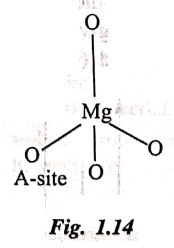
this type each metal atom (divalent) is surrounded by four O2
‒
ions in a tetragonal fashion. For
example, if the metal atom is Mg2+, then the structure is as shown
in Fig. 1.14 and it is called 'A' site. Totally in an unit cell, there will be
8 tetrahedral (8A) sites.
Each
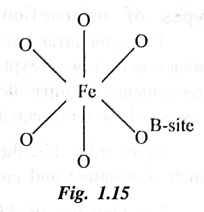
Fe3+ (trivalent) is surrounded by six O2‒ ions and forms
an octahedral fashion as shown in
Fig. 1.15. Totally, there will be 16 such octahedral sites in the unit cell.
This is indicated by 'B' site.
Thus
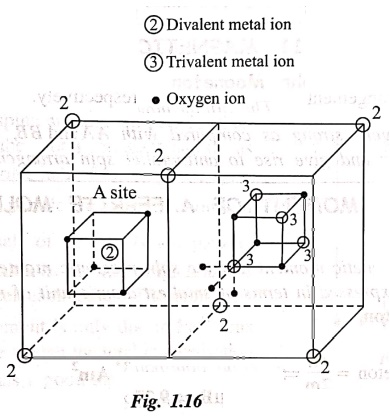
in a regular spinal, each divalent metal ion (Mg2+) exists in a
tetrahedral form (A site) and each trivalent metal ion (Fe3+) exists
in a octahedral form (B site). Hence the sites A and B combine together to form
a regular spinal ferrite structures as shown in Fig. 1.16.
Inverse spinal: Eg., Fe3+
[Fe2+ Fe3+]O4
In
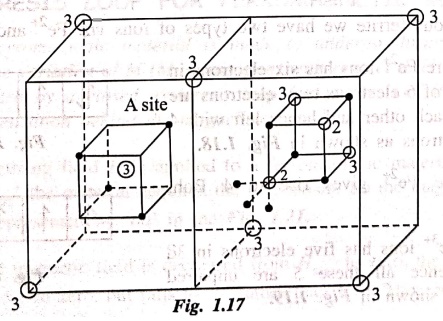
this, the Fe3+ ions (trivalent) occupies all the A sites
(tetrahedral) and half of the B sites (Octahedral) also. Thus the left out B
sites will be occupied by the divalent (Fe2+). The inverse spinal
structure is as shown in Fig. 1.17.
Types of interaction present in the ferrites
The
spin arrangement between the A site and B site is in an antiparallel manner and
it was explained by Neel. According to him, in ferrites, the spin arrangement
is antiparallel and there exists some interaction between the A and B sites
which is represented as AB interaction.
Apart
from this, there are two more interactions (i.e.,) AA and BB interaction which
is negative and considerably weaker than AB interaction.
The
tendency of AB interaction is to align all A spins parallel to each other and
antiparallel to all B spins, but the tendency of AA and BB interaction is to
spoil the parallel arrangement of A and B spins respectively.
Since
AB is very strong as compared with AA and BB, the effect of AB interaction
dominates and give rise to antiparallel spin arrangement.
Applied Physics CSIE II: UNIT I: Magnetic Materials : Tag: Applied Physics : - Structure of Ferrites
Applied Physics CSIE II: UNIT I: Magnetic Materials
Under Subject
Applied Physics (CSIE) II
PH25C03 2nd Semester AIDS, CSE, IT, CSE(CY) Dept | 2025 Regulation | 2nd Semester 2025 Regulation
Related Subjects

English Essentials II
EN25C02 2nd Semester | 2025 Regulation | 2nd Semester 2025 Regulation

Tamils and Technology தமிழர்களும் தொழில்நுட்பமும்
UC25H02 2nd Semester | 2025 Regulation | 2nd Semester 2025 Regulation
Linear Algebra
MA25C02 2nd Semester | 2025 Regulation
Applied Physics (CSIE) II
PH25C03 2nd Semester AIDS, CSE, IT, CSE(CY) Dept | 2025 Regulation | 2nd Semester 2025 Regulation
Digital Principles and Computer Organization
CS25C06 2nd Semester AIDS, CSE, IT, CSE(CY) Dept | 2025 Regulation | 2nd Semester 2025 Regulation

Basic Electrical and Electronics Engineering
EE25C01 2nd Semester | 2025 Regulation | 2nd Semester 2025 Regulation
Python for Data Science
AD25201 2nd Semester AIDS Dept | 2025 Regulation | 2nd Semester 2025 Regulation

Re-Engineering for Innovation
ME25C05 2nd Semester | 2025 Regulation | 2nd Semester 2025 Regulation
Python for Data Science - Laboratory
AD25201 2nd Semester AIDS Dept | 2025 Regulation | 2nd Semester 2025 Regulation