Applied Physics CSIE II: UNIT I: Magnetic Materials
GMR Sensors in Magnetic Hard Disk Drive (HDD) Memories

Introduction, Principle, Construction, Working, Advantages, Disadvantages, Applications - GMR Sensors in Magnetic Hard Disk Drive (HDD) Memories
GMR SENSORS IN MAGNETIC
HARD DISK DRIVE [HDD] MEMORIES
Introduction
In
the field of digital data storage, hard disk drive (HDD) maintained its leading
position among other data storage devices.
Hard
disk drives [HDD] made up of magnetic garnet materials are called magnetic hard disk drives. It is a mass
data storage device recently used for storing data to a very high level in
terms of Tera bytes.
Now‒a‒days
GMR [Giant Magneto Resistive] sensors, which has a very high magnetic
sensitivity are used to read the data at greater speed.
Principle
In
Hard disk drives, the binary data in terms of zero's (0) and one's (1) are
stored by inducing magnetic moment in a thin magnetic layer and GMR effect is
used as the principle to read the data in HDD.
Here
zero (0) represents missing transition and one (1) represents transition in the
medium.
Construction
The
HDD consists of recording medium madeup of thin layer of magnetic garnets grown
over the substrate The GMR sensor, which is made up of ferrites and anti
ferromagnetic materials is used as reading element. The writing element is made
up of inductive magnetic transducer.
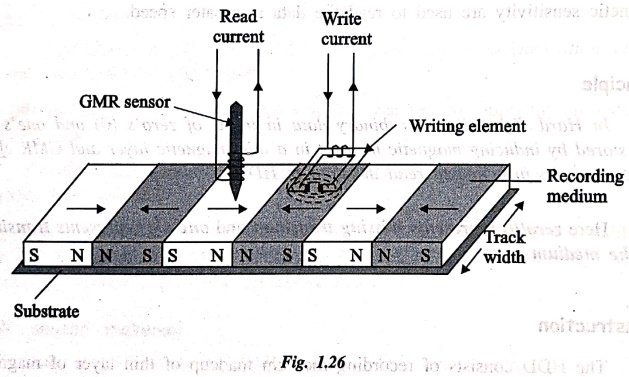
The
writing element and the GMR sensor shall be made to slide over the recording
media in the longitudinal direction as shown in Fig. 1.26. Hence this method is
also called as longitudinal recording.
The
flow of current through the GMR sensor, and writing element shall be adjusted
and inturn the magnetization is sensed (or) controlled in the recording media.
Working
Writing / Storing
1.
Initially the current is passed through the writing element and a magnetic
field is induced in between the gap of the inductive magnetic transducer.
2.
During writing, the amplitude of current is kept constant, and the direction of
current is reversed.
3.
Due to reversal of current, the magnetization orientation is reversed in the
recording medium i.e., from South → North as shown in Fig. 1.26.
4.
When the induced magnetic field is greater than the coercivity of the recording
media, then data is recorded in the form of 1.
5.
Thus one (1) is stored as data in the recording medium as a magnetic
transition.
6.
When there is no magnetic transition, then it is referred as zero (0).
7.
In this way the zero's (0's) and one's (1's) are stored in the recording medium
Reading/Retrieving
8.
Giant magnetoresistive (GMR) effect is the principle used to read/retrieve the
data from the recording medium.
9.
When the GMR sensor is made to move near the recorded medium, then, the
resistance of the GMR sensor varies, with respect to the orientation of the
magnetic moments as follows.
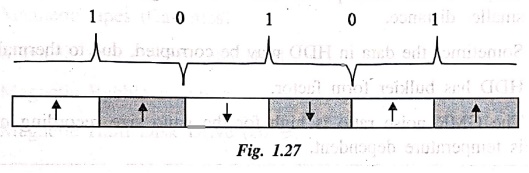
10.
When the layers are magnetised in
parallel manner, then the resistance in the GMR sensor is minimum and
therefore maximum current flows through the sensor, which represents the data
as one (1), as shown in Fig. 1.27.
11.
When the layers are magnetised in antiparallel manner, then the resistance in
the GMR sensor will be maximum and therefore minimum (or) no current will flow
through the sensor, which represents the data as zero (0), as shown in Fig.
1.27.
12.
Therefore, with the help of the reading current, the zero's (0's) and one's
(1's) can be retrieved from the magnetic hard disk drive.
Note:
Recently spin valve sensors, which consists of GMR trilayer (Two ferromagnetic
layers, separated by one non‒metallic inter layer), adjacent to an
antiferromagntic layer are used as reading element for superior magnetic
sensitivity and better performance.
Advantages
1.
HDD's can store data interms of Terabytes and in future it can store data
interms of Petabytes and Exabytes.
Note:
1 Terabyte = 1024
Gigabytes
1 Petabyte = 1024
Tetrabytes
1 Exabytes 1024
Petabytes
2.
It is has very large storage capacity.
3.
It is compact in size and can be easily transferred from one place to another.
4.
The size of the recording medium in HDD shall be reduced upto few nano‒metres
using nanotechnology.
5.
GMR sensors are non diffusive and are very sensitive in reading.
Disadvantages
1.
HDD is slower than SSD [solid state drives].
2.
They consume more power and will damage, when dropped even at a smaller
distance.
3.
Sometimes the data in HDD may be corrupted, due to thermal radiation.
4.
HDD has bulkier form factor.
5.
The GMR noise ratio is high for the nano size recording media as it is
temperature dependent.
Applications
1.
HDD's are used as storage devices in cloud applications.
2.
They are used in coding and signal processing units.
3.
It is used in many Engineering fields such as control systems, nanoelectronics,
etc.
4.
The GMR and spin valve sensors are used in modern HDD by IBM.
Applied Physics CSIE II: UNIT I: Magnetic Materials : Tag: Applied Physics : - GMR Sensors in Magnetic Hard Disk Drive (HDD) Memories
Applied Physics CSIE II: UNIT I: Magnetic Materials
Under Subject
Applied Physics (CSIE) II
PH25C03 2nd Semester AIDS, CSE, IT, CSE(CY) Dept | 2025 Regulation | 2nd Semester 2025 Regulation
Related Subjects

English Essentials II
EN25C02 2nd Semester | 2025 Regulation | 2nd Semester 2025 Regulation

Tamils and Technology தமிழர்களும் தொழில்நுட்பமும்
UC25H02 2nd Semester | 2025 Regulation | 2nd Semester 2025 Regulation
Linear Algebra
MA25C02 2nd Semester | 2025 Regulation
Applied Physics (CSIE) II
PH25C03 2nd Semester AIDS, CSE, IT, CSE(CY) Dept | 2025 Regulation | 2nd Semester 2025 Regulation
Digital Principles and Computer Organization
CS25C06 2nd Semester AIDS, CSE, IT, CSE(CY) Dept | 2025 Regulation | 2nd Semester 2025 Regulation

Basic Electrical and Electronics Engineering
EE25C01 2nd Semester | 2025 Regulation | 2nd Semester 2025 Regulation
Python for Data Science
AD25201 2nd Semester AIDS Dept | 2025 Regulation | 2nd Semester 2025 Regulation

Re-Engineering for Innovation
ME25C05 2nd Semester | 2025 Regulation | 2nd Semester 2025 Regulation
Python for Data Science - Laboratory
AD25201 2nd Semester AIDS Dept | 2025 Regulation | 2nd Semester 2025 Regulation