Applied Physics CSIE II: UNIT I: Magnetic Materials
Explanation of Hysteresis on the basis of Domains
We know when the ferromagnetic material is subjected to external field, there is an increase in the value of the resultant magnetic moment due to two process, viz.,
EXPLANATION OF
HYSTERESIS ON THE BASIS OF DOMAINS
We
know when the ferromagnetic material is subjected to external field, there is
an increase in the value of the resultant magnetic moment due to two process,
viz.,
(i)
The movement of domain walls
(ii)
Rotation of domain walls
Note:
The movement and rotation of domain walls due to application of magnetic field
is given in Appendix‒1.
When
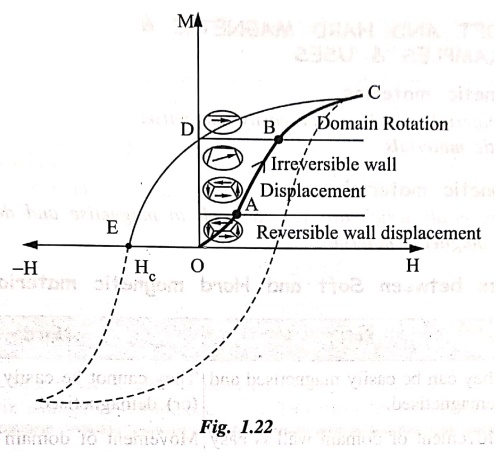
a small external field is applied, the domains walls is displaced slightly in
the easy direction of magnetisation. This gives rise to small magnetisation
corresponding to the initial portion of the hysteresis curve (OA) as shown in
Fig. 1.22.
Now,
if the applied field is removed, then the domains returns to its original
state, and is known as reversible
domains.
When
the field is increased, large number of domains contribute to the magnetisation
and thus the magnetisation (M) increases rapidly with H.
Now,
even when the field is removed, because of the displacement of domain wall to a
very large distance. The domain boundaries do not come back to their original
position. This process is indicated as AB in Fig. 1.22 and this domains are
called irreversible domains.
At
point 'B' all the domains have got magnetised along the easy direction.
Now,
when the field is further increased, the domains start rotating along the field
direction and the anisotropic energy is stored in the hard direction, represented as BC in the Fig. 1.22.
Thus
the specimen is said to attain the maximum magnetisation. At this position,
even after the removal of external field the material posses maximum
magnetisation, called residual magnetism (or) retentivity, represented by OD in Fig. 1.22.
Actually
after the removal of the external field, the specimen will try to attain the
original configuration by the movement of Bloch wall. But this movement is
stopped due to the presence of impurities, lattice imperfections etc. Therefore
to overcome this, a large amount of reverse magnetic field is applied to the
specimen. The amount of energy spent to reduce the magnetisation to zero is
called as coercivity represented by 'OE in the Fig. 1.22.
Hysteresis Loss
It
is the loss of energy in taking a ferromagnetic specimen through a complete
cycle of magnetisation and the area enclosed is called hysteresis loop.
Based
on the area of the hysteresis loop, the magnetic materials are classified into
soft and hard magnetic materials.
Applied Physics CSIE II: UNIT I: Magnetic Materials : Tag: Applied Physics : - Explanation of Hysteresis on the basis of Domains
Applied Physics CSIE II: UNIT I: Magnetic Materials
Under Subject
Applied Physics (CSIE) II
PH25C03 2nd Semester AIDS, CSE, IT, CSE(CY) Dept | 2025 Regulation | 2nd Semester 2025 Regulation
Related Subjects

English Essentials II
EN25C02 2nd Semester | 2025 Regulation | 2nd Semester 2025 Regulation

Tamils and Technology தமிழர்களும் தொழில்நுட்பமும்
UC25H02 2nd Semester | 2025 Regulation | 2nd Semester 2025 Regulation
Linear Algebra
MA25C02 2nd Semester | 2025 Regulation
Applied Physics (CSIE) II
PH25C03 2nd Semester AIDS, CSE, IT, CSE(CY) Dept | 2025 Regulation | 2nd Semester 2025 Regulation
Digital Principles and Computer Organization
CS25C06 2nd Semester AIDS, CSE, IT, CSE(CY) Dept | 2025 Regulation | 2nd Semester 2025 Regulation

Basic Electrical and Electronics Engineering
EE25C01 2nd Semester | 2025 Regulation | 2nd Semester 2025 Regulation
Python for Data Science
AD25201 2nd Semester AIDS Dept | 2025 Regulation | 2nd Semester 2025 Regulation

Re-Engineering for Innovation
ME25C05 2nd Semester | 2025 Regulation | 2nd Semester 2025 Regulation
Python for Data Science - Laboratory
AD25201 2nd Semester AIDS Dept | 2025 Regulation | 2nd Semester 2025 Regulation