Applied Physics CSIE II: UNIT I: Magnetic Materials
Principle of Magnetic Recording in Computer Data Storage
Generally ferro or ferrimagnetic materials are used in the storage devices, because in this type of materials only the magnetic interaction between any two dipoles align themselves parallel to each other.
PRINCIPLE OF MAGNETIC
RECORDING IN COMPUTER DATA STORAGE
Now
a days, large number of informations are stored in (or) retrieved from the
storage devices, by using the magnetic phenomena. The main part of these magnetic
storage devices is magnetic recording heads and they function according to the
principles of magnetic induction.
Generally
ferro or ferrimagnetic materials are used in the storage devices, because in
this type of materials only the magnetic interaction between any two dipoles
align themselves parallel to each other. Due to this parallel alignment, even
if we apply small amount of magnetic field, a large value of magnetisation is
produced. By using this property informations are stored in the storage devices.
In
the storage devices, the recording of digital data (0's and 1's) depends upon
the direction of magnetisation in the medium.
Magnetic parameters for recording
1.
When current is passed through a coil, a magnetic field is induced. This
principle, called "electromagnetic
induction" is used as a basic parameter in the storage device.
2.
The ease with which the material can be magnetised is another parameter.
3.
We know the soft magnetic materials are the materials which can easily be
magnetised and demagnetised. Hence based on this parameter, a data Le can be
stored and erased easily. Such magnetic materials are used in temporary storage devices.
4.
Similarly we know hard magnetic materials cannot be easily magnetised and
demagnetised easily. So, such magnetic materials are used in permanent storage devices.
5.
In soft magnetic materials, the electrical resistance varies with respect to
the magnetisation and this effect is called magneto‒resistance. This parameter is used in specific thin film
systems.
Note:
If the change in electrical resistance is very high compared to the
magnetisation, it is called GIANT MAGNETO‒ RESISTANCE (GMR) effect.
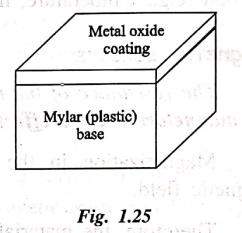
Magnetic Medium
Magnetic
medium is made of magnetic material (ferrous or ferric oxide) deposited on in
plastic as shown in Fig. 1.25.
Read‒Write Mechanism
The
magnetic medium move across the read/write heads and either logic 1's or logic
0's are written on the medium. Then, the medium moves across the head again,
the magnetised spots on the medium generate small electrical signals and this
different direction signals represent logic 1's and 0's on the medium.
Now,
when the recorded medium moves over the read head, the change in magnetic field
generates very small signals in the head winding and they are amplified. From
this the logic signals 1's and 0's are read depending on the data stored on the
medium.
Applied Physics CSIE II: UNIT I: Magnetic Materials : Tag: Applied Physics : - Principle of Magnetic Recording in Computer Data Storage
Applied Physics CSIE II: UNIT I: Magnetic Materials
Under Subject
Applied Physics (CSIE) II
PH25C03 2nd Semester AIDS, CSE, IT, CSE(CY) Dept | 2025 Regulation | 2nd Semester 2025 Regulation
Related Subjects

English Essentials II
EN25C02 2nd Semester | 2025 Regulation | 2nd Semester 2025 Regulation

Tamils and Technology தமிழர்களும் தொழில்நுட்பமும்
UC25H02 2nd Semester | 2025 Regulation | 2nd Semester 2025 Regulation
Linear Algebra
MA25C02 2nd Semester | 2025 Regulation
Applied Physics (CSIE) II
PH25C03 2nd Semester AIDS, CSE, IT, CSE(CY) Dept | 2025 Regulation | 2nd Semester 2025 Regulation
Digital Principles and Computer Organization
CS25C06 2nd Semester AIDS, CSE, IT, CSE(CY) Dept | 2025 Regulation | 2nd Semester 2025 Regulation

Basic Electrical and Electronics Engineering
EE25C01 2nd Semester | 2025 Regulation | 2nd Semester 2025 Regulation
Python for Data Science
AD25201 2nd Semester AIDS Dept | 2025 Regulation | 2nd Semester 2025 Regulation

Re-Engineering for Innovation
ME25C05 2nd Semester | 2025 Regulation | 2nd Semester 2025 Regulation
Python for Data Science - Laboratory
AD25201 2nd Semester AIDS Dept | 2025 Regulation | 2nd Semester 2025 Regulation