Applied Calculus: UNIT I: Differential Calculus
Continuous functions
Differential Calculus
The limit of a function as x approaches a can often be found simply by calculating the value of the function at a. The functions with this property are called continuous at a.
CONTINUOUS FUNCTION
The limit of a function
as x approaches a can often be found simply by calculating the value of the
function at a. The functions with
this property are called continuous
at a.
Definition of continuity:
A function f is a continuous at a number a
if
limx→α f(x) = f(a)
Note:
The above definition
requires three things if f is a
continuous at a.
(1) f(a) is defined (i. e., a is in the
domain of f)
(2) lim x→α f(x) exists
(3) lim x→α f(x) = f(a)
The definition says
that f is continuous at a if f(x)
approaches f(a) as x approaches a. Thus a continuous function
f has the property that a small change in x produces only a small change in f(x).
In fact, the change in f(x) can be kept as small as we please
by keeping the change in x sufficiently
small.
Physical phenomena are
usually continuous. For example, height of a person varies continuously with
time, velocity of a vehicle varies continuously with time.
Geometrically the graph
of the function can be drawn without removing your pen from the paper, so, we
can say the function is continuous.
If f is defined near a (in other words, f is defined on an open interval containing a, except perhaps at a),
we say that ƒ is discontinuous at a (or
f is discontinuity at a) if f is not continuous at a.
Physically,
discontinuous occurs in such situations electric current.
There are three type of
discontinuity namely
1. Removable
discontinuity.
2. Jump discontinuity.
3. Infinite
discontinuity.

Left and Right Continuous
A function f is a continuous from the right at a
point a if
limx→a+
f(x) = f(a)
A
function f is a continuous from the
left at a point a if
limx→a‒ f(x) = f(a)
Theorem
The following types of
functions are continuous in their domain
(1) Polynomial function
is continuous for all x ∈ R.
(2) Rational function
is continuous for all x ∈ R.
(3) Root function is
continuous for x≥ 0.
(4) Trigonometric
functions sinx and cos x are
continuous for all x ∈ R, where tan x is discontinuous at x == π/2.
(5) Inverse
trigonometric functions for all x ∈ R.
(6) Exponential
functions for all x ∈ R.
(7) Logarithmic
functions continuous for x>0.
Theorem:
If ƒ and g are continuous at a point a, then
(1)f+g is continuous at
a
(2) f g is continuous at a
(3) cf is continuous at
a, where c is constant
(4) fg is continuous at
a
(5) f/g is continuous
at a if g(a) 0
Example
75. Discuss the continuity of the function f(x)
= 
Solution:
A function f is a continuous at a point a if
limx→af(x) = f(a)
The given function 1/x2
is defined for all real
value of x and also ƒ(0) = 1
limx→0
f(x) = limx→0 1/x2 = ∞
limx→a
f(x) does not exists.
Hence f(x) is discontinuous at x = 0.
Example
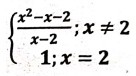
76. Discuss the continuity of the function f(x)
= 
Solution: A function f is a continuous at a point a if
limx→a
f(x) = f(a)
The given function (x2‒x‒2)/(x‒2) is defined for
all value of x and also f(2) = 1.

limx→2 f(x) = 3 ≠ 1 = f(2). Hence f(x) is
discontinuous at x = 2.
Example
77. Discuss the continuity of the function f(x)
= 
Solution:
A function f is a continuous at a
point a if
limx→a
f(x) = f(a)
The given function (x2‒x‒2)/(x‒2) is defined for
all value of x and also f(2) = 3.

limx→2 f(x) = 3 = f(2). Hence f(x) is continuous
at x = 2.
Example
78. Use the definition of continuity and the properties of limits to show that
the function is continuous at a given number a.
f(x) = (x + 2x3)4;
a = −1
Solution:
A function f is a continuous at a
point a if
limx→α f(x)
= f(a)
The given function
f(x)
= (x + 2x3)4
limx→α f(x)
= limx→‒1 f(x) = (limx→‒1 (x
+ 2x3)4)
= (‒1+2(‒1)3)4
= (−1 + 2(−1))4
= (−3)4
= 81 ... (1)
f(a)
= f(‒1)
= (‒1+2(‒1)3)4
= 81 ... (2)
From (1) and (2),
limx→α f(x)
= f(a)
f(x)
is continuous at a = ‒1
Example
79. Use the definition of continuity and the properties of limits to show that
the function is continuous at a given number a.
f(x) = 3x4 − 5x + 3√[x2 + 4], a = 2
Solution:
A function f is a continuous at a
point a if
lim x→α f(x)
= f(a)
The given function
f(x)
= 3x4 ‒ 5x + 3√[x2 + 4]
limx→α f(x)
= limx→2 f(x)
= 3(2)4 ‒
5(2) + 3√(22+4) = 3(16) ‒ 10 + 3√[4 + 4]
= 48‒10+3√8 =
38+2
= 40 ... (1)
f(a)
= f(2)
= 3(2)4‒5(2)
+ 3√(22+4) = 3(16) ‒ 10 + 3√(4 + 4)
= 48‒10+ 3√8
= 38+2
= 40 ... (2)
From (1) and (2),
limx→a f(x)
= f(a)
f(x)
is continuous at a = 2
Example
80. Show that f is continuous on (‒∞,
∞), f(x) = 
Solution:
1‒x2 is a polynomial which
is continuous for x≤ 1 and logx is
continuous for x > 1
f(x) is continuous in the
domain (‒∞,1) U (1,∞).
At x = 1

To
find f(1):
Since x = 1 lies in x ≤ 1
f(x)
= 1‒x2
ƒ(1) = 1‒12
= 0
limx→1f(x)
= f(1)
Hence f(x) is continuous at x = 1
f(x)
is continuous on (‒∞, ∞).
Example
81. Let f(x) =  Evaluate
each if the (x‒3)2 if x >3
Evaluate
each if the (x‒3)2 if x >3
following
limits, if they exist

Also,
find where f(x) is continuous.
Solution:

Also f is continuous at x = 3 since by (4) and (6)
Example
82. Show that ƒ is continuous on (‒∞, ∞), f(x)
=  .
.
Solution:
sin x is continuous for x > π/4 and
cos x is continuous for x≤ π/4.
ƒ(x) is continuous in the domain (‒∞,π/4)U (π/4,∞).
At x = π/4

Hence f(x) is continuous at x = π/4.
f(x)
is continuous on (‒∞, ∞).
Example
83. For what values of constant c is the function f continuous on (‒∞,∞)

Solution:
Given f is continuous in the domain (‒∞,
∞).
Since f(x) is continuous at x = 2, we have
lim x→2‒ f(x)
= limx→2 f(x) ... (1)
lim x→2‒ f(x)
= lim x→2 (cx2 + 2x)
c(2)2 + 2(2)
= 4c + 4
lim x→2+ f(x)
= lim x→2 (x3‒ cx).
= (2)3‒ c(2) = 8‒2c
Since f is continuous in the domain (‒∞, ∞),
lim x→2‒ f(x)
= lim x→2+ f(x)
4c+4=8‒2c
4c+2c=8‒4
6c = 4
c = 2/3
Example
84. For what values of constant a and
b is f(x) =  is continuous at every x?
Solution:
Given f is continuous in the domain (‒∞,
∞).
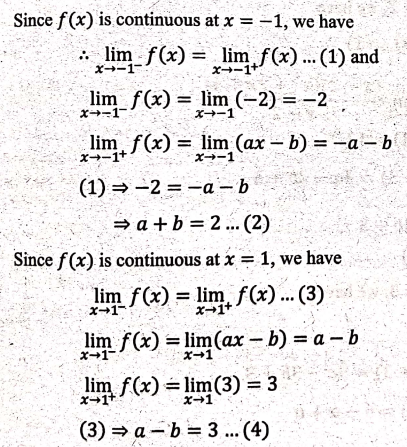
(3) a ‒ b = 3... (4)
Adding (2)and (4), we
get
2a = 5
a=5/2
Substitute a = 5/2 in (2), we get
5/2 + b = 2
B = ‒ 1/2
Example
85. For what values of constant a, b is the function f continuous on (‒∞, ∞)

Solution:
Given f is continuous in the domain (‒∞,
∞).
Since f(x) is continuous at x = 2, we have
lim f(x) = lim f(x) ... (1)
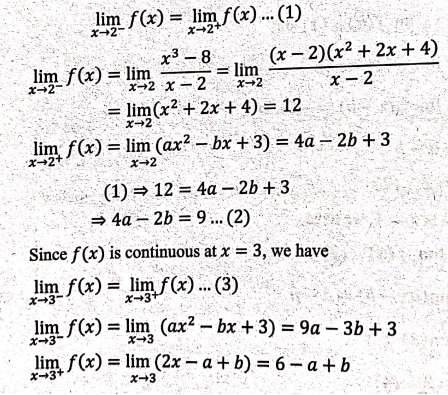
(3) ⇒
9a‒3b+3
= 6‒a+b
⇒
10a‒4b = 3... (4)
Solving for (2) and
(4), we ge
a =
‒ 15/2 and b= ‒ 39/2
Example
86. Where is the function f(x) = Inx+tan‒1x / x2‒1 continuous?
Solution: y =
ln x is continuous for x > 0 i.e(0, ∞) and y = tan‒1x is is continuous on R.
.. y = ln x + tan‒1x is continuous on (0,∞). The
denominator,
y = x2
‒1 is a polynomial, so it is continuous for all x. However, the function is continuous where x2‒1 = 0 ↔ x = ±1. Since the domain of the numerator is
(0,∞), take x = 1. Hence f(x) is not continuous at x = 1.
f(x) = Inx+tan‒1x / x2‒1 is
continuous on the interval (0,1) U (1,∞).
Example
87. Show that function f(x) = 1 − √[1−x2] is the continuous in the
interval [‒1,1].
Solution:

= ƒ(1)
f(x)
is continuous at x = 1
f(x)
is continuous on [‒1,1]
Example
88. Use the definition of continuity and the properties of limits to show that
the functions f(x) = x+√[x‒4] is continuous on the interval [4,∞]
Solution:
Let ‒4 < a < 1
limx→a
f(x) = limx→a
(x + √[x‒4]) = a + √[a‒4]
= f(a)
f(x)
is continuous on (4, ∞]
lim x→4 f(x) = lim x→4
(x + √[x‒4])
= 4+√[4‒4] = 4
f(4)
= 4+√[4‒4] = 4
lim x→4 f(x) = f(4)
Hence f(x) is continuous on x = 4
f(x)
is continuous on [4, ∞]
Example
89. Evaluate lim
x→π [ sinx / 2+cosx ] using continuity
Solution:
The function y sinx is continuous for all values of x. The function y = 2+ cos x is sum of
two continuous functions and therefore continuous for all values of x. Notice that 2 + cos x is never zero because
cosx ≥ ‒1⇒
2+ cos x ≥ 2 −1 = 1
2 + cosx ≥ 1
Thus the ratio
f(x)
= sinx / 2+cosx
is continuous for all
values of x. Hence by definition of
continuous function
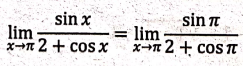
0 / 2‒1 = 0.
Example
90. Discuss the continuity of f(x) =
tan x.
Solution:
The function f(x) = tan x = sinx / cosx is continuous
except when cosx = 0.
When x = ± [ (2n‒1)π /2 ], n = 1,2,3,..., cos x = 0. Therefore, f(x) =
tan x has infinite discontinuities
when x = ±π/2, ± зπ/2, ± 5π/2, ...
and the same is illustrated in the following figure.

EXERCISE
24. Use the definition
of continuity and the properties of limits to show that the function is
continuous on the given interval.
(a) f(x) = x2 + √[7 –x], a = 4
(b) f(x) = 2x‒3x2 / 1+x3 , a=1
(c) f(x) = 2x+3 / x‒2 , (2,∞)
(d) f(x) = 2√[3‒x] , (‒∞,3]
(e) f(x) =
x2+5x / 2x+1
, a = 2
(f) f(x) = 2√[3x2 + 1], a = 1
25. Use continuity to evaluate
the limit.
(a) limx→4 [
5+√x / √5+x ]
(b) lim x→1 ex2-x
26. Where are each of
the following functions discontinuous?

(d) f(x) = [x] Ans: discontinuities at all
of the integers.
Applied Calculus: UNIT I: Differential Calculus : Tag: Applied Calculus : Differential Calculus - Continuous functions
Applied Calculus: UNIT I: Differential Calculus
Under Subject
Applied Calculus
MA25C01 Maths 1 M1 - 1st Semester | 2025 Regulation | 1st Semester 2025 Regulation
Related Subjects

English Essentials I
EN25C01 1st Semester | 2025 Regulation | 1st Semester 2025 Regulation

தமிழர் மரபு - Heritage of Tamils
UC25H01 1st Semester | 2025 Regulation | 1st Semester 2025 Regulation
Applied Calculus
MA25C01 Maths 1 M1 - 1st Semester | 2025 Regulation | 1st Semester 2025 Regulation
Applied Physics I
PH25C01 1st Semester | 2025 Regulation | 1st Semester 2025 Regulation

Applied Chemistry I
CY25C01 1st Semester | 2025 Regulation | 1st Semester 2025 Regulation

Makerspace
ME25C04 1st Semester | 2025 Regulation | 1st Semester 2025 Regulation
Computer Programming C
CS25C01 1st Semester | 2025 Regulation | 1st Semester 2025 Regulation
Computer Programming Python
CS25C02 1st Semester | 2025 Regulation | 1st Semester 2025 Regulation
Fundamentals of Electrical and Electronics Engineering
EE25C03 1st Semester | 2025 Regulation | 1st Semester 2025 Regulation
Introduction to Mechanical Engineering
ME25C03 1st Semester | 2025 Regulation | 1st Semester 2025 Regulation

Introduction to Civil Engineering
CE25C01 1st Semester Civil Department | 2025 Regulation | 1st Semester 2025 Regulation
Essentials of Computing
CS25C03 1st Semester - AID CSE IT Department | 2025 Regulation | 1st Semester 2025 Regulation

Applied Physics I Laboratory
PH25C01 1st Semester practical Laboratory Manual | 2025 Regulation | 1st Semester Laboratory 2025 Regulation

Applied Chemistry I Laboratory
CY25C01 1st Semester practical Laboratory Manual | 2025 Regulation | 1st Semester Laboratory 2025 Regulation

Computer Programming C Laboratory
CS25C01 1st Semester practical Laboratory Manual | 2025 Regulation | 1st Semester Laboratory 2025 Regulation

Computer Programming Python Laboratory
CS25C02 1st Semester practical Laboratory Manual | 2025 Regulation | 1st Semester Laboratory 2025 Regulation
Engineering Drawing
ME25C01 EEE Mech Dept | 2025 Regulation | 2nd Semester 2025 Regulation

Basic Electronics and Electrical Engineering
EE25C04 1st Semester ECE Dept | 2025 Regulation | 2nd Semester 2025 Regulation