Applied Calculus: UNIT I: Differential Calculus
Derivative of a function
Differential Calculus
1. The product, quotient and chain rules 2. Differentiation of some standard functions 3. Differentiation of inverse trigonometric functions 4. Derivatives of hyperbolic functions 5. Problems under derivatives 6. Derivatives using logarithm 7. Velocities
DERIVATIVE AS A FUNCTION
In geometry, the
tangent line (or simply tangent) to a plane curve at a given point is the
straight line that "just touches" the curve at that point. In other
words, a tangent line should have the same direction as the curve at the point
of contact. As it passes though the point where the tangent line and the curve
meet, called the point of tangency, the tangent line is "going in the same
direction" as the curve, and is thus the best straight‒line approximation
to the curve at that point.
The geometrical idea of
the tangent line as the limit of secant lines serves as the motivation for
analytical methods that are used to find the tangent lines explicitly. The
question of finding the tangent line to a graph, or the tangent line problem,
was one of the central questions leading to the development of calculus.
The Tangent Problem
If a curve C has the
equation y = f(x) and we want to find the tangent line to C at the point P(a, f(a)), then we consider a nearby point
Q(x, f(x)), where x ≠ a, and compute the
slope of the secant line PQ:
mPQ = [ f(x) ‒ f(a) ] / (x‒a)
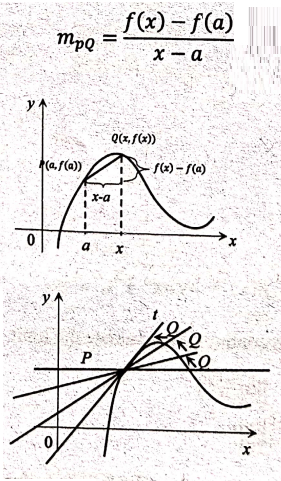
Then we let Q approach
P along the curve C by letting x approaches
a. If mPQ approaches a
number m, then we define the tangent t to be the line through P with slope m. (This amounts to saying that the tangent line is the limiting
position of the secant line PQ as Q approaches P).
Definition 1:
The tangent line to the
curve y = f(x) at the point P(a, f(a)) is the line through P with slope
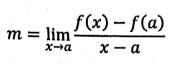
provided that this
limit exists.
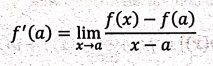
Definition 2:
The derivative of a
function f at a number a, denoted by f'(a), is

if this limit exists.
If we write x = a
+ h, then we have h = x‒a and h approaches 0 if and only if
x approaches a. Therefore an
equivalent way of starting the definition of the derivative, as we saw in
finding tangent lines, is
Remark:
The tangent line to y = f(x)
to (a, f(a)) whose slope is equal to f'(a), the derivative of f at a. Using point‒slope form, the tangent line can be expressed as
y‒f(a) = f'(a)(x − a)
Definition 3:
A function f is differentiable at a if f'(a)
exists. It is differentiable on an open interval (a, b) [or (a, ∞) or (‒∞, a) or (‒∞, ∞)] if it is differentiable at every number in the
interval.
Definition 4:
The tangent line x = a
to y = f(x) is said to be a horizontal
tangent if f'(a) = 0.
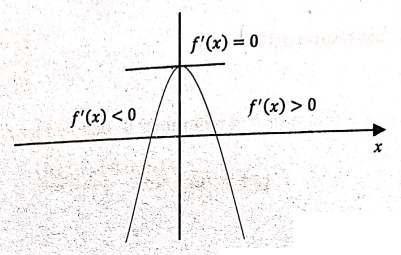
Derivatives can help
graph many functions. The first derivative of a function is the slope of the
tangent line for any point on the function. Therefore, it tells when the
function is increasing, decreasing or where it has a horizontal tangent.
Consider the following graph. Notice on the left side, the function is
increasing and the slope of the tangent line is positive. At the vertex point
of the parabola, the tangent is a horizontal line, meaning f '(x)= 0 and on the
right side the graph is decreasing and the slope of the tangent line is
negative.
1. THE PRODUCT, QUOTIENT AND CHAIN RULES
The product rules
Theorem:
If
ƒ and g are both differentiable, then

Proof: Let u = f(x)
and v = g(x) are both positive differentiable functions. Then x changes by an amount Δx, then the corresponding changes in u and v are
Δu = f(x + Δx) ‒ f(x),
Δv = g(x + Δx) ‒ g(x)
Δ(uv) = (u + Δu)(v
+ Δv) ‒ uv
= uΔv + vΔu + ΔuΔv
If we divide by Δx, we get
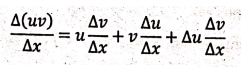
If we now let Δx→ 0, we get the derivative of uv:

The Quotient Rule:
Theorem:
If ƒ and g are both differentiable,
then
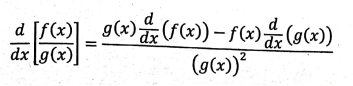
Proof:
We find a rule for
differentiating the quotient of two differentiable functions u = f(x)
and v = g(x) in much the same way that we found the Product Rule. If x, u and v change by amount Δx, Δu, and Δv, then the corresponding change in the quotient u/v
is

As Δx → 0, Δv→ 0 also, because v = g(x) is differentiable and therefore continuous.
Then, using the Limit Laws, we get
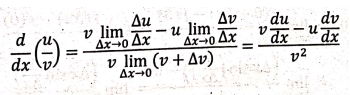
Chain Rule:
If g is differentiable at x and
ƒ is differentiable at g(x), then the
composite function f = fog defined by F(x) = f(g(x)) is
differentiable at x and F' is given by the product
F
'(x)
= f '(g(x)). g'(x)
In Leibniz notation, if y = f(u)
and u = g(x) are both differentiable functions, then
dy/dx =
dy/du • du/dx
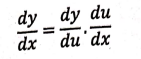
Proof: Let Δu (Δu
≠ 0) be the change in u corresponding
to a change of Δx in x, that is, Δu = g(x + Δx) − g(x).

PROBLEMS UNDER DERIVATIVES
Let y = f(x) be a function
defined on R. Then
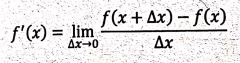
Derivate at a point x = a
is f '(a) = 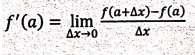
Example
91. Determine whether f '(0) exist or
not f(x) = 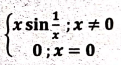
Solution:
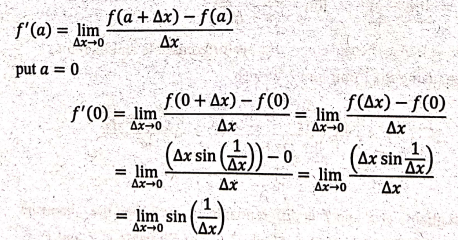
This value is not
unique (value lies between ‒1 and 1)
f '(0)
does not exists.
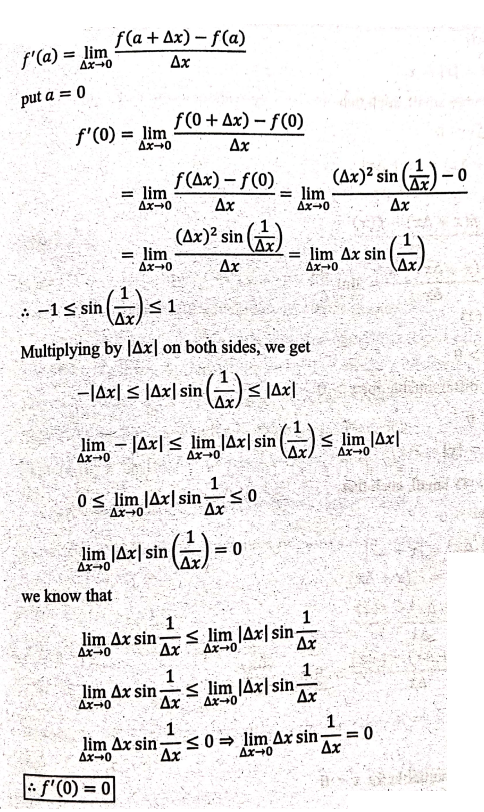
Example
92. Determine whether f'(0) exist or
not f(x) = 
Solution:
Example
93. Whether is the function f(x) =
|x| is differentiable?
Solution:
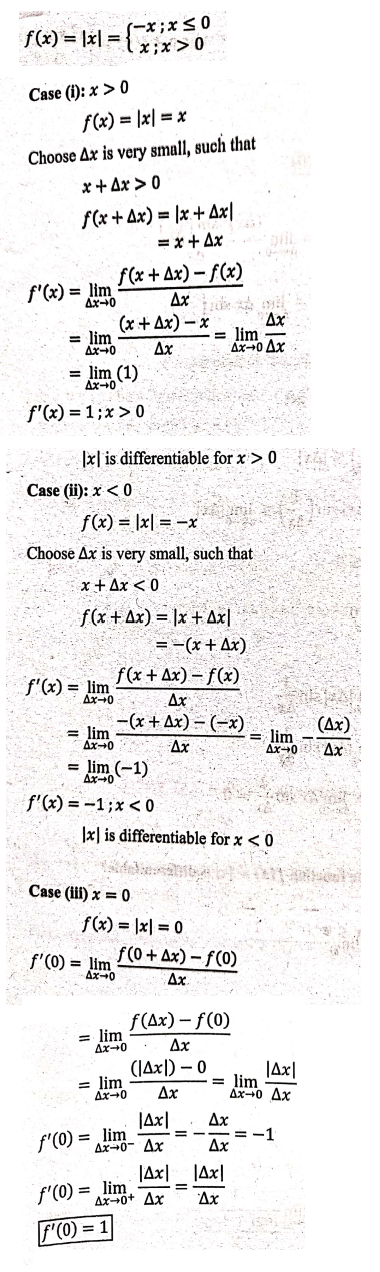
f '(0) = 1
Since f '(0) is not unique, f '(0) dose not exits.
Hence f(x) = |x| is differentiable expect at the origin.
Both continuity and
differentiability are desirable properties for a function. The following
theorem shows how these properties are related.
Theorem:
Every differentiable function is continuous
Remark:
Continuous function need not be differentiable.
Example:
f(x)
= |x| is continuous at origin but not
differentiable at origin.
2. DIFFERENTIATION OF SOME STANDARD FUNCTIONS
Example
94. Find the derivative of constant function.
Solution:
Let f(x) = c
:. f(x + Δx) = c

f
'(x) = 0
Example
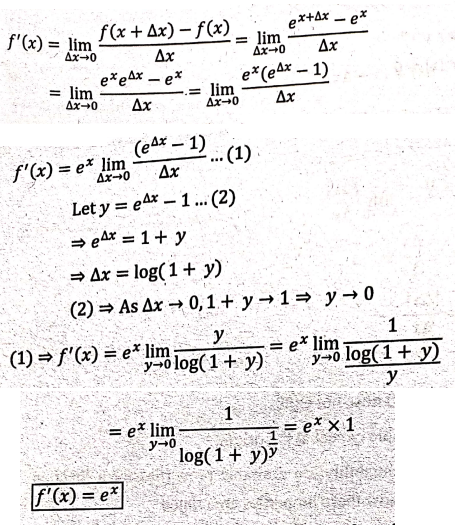
95. Find the derivative of the function f(x)
= ex.
Solution:
Let f(x) = ex
f(x + Δx) = ex+Δx
Example
96. Find the derivative of the function f(x)
= log x
Solution:

Example
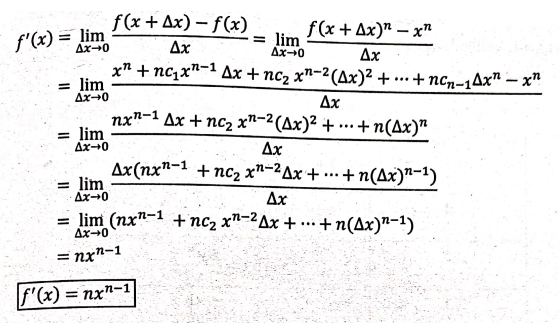
97. Find the derivative of the function f(x)
= xn; n is a positive integers.
Solution:
Let f(x) = xn
:. f(x+Δx) = (x + Δx)n
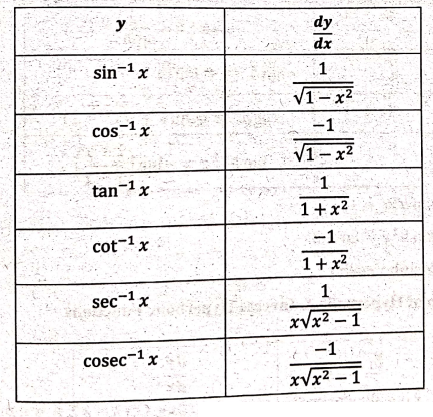
3. DIFFERENTIATION OF INVERSE TRIGONOMETRIC FUNCTIONS
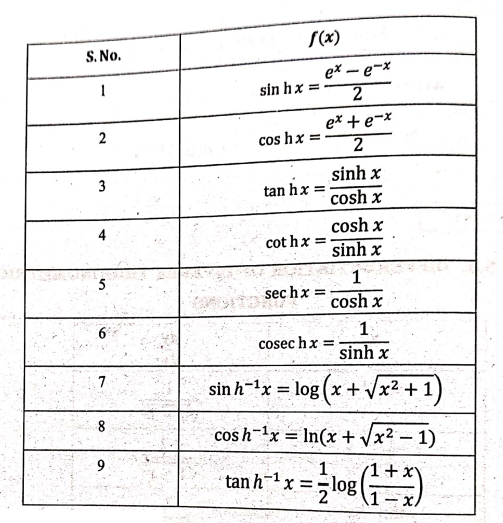
4. DERIVATIVES OF HYPERBOLIC FUNCTIONS
Some even and odd
combinations of the exponential function ex
and e‒x arise frequently
in Mathematics and its applications that they deserve to be given special
names. In many ways they are analogous to the trigonometric functions and they
have the same relationship to the hyperbola, that the trigonometric functions
have to the circle. For this, they are called hyperbolic functions and individually
called hyperbolic sine, hyperbolic cosine and so on.
Formulae for Hyperbolic & Inverse Hyperbolic Functions
10. cos h2x ‒ sin h2x = 1
11. cos h2x + sin h2x = cos h2x
12. sinh 2x = 2 sinh x cosh x
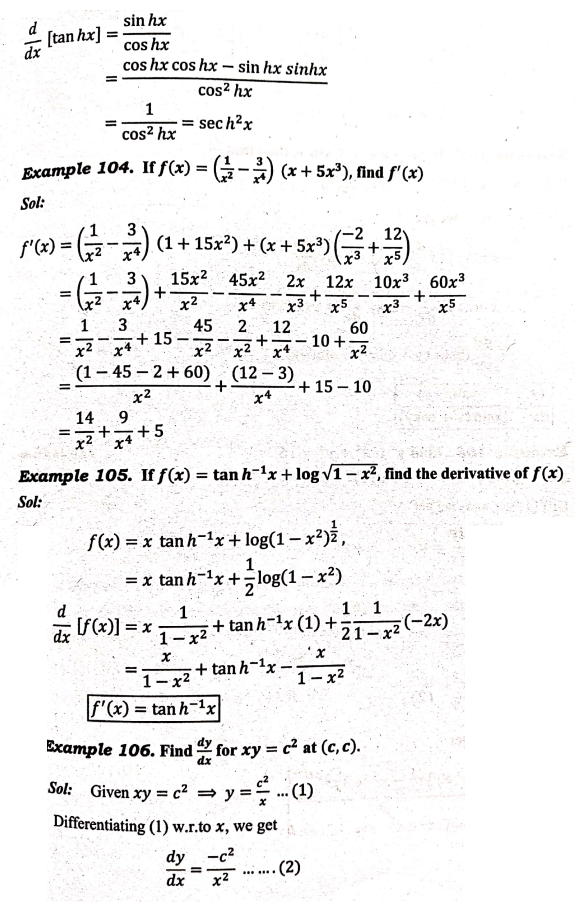
Differentiation of Hyperbolic & Inverse Hyperbolic Functions

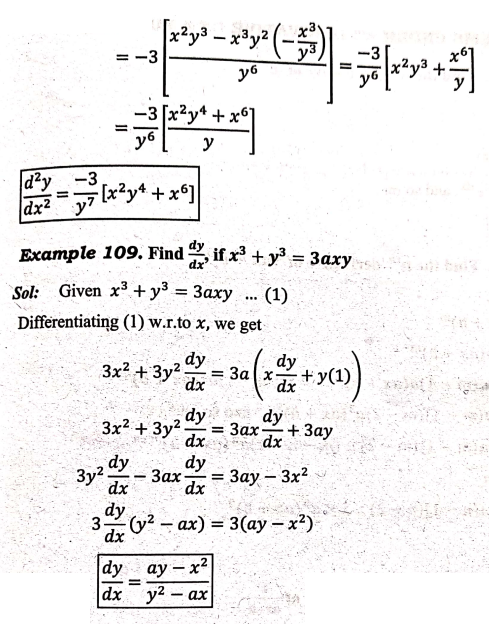
5. PROBLEMS UNDER DERIVATIVES

Example
98. Find the derivative of (i) x e‒2x (ii) x(x2 ‒ 1)(x2+4)
Solution:
(i) d/dx (xe‒2x)
= x(‒2 e‒2x) + (1)e‒2x
= ‒2xe‒2x + e‒2x = e−2x(‒2x+1)
(ii) d/dx [x(x2 ‒ 1) (x2 + 4)]
= 1(x2‒1)(x2+4) + x(2x)(x2+4)
+ x(x2‒1)2x
= x2 + 4x2
‒ x2 ‒ 4 + 2x2 + 8x2 + 2x2
‒ 2x2
= 5x4 +9x2
‒ 4


Example
110. The equation of motion of a particle is S = 2t3 ‒ 5t2
+ 3t + 4, where S is measured in centimeters and t in seconds. Find the acceleration as a function of time. What is
the acceleration after 2 seconds?
Solution:
It is given that S = 2t3‒5t2+3t+4
Velocity = V(t) = ds/ dt
= 6t2‒10t+3
Acceleration = a(t)
= dV/ dt = d2s/dt2 =
12t‒10
The acceleration after
2 second is a(2) = 24‒10 = 14 cm/sec2
PROBLEMS
UNDER nth DERIVATIVE OF A FUNCTION
Example
111. Find the nth
derivative of eax
Solution:
Let y = eax
Then
y'
= aeax
y"
= a2eax and so
on ...
:: yn = an
eax
Example
112. Find the nth
derivative of (ax + b)m.
Solution:
Let y = (ax + b)m
Then
y'
= ma(ax + b)m‒1
y"
= ma(m − 1)a(ax + b)m‒2
= m(m−1)a2(ax+b)m‒2
y"'
= m(m − 1)(m − 2)a3(ax + b)m‒3 and
so on....
y(n)
= m(m −1)(m − 2) ... (m − n
+ 1)an (ax + b)m‒n
When m = n
y(n)
= n(n − 1)(n − 2) ... 1 × an (ax + b)°
.. y(n)
= n! an
Example
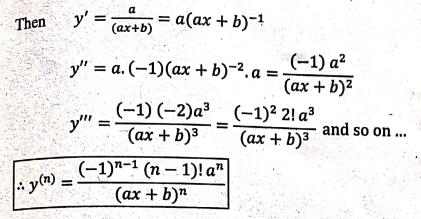
113. Find the nth derivative of 1 / ax+b
Solution:

Example
114. Find the nth
derivative of log(ax + b)
Solution:
Let y = log(ax + b)
Example
115. Find the nth
derivative of sin(ax + b)
Solution:
Let y=sin(ax + b)
Then
y'
= acos(ax+b)
= asin (ax+b+π/2)
= asin(ax + b') where b' = b + π/2
y"
= a2 cos(ax + b')
= a2 sin (ax + b' + π/2) = a2 sin (ax + b + π/2 + π/2)
= a2 sin (ax+b+2(π/2))
y''' = a3sin
(ax+b+3(π/2)) and so on...
y(n)
= an sin (ax + b + n(π/2) )
Example
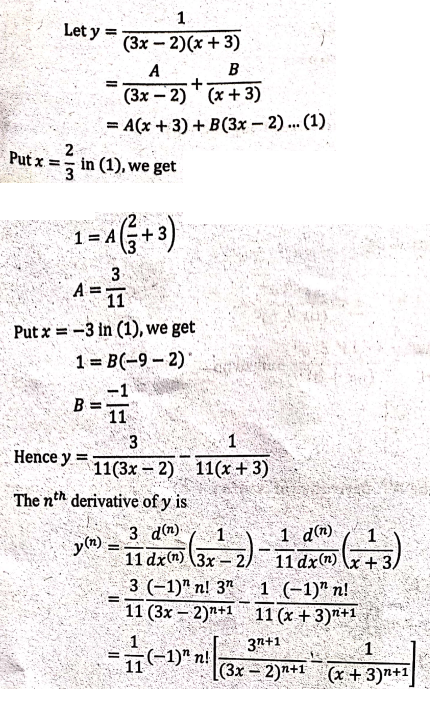
116. Find the nth differential coefficient of 1 / [(3x‒2)(x+3)] with
respect to x.
Solution:
Example
117. If f(x) = xex then find f'(x).
Also find the nth derivative fn(x).
Solution:
Let f(x) = xex
To find f '(x)
Then f '(x)
= xex + ex (1)
f '(x) = xex + ex
To find the nth
derivative
f "(x) = xex
+ ex(1) + ex
= xex + 2ex
ƒ'''(x) = xex
+ ex(1) + 2ex
= xex + 3ex and so on...
: f n(x) = xex
+ nex
fn(x) = (x + n)ex
6. DERIVATIVES USING LOGARITHM
Example
118. Find the differential coefficient of 
Solution:

Example
119. If y = ax, find dy/dx.
Solution:
y
=
ax
log y = log ax
log y = xlogax
Different w.r.t x
1/y . dy/dx = log a
dy/dx = y loga
dy/dx = = ax loga
Example
120. If yx = xy, find dy/dx.
Solution:
yx
= xy
log yx = log xy
xlog y = y
log x
Different w.r.t x

Example
121. If y = (sin x)x, find dy/dx.
Solution:
y = (sin x)x
log y = log(sinx)x
log y = xlog(sin x)
Different w.r.t x

dy/dx = y(x
cotx + log sinx)
Example
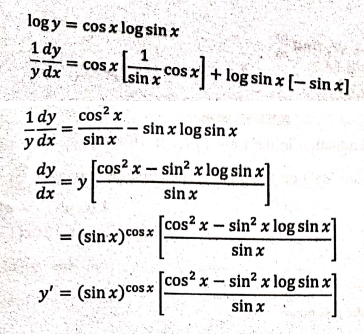
122. Find y' if y = (sin x)cos x
Solution:
Given y (sin x)cos x
log y = cos x log sin x
Example
123. If y = u+v where u = xx,
v = x1/x then find dy/dx.
Solution:
y = u+v

EXERCISE
27. Write the composite
function in the form f[g(x)].
[Identify the inner function u = g(x) and the other function y = f(u)].
Then find the derivative
(a) y = sin 4x Ans: y'(x) = 4 cos 4x
(b) y = (1‒x2)10
Ans: y'(x) = ‒20x(1 − x2)9
(c) y = e√x Ans: y' (x) = e√x / 2√x
28. Find the derivative
of the functions.
(a) f(x) = 4√[1+ 2x + x3] Ans:
f'(x) = 2+3x2 / 4(1+2x+x3)3/4
(b) f(x) = 1 / (x4 +1)3 Ans:
f '(x) = ‒ [ 12x3
/ (x4+1)4 ]
(c) y(x) = cos(a3 + x3) Ans:
y'(x) = ‒3x2 sin(a3 + x3)
(d) f(x) = (2x − 3)4(x2
+ x + 1)5 Ans:
f '(x) = (2x − 3)3
(x2 + x + 1)4 (28x2
‒ 12x‒7)
(e) y(x)
= [ (x2+1)/(x2+1) ]3 Ans: y'(x) = ‒12x(x2+1)2
/ (x2‒1)4
(f) y(x)
= √[1 + 2e3x] Ans: y'(x): = 3e3x / √[1+2e3x]
(g) F(t) = etsin 2t Ans: F ' (t) et sin
2t (2t cos 2t + sin 2t)
(h) y(x))=sin(tan
2x) Ans: y'(x) = 2
cos(tan 2x) sec2(2x)
(i) y(x)
= cos ( 1‒e2x / 1+e2x ) Ans: y'(x) = [ 4e2x
sin (1‒e2x / 1+e2x) ] / (1+e2x)2
29. Find y' and y"
for the following.
(a) y(x) = cos(x2)
Ans:
y'(x) = ‒2x sin(x2), y"(x)
= ‒4x2 cos(x2)‒
2 sin(x2)
(b) y(x) = eax
sin βx
Ans:
y'(x) = eax [β cos β + a
sin βx], y(x) = eax [(a2
‒ β2) sin βx + 2a cos βx]
30. Find the nth
derivative of ex.
Ans:
ex
31. Find dy/dx by
implicit differentiation.
(a) x3 + y3 +1
(b) x2 + xy − y2 = 4
(c) x4(x + y) = y2(3x − y)
Ans:
y'=
‒ x2/y2, y'= 2x+y
/ 2y‒x, y'= 3y2‒5x4‒4x3y
/ x4+3y2‒6xy
32. Find the derivative
of the given functions.
(a) y = tan‒1 √x Ans: y'= 1 / 2√[x(1+x)]
(b) y = sin‒1(2x
+ 1) Ans: y'= 1 / √[‒x2‒x]
(c) h(t) = cot‒1(t)
+ cot‒1 (1/t) Ans: h'(t)=0
(d) f(x) = √[1 − x2] sin x Ans: f'(x)=1 ‒ xsinx/√(1‒x2)
33. Differentiate the
following functions.
(a) f(x) = sin(log x) Ans: f '(x) = cos(logx) / x
(b) f(x) = log10(x3 + 1) Ans: f '(x)
=3x2 / [ (x3+1) log 10 ]
(c) g(x) = log[x√[x2 – 1]
Ans: g '(x) = 2x2‒1
/ x(x2‒1)
7. VELOCITIES
We investigated the
motion of a ball dropped from the CN Tower and defined its velocity to be the
limiting value of average velocities over shorter and shorter time periods.
In general, suppose an
object moves along a straight line according to an equation of motion = f(t),, where s is the displacement
(directed distance) of the object from the origin at time t. The function f that describes the motion is called
the position function of the object. In the time interval from t = a
to t = a+ h the change in
position is f(a + h) ‒ f(a) (See Figure 5.) The average
velocity over this time interval is
Average
velocity = displacement / time
= f(a+h)‒f(a) / h
Now suppose we compute
the average velocities over shorter and shorter time intervals [a, a
+ h]. In other words, we let h approach 0. As in the example of the
falling ball, we define the velocity (or instantaneous velocity) v(a)
at time t = a to be the limit of these average velocities.
v(a) = limh→0 [ f(a+h) = f(a) ] / h

This means that the
velocity at time t = a is equal to the slope of the tangent
line at
P.
Now that we know how to
compute limits, let's reconsider the problem of the falling ball.
Note: If initial velocity is zero, equation of motion is
s= ½
at2 = ½ × 9.8t2
= 4.9 t2
Example
124. Suppose that a ball is dropped from the upper observation
deck
of the CN Tower, 450 m above the ground.
(a)
What is the velocity of the ball after 5 seconds?
(b)
How fast is the ball traveling when it hits the ground?
Solution:
We will need to find the velocity both when t = 5 and when the ball hits the
ground, so it's efficient to start by finding the velocity at a general time t = a.
Using the equation of motions s = f(t)
= 4.9 t2, we have
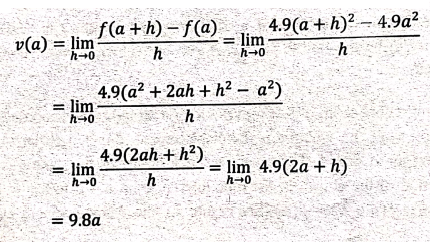
= 9.8a
(a) The velocity after
5 s is v(5) = (9.8) (5) = 49m/s.
(b) Since the
observation deck is 450 m above the ground, the ball will hit the ground at the
time t1 when s(t1)
= 450, that is,
4.9 t12=450
t12=450/4.9
t1=√[450/4.9]
≈ 9.6s
The velocity of the
ball as it hits the ground is therefore
450
v(t1)
= 9.8t1 = 9.8 √[450/4.9] ≈ 94 m/s
Example
125. The position of a particle is given by the equation
s
= f(t) = t3 ‒ 6t2
+ 9t
where
t is measured in seconds and s in meters
(a)
Find the velocity at time t.
(b)
What is the velocity after 2 s? After 4 s?
(c)
When is the particle at rest?
(d)
When is the particle moving forward (that is, in the positive direction)?
(e)
Draw a diagram to represent the motion of the particle.
(f)
Find the total distance traveled by the particle during the first five seconds.
(g)
Find the acceleration at time t and after 4 s.
(h)
Graph the position, velocity, and acceleration functions for 0 ≤t≤5.
(i)
When is the particle speeding up? When is it slowing down?
Solution:
(a) The velocity
function is the derivative of the position function
s = f(t)
= t3 − 6t2 + 9t
v(t) = ds/dt = 3t2‒12t+9
(b) The velocity after
2 s means the instantaneous velocity when t = 2,
that is,
v(2)
= (ds/dt)|t=2= 3(2)2‒12(2)+9 = ‒3 m/s
The velocity after 4 s
is
v(4)
= 3(4)2 – 12(4)+9 = 9 m/s
(c) The particle is at
rest when v(t) = 0, that is,
3t2‒12t+9= 3(t2‒4t+3)= 3(t − 1)(t − 3) = 0
and this is true when t
= 1 or t = 3. Thus the particle is at rest after 1 s and after 3
s.
(d) The particle moving
in the positive direction when v(t)
> 0, that is
3t2‒12t+9 = 3(t
− 1)(t −3) > 0
This inequality is true
when both factors are positive (t > 3) or when both factors are negative (t
< 1). Thus the particle moves in the positive direction in the time
intervals t < 1 and t > 3. It moves backward (in the negative direction)
when 1<
t< 3.
(e) Using the
information from part (d) we make a schematic sketch in the following figure of
the motion of the particle back and forth along a line (the s‒ axis).

(f) Because of what we
learned in parts (d) and (e), we need to calculate the distances traveled
during the time intervals [0, 1], [1, 3], and [3, 5] separately. The distance
traveled in the first second is
|f(1)‒f(0)| = |4‒0| = 4m
From t = 1 to t = 3 the
distance traveled is
|f(3)‒f(1)| = |0‒4| = 4m
From t = 3 to t = 5 the
distance traveled is
|f(5) ‒ƒ(3)| = |20‒1| = 20m
The total distance is 4
+ 4 +20= 28m.
(g) The acceleration is
the derivative of the velocity function:
a(t) = d2s/dt2
= dv/dt = 6t‒12
a(4)=6(4)
‒ 12 = 12m/s2
(h) The following
figure shows the graphs of s, v, and a.
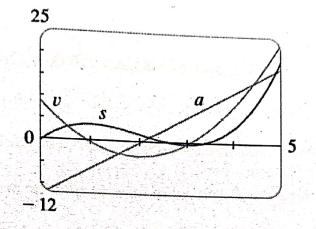
(i) The particle speeds
up when the velocity is positive and increasing (v and a are both
positive) and also when the velocity is negative and decreasing (v and a are both negative). In other words, the particle speeds up when
the velocity and acceleration have the same sign. (The particle is pushed in
the sake direction it is moving). From the above figure we see that this
happens when 1 < t < 2 and when t> 3. The particle slows down when v
and a have opposite signs, that is, when 0≤t<1 and when 2<t<3. The
following figure summarizes the motion of the particle.

Applied Calculus: UNIT I: Differential Calculus : Tag: Applied Calculus : Differential Calculus - Derivative of a function
Applied Calculus: UNIT I: Differential Calculus
Under Subject
Applied Calculus
MA25C01 Maths 1 M1 - 1st Semester | 2025 Regulation | 1st Semester 2025 Regulation
Related Subjects

English Essentials I
EN25C01 1st Semester | 2025 Regulation | 1st Semester 2025 Regulation

தமிழர் மரபு - Heritage of Tamils
UC25H01 1st Semester | 2025 Regulation | 1st Semester 2025 Regulation
Applied Calculus
MA25C01 Maths 1 M1 - 1st Semester | 2025 Regulation | 1st Semester 2025 Regulation
Applied Physics I
PH25C01 1st Semester | 2025 Regulation | 1st Semester 2025 Regulation

Applied Chemistry I
CY25C01 1st Semester | 2025 Regulation | 1st Semester 2025 Regulation

Makerspace
ME25C04 1st Semester | 2025 Regulation | 1st Semester 2025 Regulation

Computer Programming C
CS25C01 1st Semester | 2025 Regulation | 1st Semester 2025 Regulation

Computer Programming Python
CS25C02 1st Semester | 2025 Regulation | 1st Semester 2025 Regulation

Fundamentals of Electrical and Electronics Engineering
EE25C03 1st Semester | 2025 Regulation | 1st Semester 2025 Regulation

Introduction to Mechanical Engineering
ME25C03 1st Semester | 2025 Regulation | 1st Semester 2025 Regulation

Introduction to Civil Engineering
CE25C01 1st Semester Civil Department | 2025 Regulation | 1st Semester 2025 Regulation

Essentials of Computing
CS25C03 1st Semester - AID CSE IT Department | 2025 Regulation | 1st Semester 2025 Regulation

Applied Physics I Laboratory
PH25C01 1st Semester practical Laboratory Manual | 2025 Regulation | 1st Semester Laboratory 2025 Regulation

Applied Chemistry I Laboratory
CY25C01 1st Semester practical Laboratory Manual | 2025 Regulation | 1st Semester Laboratory 2025 Regulation

Computer Programming C Laboratory
CS25C01 1st Semester practical Laboratory Manual | 2025 Regulation | 1st Semester Laboratory 2025 Regulation

Computer Programming Python Laboratory
CS25C02 1st Semester practical Laboratory Manual | 2025 Regulation | 1st Semester Laboratory 2025 Regulation
Engineering Drawing
ME25C01 EEE Mech Dept | 2025 Regulation | 2nd Semester 2025 Regulation

Basic Electronics and Electrical Engineering
EE25C04 1st Semester ECE Dept | 2025 Regulation | 2nd Semester 2025 Regulation