Applied Calculus: UNIT I: Differential Calculus
Differential Calculus: Introduction
Calculus is the mathematical tool used to analyze changes in physical quantities.
UNIT‒I
DIFFERENTIAL CALCULUS
INTRODUCTION
Calculus is the
mathematical tool used to analyze changes in physical quantities. It was
developed in the 17th century to study four major classes of scientific and
mathematical problems of the time. It is used to find the tangent line to a
curve at a point, the length of a curve, the area of a region, and the volume
of a solid. Find minima, maxima of quantities, such as the distance of a planet
from sun. Given a formula for the distance traveled by a body in any specified
amount of time, find the velocity and acceleration or velocity at any instant,
and vice versa.
Before we study
differential calculus, it is important to understand the concept of functions
and their graphs. This is a major pre‒requisite before any Calculus course
often dealt with in a separate course called Pre‒Calculus. The fundamental and
important aspects of calculus are depending upon functions. The basic concepts
of calculus are concerned with function, graphs, and their transformations. A
function can be represented by an equation, table, graph or simply in words.
Function arises when one quantity depends on another quantity.
Let as consider the
following example
The area A of a circle
depends on the radius r of the
circle. Therefore, the area is related by the equation A = πr2,
where r (positive number) is
associated with one value of A and it is defines as A is a function of r. Thus r is called the independent variables
and A is called the dependent variable.
Function
A function is a rule that
assigns to each element x in a set D
to exactly one element, called f(x),
in a set E. It is denoted by f: D→ E.
Consider functions for
which the sets D and E are sets of real numbers. The set D is called the domain
of the function. The number f(x) is
the value of f at x and is read "f of
x". The range of f is the set of all possible values of f(x) as x throughout the domain. A symbol that represents an arbitrary
number in the domain of a function f is
called an independent variable. A symbol that represents a number in the range
of f is called a dependent variable.
A function can be
represented using an arrow diagram as shown below:
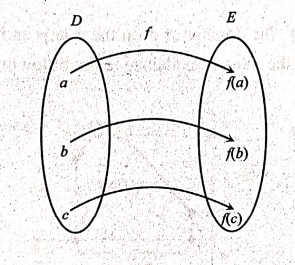
Each arrow connects an
element of D to an element of E. The arrow indicates that f(x) is associated with x,
f(a) is associated with a, and so on. The most common method for
visualizing a function is its graph. If f
is a function with domain D, then its graph is the set of ordered pairs
{(x, f(x))|x ϵ D}.
In other words, the
graph of ƒ consists of all points (x,y)
in the coordinate plane such that y =
f(x) and x is in the domain of f.
The graph of a function f gives us a useful picture of the
behavior or "life history" of a function.
Since the y‒coordinate
of any point (x, y) on the graph is y = f(x),
we can read the value of f(x) from the
graph as being the height of the graph above the point x. This procedure is demonstrated in the following figure.
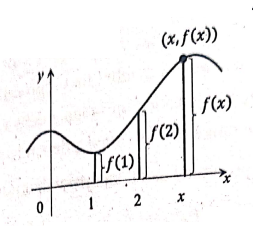
Using the graph of ƒ,
the domain off on the x‒axis and its range on the y‒axis can be obtained and
the same is explained in the following figure.
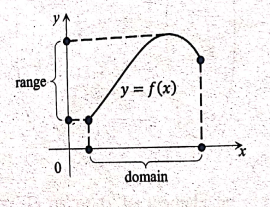
Thought out this
chapter D and E are a set of real numbers. The set D is called domain
of the function. The range of f is
the set of all possible value of f(x)
as x varies thought the domain.
Note:
If y = f(x) is a function,
then x is called independent variable and y is
called dependent variable.
Vertical Line Test:
A curve in the xy plane is the graph of a function of x if and only if no vertical line
intersects the curve more than once.
Let us consider the two
curves below to represent vertical line test.
If each vertical line x = a intersects a curve only once at
(a, b), then exactly one functional value is defined by f(a) = b.
If the line x = a intersects the curve at two
different points (a, b) and (a, c), then the curve can't represent a function
because a function can assign two values to a.

Applied Calculus: UNIT I: Differential Calculus : Tag: Applied Calculus : - Differential Calculus: Introduction
Applied Calculus: UNIT I: Differential Calculus
Under Subject
Applied Calculus
MA25C01 Maths 1 M1 - 1st Semester | 2025 Regulation | 1st Semester 2025 Regulation
Related Subjects

English Essentials I
EN25C01 1st Semester | 2025 Regulation | 1st Semester 2025 Regulation

தமிழர் மரபு - Heritage of Tamils
UC25H01 1st Semester | 2025 Regulation | 1st Semester 2025 Regulation
Applied Calculus
MA25C01 Maths 1 M1 - 1st Semester | 2025 Regulation | 1st Semester 2025 Regulation
Applied Physics I
PH25C01 1st Semester | 2025 Regulation | 1st Semester 2025 Regulation

Applied Chemistry I
CY25C01 1st Semester | 2025 Regulation | 1st Semester 2025 Regulation

Makerspace
ME25C04 1st Semester | 2025 Regulation | 1st Semester 2025 Regulation
Computer Programming C
CS25C01 1st Semester | 2025 Regulation | 1st Semester 2025 Regulation
Computer Programming Python
CS25C02 1st Semester | 2025 Regulation | 1st Semester 2025 Regulation
Fundamentals of Electrical and Electronics Engineering
EE25C03 1st Semester | 2025 Regulation | 1st Semester 2025 Regulation
Introduction to Mechanical Engineering
ME25C03 1st Semester | 2025 Regulation | 1st Semester 2025 Regulation

Introduction to Civil Engineering
CE25C01 1st Semester Civil Department | 2025 Regulation | 1st Semester 2025 Regulation
Essentials of Computing
CS25C03 1st Semester - AID CSE IT Department | 2025 Regulation | 1st Semester 2025 Regulation

Applied Physics I Laboratory
PH25C01 1st Semester practical Laboratory Manual | 2025 Regulation | 1st Semester Laboratory 2025 Regulation

Applied Chemistry I Laboratory
CY25C01 1st Semester practical Laboratory Manual | 2025 Regulation | 1st Semester Laboratory 2025 Regulation

Computer Programming C Laboratory
CS25C01 1st Semester practical Laboratory Manual | 2025 Regulation | 1st Semester Laboratory 2025 Regulation

Computer Programming Python Laboratory
CS25C02 1st Semester practical Laboratory Manual | 2025 Regulation | 1st Semester Laboratory 2025 Regulation
Engineering Drawing
ME25C01 EEE Mech Dept | 2025 Regulation | 2nd Semester 2025 Regulation

Basic Electronics and Electrical Engineering
EE25C04 1st Semester ECE Dept | 2025 Regulation | 2nd Semester 2025 Regulation