Applied Calculus: UNIT I: Differential Calculus
One side limits and Infinite limits
Limit of a function | Differential Calculus
Explanation, Formula, Equation, Example and Solved Problems - Differential Calculus: Limit of a function: One side limits and Infinite limits
ONE SIDED LIMITS
Consider the Heaviside unit step function H defined by H(t) = 
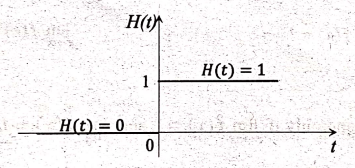
From the definition of the function and from the graph, H(t) approaches 0 from the left and H(t) approaches 1 as t approaches 0 from the right.
The limits can be written as
lim t→0‒ H(t) and lim t→o+ H(t).
The symbol "t→0‒" represents that the only values of t that are less than 0 have to be considered. Similarly "t → 0+" represents that the only values of t that are greater than 0. The limit that is considered when the values of t are only less than 0 is known as the left limit and the limit that is considered when the values of t are greater than or equal to 0 is known as right limit.
In general, the left and right limits are defined as follows.
Definition:
The left limit as x approaches as of f(x) is L if the values of f(x) gets as close to L as when x is very close to left of a,
For x <a, lim x→a‒ f(x) = L.
The right limit, written with a+, requires that x lies on the right of a,
For x > a, lim x→a+ f(x) = L
Note: Remembering that x→a‒ means that the only values of x that are less than a are considered, and similarly x→a+ at means that only values satisfying x>a. Illustrations of these cases are given in the following figure

Theorem:
limx→α f(x) = L if and only if lim x→α‒ f(x) = L and lim x→α+ f(x) = L
2. INFINITE LIMITS
Definition: Let f be a function defined on both sides of "a", except possibly at
"a" itself. Then lim x→a f(x) = ∞ means that the values of f(x) can he made arbitrarily large (as large as we please) by taking x sufficiently close to a, but not equal to a.
Another notation for lim x→α f(x) = ∞ is f(x) → ∞ as x → a.
Again, the symbol ∞ is not a number, but the expression lim x→α ƒ(x) = ∞ is often read as
"the limit of f(x), as x approaches a, is infinity"
or "f(x) becomes infinite as x approaches a"
or "f(x) increases without bound as x approaches a"
Consider the function f(x)=1/x2. As x becomes close to 0, x2 also becomes close to 0, and f(x) becomes very large and the same may be observed from the following table. In fact, it appears from the graph of the function f(x) = 1 / x2 shown in the following figure, that the values of f(x) can be made arbitrarily large by taking x close enough to 0. Thus the values of f(x) do not approach a number, so lim x→0 f(x) = lim x→0 1/x2 does not exist. To indicate the kind of behavior, it is written using the notation lim x→0ƒ(x) = 1/x2 = ∞.

Definition: Let f be a function defined on both sides of a, except possibly at a itself. Then lim x→a f(x) = ‒∞ means that the values of f(x) can be made arbitrarily negative large by taking x sufficiently close to a, but not equal to a.
The symbol lim x→a f(x) = ‒∞ can be read as "the limit of f(x), as x approaches a, is negative infinity" or "f(x) decreases without bound as x approaches a".
Now consider the function f(x) = ‒ 1/x2. As x→0, f(x)→ ‒∞.
Symbolically, it writes as lim x→0 (‒1/x2) = x2.
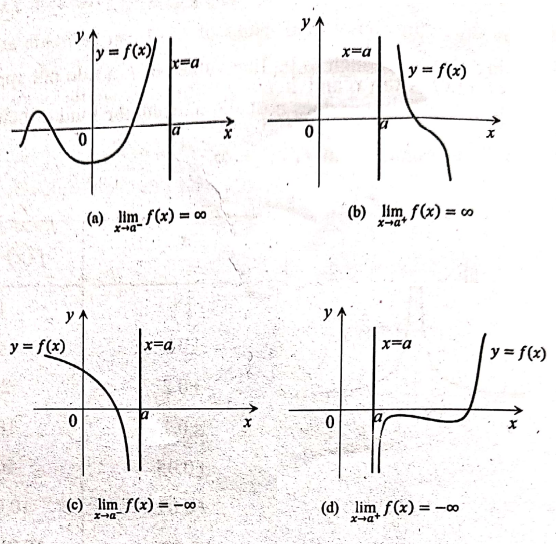
Similar definitions can be given for the one‒sided infinite limits.
lim x→a‒ f(x) = ∞, lim x→a+ f(x) = ∞, lim x→a‒ f(x) = −∞, lim x→a+ f(x) = −∞
Illustrations of these cases are given in the following figure
Note:
If lim x→a f(x) = ∞ or lim x→a f(x) = ‒∞, then we say lim x→a f(x) does not exists.
Definition:
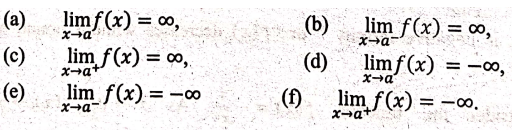
The vertical line x = a is called a vertical asymptote of the curve y = f(x) if at least one of the following statements is true:
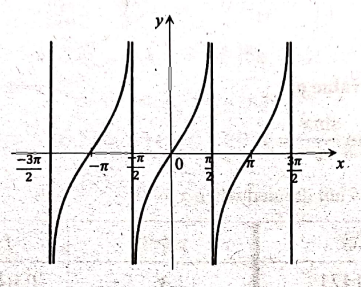
Consider the function f(x) = tan x. Because tanx = sinx / cosx, the vertical asymptotes are defined by cos x = 0, cos x → 0 as x→(π/2)+, whereas sin x is positive when x is near π/2, Therefore,

This shows that the line x = π/2 is a vertical asymptote. Similar reasoning shows that the lines x = ±(2n+1) π/2, where n is an integer, are all vertical asymptotes of f(x) = tanx and it can be confirmed from the graph of the function presented in the following figure.
Example 36. Evaluate limx→1(x2‒1) / (x‒1) without simplifying it.
Solution:
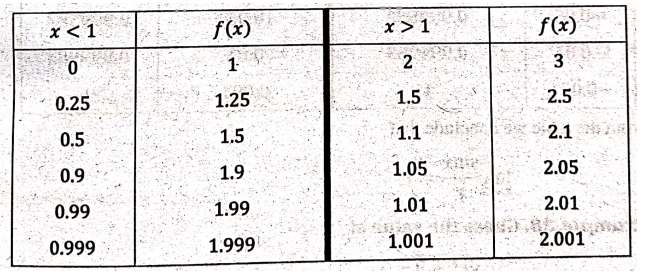
From the table we conclude that

Example 37. Guess the value of
limx→0 Sinx/x = 1
The function f(x) = sin x / x is not defined when x = 0.
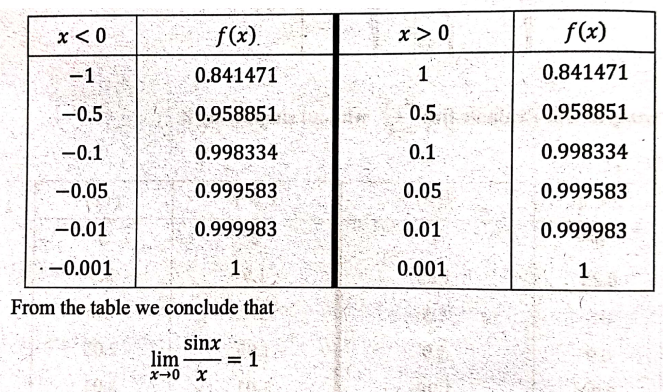
limx→0 Sinx/x = 1
Example 38. Guess the value of
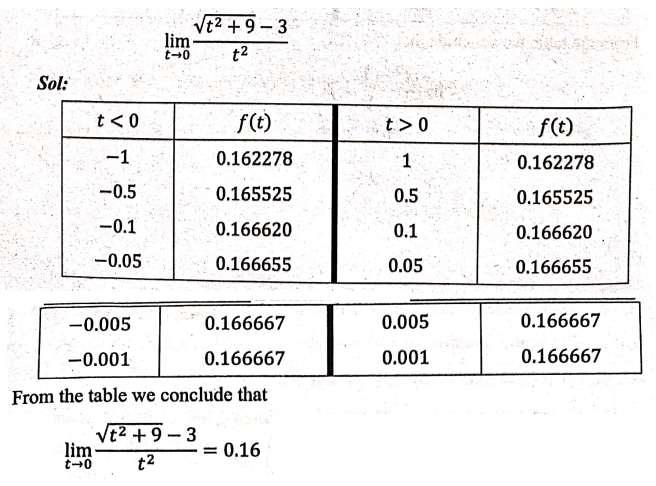
Example 39. Guess the value of the limit (if it exits) for the function limx→0 [ e5x‒1 / x ] = 5 by evaluating the function at the given number x = ±0.5, ±0.1, ±0.01, ±0.001, ±0.0001 (correct to six decimal places)
Solution: The function f(x) = lim x→0 [ e5x‒1 / x ] is not defined when x = 0.

From the table we conclude that
limx→0 [ e5x‒1 / x ] = 5
Example 40. Investigate
lim x→0 sin (π/x)
Solution: The function sin x is bounded and |sin x| ≤ 1. Therefore, the given function sin (π/x) is also bounded maximum and minimum values of sin (π/x) is ±1. This can be attained by the function, if
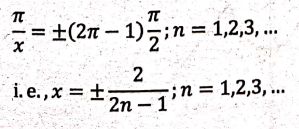
As n becomes large the value x is closer to 0 and in the neighborhood of x= 0, the value of the function sin (π/x) is either ‒1 or +1. That is, the values of the function near 0 oscillates between ‒1 and +1.
The property of function is presented graphically in Fig. and the oscillation of the function between ‒1 and +1. Hence, the limit does not exist.

Example 41. Sketch the graph of the function f(x) = 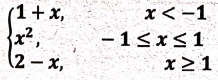 and use it to determine the values of "a" for which lim x→a f(x) exists.
Solution: From the graph, it is observed that lim x→a f(x) exists for all "a" except when a = −1, since the right and left limits are different at a = ‒1.

Example 42.
Sketch the graph of the function f(x) = 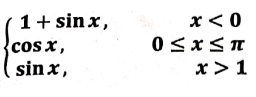 and use it to determine the values of "a" for which lim x→a ƒ(x) exists.
Solution: From the graph, it is noticed that lim x→a f(x) exists for all "a" except when a = π, since the left and right limits are different at the point a = π.

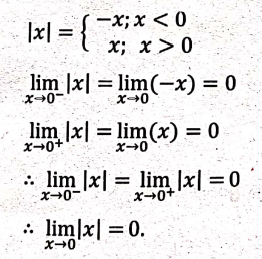
Example 43. Show that lim x→0 |x| = 0
Solution:
Example 44. Prove lim x→a |x|/x does not exist.
Solution:

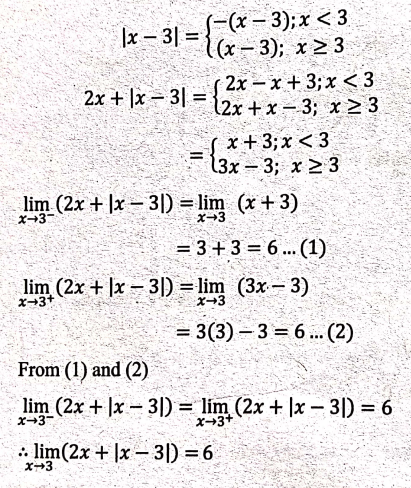
Example 45. Find the limit limx→3(2x+|x‒3|) if it exits. If the limit does not exist. Explain why?
Solution:
Example 46. Find the limit lim x→3( 3x+9 / |x+3| ) if exits. If the limit does not exits. explain why?
Solution:


Definition: [[x]] is defined by the largest integer is less than or equal to [[x]] is called as greatest integer function.
eg: [[4]] = 4
[[4.3]] = 4
[[−1.5]] = −2
Example 49. Draw the graph of f(x) = [[x]] and show that lim x→3[[x]] does not exists.
0 ≤x≤1⇒ [[x]] = 0
1 < x < 2 ⇒ [[x]] =1
‒1≤x<0= [[x]] = ‒1

Example 50. Draw the graph of f(x) = [[cosx]] ‒ π ≤ x ≤π.
a) Sketch the graph of ƒ (x)
b) Evaluate each limit, if it exists.
c) For what values of a does lim x→af(x) exist.
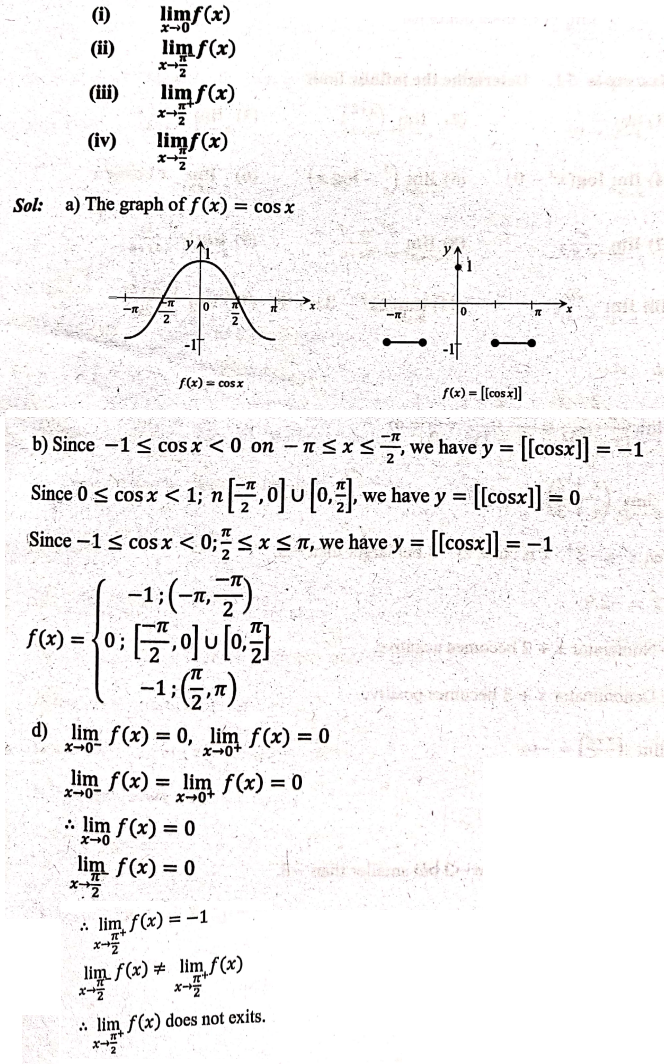
Example 51. Determine the infinite limit.
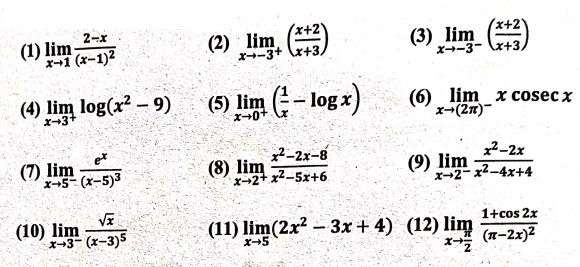
Solution:
(1) limx→1 [2‒x] / (x−1)2 = 1/0 = ∞
(2) lim x→3+( x+2 / x+3 )
Given x→‒3+. x is close to ‒3 but larger than ‒3.
Let x = ‒2.9
The Numerator x + 2 becomes negative.
The Denominator x + 3 becomes positive.
lim x→3+( x+2 / x+3 ) = ‒∞
(3) lim x→3‒( x+2 / x+3 )
Given x→3‒. x is close to ‒3 but smaller than ‒3.
Let x = ‒3.1
The Numerator x + 2 becomes negative.
The Denominator x + 3 becomes negative.
lim x→3‒( x+2 / x+3 ) = ∞
(4) limx→3+ log(x2 ‒ 9)
Given x→ 3+. x is close to 3 but larger than 3.
Let x = 3.1
log(x2 ‒ 9) becomes negative.
limx→3+ log(x2 ‒ 9) = −∞
(5) limx → 0+ ( 1/x ‒ logx ) = lim x → 0+ ( [1‒xlogx] / x )
Given x → 0+. x is close to 0 but larger than 0.
Let x = 0.1
The Numerator (1‒ x logx) becomes positive.
The Denominator x becomes positive.
lim x→0+ (1/x ‒ logx) =∞
(6) 
Given x → (2π) ̄. x is close to 2π but smaller than 2л.
x lies in the fourth quardrant.
The Denominator sin x becomes negative.
The Numerator x becomes positive.
limx→(2π)‒ x cosecx = ‒∞
(7) 
Given x→ 5‒. x is close to 5 but smaller than 5.
Let x = 4.9
The Numerator ex becomes positive.
The Denominator (x‒5)3 becomes negative.
= ‒∞
(8) 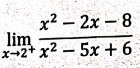
Given x → 2+. x is close to 2 but larger than 2.
Let x = 2.1
The Numerator x2 ‒ 2x ‒ 8 becomes negative.
The Denominator x2‒5x+6 becomes negative.
= ∞
(9) 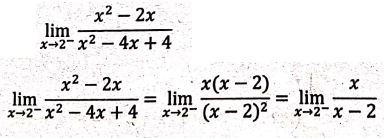
Given x → 2‒. x is close to 2 but smaller than 2.
Let x 1.9
The Numerator x becomes positive.
The Denominator x‒2 becomes negative.
 = ‒∞
= ‒∞
(10) 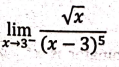
Given x→3‒. x is close to 3 but smaller than 3.
Let x = 2.9
The Numerator √x becomes positive.
The Denominator (x‒3)5 becomes negative.
= ‒∞
(11) limx→5(2x2 ‒ 3x + 4)
limx→5(2x2 ‒ 3x + 4) = 2(5)2 ‒ 3(5) + 4
=2(25) ‒ 15+4
= 50 ‒ 15+ 4 = 54 ‒ 15 = 39
(12)
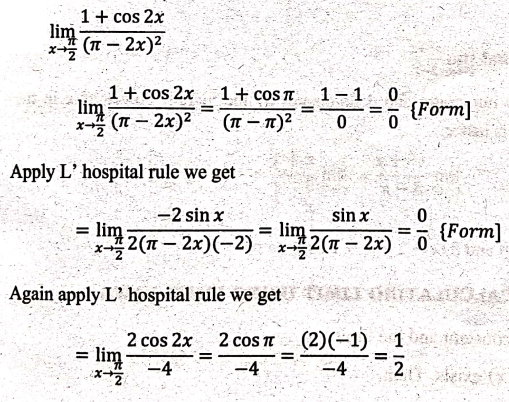
Example 52. Evaluate limx→∞ [3x2‒x‒2] / [5x2+4x+1]
Solution: As x becomes large, both numerator and denominator become large, so it isn't obvious what happens to their ratio. We need to do some preliminary algebra.
To evaluate the limit at infinity of any rational function, we first divide both the numerator and denominator by the highest power of x that occurs in the denominator. (We may assume that x ≠ 0, since we are interested only in large values of x.) In this case the highest power of x in the denominator is x2, so we have

Example 53. Find limx→∞[x2+x] / [3‒x]
Solution:
We divide the numerator and denominator by the highest power of x in the denominator, which is just x:
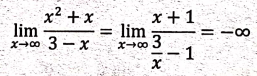
because x + 1→ ∞ and 3/x ‒1→ ‒1 as x → ∞
Applied Calculus: UNIT I: Differential Calculus : Tag: Applied Calculus : Limit of a function | Differential Calculus - One side limits and Infinite limits
Applied Calculus: UNIT I: Differential Calculus
Under Subject

Applied Calculus
MA25C01 Maths 1 M1 - 1st Semester | 2025 Regulation | 1st Semester 2025 Regulation
Related Subjects

English Essentials I
EN25C01 1st Semester | 2025 Regulation | 1st Semester 2025 Regulation

தமிழர் மரபு - Heritage of Tamils
UC25H01 1st Semester | 2025 Regulation | 1st Semester 2025 Regulation
Applied Calculus
MA25C01 Maths 1 M1 - 1st Semester | 2025 Regulation | 1st Semester 2025 Regulation

Applied Physics I
PH25C01 1st Semester | 2025 Regulation | 1st Semester 2025 Regulation

Applied Chemistry I
CY25C01 1st Semester | 2025 Regulation | 1st Semester 2025 Regulation

Makerspace
ME25C04 1st Semester | 2025 Regulation | 1st Semester 2025 Regulation

Computer Programming C
CS25C01 1st Semester | 2025 Regulation | 1st Semester 2025 Regulation

Computer Programming Python
CS25C02 1st Semester | 2025 Regulation | 1st Semester 2025 Regulation

Fundamentals of Electrical and Electronics Engineering
EE25C03 1st Semester | 2025 Regulation | 1st Semester 2025 Regulation

Introduction to Mechanical Engineering
ME25C03 1st Semester | 2025 Regulation | 1st Semester 2025 Regulation

Introduction to Civil Engineering
CE25C01 1st Semester Civil Department | 2025 Regulation | 1st Semester 2025 Regulation

Essentials of Computing
CS25C03 1st Semester - AID CSE IT Department | 2025 Regulation | 1st Semester 2025 Regulation

Applied Physics I Laboratory
PH25C01 1st Semester practical Laboratory Manual | 2025 Regulation | 1st Semester Laboratory 2025 Regulation

Applied Chemistry I Laboratory
CY25C01 1st Semester practical Laboratory Manual | 2025 Regulation | 1st Semester Laboratory 2025 Regulation

Computer Programming C Laboratory
CS25C01 1st Semester practical Laboratory Manual | 2025 Regulation | 1st Semester Laboratory 2025 Regulation

Computer Programming Python Laboratory
CS25C02 1st Semester practical Laboratory Manual | 2025 Regulation | 1st Semester Laboratory 2025 Regulation

Engineering Drawing
ME25C01 EEE Mech Dept | 2025 Regulation | 2nd Semester 2025 Regulation

Basic Electronics and Electrical Engineering
EE25C04 1st Semester ECE Dept | 2025 Regulation | 2nd Semester 2025 Regulation