Python for Data Science: Chapter 3: Foundations of Data Science
Data science process: 1. Defining Research Goals
Questions: 1. Explain how will you define the research goals during the data analysis process? 2.What is project charter? Explain.
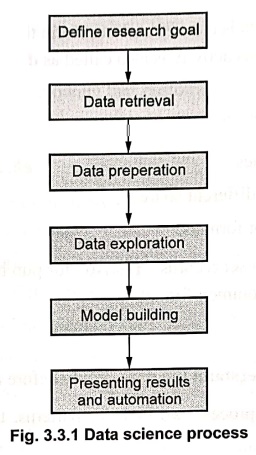
Data science process is a series of activities that help us move from a
business problem to a useful solution based on data. 1. Define research goals
2. Data retrieval 3. Data preparation 4. Data exploration 5. Model building 6.
Presenting results and automation
Defining Research Goals
•
Before performing data science project, we must first understand what the
project is about, why it is needed and how it will be done.
•
Every project begins by answering three important questions:‒
1)
What: What is the goal of the project?
2)
Why: Why is the project important for
the company?
3)
How: How will the project be carried
out.
For
example ‒ i) what is the project? "predict customer churn" (who will
stop using the service). ii) Why to predict customer churn ‒ because we want to
reduce the customer loss and increase profits. iii) How to carry out this? ‒ By
collecting customer data and building prediction model.
•
The goal of asking these questions is to
make sure that everyone ‒ team members, clients and management clearly
understand the project's purpose and agrees on what needs to be done.
1. Understand Goals and the Context of the Research
•
Finding the goal is the main purpose
of your project ‒ what exactly you are trying to find or prove.
•
Spend time talking to managers or clients to understand their expectations. Ask
clear questions ‒ What, Why and How.
•
Keep refining the goal until it is
specific and measurable. For example ‒ Research Goal : "To develop a model
that predicts which customers are likely to cancel their subscription in the
next 3 months." This goal is clear, focused and practical.
•
Many data scientists fail not because of weak technical skills, but because
they don't truly understand what the business
needs. Hence understanding context matters a lot.
•
Defining research goals ensures you
know what to do and why you are doing it.
2. Create Project Charter
•
Once you fully understand the business problem and research goal, the next step
is to create a Project Charter.
•
A Project Charter is a short
document that summarizes all key information about the project.
•
It acts as an agreement between the
data science team and the client or management.
•
A well‒prepared project charter should include the following:
■
Clear research
goal ‒ What you are trying to achieve.
■
Project mission
and context ‒ Why the project is important.
■
Methodology ‒
How you plan to perform your analysis (tools, techniques, algorithms)
■
Resources
needed ‒ Data, software, people and hardware required.
■
Feasibility
proof ‒ Evidence that the project can actually be completed (a small
test or "proof of concept").
■
Deliverables ‒ What
you will produce (for example, a report, model, or dashboard).
■
Success criteria ‒ How you'll measure if
the project succeeded (accuracy %, improved sales, etc.)
■
Timeline ‒
Key milestones and completion date.
Sample project charter
Component
‒ Example
for a customer Churn project
Goal
‒ Predict which customers may cancel their service.
Context
‒ Company wants to reduce the customer loss.
Method
‒ Use Python to build prediction model using customer data.
Resources
‒ Customer Data, data scientist and data analyst.
Deliverables
‒ A working prediction model with dashboard.
Success criteria
‒ Model accuracy must be above 85%.
Timeline
‒ Two months.
•
Creating a project charter ensures
everyone agrees on how it will be done and what success looks like.
Review Questions
1. Explain how will
you define the research goals during the data analysis process?
2.What is project
charter? Explain.
Python for Data Science: Chapter 3: Foundations of Data Science : Tag: Computer Programming, Python, Data Science : - Data science process: 1. Defining Research Goals
Python for Data Science: Chapter 3: Foundations of Data Science
Under Subject
Python for Data Science
AD25201 2nd Semester AIDS Dept | 2025 Regulation | 2nd Semester 2025 Regulation
Related Subjects
English Essentials II
EN25C02 2nd Semester | 2025 Regulation | 2nd Semester 2025 Regulation
Tamils and Technology தமிழர்களும் தொழில்நுட்பமும்
UC25H02 2nd Semester | 2025 Regulation | 2nd Semester 2025 Regulation
Linear Algebra
MA25C02 2nd Semester | 2025 Regulation
Applied Physics (CSIE) II
PH25C03 2nd Semester AIDS, CSE, IT, CSE(CY) Dept | 2025 Regulation | 2nd Semester 2025 Regulation
Digital Principles and Computer Organization
CS25C06 2nd Semester AIDS, CSE, IT, CSE(CY) Dept | 2025 Regulation | 2nd Semester 2025 Regulation

Basic Electrical and Electronics Engineering
EE25C01 2nd Semester | 2025 Regulation | 2nd Semester 2025 Regulation
Python for Data Science
AD25201 2nd Semester AIDS Dept | 2025 Regulation | 2nd Semester 2025 Regulation

Re-Engineering for Innovation
ME25C05 2nd Semester | 2025 Regulation | 2nd Semester 2025 Regulation
Python for Data Science - Laboratory
AD25201 2nd Semester AIDS Dept | 2025 Regulation | 2nd Semester 2025 Regulation