Python for Data Science: Chapter 3: Foundations of Data Science
Data Warehousing
Definition, Real world examples, Need, Characteristics, Components, ETL Process, Advantages, Limitations, Applications | Data Science
Questions: 1.Write the main purpose of a data warehouse. 2.List and explain the key characteristics of a data warehouse. 3.What is the ETL process? Describe its three stages briefly. 4. Explain the term metadata in the context of a data warehouse. 5. Explain the difference between data mining and data warehousing. 6. Definition of data warehousing, Real world examples of data warehousing, Need for data warehouse, Characteristics of data warehouses, Components of Data Warehouse, ETL Process, Advantages of data warehousing and Limitations of data warehousing, Applications of data warehousing
Data
Warehousing
• Definition :
Data warehousing is a large, centralized storage system that collects and
stores data from different sources in one place for analysis and reporting.
•
In short, data warehouse is like big library for data.
Real‒world examples of data warehousing
1) Amazon:
It tracks customer purchases and recommended products.
2) Netflix:
It stores users viewing history to recommend shows.
3) Walmart:
It analyzes sales and supply chain data from all stores.
Need for data warehouse
1)
It collects data from different systems into one place.
2)
It supports in decision making.
3)
Data is cleaned, transformed and stored in consistent format. Thus quality of data is improved.
4)
Analysts do not need to search for
the data from multiple databases. Everything is available one place.
5)
Data warehouses store data for many
years. This allows the analyst to identify long term trends and patterns.
Characteristics of data warehouses
1)
Data in data warehouse is combined from multiple sources into one format.
2)
The data is arranged as per the subject like Sales, inventory, customer‒details
3)
Historical data is present in the data warehouse.
4)
Once data is entered in data warehouse it is not changed or deleted.
1. Components of Data Warehouse
•
Here are some core components of data warehouses
1) Data sources:
This is a system where raw data from multiple sources come from.
2) ETL tools:
ETL stands for Extract, Transform and Load. The ETL tools collect, clean and
load data into the warehouse.
3) Data storage:
It is a central repository that stores all data. For example Oracle, SQL server.
4) Metadata: Data about data.
It is a data that describes the structure and meaning of data.
5) Data marts:
These are subset of data warehouse which is customized for specific departments
or business functions like Sales or Finance.
6) Query and analysis tools / Front
end:
These tools allow users to run queries, generate reports and perform data
analysis. For examples ‒ SQL Clients, dashboards.
7) Management and Administration:
These are the tools that handle tasks like performance tuning, security, backup
and user access control.
2. ETL Process
•
ETL stands for Extract, Transform and Load. It is the core activity in data warehousing.
The
ETL process prepares data before it enters the warehouse.
1.Extract:
It collects data from different sources. For example ‒ Sales data can be
collected from various branches. Customer data from Customer Relationship Management (CRM).
2.Transform:
This is an activity in where the data is cleaned and stored into particular
format. The same uniform format of the data is maintained by this activity.
3. Load:
Under this activity the stored transformed data is entered into the warehouse.
For instance ‒ Sales data can be loaded into Sales warehouse.
3. Advantages and Limitations
Advantages
1)
All data is available in one place. Hence access to information is faster.
2)
The data help the managers because data is accurate and in uniform format.
3)
The historical data is available. So, performance can be compared over the
years.
4)
The data warehouse support data mining and business intelligence tools.
Limitations
1) Costly:
Building and maintaining data warehouse can be very expensive.
2) Complex setup: For creating
data warehouse the complex setup is needed. This requires skilled technical
team.
3) Data delay:
Huge data is stored in dataware house is not real time. It is updated
periodically.
4) Storage space:
It requires large storage space for storing historic data.
4. Applications
1)
Financial analysis: It is used to track expenses, forecast
revenue and evaluate investment performance.
2) Supply
chain management:
Monitors inventory, logistics and vendor performance and sales trend.
3) Customer
relationship management: It is used to store customer
information, preferences, and behaviour.
4) Healthcare
:
It is used to manage patient records and treatment outcomes.
5)
Government secor: The data warehouse is useful for
maintaining and analyzing tax, health and policy records for transparency and
planning.
6)
Banking: The warehouse is also used to track account
performances, assess the credit risks and support fraud detection.
5. Difference
between Data Mining and Data Warehousing.
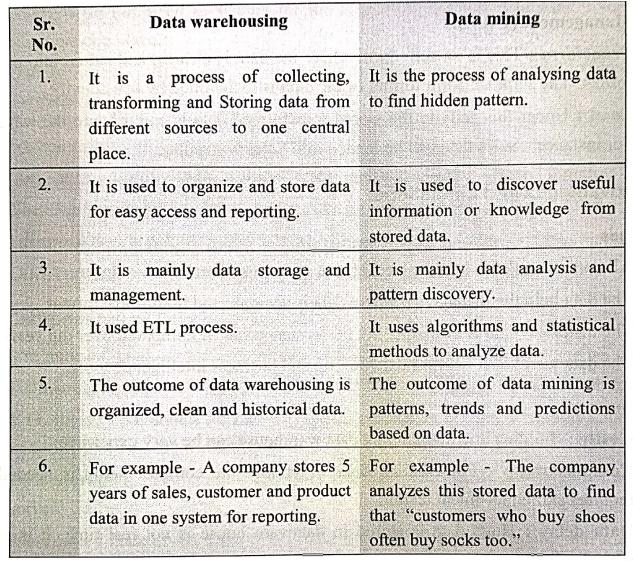
Data
warehousing
1.It
is a process of collecting, transforming and Storing data from different
sources to one central place.
2.It
is used to organize and store data for easy access and reporting.
3.It
is mainly data storage and management.
4.It
used ETL process.
5.The
outcome of data warehousing is organized, clean and historical data.
6.For
example ‒ A company stores 5 years of sales, customer and product data in one
system for reporting.
Data
mining
1.It
is the process of analysing data to find hidden pattern.
2.It
is used to discover useful information or knowledge from stored data.
3It
is mainly data analysis and pattern discovery.
4.It
uses algorithms and statistical methods to analyze data.
5.The
outcome of data mining is patterns, trends and predictions based on data.
6.For
example The company analyzes this stored data to find that "customers who
buy shoes often buy socks too."
Review Questions
1.Write the main
purpose of a data warehouse.
2.List and explain the
key characteristics of a data warehouse.
3.What is the ETL
process? Describe its three stages briefly.
4. Explain the term
metadata in the context of a data warehouse.
5. Explain the
difference between data mining and data warehousing.
Python for Data Science: Chapter 3: Foundations of Data Science : Tag: Computer Programming, Python, Data Science : Definition, Real world examples, Need, Characteristics, Components, ETL Process, Advantages, Limitations, Applications | Data Science - Data Warehousing
Python for Data Science: Chapter 3: Foundations of Data Science
Under Subject
Python for Data Science
AD25201 2nd Semester AIDS Dept | 2025 Regulation | 2nd Semester 2025 Regulation
Related Subjects

English Essentials II
EN25C02 2nd Semester | 2025 Regulation | 2nd Semester 2025 Regulation
Tamils and Technology தமிழர்களும் தொழில்நுட்பமும்
UC25H02 2nd Semester | 2025 Regulation | 2nd Semester 2025 Regulation
Linear Algebra
MA25C02 2nd Semester | 2025 Regulation

Applied Physics (CSIE) II
PH25C03 2nd Semester AIDS, CSE, IT, CSE(CY) Dept | 2025 Regulation | 2nd Semester 2025 Regulation
Digital Principles and Computer Organization
CS25C06 2nd Semester AIDS, CSE, IT, CSE(CY) Dept | 2025 Regulation | 2nd Semester 2025 Regulation

Basic Electrical and Electronics Engineering
EE25C01 2nd Semester | 2025 Regulation | 2nd Semester 2025 Regulation
Python for Data Science
AD25201 2nd Semester AIDS Dept | 2025 Regulation | 2nd Semester 2025 Regulation

Re-Engineering for Innovation
ME25C05 2nd Semester | 2025 Regulation | 2nd Semester 2025 Regulation
Python for Data Science - Laboratory
AD25201 2nd Semester AIDS Dept | 2025 Regulation | 2nd Semester 2025 Regulation