Python for Data Science: Chapter 3: Foundations of Data Science
Foundations of Data Science: Two Marks Important Questions and Answers
Python for Data Science
Python for Data Science: Chapter 3: Foundations of Data Science : Anna University Part A Two Marks Important Questions and Answers
Python
for Data Science
Chapter
3: Foundations of Data Science
Two Marks
Questions with Answers
1. What
is data science?
Answer: Data
science is the study of data to extract useful insights and knowledge using
scientific methods, algorithms and tools especially using programming language
like Python.
2. Who is
data scientist ?
Answer: A
data scientist is a professional who analyzes data using tools and techniques
to find meaningful patterns and make predictions.
3. Name
any two disciplines that are used in data science.
Answer: Data
science uses several fields such as Statistics, Computer science, Mathematics
and domain knowledge.
4. State
any two applications of data science.
Answer:
1) Healthcare:
Data science is used in healthcare to predict diseases early and to provide
personalized treatment plans for the patients based on their medical history.
2) Retail:
Retail companies use data science to understand customer buying behaviour and
to manage inventory efficiently so that products are available when needed.
5. How
can data science improve government decision‒making?
Answer: By
analyzing public data, it helps in policy planning, resource allocation and
predicting social trends.
6. List
any two steps of the data science process.
Answer: Data
collection and data preparation.
7. What
happens in data retrieval step?
Answer: Data
is collected from internal and external sources and some extend of quality
check on data is performed.
8. Explain
how what, why and how kewords are helpful in defining research goals?
Answer: Every
project begins by answering three important questions :
1. What:
What is the goal of the project?
2. Why:
Why is the project important for the company?
3. How:
How will the project be carried out
For
example ‒ i) what is the project? "predict customer churn"(who will
stop using the service). ii) Why to predict customer churn ‒ because we want to
reduce the customer loss and increase profits. iii) How to carry out this ? ‒
By collecting customer data and building prediction model.
9. Why is
defining research goals important?
Answer: They
help all stakeholders agree on project objectives and success criteria.
10. What
happens if the research goal is not clearly defined?
Answer: The
entire analysis may go off track, leading to irrelevant insights and wasted
effort.
11. What
is project charter ?
Answer: A
Project Charter is a short document
that summarizes all key information about the project.
It
acts as an agreement between the
data science team and the client or management.
12. Why
is data preparation so important in data science process ?
Answer: It
cleans and transforms raw data into usable form for analysis.
13. Name
three stages of data preparation.
Answer: The
three stages of data preparation are ‒ Data cleaning, transformation and data
combining.
14. What
is data cleaning?
Answer: It
is the process of identifying and correcting errors, missing values and
inconsistencies in data.
15. What
is meant by outlier?
Answer: It
is an observation that is very different from other data points.
16. What
is the difference between noise and anomalies?
Answer: Noise
is random error in data; anomalies are unusual patterns that may indicate
important
events.
17.
Should outliers always be removed?
Answer:
Not always‒ if they represent real rare events (like fraud), they should be
studied, not deleted.
18. How
does data wrangling differ from data cleaning?
Answer: Data
cleaning fixes errors; wrangling also reshapes and transforms data for
analysis.
19. What
is data exploration ?
Answer: It
is the process of analyzing data visually or statistically to understand its
main characteristics.
20. Name
one non‒graphical method of data exploration
Answer: Descriptive
statistic in which mean, median and mode are calculated.
21. What
is the purpose of EDA ?
Answer:
The
purpose of EDA(Exploratory Data Analysis) is to identify patterns, trends and
relationships in data before modeling.
22. Why
is visualization crucial in EDA ?
Answer: Visualization
is crucial because visual patterns often reveal trends, errors, or outliers
that statistical summaries might miss.
23. What
is model building in data science?
Answer: The
process of creating mathematical or machine learning models to make predictions
or classifications, is called model building.
24. List
three main steps of model building
Answer:
1)
Model selection
2)
Model execution
3)
Model evaluation.
25. What
is meant by model diagnostic.
Ans:
Checking whether the model's assumptions and performance are correct.
26. Why
is presenting findings important?
Answer: Presenting
findings step is important because it helps non‒technical users understand and
use the insights effectively.
27. What
are some tools used to present data findings ?
Answer: Tools
like Power BI, Tableau, and Matplotlib help create clear and interactive visual
reports.
28. What
does automating a model mean?
Answer: Automating
means Making the model run automatically to update results without manual work.
29. What
are soft skills in data science ?
Answer: Communication
and presentation skills used to explain results clearly.
30. What
is data mining?
Answer: It
is a process of discovering useful patterns and relationships from large
datasets.
31. Name
any two data mining techniques.
Answer: Classification
and Clustering.
32. How
does data mining differ from data warehousing?
Answer: Data
warehousing stores and organizes data; data mining extracts patterns and
insights from it.
33. What
is association rule mining ?
Answer: Finding
items that often occur together, like "people who buy bread also buy
butter."
34. What
is the relationship between data mining and data science ?
Answer: Data
Mining is a part of Data Science focused on pattern discovery.
35. What
is a data warehouse ?
Answer: Data
warehouse is a large storage system that combines and stores data from many
sources for analysis and reporting.
36. What
is the main purpose of a data warehouse ?
Answer: To
provide clean, organized, historical data for decision‒making.
37.
Differentiate between data science and data mining ?
Answer:
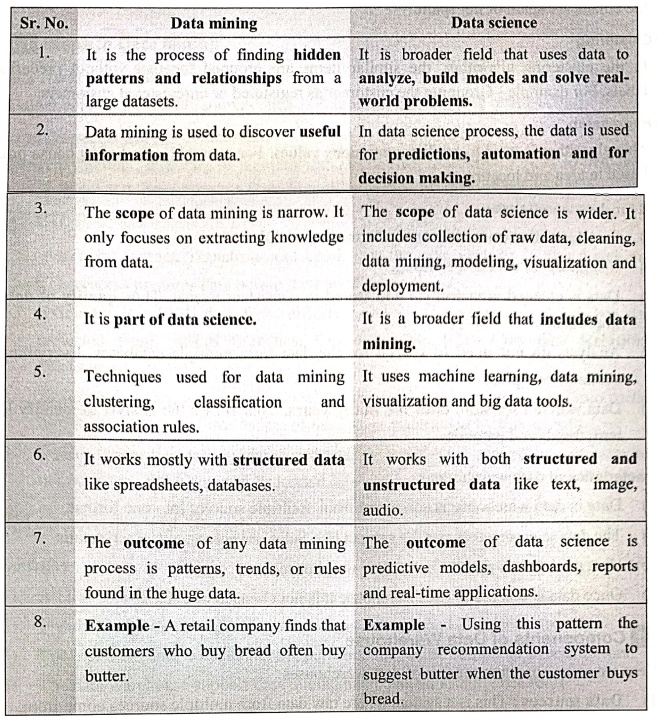
Data mining
1.It
is the process of finding hidden
patterns and relationships from a large datasets.
2.Data
mining is used to discover usefulfor
information from data.
3.The
scope of data mining is narrow. It
only focuses on extracting knowledge from data.
4.It
is part of data science.
5.Techniques
used for data mining clustering, classification and association rules.
6.
It works mostly with structured data
like spreadsheets, databases.
7.The outcome of any data mining process is
patterns, trends, or rules found in the huge data.
8. Example ‒ A retail company finds that
customers who buy bread often buy butter.
Data science
1.
It is broader field that uses data to
analyze, build models and solve real‒ world problems.
2.
In data science process, the data is used predictions,
automation and for decision making.
3.
The scope of data science is wider.
It includes collection of raw data, cleaning, data mining, modeling,
visualization and deployment.
4.
It is a broader field that includes data
mining.
5.
It uses machine learning, data mining, visualization and big data tools.
6.It
works with both structured and
unstructured data like text, image, audio.
7.The outcome of data science is predictive
models, dashboards, reports and real‒time
applications.
8. Example Using this pattern the company
recommendation system to suggest butter when the customer buys bread.
38. Give one advantage and one limitation of a data warehouse.
Answer: Advantage:
It supports faster and more accurate decision‒making.
Limitation: It requires high setup and maintenance cost.
39.
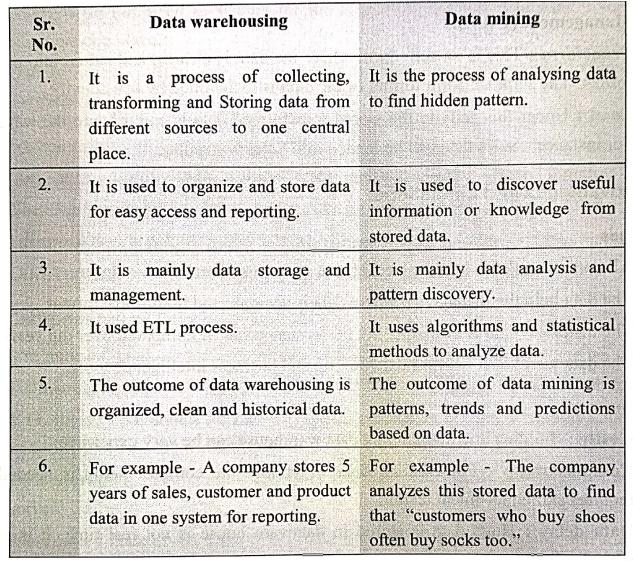
Data warehousing
1.It is a process of collecting, transforming and Storing data from different sources to one central place.
2.It is used to organize and store data for easy access and reporting.
3.It is mainly data storage and management.
4.It used ETL process.
5.The outcome of data warehousing is organized, clean and historical data.
6.For example ‒ A company stores 5 years of sales, customer and product data in one system for reporting.
Data mining
1.It is the process of analysing data to find hidden pattern.
2.It is used to discover useful information or knowledge from stored data.
3It is mainly data analysis and pattern discovery.
4.It uses algorithms and statistical methods to analyze data.
5.The outcome of data mining is patterns, trends and predictions based on data.
6.For example The company analyzes this stored data to find that "customers who buy shoes often buy socks too."
Python for Data Science: Chapter 3: Foundations of Data Science : Tag: Computer Programming, Python, Data Science : Python for Data Science - Foundations of Data Science: Two Marks Important Questions and Answers
Python for Data Science: Chapter 3: Foundations of Data Science
Under Subject
Python for Data Science
AD25201 2nd Semester AIDS Dept | 2025 Regulation | 2nd Semester 2025 Regulation
Related Subjects

English Essentials II
EN25C02 2nd Semester | 2025 Regulation | 2nd Semester 2025 Regulation

Tamils and Technology தமிழர்களும் தொழில்நுட்பமும்
UC25H02 2nd Semester | 2025 Regulation | 2nd Semester 2025 Regulation

Linear Algebra
MA25C02 2nd Semester | 2025 Regulation

Applied Physics (CSIE) II
PH25C03 2nd Semester AIDS, CSE, IT, CSE(CY) Dept | 2025 Regulation | 2nd Semester 2025 Regulation

Digital Principles and Computer Organization
CS25C06 2nd Semester AIDS, CSE, IT, CSE(CY) Dept | 2025 Regulation | 2nd Semester 2025 Regulation

Basic Electrical and Electronics Engineering
EE25C01 2nd Semester | 2025 Regulation | 2nd Semester 2025 Regulation
Python for Data Science
AD25201 2nd Semester AIDS Dept | 2025 Regulation | 2nd Semester 2025 Regulation

Re-Engineering for Innovation
ME25C05 2nd Semester | 2025 Regulation | 2nd Semester 2025 Regulation
Python for Data Science - Laboratory
AD25201 2nd Semester AIDS Dept | 2025 Regulation | 2nd Semester 2025 Regulation