Python for Data Science: Chapter 3: Foundations of Data Science
Data science process: 6. Present Findings and Build Application
Questions: 1.What is the purpose of the "Present Findings" stage in the data science process? 2. Why is it important to present your findings clearly after building a model? 3.What is meant by model automation, explain with example. Why is it necessary? 4.Give examples of soft skills that are helpful when presenting data science results. 5. Importance of presentation and automation
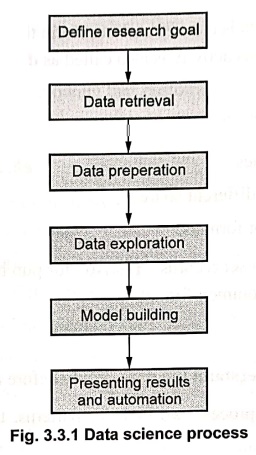
Data science process is a series of
activities that help us move from a business problem to a useful solution based
on data. 1.
Define research goals 2. Data retrieval 3. Data preparation 4. Data exploration
5. Model building 6. Presenting results and automation
6. Present
Findings and Build Application
•
After completion of data analysis and
building a well performing model the next step is to ‒
1) Present findings
clearly to teams, managements or clients.
2) Automate data analysis
so the model can be regularly used.
Importance of presentation and automation
1)
The value of data science comes not just by building models but from how well
the project is communicated and applied for real‒life problem solving.
2)
If people understand the findings from your data analysis, they can make better
business decisions.
3)
Automation of data analysis ensures to stay updated without repeating the same
work manually.
1. Present Your Findings
•
We need to present the findings of the
data analysis in order to communicate the insights, predictions and
recommendations in simple and meaningful way to everyone.
•
For presenting the findings to the technical persons you need to discuss
methods, accuracy and assumptions.
•
Replace the numbers with clear charts
and dashboards. For example ‒ A bar chart showing "Sales growth by
region" is easier to understand than using long table.
• Make use of some common presentation tools.
These tools and their purpose are given in the following table
Presentation
tool ‒ Purpose
Powerpoint
or Google Slides :‒ Present reports and summaries.
Excel
or Google Sheets :‒ Shares data
summaries and charts
Power
BI :‒ Creates interactive dashboards.
Jupyter
Notebook :‒ Combine Code and results.
2. Build the Application and Automate
•
After building the models, we want to use them regularly. For example ‒ we
need to generate daily reports or update predictions automatically.
• Common tools for automation are
Python, Excel, Power BI, or Application Programming Interfaces(APIs).
•
For example ‒ If we build a model "Customer Churn(leaving service)
Prediction Model for a telecom company".
1) We present our result: The model
predicts 90% accuracy in identifying customers likely to leave. Visualize
results in a PowerPoint or dashboard.
2) We automate it:
Every month, new customer data is fed into the model. The output updates an
online dashboard automatically for the marketing team.
•
This saves time and ensures continuous
insights. Ultimately it helps in overall improvement in taking business
decisions.
Role of soft skills
•
The final stage of data science process that is ‒ "Presenting results and
Automation" requires communication, presentation and teamwork.
•
Data scientists must:
1.Explain
complex results in simple language,
2.Work
with managers and decision‒makers to turn insights into action.
3.Collaborate
with developers or IT teams to deploy models.
Review Questions
1.What is the purpose
of the "Present Findings" stage in the data science process?
2. Why is it important
to present your findings clearly after building a model?
3.What is meant by
model automation, explain with example. Why is it necessary?
4.Give examples of
soft skills that are helpful when presenting data science results.
Python for Data Science: Chapter 3: Foundations of Data Science : Tag: Computer Programming, Python, Data Science : - Data science process: 6. Present Findings and Build Application
Python for Data Science: Chapter 3: Foundations of Data Science
Under Subject
Python for Data Science
AD25201 2nd Semester AIDS Dept | 2025 Regulation | 2nd Semester 2025 Regulation
Related Subjects

English Essentials II
EN25C02 2nd Semester | 2025 Regulation | 2nd Semester 2025 Regulation
Tamils and Technology தமிழர்களும் தொழில்நுட்பமும்
UC25H02 2nd Semester | 2025 Regulation | 2nd Semester 2025 Regulation
Linear Algebra
MA25C02 2nd Semester | 2025 Regulation
Applied Physics (CSIE) II
PH25C03 2nd Semester AIDS, CSE, IT, CSE(CY) Dept | 2025 Regulation | 2nd Semester 2025 Regulation
Digital Principles and Computer Organization
CS25C06 2nd Semester AIDS, CSE, IT, CSE(CY) Dept | 2025 Regulation | 2nd Semester 2025 Regulation

Basic Electrical and Electronics Engineering
EE25C01 2nd Semester | 2025 Regulation | 2nd Semester 2025 Regulation
Python for Data Science
AD25201 2nd Semester AIDS Dept | 2025 Regulation | 2nd Semester 2025 Regulation

Re-Engineering for Innovation
ME25C05 2nd Semester | 2025 Regulation | 2nd Semester 2025 Regulation
Python for Data Science - Laboratory
AD25201 2nd Semester AIDS Dept | 2025 Regulation | 2nd Semester 2025 Regulation