Python for Data Science: Chapter 3: Foundations of Data Science
Data Science Process: Overview
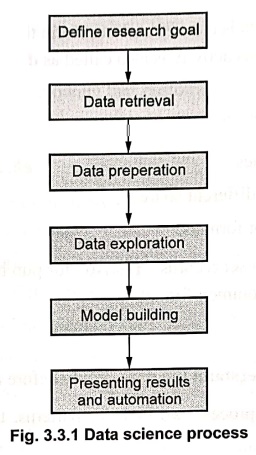
Data science process is a series of activities that help us move from a business problem to a useful solution based on data. 1. Define research goals 2. Data retrieval 3. Data preparation 4. Data exploration 5. Model building 6. Presenting results and automation
Data
Science Process: Overview
Data
science process is a series of activities that help us move from a business
problem to a useful solution based on data.
Define research goal
↓
Data retrieval
↓
Data preperation
↓
Data exploration
↓
Model building
↓
Presenting results and automation
Fig. 3.3.1 Data
science process
Following
are the steps of data science process ‒
1. Define research goals:
•
This is the first and most important
step.
•
This is a step in which we clearly
define what problem we are solving, why
it is important, and how to solve it.
•
The output of this step is usually a short document called project charter which explains project's purpose and plan.
•
For example ‒ A company wants to reduce
customer churn (people leaving their service). So research goal could be
"Predict which customers are likely to leave in next three months"
2. Data retrieval:
•
After defining the goal, the next step
is to collect data from right sources.
•
We need to find relevant and reliable
data for analysis.
•
Data can be collected from company databases, public web sites, APIs,
Sensors, Surveys.
•
The collected data is usually raw.
That means it may have errors, missing values or inconsistent formats.
•
For example ‒ The company collects
customer information like ‒ name, age, purchase history and subscription
duration from its database.
3. Data preparation :
•
This is a step in which data is cleaned and transform the raw data in such a
manner that it
can
be used in models. This activity is also called as data preprocessing.
•
It includes ‒
■
Removing duplicates
■
Filling in missing values.
■
Combining data from different sources
■
Changing data types or formats.
•
For example ‒ If one data set records "Yes/No" for purchase and
another uses "1/0”, we can convert them into a common format.
4. Data exploration :
•
In this step we try to understand the
data deeply before modeling.
•
During data exploration process, we look for patterns, trends and relationships
among the variables.
•
We use graphs, charts and statistics
to visualize and describe data.
•
This helps us to decide which type of
model or analysis will work best.
•
For example ‒ We might discover that
customers aged 18‒25 have a higher chances of leaving compared to other age
groups.
5. Model building:
•
This is a data modelling step. In this
step, we apply machine learning algorithms (like linear regression model,
Decision trees or clustering).
•
Sometimes simple models can perform better than the complex ones.
•
We can combine multiple simple models to improve the results.
•
For example ‒ Build a prediction model to estimate which customers are likely
to leave next month based on their behaviour.
6. Presenting results and automation:
•
This is a final step of data science process.
•
In this step, we have to communicate our results clearly to decision makers.
•
Make use of charts, dashboards, or reports to show how your findings can
improve the business.
•
If the process needs to be repeated regularly then we can automate the model so
it runs automatically with new data.
•
For example ‒ Present a report showing
that customers who use the app less than twice a week are more likely to leave ‒
and recommend strategies to re‒engage them.
Python for Data Science: Chapter 3: Foundations of Data Science : Tag: Computer Programming, Python, Data Science : - Data Science Process: Overview
Python for Data Science: Chapter 3: Foundations of Data Science
Under Subject
Python for Data Science
AD25201 2nd Semester AIDS Dept | 2025 Regulation | 2nd Semester 2025 Regulation
Related Subjects
English Essentials II
EN25C02 2nd Semester | 2025 Regulation | 2nd Semester 2025 Regulation
Tamils and Technology தமிழர்களும் தொழில்நுட்பமும்
UC25H02 2nd Semester | 2025 Regulation | 2nd Semester 2025 Regulation
Linear Algebra
MA25C02 2nd Semester | 2025 Regulation
Applied Physics (CSIE) II
PH25C03 2nd Semester AIDS, CSE, IT, CSE(CY) Dept | 2025 Regulation | 2nd Semester 2025 Regulation
Digital Principles and Computer Organization
CS25C06 2nd Semester AIDS, CSE, IT, CSE(CY) Dept | 2025 Regulation | 2nd Semester 2025 Regulation

Basic Electrical and Electronics Engineering
EE25C01 2nd Semester | 2025 Regulation | 2nd Semester 2025 Regulation
Python for Data Science
AD25201 2nd Semester AIDS Dept | 2025 Regulation | 2nd Semester 2025 Regulation

Re-Engineering for Innovation
ME25C05 2nd Semester | 2025 Regulation | 2nd Semester 2025 Regulation
Python for Data Science - Laboratory
AD25201 2nd Semester AIDS Dept | 2025 Regulation | 2nd Semester 2025 Regulation