Digital Principles and Computer Organization: Chapter 12: IO Systems
Interrupt-Driven I/O
1. Recognition of Interrupt and Response to Interrupt, 2. Comparison between Programmed I/O and Interrupt Driven I/O. Questions: 1. What is interrupt? 2. What is the basic difference between branch instruction a call subroutine instruction and program interrupt? 3. Discuss the general steps involved in interrupt driven data transfer. 4. How does the processor handle an interrupt request? 5. Explain the following: Hardware interrupts. 6. Write short note on Interrupts. 7. What are the steps in handling interrupts ? 8. Why are interrupt masks provided in any processor? 9. What is a non-maskable interrupt? What is the action performed on receipt of a NMI? 10. What are vectored interrupts ?ngle 11. What do you mean by interrupt nesting?
Interrupt–Driven I/O
•
Sometimes it is necessary to have the computer automatically execute one of a
collection of special routines whenever certain conditions exists within a
program or the computer system e.g. It is necessary that computer system should
give response to devices such as keyboard, sensor and other components when
they request for service.
•
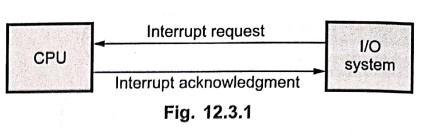
This method provides an external asynchronous input that would inform the
processor that it should complete whatever instruction that is currently being executed
and fetch a new routine (Interrupt Service Routine) that will service the
requesting device. Once this servicing is completed, the processor would resume
exactly where it left off. The event that causes the interruption is called interrupt and the special routine
executed to service the interrupt is called Interrupt Service Routine (ISR).
•
The interrupt service routine is different from subroutine because the address
of ISR is predefined or it is available in Interrupt Vector Table (IVT),
whereas subroutine address is necessarily to be given in subroutine CALL
instruction. IRET instruction is used to return from the ISR whereas RET
instruction is used to return from subroutine. IRET instruction restores flag
contents along with CS and IP in the IA–32 architecture; however RET
instruction only restores CS and IP contents.
•
An interrupt caused by an external signal is referred as a hardware interrupt.
•
Conditional interrupts or interrupts caused by special instructions are called software interrupts.
Enabling and disabling interrupts
•
Most of the processors provide the masking facility. In the processor those
interrupts which can be masked under software control are called maskable interrupts.
The
interrupts which can not be masked under software control are called non–maskable interrupts.
•
Maskable interrupts are enabled and disabled under program control. By setting
or resetting particular flip–flops in the processor, interrupts can be masked
or unmasked, respectively.
•
When masked, processor does not respond to the interrupt even though the
interrupt is activated.
Vectored interrupts
•
When the external device interrupts the processor (interrupt request),
processor has to execute interrupt service routine for servicing that
interrupt. If the internal control circuit of the processor produces a CALL to
a predetermined memory location which is the starting address of interrupt
service routine, then that address is called vector address and such interrupts are called vector interrupts.
For
vector interrupts fastest and most flexible response is obtained since such an
to direct hardware–implemented transition interrupt causes to the correct
interrupt–handling program. This technique is called vectoring. When processor is interrupted, it reads the vector
address and loads it into the PC.
Interrupt nesting
•
For some devices, a long delay in responding to an interrupt request may cause
error in the operation of computer. Such interrupts are acknowledged and
serviced eventhough processor is executing an interrupt service routine for
another device.
•
A system of interrupts that allows an interrupt service routine to be
interrupted is known as nested
interrupts.
Interrupt priority
•
When interrupt requests arrive from two or more devices simultaneously, the
processor has to decide which request should be serviced first and which one
should be delayed. The processor takes the decision with the help of interrupt
priorities.
•
It accepts the request having the highest priority.
1. Recognition of Interrupt and Response to Interrupt
•
The CPU recognizes the interrupt when the external asynchronous input
(interrupt input) is asserted (a signal is sent to the interrupt input) by an
I/O device.
•
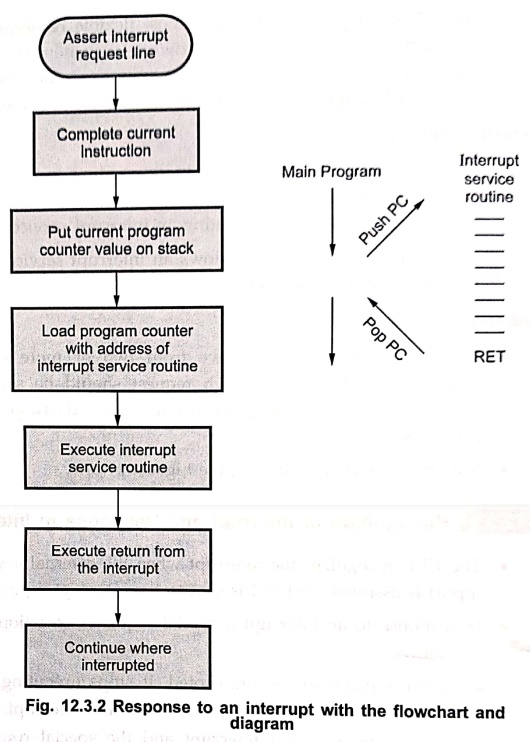
In response to an interrupt a special sequence of actions are performed. These
are as follows :
■
When a processor is interrupted, it stops executing its current program and
calls a special routine which "services" the interrupt. The event
that causes the interruption is called interrupt
and the special routine which is executed is called interrupt service routine.
1.
processor completes its current instruction. No instruction is cut–off in the Middle of its execution.
2.
The program counter's current contents are stored on the stack. Remember,
during the execution of an instruction the program counter is pointing to the
memory location for the next instruction.
3.
The program counter is loaded with the address of an interrupt service routine.
4.
Program execution continues with the instruction taken from the memory location
pointed by the new program counter contents.
5.
The interrupt program continues to execute until a return instruction is
executed.
6.
After execution of the RET instruction processor gets the old address (the
address of the next instruction from where the interrupt service routine was
called.) of the program counter form the stack and puts it back into the
program counter. This allows the interrupted program to continue executing at
the instruction following the one where it was interrupted. Fig. 12.3.2 shows
the response to an interrupt with the flowchart diagram.
2. Comparison between Programmed I/O and Interrupt Driven I/O
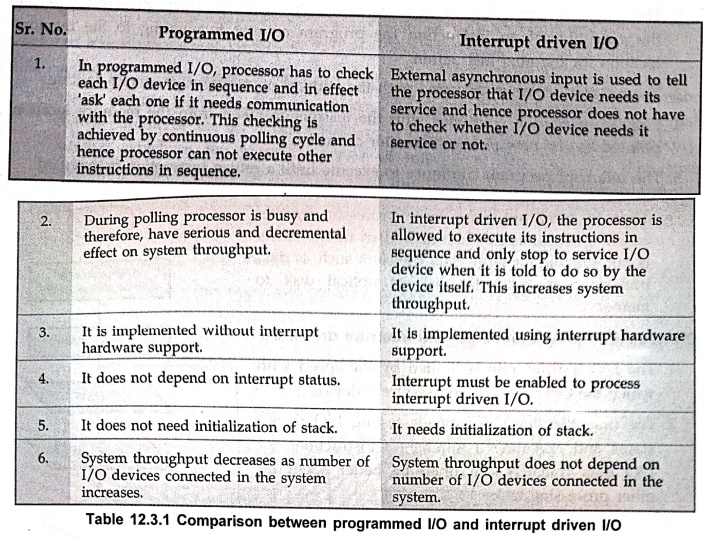
Table
12.3.1 gives the comparison between programmed I/O and interrupt driven I/O.
Programmed I/O
1.
In programmed I/O, processor has to check each I/O device in sequence and in
effect 'ask' each one if it needs communication with the processor. This
checking is achieved by continuous polling cycle and hence processor can not
execute other instructions in sequence.
2.
During polling processor is busy and therefore, have serious and decremental
effect on system throughput.
3.
It is implemented without interrupt hardware support.
4.
It does not depend on interrupt status.
5.
It does not need initialization of stack.
6.
System throughput decreases as number of I/O devices connected in the system
increases.
Interrupt driven I/O
1.
External asynchronous input is used to tell the processor that I/O device needs
its service and hence processor does not have to check whether I/O device needs
it service or not.
2.
In interrupt driven I/O, the processor is allowed to execute its instructions
in sequence and only stop to service I/O device when it is told to do so by the
device itself. This increases system throughput.
3.
It is implemented using interrupt hardware support.
4.
Interrupt must be enabled to process interrupt driven I/O.
5.
It needs initialization of stack.
6.
System throughput does not depend on number of I/O devices connected in the
system.
Review Questions
1. What is interrupt?
2. What is the basic
difference between branch instruction a call subroutine instruction and program
interrupt?
3. Discuss the general
steps involved in interrupt driven data transfer.
4. How does the
processor handle an interrupt request?
5. Explain the
following : Hardware interrupts.
6. Write short note on
: Interrupts.
7. What are the steps
in handling interrupts ?
8. Why are interrupt
masks provided in any processor?
9. What is a non–maskable
interrupt? What is the action performed on receipt of a NMI?
10. What are vectored
interrupts ?
11. What do you mean
by interrupt nesting?
Digital Principles and Computer Organization: Chapter 12: IO Systems : Tag: : - Interrupt-Driven I/O
Digital Principles and Computer Organization: Chapter 12: IO Systems
Under Subject
Digital Principles and Computer Organization
CS25C06 2nd Semester AIDS, CSE, IT, CSE(CY) Dept | 2025 Regulation | 2nd Semester 2025 Regulation
Related Subjects

English Essentials II
EN25C02 2nd Semester | 2025 Regulation | 2nd Semester 2025 Regulation

Tamils and Technology தமிழர்களும் தொழில்நுட்பமும்
UC25H02 2nd Semester | 2025 Regulation | 2nd Semester 2025 Regulation
Linear Algebra
MA25C02 2nd Semester | 2025 Regulation
Applied Physics (CSIE) II
PH25C03 2nd Semester AIDS, CSE, IT, CSE(CY) Dept | 2025 Regulation | 2nd Semester 2025 Regulation
Digital Principles and Computer Organization
CS25C06 2nd Semester AIDS, CSE, IT, CSE(CY) Dept | 2025 Regulation | 2nd Semester 2025 Regulation

Basic Electrical and Electronics Engineering
EE25C01 2nd Semester | 2025 Regulation | 2nd Semester 2025 Regulation
Python for Data Science
AD25201 2nd Semester AIDS Dept | 2025 Regulation | 2nd Semester 2025 Regulation

Re-Engineering for Innovation
ME25C05 2nd Semester | 2025 Regulation | 2nd Semester 2025 Regulation
Python for Data Science - Laboratory
AD25201 2nd Semester AIDS Dept | 2025 Regulation | 2nd Semester 2025 Regulation