Digital Principles and Computer Organization: Chapter 12: IO Systems
IO Systems: Interrupt Types and Priority Handling
1. Interrupt Types, 2. Priority Handling: Daisy-Chaining Priority, Arrangement of Priority Groups, Vectored Interrupts Scheme / Priority Interrupt Hardware, Priority Encoder. Questions: 1. List out types of interrupt. Explain any one. 2. What are priority interrupts? Explain any one interrupt priority scheme. 3. Explain daisy chain priority interrupt.
Interrupt Types and
Priority Handling
1. Interrupt Types
•
Interrupts can be classified into different types based on their origin and
handling priority :
1. Hardware interrupts
•
Generated by hardware devices (I/O devices, timers, etc.).
• Example :
A keyboard pressing a key or a disk signaling data transfer completion.
• Subtypes :
■
Maskable Interrupts (IRQ) : Can be
turned off (masked) by the CPU if needed.
■
Non–Maskable Interrupts (NMI) :
Cannot be ignored; usually used for critical errors (e.g., hardware failure).
2. Software Interrupts
•
Generated by programs using special instructions.
•
Often used to request operating system services (system calls).
• Example :
In × 86 systems, the INT instruction triggers a software interrupt.
3. Internal Interrupts (Exceptions / Traps)
•
Arise from the CPU itself due to abnormal conditions during execution.
• Examples :
Divide–by–zero error, invalid opcode, page fault.
•
Used for error handling and debugging.
4. External Interrupts
•
Arise from external hardware devices signaling the CPU.
• Example :
Mouse movement, incoming network packet.
5. Vectored and Non–Vectored Interrupts
• Vectored interrupts :
The device provides the address of the ISR directly (fast handling).
• Non–Vectored
Interrupts : CPU must determine the ISR address through
polling or fixed locations.
2. Priority Handling
•
When interrupt requests arrive from two or more devices simultaneously, the
processor has to decide which request should be serviced first and which one
should be delayed. The processor takes the decision with the help of interrupt
priorities. It accepts the request having the highest priority.
•
In case polling to identify the interrupting device, priority is automatically
assigned by the order in which devices are polled.
•
No further arrangement is required to accommodate simultaneous interrupt
requests.
1. Daisy–Chaining Priority
•
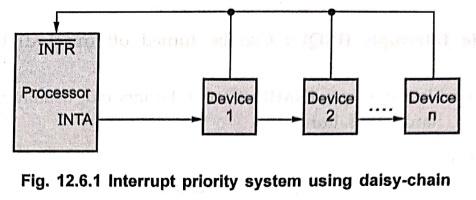
In case of vectored interrupts, the priority of any device is usually
determined by the way the device is connected to the processor. Most Common way
to connect the devices is to form a daisy chain, as shown in Fig. 12.6.1.
2. Arrangement of Priority Groups
•
As shown in Fig. 12.6.1, the interrupt request line ( ) is
common to all devices and the interrupt acknowledge line (INTA) is connected in
a daisy–chain fashion.
) is
common to all devices and the interrupt acknowledge line (INTA) is connected in
a daisy–chain fashion.
•
In daisy–chain fashion the signal is allowed to propagate serially through the
devices.
•
When more than one devices issue an interrupt request, the line is activated and processor responds by setting the INTA line. This signal
is received by device 1. Device 1 passes the signal to the device 2 only if it
does not require any service. If device 1 requires service, it blocks the INTA
line and puts its identification code on the data lines. Therefore, in daisy–chain
arrangement, the device that is electrically closest to the processor has the
highest priority.
•
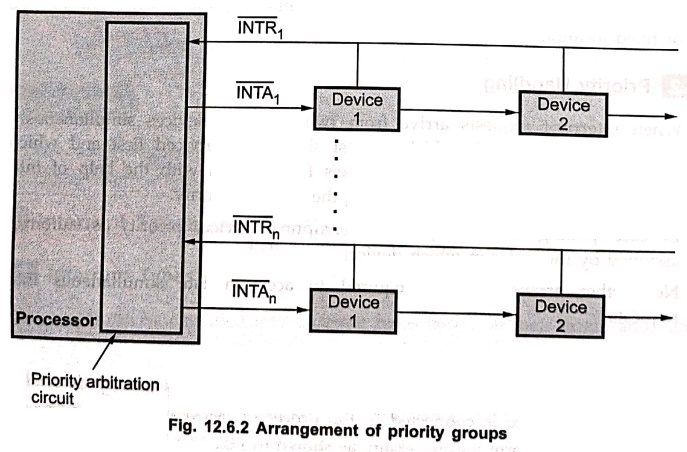
Fig. 12.6.2 shows another arrangement for handling priority interrupts. Here,
device are organised in groups and each group is connected at a different
priority level. Within a group, devices are connected in a daisy–chain.
3. Vectored Interrupts Scheme / Priority Interrupt Hardware
•
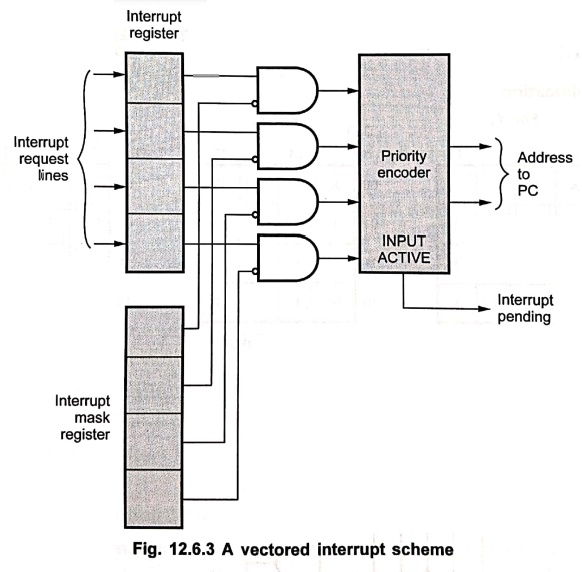
Fig. 12.6.3 shows a widely used vectored interrupt scheme. As shown in Fig.
12.6.3, interrupt request signals are stored in the interrupt register. The
programmable interrupt mask register is used to disable any or all of the
interrupt request lines. For any AND gate, one input is the interrupt request
signal from interrupt register and second input is the inverted mask condition
for the same interrupt from interrupt mask register. When any interrupt is
masked (1), the input to AND gate is zero, hence output goes zero. This means
when interrupt is masked, the corresponding interrupt request line is disabled.
When interrupt request is present for unmasked interrupt, that is fed into a
priority encoder which produces the address which is then inserted into the
program counter.
4. Priority Encoder
•
A priority encoder is an encoder circuit that includes the priority function.
In priority encoder, if two or more inputs are equal to 1 at the same time, the
input having the highest priority will take precedence.
•
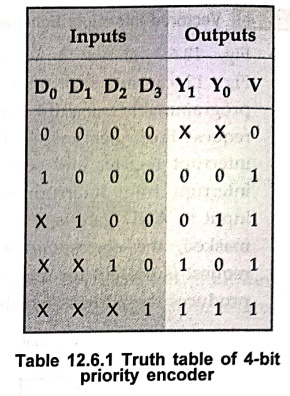
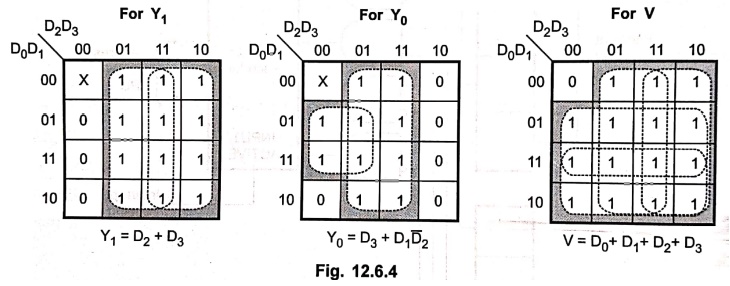
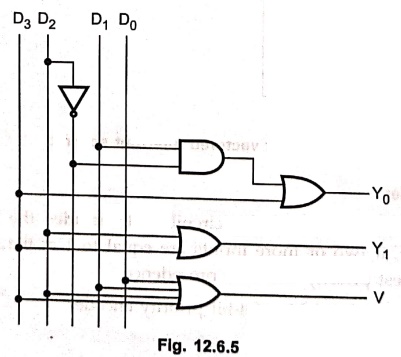
Table 12.6.1 shows truth table of 4–bit priority encoder.
•
Table 12.6.1 shows D3 input with highest priority and D0
input with lowest priority. When D3 input is high, regardless of
other inputs output is (Y1 Y0 = 11) 11.
•
The D2 has the next priority. Thus, when D3 = 0 and D2
= 1, regardless of other two lower priority input, output is 10.
•
The output for D1 is generated only if higher priority inputs are 0
and so on.
•
The output V (a valid output indicator) indicates, one or more of the inputs
are equal to 1. If all inputs are 0, V is equal to 0 and the other two outputs
(Y1 and Y0) of the circuit are not used.
K–map simplification
Logic diagram
Review Questions
1. List out types of
interrupt. Explain any one.
2. What are priority
interrupts? Explain any one interrupt priority scheme.
3. Explain daisy chain
priority interrupt.
Digital Principles and Computer Organization: Chapter 12: IO Systems : Tag: : - IO Systems: Interrupt Types and Priority Handling
Digital Principles and Computer Organization: Chapter 12: IO Systems
Under Subject
Digital Principles and Computer Organization
CS25C06 2nd Semester AIDS, CSE, IT, CSE(CY) Dept | 2025 Regulation | 2nd Semester 2025 Regulation
Related Subjects

English Essentials II
EN25C02 2nd Semester | 2025 Regulation | 2nd Semester 2025 Regulation

Tamils and Technology தமிழர்களும் தொழில்நுட்பமும்
UC25H02 2nd Semester | 2025 Regulation | 2nd Semester 2025 Regulation
Linear Algebra
MA25C02 2nd Semester | 2025 Regulation
Applied Physics (CSIE) II
PH25C03 2nd Semester AIDS, CSE, IT, CSE(CY) Dept | 2025 Regulation | 2nd Semester 2025 Regulation
Digital Principles and Computer Organization
CS25C06 2nd Semester AIDS, CSE, IT, CSE(CY) Dept | 2025 Regulation | 2nd Semester 2025 Regulation

Basic Electrical and Electronics Engineering
EE25C01 2nd Semester | 2025 Regulation | 2nd Semester 2025 Regulation
Python for Data Science
AD25201 2nd Semester AIDS Dept | 2025 Regulation | 2nd Semester 2025 Regulation

Re-Engineering for Innovation
ME25C05 2nd Semester | 2025 Regulation | 2nd Semester 2025 Regulation
Python for Data Science - Laboratory
AD25201 2nd Semester AIDS Dept | 2025 Regulation | 2nd Semester 2025 Regulation