Digital Principles and Computer Organization: Chapter 7: Sequential Circuits - Registers
Introduction (Buffer and Controlled Buffer Register)
Questions 1. What is register? 2. What is buffer register? 3. What do you mean by controlled buffer register?
Digital
Principles and Computer Organization:
Chapter 7: Sequential
Circuits - Registers
Introduction
•
We have seen that a flip-flop is nothing but a binary cell capable of storing
one bit information and can be connected together to perform counting operations.
Such a group of flip-flops is called counter. We have also seen that group of
flip-flops can be used to store a word, which is called register.
•
A flip-flop can store 1-bit information. So an n-bit register has a group of n
flip-flops and is capable of storing any binary information/number containing
n-bits.
1. Buffer Register
•
Fig. 7.1.1 shows the simplest register constructed with four D flip-flops. This
register is also called buffer register. Each D flip-flop is triggered with a
common negative edge clock pulse. The input bits set up the flip-flops for
loading. Therefore, when the first negative clock edge arrives, the stored
binary information becomes,
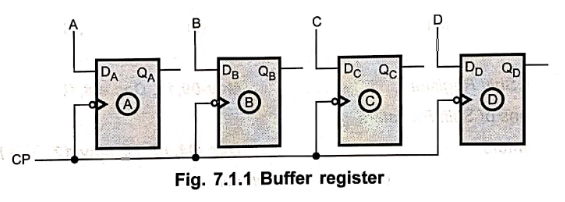
QAQBQCQD
= ABCD
•
In this register, four D flip-flops are used. So it can store 4-bit binary
information. Thus the number of flip-flop stages in a register determines its
total storage capacity.
2. Controlled Buffer Register
We
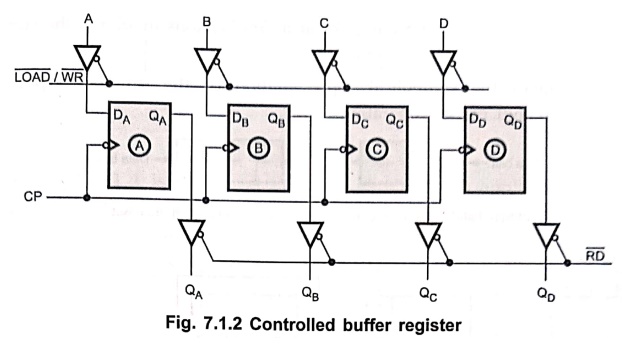
can control input and output of the register by connecting tri-state devices at
the input and output sides of register as shown in Fig. 7.1.2. So this register
is called 'controlled buffer register'.
Here,
tri-state switches are used to control the operation. When you want to store
data in the register, you have to make  or
or  signal low to
activate the tri-state buffers. When you want the data at the output, you have
to make
signal low to
activate the tri-state buffers. When you want the data at the output, you have
to make  signal low to activate the buffers. Controlled buffer
registers are commonly used for temporary storage of data within a digital
system.
signal low to activate the buffers. Controlled buffer
registers are commonly used for temporary storage of data within a digital
system.
As
seen above the 4-bit register can store 4-bit binary information. In general,
n-bit register can store n-bit binary information.
Example: 1
Determine the number of
flip–flops needed to construct a register capable of storing,
i) A 6–bit binary
number
ii) Decimal numbers up
to 32
iii) Hexadecimal
numbers up to F
iv) Octal numbers up to
10.
Solution :
i)
A 6–bit binary number requires register with 6 flip–flops.
ii)
(32)10 = (100000)2. The number of bits required to
represent 32 in binary are six, therefore, 6 flip–flops are needed to construct
a register capable of storing 32 decimal.
iii)
(F)16 = (1111)2. The number of bits required to represent
(F)16 in binary are four, therefore four flip–flops are needed to
construct a register capable of storing (F)16.
iv) (10)8 =(1000)2. The
number of bits required to represent (10)8 in binary are four,
therefore, four flip–flops are needed to construct a register capable of
storing (10)8.
Review Questions
1. What is register?
2. What is buffer
register?
3. What do you mean by
controlled buffer register?
Digital Principles and Computer Organization: Chapter 7: Sequential Circuits - Registers : Tag: : - Introduction (Buffer and Controlled Buffer Register)
Digital Principles and Computer Organization: Chapter 7: Sequential Circuits - Registers
Under Subject
Digital Principles and Computer Organization
CS25C06 2nd Semester AIDS, CSE, IT, CSE(CY) Dept | 2025 Regulation | 2nd Semester 2025 Regulation
Related Subjects

English Essentials II
EN25C02 2nd Semester | 2025 Regulation | 2nd Semester 2025 Regulation

Tamils and Technology தமிழர்களும் தொழில்நுட்பமும்
UC25H02 2nd Semester | 2025 Regulation | 2nd Semester 2025 Regulation
Linear Algebra
MA25C02 2nd Semester | 2025 Regulation
Applied Physics (CSIE) II
PH25C03 2nd Semester AIDS, CSE, IT, CSE(CY) Dept | 2025 Regulation | 2nd Semester 2025 Regulation
Digital Principles and Computer Organization
CS25C06 2nd Semester AIDS, CSE, IT, CSE(CY) Dept | 2025 Regulation | 2nd Semester 2025 Regulation

Basic Electrical and Electronics Engineering
EE25C01 2nd Semester | 2025 Regulation | 2nd Semester 2025 Regulation
Python for Data Science
AD25201 2nd Semester AIDS Dept | 2025 Regulation | 2nd Semester 2025 Regulation

Re-Engineering for Innovation
ME25C05 2nd Semester | 2025 Regulation | 2nd Semester 2025 Regulation
Python for Data Science - Laboratory
AD25201 2nd Semester AIDS Dept | 2025 Regulation | 2nd Semester 2025 Regulation