Digital Principles and Computer Organization: Chapter 5: Sequential Circuits - Flip-Flops
Introduction of Sequential Circuits
Questions: 1. Define sequential logic circuit. 2. What is flip-flop? 3. Give the comparison between combinational and sequential logic circuits. 4. What is clock? State its use.
Digital Principles and Computer Organization:
Chapter 5: Sequential Circuits - Flip-Flops
Introduction
•
There are many applications in which digital outputs are required to be
generated in accordance with the sequence in which the input signals are
received. This requirement cannot be satisfied using a combinational logic
system. These applications require outputs to be generated that are not only
dependent on the present input conditions but they also depend upon the past
history of these inputs. The past history is provided by feedback from the
output back to the input.
•
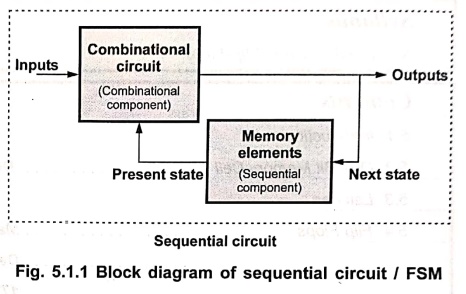
Fig. 5.1.1 shows the block diagram of sequential Inputs circuit/Finite State
Machine (FSM). As shown in Fig. 5.1.1, memory elements are connected to the
combinational circuit as a feedback path.
•
The information stored in the memory elements at any given time defines the present state of the sequential
circuit. The present state and the external inputs determine the outputs and
the next state of the sequential
circuit. Thus we can specify the sequential circuit by a time sequence of
external inputs, internal states (present states and next states), and outputs.
The counters and registers are the common examples of sequential circuits.
The memory element used
in sequential circuits is a flip–flop which is capable of storing 1–bit binary
information.
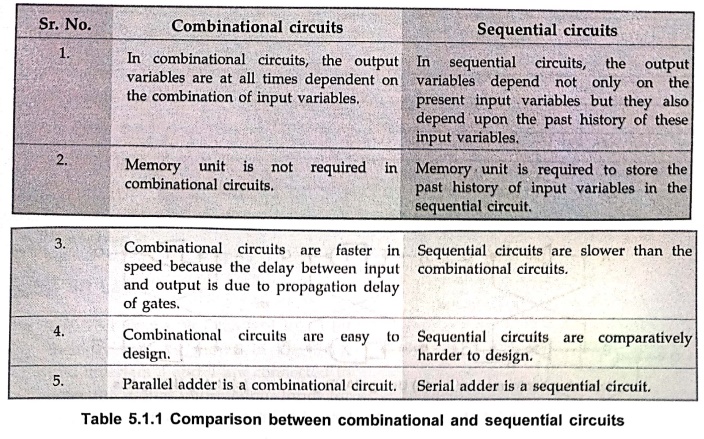
Comparison between Combinational and Sequential Logic Circuits
Combinational circuits
1.
In combinational circuits, the output variables are at all times dependent on
the combination of input variables.
2.
Memory unit is not required in combinational circuits.
3.
Combinational circuits are faster in speed because the delay between input and
output is due to propagation delay of gates.
4.
Combinational circuits are easy to design.
5.
Parallel adder is a combinational circuit.
Sequential circuits
1.
In sequential circuits, the output variables depend not only on the present
input variables but they also depend upon the past history of these input
variables.
2.
Memory unit is required to store the past history of input variables in the
sequential circuit.
3.
Sequential Circuits are slower than the combinational circuits.
4.
Sequential circuits are comparatively harder to design.
5.
Serial adder is a sequential circuit.
Clock
•
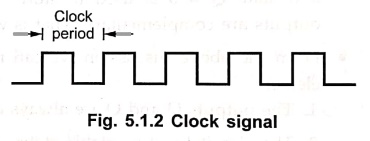
A clock signal is a particular type of signal that oscillates between a high
and a low state and is utilized to co–ordinate actions of circuits. It is
produced by a clock generator. The most common clock signal is in the form of a
square wave with a 50% duty cycle, usually with a fixed, constant frequency as
shown in Fig. 5.1.2. Circuits using the clock signal for synchronization may
become active at either the rising edge, falling edge or in the case of double
data rate, both in the rising and in the falling edges of the clock cycle.
•
The time required to complete one cycle is called 'clock period' or 'clock
cycle'. Ideally, the clock signal should have sharp transitions from one
level to other as shown in Fig. 5.1.2.
Review Questions
1. Define sequential
logic circuit.
2. What is flip–flop?
3. Give the comparison
between combinational and sequential logic circuits.
4. What is clock?
State its use.
Digital Principles and Computer Organization: Chapter 5: Sequential Circuits - Flip-Flops : Tag: : - Introduction of Sequential Circuits
Digital Principles and Computer Organization: Chapter 5: Sequential Circuits - Flip-Flops
Under Subject
Digital Principles and Computer Organization
CS25C06 2nd Semester AIDS, CSE, IT, CSE(CY) Dept | 2025 Regulation | 2nd Semester 2025 Regulation
Related Subjects

English Essentials II
EN25C02 2nd Semester | 2025 Regulation | 2nd Semester 2025 Regulation

Tamils and Technology தமிழர்களும் தொழில்நுட்பமும்
UC25H02 2nd Semester | 2025 Regulation | 2nd Semester 2025 Regulation
Linear Algebra
MA25C02 2nd Semester | 2025 Regulation
Applied Physics (CSIE) II
PH25C03 2nd Semester AIDS, CSE, IT, CSE(CY) Dept | 2025 Regulation | 2nd Semester 2025 Regulation
Digital Principles and Computer Organization
CS25C06 2nd Semester AIDS, CSE, IT, CSE(CY) Dept | 2025 Regulation | 2nd Semester 2025 Regulation

Basic Electrical and Electronics Engineering
EE25C01 2nd Semester | 2025 Regulation | 2nd Semester 2025 Regulation
Python for Data Science
AD25201 2nd Semester AIDS Dept | 2025 Regulation | 2nd Semester 2025 Regulation

Re-Engineering for Innovation
ME25C05 2nd Semester | 2025 Regulation | 2nd Semester 2025 Regulation
Python for Data Science - Laboratory
AD25201 2nd Semester AIDS Dept | 2025 Regulation | 2nd Semester 2025 Regulation