Applied Physics CSIE II: UNIT I: Magnetic Materials
Magnetic Materials: Two Marks Important Questions and Answers
Applied Physics
Applied Physics CSIE II: UNIT I: Magnetic Materials: Anna University Part A Two Marks Important Questions and Answers
Applied Physics CSIE II
UNIT I: Magnetic Materials
ANNA UNIVERSITY PART A
QUESTIONS And ANSWERS
1. On the basis of spin
how the materials are classified as para, ferro, antiferro and ferri magnetic.
(i)
Paramagnetic materials have few unpaired electron spins of equal magnitudes.
(ii)
Ferro magnetic materials have many unpaired electron spins with equal
magnitudes.
(iii)
Anti ferro magnetic materials have equal magnitude of spins but in antiparallel
manner.
(iv)
Ferrimagnetic materials have spins in antiparallel manner but with unequal
magnitudes.
2. Give Curie‒Weiss law
and its importance.
Curie‒Weiss
law is given by
χm = C / [T‒θ]

where
C→
Curie constant
T→
Absolute temperature
θ→
Curie temperature
Importance:
It determines the susceptibility of the magnetic materials in terms of
temperatures (i.e.,) If the temperature is less than Curie temperature, a
paramagnetic material becomes diamagnetic and if the temperature is greater
than Curie temperature, a ferromagnetic material becomes paramagnetic material.
3. What do you
understand by the term, "magnetic domains" and "domain
walls"?
Magnetic
domains are the small regions in a ferromagnetic material which has a group of
atoms. These atoms can be completely magnetised by favourable exchange spin‒spin
interaction. The walls of these small regions (or) domains are called domain
walls.
4. What are soft and
hard magnetic materials? (or) Compare soft and hard magnetic materials on basis
of Hysteresis loop. give examples.
Soft
1.
They can be easily magnetised and demagnetised.
2.
Movement of domain wall is easy and hence even for a small applied field large
magnetisation occurs.
3.
The Hysteresis loop is very steep as shown in Fig. (1a).
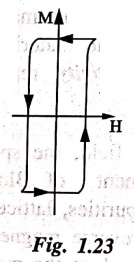
4.
Loop area is less and hence the hysteresis loss is minimum.
5.
Examples, Iron, silicon alloys, Ferrites, Garnets etc.
Hard
1.
They cannot be easily magnetised (or) demagnetised.
2.
Movement of domain wall is not easy due to the presence of impurities and hence
large field is required for magnetisation.
3.
The Hysteresis loop is very broad as s shown in Fig. (1b).
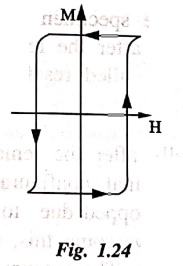
4.
The loop area is large and hence the hysteresis loss is maximum.
5.
Carbon steel, Tungsten steel, Chromium steel, Cu‒Ni‒Fe (Cunife), Cu‒Ni‒Co
(Cunico), Al‒Ni‒Co (Alnico)
5. Draw hysteresis loop
and show the retentivity and co‒ercivity in it.
The
hysteresis loop, retentivity and co‒ercivity is shown in Fig.
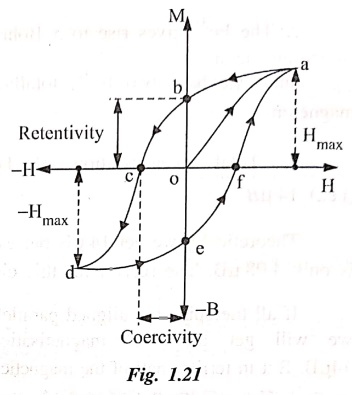
6. What are Ferrites
and Ferrox cubes?
Ferrites
are the modified structure of iron with no carbon in which the magnetic moments
are of unequal magnitudes. They are made by two (or) more different kinds of
atoms. Its general formula is given by X2+ Fe23+O4
where
X2+ is a divalent metal ion such as Mg2+, Zn2+,
Fe2+, etc.
Ferrox
cubes are the soft magnetic material for which the hysteresis loop will be in
the form of a narrow rectangle.
7. What is domain
theory of ferromagnetism?
The
group of atomic dipoles organized into tiny bounded regions in the
ferromagnetic materials are called magnetic domains. The boundaries separating
domains are called domain walls. In Ferro‒magnets, when external magnetic field
is applied, the domains align and results in large net magnetization.
8. Define antiferromagnetism.
Mention two materials that exhibit antiferromagnetism.
In
antiferromagnetism the spins are aligned in antiparallel manner (Fig. 1(d)) due
to unfavourable exchange interaction among them, resulting in zero magnetic
moment. Even when the field is increased, it has almost zero induced magnetic moment.
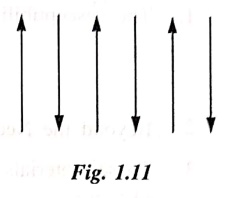
Antiferro‒magnetic
materials:
(i)
Ferrous oxide (FeO) (ii) Manganese Oxide (MnO4) (iii) Manganese
Sulphide (MnS) (iv) Chromium Oxide (Cr2O3)
These
elements will be wide range of applications in magnetic storage devices.
9. Define magnetic
lines of force and magnetic lines of induction
Magnetic
lines of force: It is defined as the continuous curve
in a magnetic field which travels externally in the magnet from north pole to
south pole.
Magnetic
lines of induction: It is the imaginary lines of forces
which are supposed to travel from south pole to north pole inside the magnet.
10. Discuss the
orientation of spin for dia, para and ferro‒magnetic substances.
Diamagnetic
materials: Here the electron spins are randomly oriented and
mostly they have equal and opposite spins. Thus the net magnetic moment is
zero.
Paramagnetic
material: Here the spins of electrons will not be equal,
which leads to have some unpaired electrons. Hence there exists some resultant
magnetic moment. Therefore in paramagnetic material the net magnetic moment is
not zero.
Ferromagnetic
material: In ferro magnetic materials the number of unpaired
electrons will be more. Hence there exists a large resultant magnetic moment in
it.
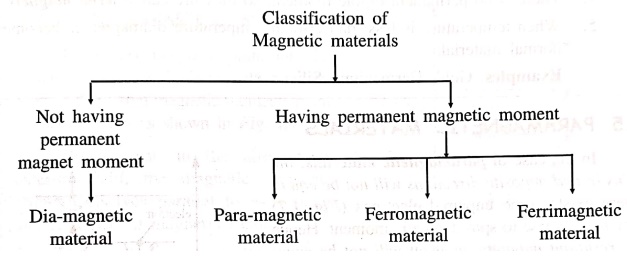
11. Classify the
magnetic materials based on their magnetic moments.
The
magnetic materials can be classified into two major categories based on the
presence of magnetic moments as follows.
Magnetic
materials are classified according to the presence or absence of the permanent
magnetic dipoles. Generally, every two electrons in an energy state of an atom
will form a pair with opposite spins. Thus the resultant spin magnetic moment
is zero. Hence they don't have permanent magnetic moments and they are called
as diamagnetic materials. Examples. gold, germanium, silicon, etc.
But
in some magnetic materials like iron, cobalt, etc., there exists unpaired
electrons. The spin magnetic moment of these unpaired electrons interact with
the adjacent atom's unpaired electron spin magnetic moment in a parallel manner
resulting in enormous permanent spin magnetic moment. These materials are
classified into paramagnetic, ferromagnetic and ferrimagnetic materials with
respect to the electron spins.
(OR)
Classification
of Magnetic materials:
1.
Not having permanent magnet moment : Dia‒magnetic material
2.
Having permanent magnetic moment: Para‒magnetic material, Ferromagnetic
material, Ferrimagnetic material
12. Define Bohr
magneton.
The
orbital magnetic moment and the spin magnetic moment of an electron in an atom
can be expressed in terms of smallest atomic unit of magnetic moment called
Bohr magneton.
1
Bohr Magneton = e / 2m
/ 2m
μB
⇒ 9.27
× 1024 Am2
13. State the
applications of ferrites.
(i)
Ferrites are used in audio transformers, video transformers, radio receivers
etc
(ii)
They are used in two port devices such as gyrator, circulator and isolator
(iii)
They are used in computers and data processing circuits
(iv)
They are used in switching circuits and parametric amplifiers.
14. What are the
required magnetic parameters for recording?
The
basic parameters required for recording are
(i)
Electromagnetic induction should occur in materials.
(ii)
The material should easily acquire magnetism.
(iii)
It should posses magneto‒resistance i.e., the electrical resistance should vary
with respect to the magnetisation.
(iv)
Soft magnets should be used for temporary storage and hard magnets should be
used for permanent storage.
15. Define Hysteresis.
What is meant hy Hysteresis loop and what do you infer from it?
When
a ferromagnetic material is made to undergo a cycle of magnetistion, the
intensity of magnetisation (I) and the magnetic flux density (B) lags behind
the applied magnetic field (H), and this process is known as Hysteresis.
The
closed curve obtained during the cycle of magnetisation of a material is known
as hysteresis loop.
Inference:
The area of the loop gives the energy loss (or) hysteresis loss during the
cycle of magnetisation.
ADDITIONAL PART A
QUESTIONS & ANSWERS
1. What is meant by
magnetic materials? Give examples.
Magnetic
materials are the materials which can be easily magnetised by keeping it in an
external magnetic field.
Examples:
Iron, Ferrites, Carbon steel etc.
2. Define magnetic flux
density and magnetic dipole with its unit.
Magnetic
flux density (B): It is defined as the number of
magnetic lines of forces (ϕm) passing normally through unit area of
cross section (A).
(i.e.,) B = ϕm / A Wbm‒2
(or) Tesla
Magnetic
dipole: Two opposite magnetic poles separated by some
distance is called magnetic dipole. It can be also be defined as the product of
magnetic pole strength (m) and the length of the magnet. (i.e.,) Mμ
= m/ Wbm‒1
3. Define magnetic
field intensity and intensity of magnetisation with its unit.
Magnetic
field intensity (H): It is defined as the force experienced
by a unit north pole placed at the given point in a magnetic field.
(i.e.,) H = F/m Am‒1
Intensity
of magnetisation [M (or) I]: It is defined as the magnetic
moment per unit volume.
(i.e.,)
I = Mμ / V Wbm‒2
4. Define magnetic
susceptibility and magnetic permeability.
Magnetic
susceptibility (χm): It is defined as the
ratio between intensity of magnetisation (M (or) I) and the magnetic field
intensity (H)
(i.e.,) χm = I / H
Magnetic
permeability (μ): It is defined as the ratio between the
magnetic flux density (B) and the magnetic field intensity (H)
(i.e.,)
μ = B / H
5. Prove μr =
1+ χm
When
a magnetic material is kept in an external magnetic field, then flux density
can be written as
B=μ0 (H+I) …………(1)
We
know u
μ=B/
H
⇒ B=μH …………(2)
Equating
(1) and (2) we get μH = μ0 (H+I)
(or)
μ0μrН
= μ0H( 1+ I/H )
Here
1/H = χm
(or)
χr = ( 1+ 1/H )
[because
μ = μ0μr]
(or)
μr = 1+χm
Hence
Proved
6. Explain the term
remanence and coercivity with its units.
Remanence/Retentivity:
It is the residual intensity of magnetisation retained by the specimen even
when the external magnetic field is cutoff.
Unit:
Wbm‒2
Coercity:
It is the strength of reverse magnetic field required to completely remove the
residual magnetisation (or) demagnetise the material.
Unit:
Ampere turn / metre
7. What is the origin
of the presence of magnetic moments in magnetic materials?
The
origin of presence of magnetic moments is due to orbital and spin motion of
electrons in atom. Generally, every two electrons in an energy state of an atom
will form a pair of opposite spins, but in some materials there exists unpaired
electron spins also. These gives rise to a resultant spin magnetic moment,
which plays a vital role in the classification of magnetic materials.
8. Why diamagnetic
materials are called weak magnets and ferromagnetic materials are called strong
magnets?
Weak
magnets: If a diamagnetic material is kept in an external
magnetic field, the electrons spins in the material reorient in such a way that
they align perpendicular to the field direction and hence the materials will
not be easily magnetised. Thus diamagnetic materials are called weak magnets.
Strong
magnets: When a ferro magnetic material is kept in an
external magnetic field, the electrons which are already aligned parallel to
the direction of magnetic field acquires a very strong magnetic moment in it.
Hence ferromagnetic materials are called strong magnets.
9. What is Curie
temperature?
Curie
temperature is the critical temperature below which a material can behaves as
ferromagnetic material and above which it can behave as paramagnetic material.
10. Compare the
properties of dia, para and ferro magnetic materials.
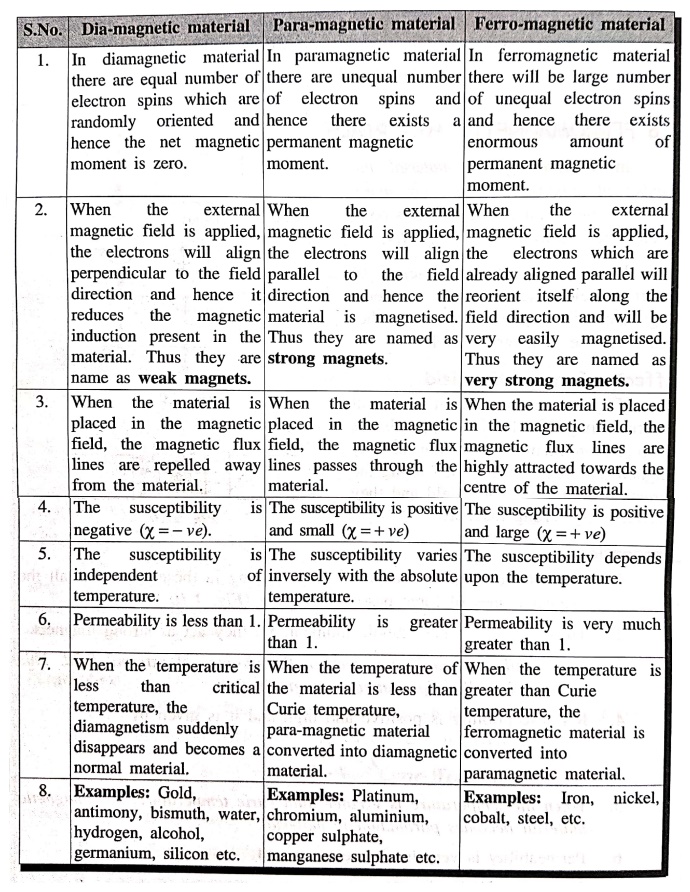
Dia‒magnetic
material
1.
In diamagnetic material there are equal number of electron spins which are
randomly oriented and hence the net magnetic moment is zero.
2.
When the external magnetic field is applied, the electrons will align
perpendicular to the field direction and hence it reduces the magnetic
induction present in the material. Thus they are name as weak magnets.
3.
When the material is placed in the magnetic field, the magnetic flux lines are
repelled away from the material.
4.
The susceptibility negative ( χ = ‒ve).
5.
The susceptibility is independent of temperature.
6.
Permeability is less than 1.
7.
When the temperature is less than critical temperature, the diamagnetism
suddenly disappears and becomes a normal material.
8.
Examples: Gold, antimony, bismuth, water, hydrogen, alcohol, germanium, silicon
etc.
Para‒magnetic
material
1.
In paramagnetic material there are unequal number of electron spins and hence
there exists a permanent magnetic moment.
2.
When the external magnetic field is applied, the electrons will align parallel
to the field direction and hence the material is magnetised. Thus they are
named as strong magnets.
3.
When the material is placed in the magnetic field, the magnetic flux lines
passes through the material.
4.
The susceptibility is positive and small (χ =+ve)
5.
The susceptibility varies inversely with the absolute temperature.
6.
Permeability is greater than 1.
7.
When the temperature of the material is less than Curie temperature,
para‒magnetic material converted into diamagnetic material.
8.
Examples: Platinum, chromium, aluminium, copper sulphate, manganese sulphate
etc.
Ferro‒magnetic
material
1.
In ferromagnetic material there will be large number of unequal electron spins
and hence there exists enormous amount of permanent magnetic moment.
2.
When the external magnetic field is applied, the electrons which are already
aligned parallel will reorient itself along the field direction and will be
very easily magnetised. Thus they are named as very strong magnets.
3.
When the material is placed in the magnetic field, the magnetic flux lines are
highly attracted towards the centre of the material.
4.
The susceptibility is positive and large (χ=+ve)
5.
The susceptibility depends upon the temperature.
6.
Permeability is very much greater than 1.
7.
When the temperature is greater than Curie temperature, the ferromagnetic
material is converted into paramagnetic material,
8.
Examples: Iron, nickel, cobalt, steel, etc.
11. Distinguish the
properties of soft and hard magnetic materials.
Soft
1.
They can be easily magnetised and demagnetised.
2.
Loop area is less and hence the hysteresis loss is minimum.
3.
Susceptibility and permeability is high
4.
Retentivity and Coercivity are small
5.
They have low eddy current loss.
6.
These materials are free from irregularities like strain or impurities.
Hard
1.
They cannot be easily magnetised (or) demagnetised.
2.
The loop area is large and hence the hysteresis loss is maximum.
3.
Susceptibility and permeability is low.
4.
Retentivity and Coercivity are large.
5.
They have high eddy current loss.
6.
These materials have large amount of impurities and lattice defects.
12. What is meant by
reversible and irreversible domains?
When
the external magnetic field applied to a domain is increased, it starts
expanding. Now when the external magnetic field is removed, if the domain
returns to its original position it is called reversible domains and if the
domain doesn't returns to its original position it is known as irreversible
domains.
13. What are the
requirements (required properties) of a transformer core material and
electromagnets?
(I)
A transformer core material should have the following requirements (properties)
(i)
High resistivity
(ii)
Low eddy current losses
(II)
An electromagnet should have the following requirements (properties)
(i)
High initial permeability
(ii)
Low coercivity.
14. What is meant by eddy
current and eddy current losses?
When
an alternating magnetic field is applied to the material, it induces an e.m.f
and sets up a large current in the material. This current is known as eddy
current and the power loss is called eddy current losses.
15. What is meant by
Garnet? Give examples.
Garnet
is a ferrimagnetic material with a typical formula Me3Fe5O12
where,
Me3 → Trivalent metal ion
Fe5
→ Trivalent ferric ion
Examples:
Gadolinium Gallium Garnet, Yttrium Iron Garnet.
Properties
(i)
They have high resistivity
(ii)
They have low hysteresis loss
16. What is GMR?
If
the charge in electrical resistance is very high compared to the magnetisation,
it is called as Giant Magneto‒Resistance (GMR) and this effect is called GMR
effect.
17. What are ESD
magnets? Give its properties.
ESD
magnets are Elongated Single Domain magnets, which are made by very small
particles with very high magnetisation. Hence these ESD magnets possess the
following properties
Properties
(i)
They are highly stable.
(ii)
They have single domain structure.
(iii)
They possess large magnetisation.
18. What is a magnetic
storage device? Give examples.
Ferro
and ferri magnetic materials which are used to store the data in form of zeros
and ones are called magnetic storage devices.
Examples:
Floppy disk, Audio cassettes, magnetic tapes etc.
19. What are the
advantages and disadvantages of magnetic disks?
Advantages
1.
It has very large storage capacity.
2.
Thousands of files can be permanently stored.
3.
Very high speed in reading and writing the informations.
4.
This is prevented from dust particles, since they are seated in special
chamber.
Disadvantages
1.
It is very costly.
2.
If data is once corrupted, there is a heavy loss of data.
20. What is meant by
magnetic bubble? How they are formed?
Magnetic
bubbles are soft magnetic materials with magnetic domains of few micrometer in
diameter.
Formation:
When a magnetic field is applied to magnetic garnets like Gadolinium Gallium
garnet, small cylindrical domain area known as magnetic bubble is formed. These
bubbles has a magnetic region of one polarity (either north (or) south)
surrounded by the other polarity.
21. Distinguish between
magnetic and optical storage devices.
Magnetic
storage devices
1.
Datas are stored using magnetic principle.
2.
Writing and reading the data can be done using electro magnets
3.
Access time is slow.
4.
Example: Floppy disks.
Optical
storage devices
1.
Datas are stored using optical principle.
2.
Writing and reading the data is made using Laser.
3.
Access time is very fast.
4.
Example: Compact disk (CD's)
22. What is meant by
Magnetic HDD? Give the principle of storing data in HDD.
Hard
disk drives [HDD] made up of magnetic garnet materials are called magnetic hard
disk drives. It is a mass data storage device recently used for storing data to
a very high level in terms of Tera bytes.
Now‒a‒days
GMR [Giant Magneto Resistive] sensors, which has a very high magnetic
sensitivity are used to read the data at greater speed.
Principle
In
Hard disk drives, the binary data in terms of zero's (0) and one's (1) are
stored by inducing magnetic moment in a thin magnetic layer and GMR effect is
used as the principle to read the data in HDD.
Here
zero(0) represents missing transition and one (1) represents transition in the
medium.
23. What are the
advantages and disadvantages of HDD?
Advantages
1.
HDD's can store data interms of Terabytes and in future it can store data
interms of Petabytes and Exabytes.
2.
It is has very large storage capacity.
3.
It is compact in size and can be easily transferred from one place to another.
4.
The size of the recording medium in HDD shall be reduced upto few nano‒metres
using nanotechnology.
5.
GMR sensors are non diffusive and are very sensitive in reading.
Disadvantages
1.
HDD is slower than SSD [solid state drives].
2.
They consume more power and will damage, when dropped even at a smaller
distance.
3.
Sometimes the data in HDD may be corrupted, due to thermal radiation.
4.
HDD has bulkier form factor.
5.
The GMR noise ratio is high for the nano size recording media as it is
temperature dependent.
24. What is the role of
GMR sensor in Magnetic HDD
1.
Giant magnetoresistive (GMR) effect is the principle used to read/retrieve the
data from the recording medium.
2.
When the GMR sensor is made to move near the recorded medium, then, the
resistance of the GMR sensor varies, with respect to the orientation of the
magnetic moments as follows.
3.
When the layers are magnetised in parallel manner, then the resistance in the
GMR sensor is minimum and therefore maximum current flows through the sensor,
which represents the data as one (1), as shown in Fig.
4.
When the layers are magnetised in antiparallel manner, then the resistance in
the GMR sensor will be maximum and therefore minimum (or) no current will flow
through the sensor, which represents the data as zero (0), as shown in Fig.
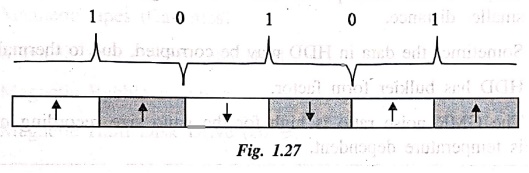
5.
Therefore, with the help of the reading current, the zero's (0's) and one's
(1's) can be retrieved from the magnetic hard disk drive.
25. Give any two
applications of Magnetic Hard disk drives.
Applications
1.
HDD's are used as storage devices in cloud applications.
2.
They are used in coding and signal processing units.
3.
It is used in many Engineering fields such as control systems, nanoelectronics,
etc.
4.
The GMR and spin valve sensors are used in modern HDD by IBM.
Applied Physics CSIE II: UNIT I: Magnetic Materials : Tag: Applied Physics : Applied Physics - Magnetic Materials: Two Marks Important Questions and Answers
Applied Physics CSIE II: UNIT I: Magnetic Materials
Under Subject
Applied Physics (CSIE) II
PH25C03 2nd Semester AIDS, CSE, IT, CSE(CY) Dept | 2025 Regulation | 2nd Semester 2025 Regulation
Related Subjects

English Essentials II
EN25C02 2nd Semester | 2025 Regulation | 2nd Semester 2025 Regulation

Tamils and Technology தமிழர்களும் தொழில்நுட்பமும்
UC25H02 2nd Semester | 2025 Regulation | 2nd Semester 2025 Regulation
Linear Algebra
MA25C02 2nd Semester | 2025 Regulation
Applied Physics (CSIE) II
PH25C03 2nd Semester AIDS, CSE, IT, CSE(CY) Dept | 2025 Regulation | 2nd Semester 2025 Regulation
Digital Principles and Computer Organization
CS25C06 2nd Semester AIDS, CSE, IT, CSE(CY) Dept | 2025 Regulation | 2nd Semester 2025 Regulation

Basic Electrical and Electronics Engineering
EE25C01 2nd Semester | 2025 Regulation | 2nd Semester 2025 Regulation

Python for Data Science
AD25201 2nd Semester AIDS Dept | 2025 Regulation | 2nd Semester 2025 Regulation

Re-Engineering for Innovation
ME25C05 2nd Semester | 2025 Regulation | 2nd Semester 2025 Regulation
Python for Data Science - Laboratory
AD25201 2nd Semester AIDS Dept | 2025 Regulation | 2nd Semester 2025 Regulation