Digital Principles and Computer Organization: Chapter 11: Memory
Memory Concept
Characteristics, Classification
1. Characteristics of Memory, 2. Classification of Primary Memory, 3. Classification of Secondary Memory. Questions: 1. Define a memory cell. Give an example. 2. Define a 'memory location' and a 'cell'. 3. Write a short note on semiconductor memories. 4. State various characteristics of memory devices and explain in brief any two. 5. Distinguish between volatile and non-volatile memories. 6. Explain the key characteristics of computer memory systems in details. 7. Explain the various characteristics of memory system. 8. Classify memories on the basic of principle of operation, physical characteristics, mode of access and fabrication technology. 9. Give the classification of semiconductor memories. 10. Which memory is called volatile? Why? 11. Explain static memory. 12. Give the classification of primary memory.
Digital Principles and Computer Organization:
Chapter 11: Memory
Memory Concept
•
Memories are made up of registers. Each register in the memory is one storage
location also called memory location.
•
Each memory location is identified by an
address. The number of storage locations can vary from a few in some
memories to hundreds of thousand in others. Each location can accommodate one
or more bits.
•
Generally, the total number of bits that a memory can store is its capacity. Most of the types the
capacity is specified in terms of bytes (group of eight bits).
•
Each register consists of storage elements (flip–flops or capacitors in
semiconductor memories and magnetic
domain in magnetic storage), each of which stores one bit of data. A storage
element is called a cell.
•
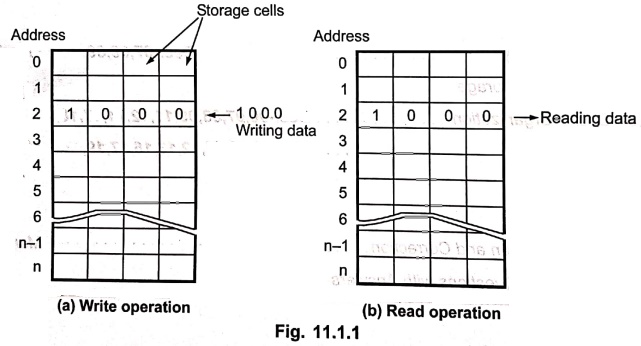
The data stored in a memory by a process called writing and are retrieved from the memory by a process called reading. Fig. 11.1.1 illustrates in a
very simplified way the concept of write, read, address and storage capacity
for a generalized memory.
•
As shown in Fig. 11.1.1 a memory unit stores binary information in groups of
bits called words. A word in memory
is an entity of bits that moves in and out of storage as a unit. A word having
group of 8–bits is called a byte.
Most computer memories use words that are multiples of eight bits in length.
Thus, a 16–bit word contains two bytes, and a 32–bit word is made of 4–bytes.
•
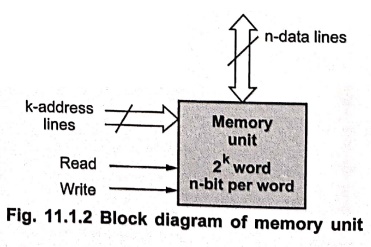
The communication between a memory and its environment is achieved through data
lines, address selection lines, and control lines that specify the direction of
transfer.
•
Fig. 11.1.2 shows the block diagram of memory unit. Then data lines provide the
information to be stored in memory and the k address lines specify the
particular word chosen among the many available. The two control inputs specify
the direction transfer.
•
When there are k address lines we can access 2k memory words. For
example, if k = 10 we can access 210 = 1024 memory words.
Illustrative Examples
Example: 1
A bipolar RAM chip is
arranged as 16 words. How many bits are stored in the chip?
Solution :
16
+ 8 = 128 bits
one
word = 8 bits.
Example: 2
How many address bits
are needed to operate a 2 K × 8 ROM?
Solution :
2
K memory locations = 2048 locations
Since
211 = 2048, we need 11 address lines.
Example: 3
How many locations are
addressed using 18 address bits?
Solution :
The
number of locations addressed = 218 = 262144.
1. Characteristics of Memory
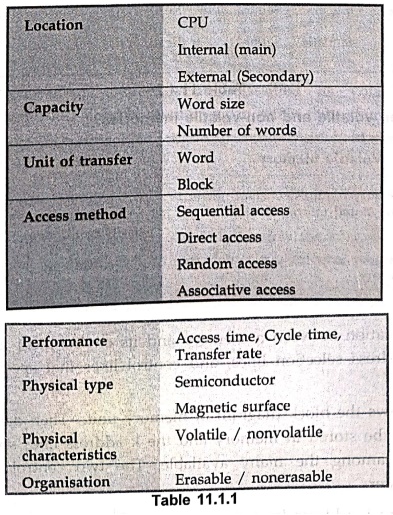
Table
11.1.1 lists the key characteristics of memory systems.
Location –
CPU
Internal
(main)
External
(Secondary)
Capacity –
Word
size
Number
of words
Unit of transfer –
Word
Block
Access method –
Sequential
access
Direct
access
Random
access
Associative
access
Performance –
Access
time, Cycle time, Transfer rate
Physical type –
Semiconductor
Magnetic
surface
Physical
characteristics –
Volatile
/ nonvolatile
Organisation –
Erasable
/ nonerasable
Physical characteristics :
Volatile/Nonvolatile: If
memory can hold data even if power is turned off, it is called nonvolatile memory; otherwise it is
called volatile memory.
Erasable/Nonerasable: The
memories in which data is once programmed cannot be erased are called nonerasable memories. On the other hand, if data in the memory is erasable then
memory is called erasable memory.
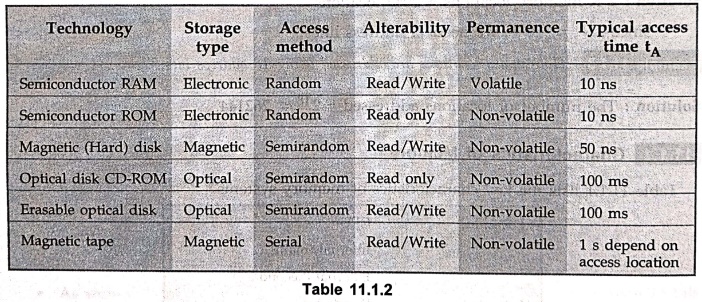
Table
11.1.2 shows the characteristics of some common memory technologies.
Characteristics of some common memory technologies
Distinguish between volatile and non–volatile memories
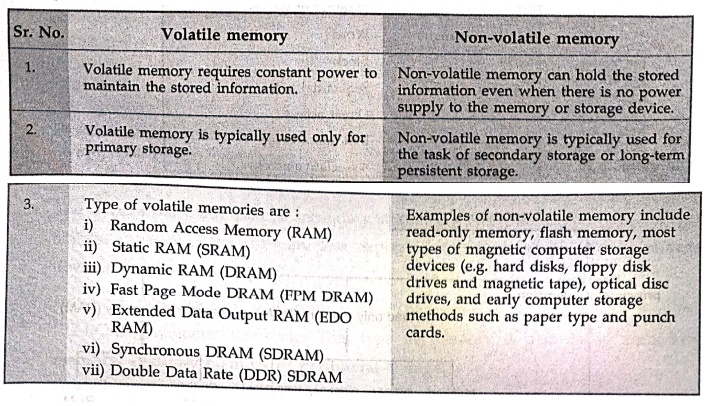
Volatile memory
1.
Volatile memory requires constant power to maintain the stored information.
2.
Volatile memory is typically used only for primary storage.
3.
Type of volatile memories are :
i)
Random Access Memory (RAM)
ii)
Static RAM (SRAM)
iii)
Dynamic RAM (DRAM)
iv)
Fast Page Mode DRAM (FPM DRAM)
v)
Extended Data Output RAM (EDO RAM)
vi)
Synchronous DRAM (SDRAM)
vii)
Double Data Rate (DDR) SDRAM
Non–volatile memory
1.
Non–volatile memory can hold the stored information even when there is no power
supply to the memory or storage device.
2.
Non–volatile memory is typically used for the task of secondary storage or long–term
persistent storage.
3.
Examples of non–volatile memory include read–only memory, flash memory, most
types of magnetic computer storage devices (e.g. hard disks, floppy disk drives
and magnetic tape), optical disc drives, and early computer storage methods
such as paper type and punch cards.
•
The processor of a computer can usually process instructions and data faster
than they are fetched from the memory unit. The memory cycle time, then is the
bottleneck in the system. One way to avoid this bottleneck is to use a cache memory. Cache memory is a small,
fast memory that is inserted between the larger, slower main memory and the
processor. It usually holds the currently active segments of a program and
their data.
•
In most modern computers, the physical main memory is not as large as the
address space spanned by an address issued by the processor. Here, the virtual
memory technique is used to extend the apparent size of the physical memory. It
uses secondary storage such as disks, to extend the apparent size of the
physical memory.
2. Classification of Primary Memory
•
memory devices can be classified based on following parameters :
■
Principle of operation
■
Physical characteristics
■
Mode of access and
■
Terminology used for fabrication.
•
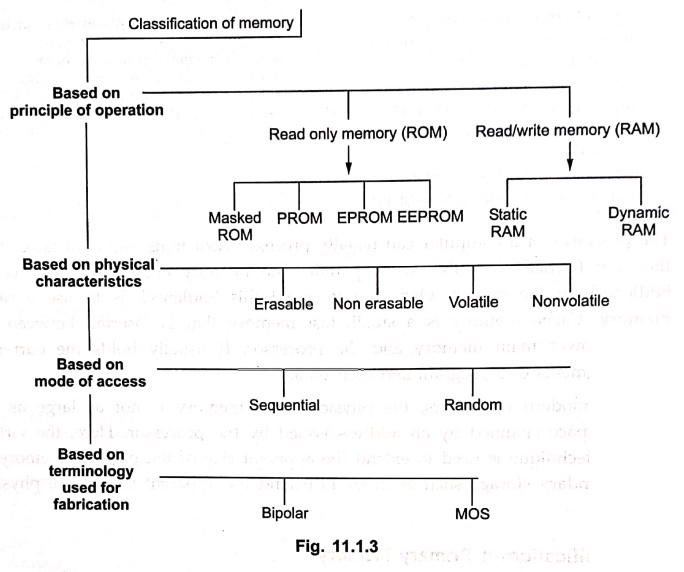
Fig. 11.1.3 shows the classification of memory.
•
Broadly semiconductor memories as classified as and non–volatile memories .Volatile
memories can retain their state as long as power is applied. On the other hand,
non–volatile memories can hold data even if power is turned off.
•
Read/Write Memories (RWMs) are those memories, which allows both read and write
operations. They are used in applications where data has to change
continuously. They are also used for temporary storage of data. ROM memories
allow only read operation. They are used to store monitor programs and
constants used in the program.
•
The volatile memories which can hold data as long as power is ON are called Static RAMs (SRAMs). Dynamic RAMs (DRAMs) stores the data as a charge on the
capacitor and they need refreshing of charge on the capacitor after every few
milliseconds to hold the data even if power is ON.
•
EPROM and EEPROM are erasable memories in which the stored data can be erased
and new data can be stored.
•
The semiconductor memories are also classified as bipolar and MOS memories
depending upon the type of transistors used to construct the individual cell.
3. Classification of Secondary Memory
•
A primary memory is costly and has a limited size. This memory is mainly used
for storing the currently processing data.
•
Secondary storage is used to store data and instructions (programs) when they
are not being processed.
•
The devices those are used as secondary storage are non–volatile and have a
larger storage capacity. Also, they are less expensive as compared to primary
storage devices.
•
However, they are slower in comparison. The examples are hard disks, floppies,
CD–ROMs, magnetic tapes etc. This type of memory is also called secondary memory, auxiliary memory or
peripheral storage.
•
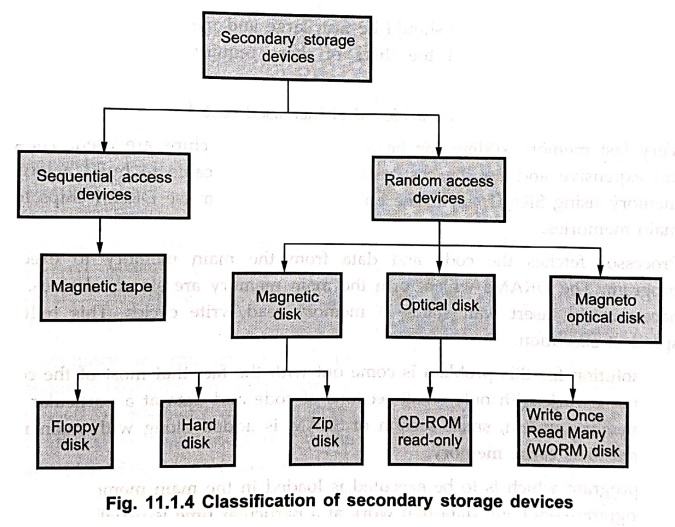
Fig. 11.1.4 shows the classification of secondary storage devices. They can be
categorized broadly according to their access types as sequential and random
(direct).
Review Questions
1. Define a memory
cell. Give an example.
2. Define a 'memory
location' and a 'cell'.
3. Write a short note
on semiconductor memories.
4. State various
characteristics of memory devices and explain in brief any two.
5. Distinguish between
volatile and non–volatile memories.
6. Explain the key
characteristics of computer memory systems in details.
7. Explain the various
characteristics of memory system.
8. Classify memories
on the basic of principle of operation, physical characteristics, mode of access
and fabrication technology.
9. Give the
classification of semiconductor memories.
10. Which memory is
called volatile? Why?
11.30 Explain static
memory.
12. Give the
classification of primary memory.
Digital Principles and Computer Organization: Chapter 11: Memory : Tag: : Characteristics, Classification - Memory Concept
Digital Principles and Computer Organization: Chapter 11: Memory
Under Subject
Digital Principles and Computer Organization
CS25C06 2nd Semester AIDS, CSE, IT, CSE(CY) Dept | 2025 Regulation | 2nd Semester 2025 Regulation
Related Subjects

English Essentials II
EN25C02 2nd Semester | 2025 Regulation | 2nd Semester 2025 Regulation

Tamils and Technology தமிழர்களும் தொழில்நுட்பமும்
UC25H02 2nd Semester | 2025 Regulation | 2nd Semester 2025 Regulation
Linear Algebra
MA25C02 2nd Semester | 2025 Regulation
Applied Physics (CSIE) II
PH25C03 2nd Semester AIDS, CSE, IT, CSE(CY) Dept | 2025 Regulation | 2nd Semester 2025 Regulation
Digital Principles and Computer Organization
CS25C06 2nd Semester AIDS, CSE, IT, CSE(CY) Dept | 2025 Regulation | 2nd Semester 2025 Regulation

Basic Electrical and Electronics Engineering
EE25C01 2nd Semester | 2025 Regulation | 2nd Semester 2025 Regulation

Python for Data Science
AD25201 2nd Semester AIDS Dept | 2025 Regulation | 2nd Semester 2025 Regulation

Re-Engineering for Innovation
ME25C05 2nd Semester | 2025 Regulation | 2nd Semester 2025 Regulation

Python for Data Science - Laboratory
AD25201 2nd Semester AIDS Dept | 2025 Regulation | 2nd Semester 2025 Regulation