Digital Principles and Computer Organization: Chapter 11: Memory
Memory Hierarchy
Questions: 1. Explain the necessity of memory hierarchy. Write a note on memory hierarchy. 2. Draw different memory address layouts and brief about the technique used to increase the a rate of fetching words from the main memory. 3. Draw the memory hierarchy in a typical computer system.
Memory Hierarchy
•
Ideally, computer memory should be fast, large and inexpensive. Unfortunately,
it is impossible to meet all the three of these requirements using one type of
memory.
•
Increased speed and size are achieved at increased cost.
•
Very fast memory system can be achieved if SRAM chips are used. These chips are
expensive and for the cost reason it is impracticable to build a large main
memory using SRAM chips. The only alternative is to use DRAM chips for large main
memories.
•
Processor fetches the code and data from the main memory to execute the
program. The DRAMs which form the main memory are slower devices. So it is
necessary to insert wait states in memory read/write cycles. This reduces the
speed of execution.
•
The solution for this problem is come out with the fact that most of the
computer programs work with only small sections of code and data at a
particular time. In the memory system, small section of SRAM is added along
with main memory, in of SRAM referred to as cache memory.
•
The program which is to be executed is loaded in the main memory, but the part
of program (code) and data that work at a particular time is usually accessed
from the cache memory.
•
This is accomplished by loading the active part of code and data from main
memory to cache memory. The cache controller looks after this swapping between
main memory and cache memory with the help of DMA controller.
•
The cache memory just discussed is called secondary
cache. Recent processors have the built–in cache memory called primary cache.
•
DRAMs along with cache allow main memories in the range of tens of megabytes to
be implemented at a reasonable cost, the size and better speed performance. But
the size of memory is still small compared to the demands of large programs with
voluminous data. A solution is provided by using secondary storage, mainly magnetic
disks and magnetic tapes to implement large memory spaces. Very large disks are
available at a reasonable price, sacrificing the speed.
•
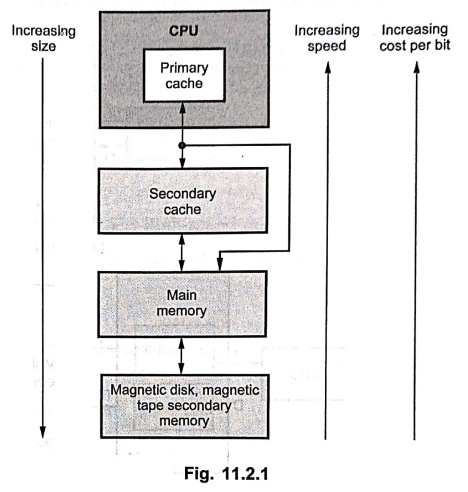
From the above discussion, we can realize that to make efficient computer
system it is not possible to rely on a single memory component, but to employ a
memory hierarchy. Using memory hierarchy
all of different types of memory units are employed to give efficient computer
system. A typical memory Rein Fig. 11.2.1.
•
In summary, we can say that a huge
amount of cost–effective storage can be provided by magnetic disks. A large,
yet affordable, main memory can be built with DRAM technology along with the
cache memory to achieve better speed performance.
•
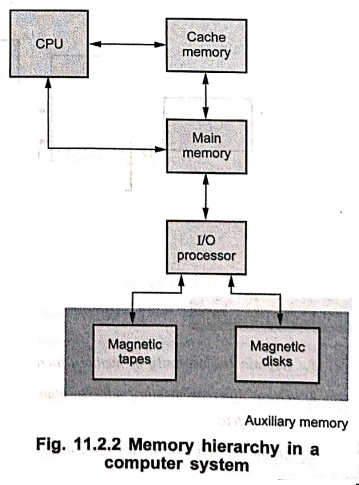
Fig. 11.2.2 shows how memory hierarchy can be employed in a computer system. As
shown in Fig. 11.2.2, at the bottom of the hierarchy magnetic tapes and
magnetic disks are used as a secondary memory. This memory is also known as auxiliary memory.
•
The main memory occupies a central position by being able to communicate
directly with the CPU and with auxiliary memory devices through an I/O
processor.
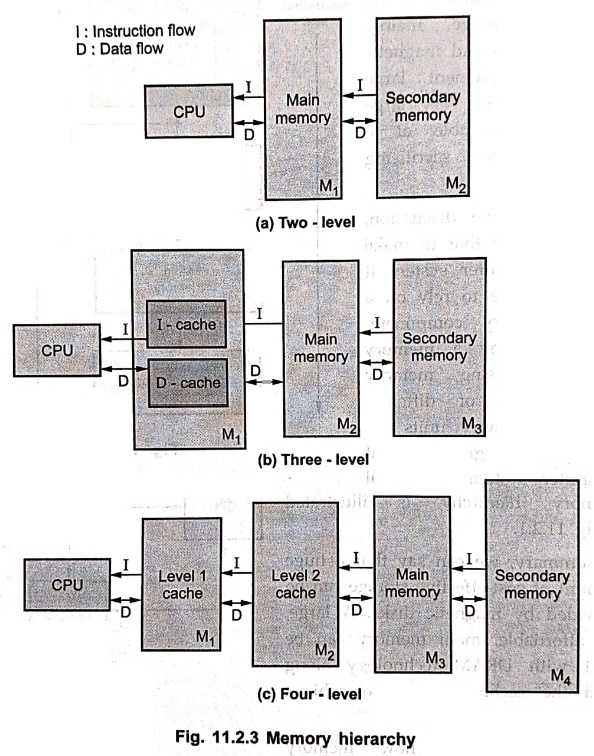
Fig.
11.2.3 shows common memory hierarchies with two, three and four levels.
Review Questions
1. Explain the
necessity of memory hierarchy. Write a note on memory hierarchy.
2. Draw different
memory address layouts and brief about the technique used to increase the a
rate of fetching words from the main memory.
3. Draw the memory
hierarchy in a typical computer system.
Digital Principles and Computer Organization: Chapter 11: Memory : Tag: : - Memory Hierarchy
Digital Principles and Computer Organization: Chapter 11: Memory
Under Subject
Digital Principles and Computer Organization
CS25C06 2nd Semester AIDS, CSE, IT, CSE(CY) Dept | 2025 Regulation | 2nd Semester 2025 Regulation
Related Subjects

English Essentials II
EN25C02 2nd Semester | 2025 Regulation | 2nd Semester 2025 Regulation

Tamils and Technology தமிழர்களும் தொழில்நுட்பமும்
UC25H02 2nd Semester | 2025 Regulation | 2nd Semester 2025 Regulation
Linear Algebra
MA25C02 2nd Semester | 2025 Regulation
Applied Physics (CSIE) II
PH25C03 2nd Semester AIDS, CSE, IT, CSE(CY) Dept | 2025 Regulation | 2nd Semester 2025 Regulation
Digital Principles and Computer Organization
CS25C06 2nd Semester AIDS, CSE, IT, CSE(CY) Dept | 2025 Regulation | 2nd Semester 2025 Regulation

Basic Electrical and Electronics Engineering
EE25C01 2nd Semester | 2025 Regulation | 2nd Semester 2025 Regulation
Python for Data Science
AD25201 2nd Semester AIDS Dept | 2025 Regulation | 2nd Semester 2025 Regulation

Re-Engineering for Innovation
ME25C05 2nd Semester | 2025 Regulation | 2nd Semester 2025 Regulation
Python for Data Science - Laboratory
AD25201 2nd Semester AIDS Dept | 2025 Regulation | 2nd Semester 2025 Regulation