Tamils and Technology: Unit I: Weaving and Pottery Ceramic Technology
Pottery (Ceramic) Technology
Tamils and Technology
Tamils and Technology: Pottery (Ceramic) Technology: 1. Multiple Stages of Pottery Industry 2. Types of Pots 3. Pottery Making Process 4. Evidences relating to Ceramic Technology 5. Uses of Earthenware 6. Clay Minerals
POTTERY (CERAMIC)
TECHNOLOGY
Pottery
is a type of material used by people for their needs with clay types. A pot is
an object made of clay. Pottery making techniques have been traced back to
ancient times. This profession is known as 'Kuyaththozhil' in Tamil and the
potters are called 'Vetco, Kalanseiko, Kuyavar' in the sangam age.
A
large part of the history of pottery belongs to pre-historic, pre-literate
ancient cultures. Much of this history is received through the artefacts
recovered from the archaeological excavations.
1. Multiple Stages of Pottery Industry
Before
Pottery becomes part of the culture, it must have crossed several stages.
1. Clay
Suitable
clay should be available for pot making. Archaeological sites where pottery
items were found are well- designed and close to locations with readily
available sources of clay suitable for heating.
2. Proper Temperature
It
should be possible to create a temperature (temperature suitable for heating)
at which the clay is transformed into the kiln.
3. Time
There
must have been enough time to prepare, shape and make the clay pot suitable for
using.
2. Types of Pots
The
Sangam Tamils used a variety of pots in terms of size and use.
1. Dasumbu
A
pot called the dasumbu was used to fill milk, curd, etc.,
2. Kannal
An
earthen pot for filling water is called kannal. It is of two types.
(i)
Thoduvai Kannal
It
refers to an earthen water storage pot with a convex mouth.
(ii)
Karuneel Kannal
The
pot is filled with water and the water is let to trickle through the small hole
at the bottom. It is used as a measuring tool.
3. Gadi
Lemon,
gooseberry, tamarind, mango pickles are preserved by keeping them in a pot
called gadi made of clay.
4.Kumizhi
A
clay pot used for cooking food at home was called kumizhi.
5.Thadavu
The
earthen pot used by the ancient Tamils to heat water in cold season is called
Thadavu. They are available in red and black colours.
6. Broken Vessel (or) Hollow Pot
The
broken pots were also used by the people during that time.
(i)
Neck Part
The
neck of a broken pot was used for safely planting saplings.
(ii)
Middle Part
The
middle part of the pot was used for frying groundnut, tamarind, corn and rice.
3. Pottery Making Process
First,
the clay soil is taken and water is poured and it is soaked for a whole day.
Then, a certain amount of sand, ash, black jaggery (Panaivellam), salt and hog
plum (Kadukkai) are added with it and it is made a thick paste.
Pottery
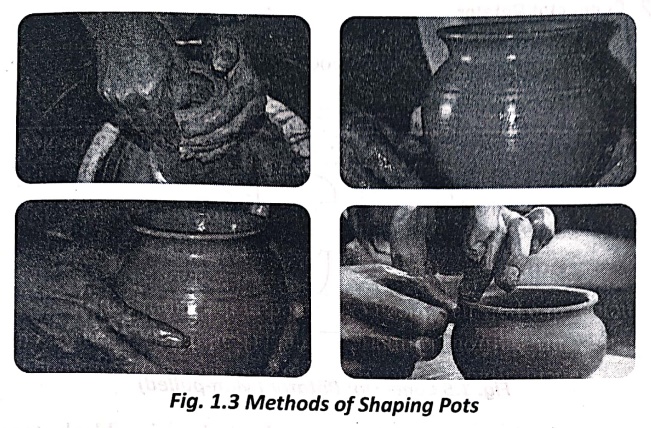
items are made using a variety of methods. Among them, the Potter's wheel is
important.
Potter's Wheel (or)
Potter's Rotators
In
the process of 'throwing', the clay is wheeled into the middle of the spinning
platform called 'Chakrathali'. The potter rotates the wheel with a stick at the
required speed. As the wheel rotates, the solid sphere of fine clay is pressed,
squeezed and gently pulled upward and outward to form a vacuum pot.
Then
the vacuum pot with the hole should be slightly dried and enlarged with a stone
and a plank to close the hole. Finally, the pot is heated to high temperature
in kiln. Now, pot gets harden.
Kinds of Rotators
In
Tamil Nadu, there are two types of rotators.
1.
Ball Point Rotator
2.
Cone-slot Rotator
1. Ball Point Rotator
Fig.1.4
Ball, hollow rotator can be rotated with a bar.
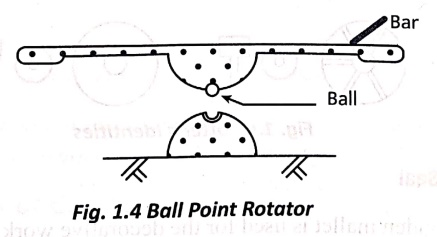
At
the bottom of the wheel, there is a small ball. It has a plinth with a small
hollow for fitting it. As it rotates using a rod, it is straight only when it
rotates, when it stops rotating, it tilts.
Edgar
Thurston has mentioned this in his book 'Castes and Tribes of India'.
2. Cone-slot Rotator
Soil
mixed with wood or coconut fiber, black stone.
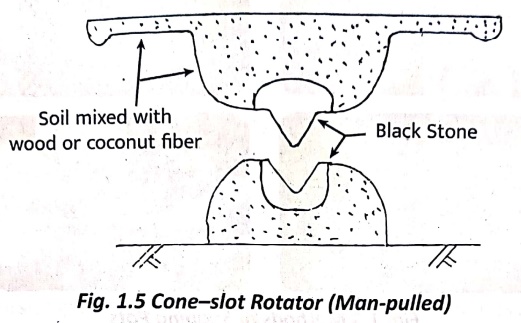
At
the lower part of the upper wheel, there is a black stone area with a conical
structure and a flat ring around it. It has a conical bottom so that it fits
just right. The hole can be rotated. The rotator will not incline. Men sit in
front of the rotator on the seat and shape the soil. His wife would sit on the
ground opposite to him and spin the rotator.
Only
a small amount of soil can be placed in ball-point rotator. But, a large amount
of soil can be placed in the cone-slot rotator.
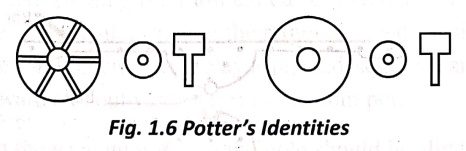
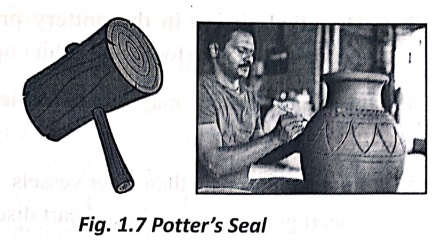
Potter's Seal
Wooden
mallet is used for the decorative work on pottery. It has a flower or an image
carved on both ends. If the vessels are properly dry, and are tapped in a row
with a wooden hammer, the flower on the tip of the hammer will form a row.
4. Evidences relating to Ceramic Technology
1.
Both types of rotators are shown on stone carvings on Tiruchengode Hill. The
stone and plate are carved along with the rotator.
2.
In the Kovoorkizhar lyrics, only the cone-slot rotator is mentioned.
3.
In Tiruchengode Nilaththambiran temple, there is a carved stone and plate board
on the Pillaiyar base located in the prakaram on the right side. Stones and
planks are used to tighten the soil hole.
4.
This is mentioned in a song sung by Iyur Mudavanar about Kulamurtaththu
Thunjiya Killivalavan Chola.
5.
There are indications of pottery technology in the hills in the village of
Thirukovilur at Kilwalai.
6.
Evidence of this is also found in the village of Giri Giri, Vellore district.
5. Uses of Earthenware
1.
A clay pot is an excellent water purifier. It also cools the human body.
2.
Food cooked in pots has the nutrients without completely losing its integrity.
As a result, the food becomes very tasty.
3.
The alkalinity of the clay in the pottery properly maintains the pH level of
the food. So health improves.
4.
Iron, phosphorous, calcium, magnesium nutrients are available to the body.
5.
Cooking pots require less oil than other vessels. Hence, the heart gets
strength. It also reduces heart diseases.
6.
Vitamins and minerals from clay pot water helps in maintaining the glucose
level of the body.
7.
Drinking clay pot water balances testosterone levels and improves body
metabolism.
6. Clay Minerals
The
primary mineral found in clay is while clay or Kaolinite. It usually includes
the following items.
40%
Aluminiam Oxide
46%
Silicon Oxide
14%
Water
Types of Clay
Generally,
two types of clay are found in nature.
1.
First layer clay
2.
Second layer clay
1. First Layer Clay
It
is found in the rock from which it was obtained. It does not contain any
sediments. It is heavy, dense and pure.
2. Second Layer Clay or
Alluvial Clay
It
forms a light sedimentary mixture. It is stored and submerged in water. They
are finer and lighter than the primary clays.
Excavation Evidence
The
17 pottery sherds found in the excavation were analyzed by the Geosciences of
the University of Pisa in Italy. The pots found at Kizhadi were used for
collecting water and for cooking. Based on the nature of the minerals and rock
particles found in these pots, it was confirmed that these pots were made
locally using a unique pottery technique. It was identified by comparing the
local soil sample.
It
is understood that the technique of pottery found at Kizhadi, the composition
of the elements prove that the nature of the clay remained the same from the
6th century BC to the 2nd century BC, according to the study report by the
University of Pisa in Italy.
The
research report explains that some of the pottery samples are similar to the
soil type found in other parts of Tamil Nadu and the period is considered to be
2nd century BC.
Tamils and Technology: Unit I: Weaving and Pottery Ceramic Technology : Tag: Tamil : Tamils and Technology - Pottery (Ceramic) Technology
Tamils and Technology: Unit I: Weaving and Pottery Ceramic Technology
Under Subject
Tamils and Technology தமிழர்களும் தொழில்நுட்பமும்
UC25H02 2nd Semester | 2025 Regulation | 2nd Semester 2025 Regulation
Related Subjects
English Essentials II
EN25C02 2nd Semester | 2025 Regulation | 2nd Semester 2025 Regulation
Tamils and Technology தமிழர்களும் தொழில்நுட்பமும்
UC25H02 2nd Semester | 2025 Regulation | 2nd Semester 2025 Regulation
Linear Algebra
MA25C02 2nd Semester | 2025 Regulation
Transforms and its Applications
MA25C03 2nd Semester EEE Dept | 2025 Regulation | 2nd Semester 2025 Regulation

Applied Physics (CE) II
PH25C02 2nd Semester Civil, Agri Depts | 2025 Regulation | 2nd Semester 2025 Regulation
Applied Physics (CSIE) II
PH25C03 2nd Semester AIDS, CSE, IT, CSE(CY) Dept | 2025 Regulation | 2nd Semester 2025 Regulation
Applied Physics (EE) II
PH25C04 2nd Semester EEE Dept | 2025 Regulation | 2nd Semester 2025 Regulation

Applied Physics (ME) II
PH25C05 2nd Semester Mechanical Dept | 2025 Regulation | 2nd Semester 2025 Regulation
Applied Chemistry (CE) II
CY25C02 2nd Semester Civil Dept | 2025 Regulation | 2nd Semester 2025 Regulation

Applied Chemistry (ME) II
CY25C03 2nd Semester Mechanical Dept | 2025 Regulation | 2nd Semester 2025 Regulation

Electron Devices
EC25C01 2nd Semester ECE Dept | 2025 Regulation | 2nd Semester 2025 Regulation
Digital Principles and Computer Organization
CS25C06 2nd Semester AIDS, CSE, IT, CSE(CY) Dept | 2025 Regulation | 2nd Semester 2025 Regulation

Basic Electrical and Electronics Engineering
EE25C01 2nd Semester | 2025 Regulation | 2nd Semester 2025 Regulation

Basic Civil and Mechanical Engineering
GE25C01 2nd Semester EEE Dept | 2025 Regulation | 2nd Semester 2025 Regulation
Data Structures using CPlusPlus
CS25C05 2nd Semester ECE Dept | 2025 Regulation | 2nd Semester 2025 Regulation
Engineering Drawing
ME25C01 EEE, Mech, Agri, EEE Depts | 2025 Regulation | 2nd Semester 2025 Regulation
Data Structures and Algorithms
CS25C04 2nd Semester EEE Dept | 2025 Regulation

Circuits and Network Analysis
EC25C02 2nd Semester ECE Dept | 2025 Regulation | 2nd Semester 2025 Regulation

Engineering Mechanics
ME25C02 2nd Semester Mech, Civil, Agri Depts | 2025 Regulation | 2nd Semester 2025 Regulation
Object Oriented Programming (OOPs)
CS25C07 2nd Semester CSE, CSE(CY) Depts | 2025 Regulation | 2nd Semester 2025 Regulation