Tamils and Technology: Unit I: Weaving and Pottery Ceramic Technology
Scratch (Graffiti) Symbols on Objects
Tamils and Technology
Tamils and Technology: Scratch (Graffiti) Symbols on Objects: 1. Types of Scratch (Graffiti) Symbols 2. Indus Scripts and Tamil Brahmi Scripts bot 3. Patterns of Scratch (Graffiti) Marks 4. Solar Appearance by Radiation Incision Lines 5. Tamizhi (Tamil - Brahmi) 6. Messages known from Scratch Codes
SCRATCH (GRAFFITI)
SYMBOLS ON OBJECTS
Ancient
Tamils used stone tools for hunting. Then, they started living in groups.
Later, they began to cultivate crops. The Sangam people made clay pots for
storing water and for cooking purposes. After the civilization developed, they
made black coloured pots, red pots, black red pots. The pots made by them were
elegant and beautiful.
The
symbols used by the people to communicate were inscribed on the pots. They
inscribed their names on the pots to recognize that it belonged to the
respective person.
Between
the end of the Indus Valley Culture and the appearance of the 'Tamizhi'
letters, there was a written form. They were called symbols and incisors by the
researchers.
1. Types of Scratch (Graffiti) Symbols
An
examination of the scratches present on the broken parts of the pottery reveals
that these scratches can be of two types.
1.
One is the markings that were put before burning the pottery.
2.
Another is the markings put on the pottery after they were burnt. Generally,
the marks were made using hard substances like stone, iron, ivory, etc.,
The
symbols put after burning the pots are the most common in Tamilnadu.
2. Indus Scripts and Tamil Brahmi Scripts bot
Excavations
at Adichanallur, Kodumanal and Kizhadi in Tamilnadu pottery inscribed with
'Tamil Brahmi' letters were found in the first clay layers. And later in the
deeper layers, pot pieces with 'codes' were found. These symbols resemble the
Indus scripts.
As
the inscriptions (codes) on the pots resemble the Indus script, it is certain
that the symbols here are the indus scripts. In the archaeological research
"Tamizhi' letters were found in the first layer and scratch symbols were
found in the next layers. It is clear that the scratch symbols are considered
to predate the Tamizhi script. The fact that the Indus alphabet is written from
the right to the left was discovered only from the scratch writing on the pot
shell.
Table
1.1 Comparison of Pottery Scratch (Graffiti) Notation with the Indus Letters
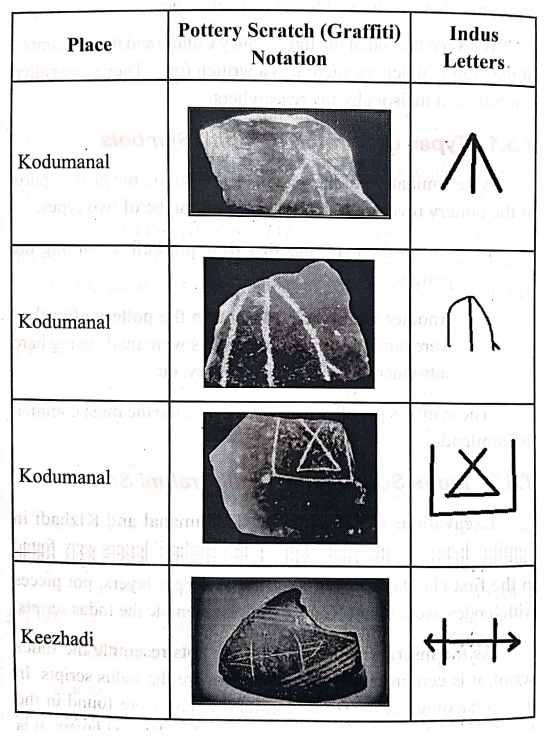
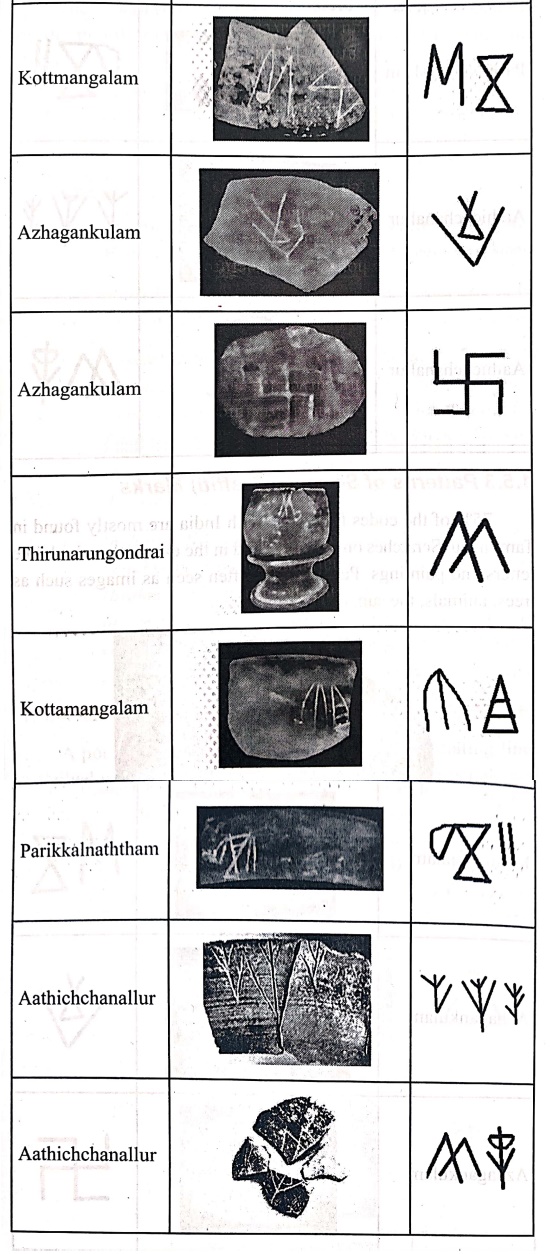
3. Patterns of Scratch (Graffiti) Marks
75%
of the codes found in South India are mostly found in Tamilnadu. Scratches on
pottery found in the excavations look like letters and paintings. Paintings are
often seen as images such as trees, animals, the sun, etc.,
Ladder,
star, trishul symbols are found on the pot pieces. More than 15 such symbols
have been identified.
Tiles
inscribed with the 'Swasthik' symbol used as an emblem by, the people of Indus
Valley have been found in Vandalur. Red coated pot pieces with 'Swasthik'
symbols were found in Bhuvanagiri. The emblems used by the people of Indus
Valley civilization had 'Swasthik' symbols. There is also a ‘trishul-like'
symbol on the black red pots.
Evidences
1.
Excavations carried out at Adichanallur, Korkai and Mangulam in Tamil Nadu have
given pot shells with symbols.
2.
In Sri Lanka, objects with similar indentations were also found in places like
Kantharodai, Manthai, Rithiyagama.
3.
A metal stamp was found at Vattukkottai in Jaffna, Sri Lanka. It is the pattern
that the potter inscribes on the vessel. It contained both the Indus script and
the Tamil script. The Tamil section is marked as Goventh. The first two forms
are Vastu Azidentical in the Indus script. The analyst reads it as Cocon. 'Co' means
potter, royal potter.
4.
In Jaffna, Sri Lanka many pot shells have been found in Vettukkadu, Paraman
Kirai. It has inscriptions in Tamil (Brahmi) script dating back to the 3rd
century BC. Mainly in one piece, the whole word Velaan is found. Potters are
called Velalar in Sri Lanka and India. It is assumed that the person who made
the pot might have carved his name on it.
4. Solar Appearance by Radiation Incision Lines
A
pot unearthed in the excavation has six radiating lines inscribed with
connecting lines. Each radiation line is coloured by 14 small connecting lines.
This gives a clear impression of the pattern of the appearance of a sun.
5. Tamizhi (Tamil - Brahmi)
The
next available notation to scratch is the Tamil Brahmi Script. They called it
Tamizhi. Pot shells inscribed with Tamizhi (Tamil Bahmi) symbols have been
excavated at Sangam sites.
Evidences
1.
110 cave inscriptions inscribed in Tamil Brahmi script belonging to the Sangam
period have been found in more than 32 towns in Tamil Nadu. These are written
by Padmasree Airavatham Mahadevan and published as a book.
2.
56 pot shells inscribed with Tamil Script at Kizhadi excavations were reported
by the Department of Archaeology, Tamil Nadu.
3.
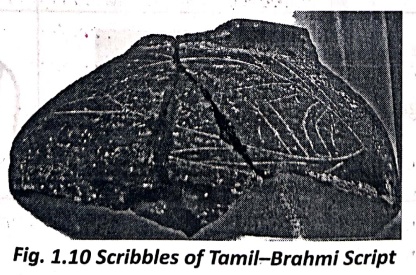
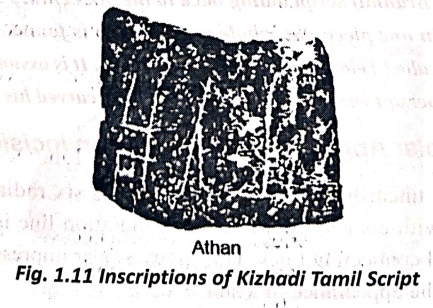
Broken pot shells with some incomplete inscriptions have been found. In one of
these, there are personal names like Kuviran Adha(n), Aadhan.
(i) Athan
The
name 'Athan' appearing in it is mentioned as 'Athan'. K. Rajan has clarified in
his book 'Early Historic Writing System' - A Journey from Graffiti to Brahmi
that there was no custom of phonetic coding to distinguish the long vowels from
the short vowels in Tamil in earlier times.
(ii) Kuviran
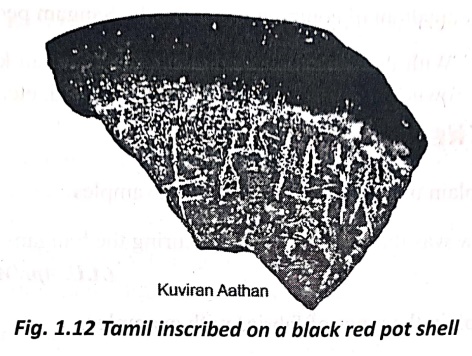
The
black red pot shell has been found to have six letters of Tamil written in a
single line. They are 'Kuviran Aath'. The missing letter could have been a
fraction of 'n'. So, it must be the name of a man. The name of this man is
'Kuviran Aathan'.
Initially,
Tamil took the form of scratch script which later changed to "Tamizhi'
script and gradually evolved into written form.
6. Messages known from Scratch Codes
1.
From the scratches found on the pots, it is confirmed that there were trade
exchanges among the traders, professionals and travellers during the Sangam
period.
2.
These symbols are written in a script that reflect the thinking of the
Paleolithic and Iron age people.
3.
During the Sangam period, these symbols were used for communication.
4.
Such studies are necessary for the Tamil to know their history.
5.
Such discoveries and studies are necessary to know the trade exchanges and the
economic conditions of the Tamils at that time.
6.
The scratch marks of the ancient Tamils were used as a medium of communication
by the Sangam people.
7.
With the help of the scratch marks, we can know the ownership of the pot
vessels, their period, etc.,
Tamils and Technology: Unit I: Weaving and Pottery Ceramic Technology : Tag: Tamil : Tamils and Technology - Scratch (Graffiti) Symbols on Objects
Tamils and Technology: Unit I: Weaving and Pottery Ceramic Technology
Under Subject
Tamils and Technology தமிழர்களும் தொழில்நுட்பமும்
UC25H02 2nd Semester | 2025 Regulation | 2nd Semester 2025 Regulation
Related Subjects
English Essentials II
EN25C02 2nd Semester | 2025 Regulation | 2nd Semester 2025 Regulation
Tamils and Technology தமிழர்களும் தொழில்நுட்பமும்
UC25H02 2nd Semester | 2025 Regulation | 2nd Semester 2025 Regulation
Linear Algebra
MA25C02 2nd Semester | 2025 Regulation
Transforms and its Applications
MA25C03 2nd Semester EEE Dept | 2025 Regulation | 2nd Semester 2025 Regulation

Applied Physics (CE) II
PH25C02 2nd Semester Civil, Agri Depts | 2025 Regulation | 2nd Semester 2025 Regulation
Applied Physics (CSIE) II
PH25C03 2nd Semester AIDS, CSE, IT, CSE(CY) Dept | 2025 Regulation | 2nd Semester 2025 Regulation
Applied Physics (EE) II
PH25C04 2nd Semester EEE Dept | 2025 Regulation | 2nd Semester 2025 Regulation

Applied Physics (ME) II
PH25C05 2nd Semester Mechanical Dept | 2025 Regulation | 2nd Semester 2025 Regulation
Applied Chemistry (CE) II
CY25C02 2nd Semester Civil Dept | 2025 Regulation | 2nd Semester 2025 Regulation

Applied Chemistry (ME) II
CY25C03 2nd Semester Mechanical Dept | 2025 Regulation | 2nd Semester 2025 Regulation

Electron Devices
EC25C01 2nd Semester ECE Dept | 2025 Regulation | 2nd Semester 2025 Regulation
Digital Principles and Computer Organization
CS25C06 2nd Semester AIDS, CSE, IT, CSE(CY) Dept | 2025 Regulation | 2nd Semester 2025 Regulation

Basic Electrical and Electronics Engineering
EE25C01 2nd Semester | 2025 Regulation | 2nd Semester 2025 Regulation

Basic Civil and Mechanical Engineering
GE25C01 2nd Semester EEE Dept | 2025 Regulation | 2nd Semester 2025 Regulation
Data Structures using CPlusPlus
CS25C05 2nd Semester ECE Dept | 2025 Regulation | 2nd Semester 2025 Regulation
Engineering Drawing
ME25C01 EEE, Mech, Agri, EEE Depts | 2025 Regulation | 2nd Semester 2025 Regulation
Data Structures and Algorithms
CS25C04 2nd Semester EEE Dept | 2025 Regulation

Circuits and Network Analysis
EC25C02 2nd Semester ECE Dept | 2025 Regulation | 2nd Semester 2025 Regulation

Engineering Mechanics
ME25C02 2nd Semester Mech, Civil, Agri Depts | 2025 Regulation | 2nd Semester 2025 Regulation
Object Oriented Programming (OOPs)
CS25C07 2nd Semester CSE, CSE(CY) Depts | 2025 Regulation | 2nd Semester 2025 Regulation