Tamils and Technology: Unit I: Weaving and Pottery Ceramic Technology
Weaving Industry (or) Weaving Technology
Tamils and Technology
Tamils and Technology: Weaving Industry (or) Weaving Technology: Definition 1. Antiquity of Weaving 2. Raw Material of Textile Industry - Cotton 3. Weaving Women (or) Cotton Women 4. Types of Fabrics 5. Dye Industry 6. Payment of Taxes to Weaving Industry 7. Export of Cloths
WEAVING INDUSTRY (OR)
WEAVING TECHNOLOGY
Definition
Weaving
is an industry used by people to produce clothing, bedspreads, mats, carpets
and socks. Weaving Technology includes functional techniques like cotton
production, loom use, dying, etc.,
A
reference to clothing is found in Tolkappiyam, a grammar book that predates
Sangam Literature. From this, we know the antiquity of the weaving industry.
Proof:
Tholkappiyam 427
1. Antiquity of Weaving
Sangam
people must have learnt the art of living by observing the fibrous covering of
palm trees and coconut trees, spiders' webs and birds' nest building skills.
Cotton came from agriculture as the beginning of human civilization. The
relationship between cotton and India is very ancient. Artifacts found in the
Indus Valley Civilization show that the Sangam people had known the art of
weaving cloth using cotton.
2. Raw Material of Textile Industry - Cotton
Cotton
is the raw material for the production of textile industry. Literature shows
that this had been produced domestically. It is pointed out in the literature
that cotton was grown in abundance and looked like a fence around the town.
Proof:
Purananooru 299:11
Cotton
was cultivated in the Mullai lands. They collected the cotton that had grown
and burst out and packed it in bundles and brought it home. This information is
understood in the poetic lines of Purananooru.
Proof:
Purananooru 393
The
Chola King Kulamurtathu Tunjiya Killivalavan fed the Panas and also offered
cotton packed in bundles. This is referred Iroupun to by the poet
Nalliraiyanar.
The
lyrics in the following songs are about the cotton plant and how cotton was
obtained and threads woven.
Proofs:
i) Purananooru: 324-7 ii) Purananooru : 393 – 12
The
nuts were removed from the cotton. It is described that the fluff from which
the nut has been removed looked like white clouds.
Proof:
Akananooru 133-6
3. Weaving Women (or) Cotton Women
In
Sangam literature, women are found to be weavers. Women without male partners
did this weaving at home as a small business.
Works of Cotton Women
1. Cleaning of Cotton
Bow
is used to separate cotton from its cocoon. Later, Sangam literature mentions
that the cotton cocoon was thoroughly pounded to remove the outer skin and the remaining
cocoons and dust. The women who removed the cotton and cleaned it by removing
the nuts and seeds from it are called 'Cotton Women". This work was
carried out by 'Cotton Women' even at night with lanterns.
Proofs:
i) Nattrinai 247 : 3-4 ii) Purananooru 326, 4-5 iii) Nattrinai 299: 7
2. Weaving the Thread
Cotton
was cleaned and ginned by hand and spun into cotton yarn. The thread was
spinned by women. They learned the technology of making women's clothes and
engaged themselves in the industry.
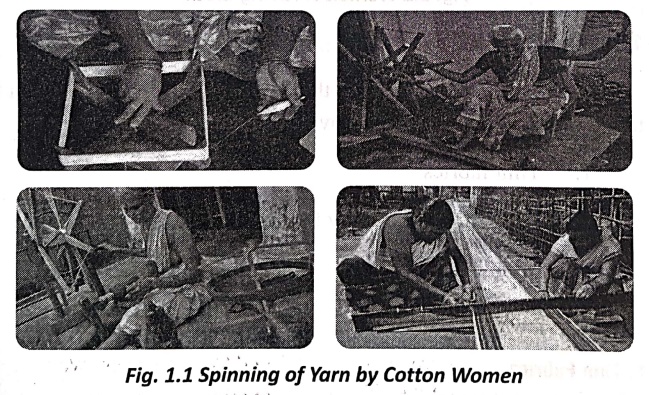
Fig.
1.1 Spinning of Yarn by Cotton Women
3. Weaving Cloth
Including
women who have lost their husbands, separated from their husbands due to
economic reasons, earned their income by undertaking weaving from their houses.
Those women who had engaged themselves in such works were called 'Cotton Women'. The yarn spinned by the
cotton women was called 'Panuval'.
Proof:
Purananooru 125: 1
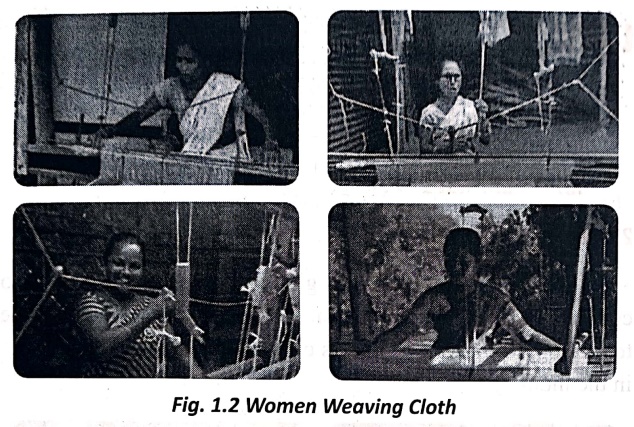
4. Types of Fabrics
There
are evidences from the Sangam Period to show that many types of clothing were
woven from the yarns.
1.
Thin fabrics
2.
Beautiful high quality fabrics like snake skin
3.
Rough clothes
4.
Silk clothes
1. Thin Fabrics
They
enjoyed dressing their waists in clothes like milk spirit, thin-paper woven
with very fine thread.
Proof:
Malaipadukadam 565
2. High quality Fabrics like Snake Skin
They
also spun high quality beautiful clothes with floral designs like snake skin
shirts.
Proof:
Purananooru 397-15
3. Rough Cloth
Evidences
say that pure coarse cloth was also produced by peeling off the inner core of
the bamboo.
Proof:
Sirupanattrupadai 83
4. Silk Clothes
Silapathikaram
speaks of weavers who knew the technique of weaving with silk thread and rat
hair as 'Nun Vinaikarugar'.
Proof:
Silapadhikaram
5. Other Types of Clothing
i)
Thirumurugartuppadai speaks of Murugan as a red- robed person.
ii)
Women used to wear red clothes during the puberty period.
iii)
During day time, women wore silk dresses and at night wore cotton dresses. This
is stated by Pattinappalai, a book of the Sangam period.
There
are a lot of evidences to show that women wore dresses during the Sangam period.
Proof:
Manimegalai 16-30, Seethalaisathanar
A
garment is a cloth that covers the upper body.
iv)
It is also evident from the statement of Elango Adigal that Sangam women wore
separate dresses for night.
Proof:
Elango Adigal; Silambu, 9-4
5. Dye Industry
1. Avuri Plant Dye
Just
as the cotton plant helped for yarning, another plant helped the Tamils in the
beginning for dyeing. That plant grown in Tamilnadu in ancient times is called
Avuri.
Avuri
flowers were plucked and soaked overnight in a big tank, while they were soaked
like that they turned yellow. Then,
they were filtered and placed in another tank. At that time, it reacted with
oxygen and turned into blue colour.
This was later called blue dye (Indigo).
2. Konrai Tree Sap
They
found a different colour by mixing Konrai tree sap.
3. Dye root, Kasukatti
They
made a nice red dye by adding dye root and Kasukatti.
4. Avuri, Saffron, Turmeric, Mustard, Lacquer
Kanchi,
Madurai and Mayuram also had dyeing techniques using Avuri, Saffron, Turmeric,
haritaki (Kadukkai), Lacquer, etc., Ancient dye pots have been excavated in the
Tamil soil.
Proof:
Porunarattrupadai 82, 93
There
are references about the dyeing art of the ancient Tamils in Sangam texts such
as Porunar Artuppadai.
6. Payment of Taxes to Weaving Industry
1. Professional Tax
*
There was a practice of taxing only the 'Weaving looms' during the Sangam
period. A non-weaving loom was called 'Madi loom'. It is not taxed.
*
In the duty imposed on looms only half the duty is imposed for the Adai looms.
*
Some of the weavers had also paid common village tax. Taxes were imposed on the
looms according to the country and town.
*
Rasu, the poet says that there was a 'road tax' for using the road for the
looms.
2. Sales Tax
After
weaving, they had gone to other places to sell the woven stuff. The tax paid
for selling on streets was called 'Kulavari' (Family Tax). According to the
inscription poet Rasu states that the weaving industry had been the most
tax-paying industry for the country.
7. Export of Cloths
During
the Sangam era, cloth was exported to foreign countries from Tamilnadu.
Proof:
i) Tamil Nadu clothes were sent to the Gangetic regions like Patalipuram and
Kasi.
ii)
Artha Sastra of Gautilya in the 3rd century BC mentions the cloth as
'Mathuram'. (Named Maduram as it was sent from Madurai, Pandianadu).
iii)
Thin garments were also exported to the countries where Yavanas lived.
iv)
There are evidences to show that the ancient Tamils travelled across the sea to
Rome and traded.
Tamils and Technology: Unit I: Weaving and Pottery Ceramic Technology : Tag: Tamil : Tamils and Technology - Weaving Industry (or) Weaving Technology
Tamils and Technology: Unit I: Weaving and Pottery Ceramic Technology
Under Subject
Tamils and Technology தமிழர்களும் தொழில்நுட்பமும்
UC25H02 2nd Semester | 2025 Regulation | 2nd Semester 2025 Regulation
Related Subjects
English Essentials II
EN25C02 2nd Semester | 2025 Regulation | 2nd Semester 2025 Regulation
Tamils and Technology தமிழர்களும் தொழில்நுட்பமும்
UC25H02 2nd Semester | 2025 Regulation | 2nd Semester 2025 Regulation
Linear Algebra
MA25C02 2nd Semester | 2025 Regulation
Transforms and its Applications
MA25C03 2nd Semester EEE Dept | 2025 Regulation | 2nd Semester 2025 Regulation

Applied Physics (CE) II
PH25C02 2nd Semester Civil, Agri Depts | 2025 Regulation | 2nd Semester 2025 Regulation
Applied Physics (CSIE) II
PH25C03 2nd Semester AIDS, CSE, IT, CSE(CY) Dept | 2025 Regulation | 2nd Semester 2025 Regulation
Applied Physics (EE) II
PH25C04 2nd Semester EEE Dept | 2025 Regulation | 2nd Semester 2025 Regulation

Applied Physics (ME) II
PH25C05 2nd Semester Mechanical Dept | 2025 Regulation | 2nd Semester 2025 Regulation
Applied Chemistry (CE) II
CY25C02 2nd Semester Civil Dept | 2025 Regulation | 2nd Semester 2025 Regulation

Applied Chemistry (ME) II
CY25C03 2nd Semester Mechanical Dept | 2025 Regulation | 2nd Semester 2025 Regulation

Electron Devices
EC25C01 2nd Semester ECE Dept | 2025 Regulation | 2nd Semester 2025 Regulation
Digital Principles and Computer Organization
CS25C06 2nd Semester AIDS, CSE, IT, CSE(CY) Dept | 2025 Regulation | 2nd Semester 2025 Regulation

Basic Electrical and Electronics Engineering
EE25C01 2nd Semester | 2025 Regulation | 2nd Semester 2025 Regulation

Basic Civil and Mechanical Engineering
GE25C01 2nd Semester EEE Dept | 2025 Regulation | 2nd Semester 2025 Regulation
Data Structures using CPlusPlus
CS25C05 2nd Semester ECE Dept | 2025 Regulation | 2nd Semester 2025 Regulation
Engineering Drawing
ME25C01 EEE, Mech, Agri, EEE Depts | 2025 Regulation | 2nd Semester 2025 Regulation
Data Structures and Algorithms
CS25C04 2nd Semester EEE Dept | 2025 Regulation

Circuits and Network Analysis
EC25C02 2nd Semester ECE Dept | 2025 Regulation | 2nd Semester 2025 Regulation

Engineering Mechanics
ME25C02 2nd Semester Mech, Civil, Agri Depts | 2025 Regulation | 2nd Semester 2025 Regulation
Object Oriented Programming (OOPs)
CS25C07 2nd Semester CSE, CSE(CY) Depts | 2025 Regulation | 2nd Semester 2025 Regulation