Applied Chemistry I: UNIT 1: Water Technology
Problems Caused by Various Impurities in Water
The followings are some important problems, caused by various impurities, which affect the quality of water.
PROBLEMS CAUSED BY VARIOUS
IMPURITIES IN WATER
The quality of water
and types of impurities present in the water is a very important parameter to
be determined in order to decide the type of application (or) treatment
required. The quality of water varies to place to place and seasons.
The followings are some
important problems, caused by various impurities, which affect the quality of water.
1. Colour
Colour is a shade
imparted by organic or inorganic material, which change the appearance of the water.
Colour is found mostly
in surface water. The colours of natural water range from pale straw through
yellowish‒brown to dark brown. The colour of natural waters is mainly due to
the presence of dissolved (or) colloidal organic (or) inorganic impurities.
Sources
1.
Organic sources
=> Algae, tannins, humic compounds organic
dyes, etc.
2.
Inorganic sources
⇒ Fe and Mn compounds,
chemicals and inorganic dyes from various industries.
Sanitary
Significance
1. The colours and the
materials, which produce colour, are often objectionable in which the water and
the manufactured product come into contact.
e.g., Dyeing, scouring
and laundering
2. Variation in colour
of water from the same source with time serves as index of quality of the
water.
e.g.,
(a) Yellowish tinge⇒ indicates the presence
of 'Cr' and organic matter.
(b) Yellowish red ⇒ indicates the presence
of iron.
(c) Red‒brown ⇒ indicates the presence
of peaty matter.
Removal of colour
Colour and colour producing materials are
removed by coagulation, settling, adsorption and filtration.
2. Tastes and Odours
Taste
Taste is the sensation
of flavour perceived in the mouth and throat on contact with a substance.
Odour
Odour is a smell (or)
scent caused by one (or) more volatilized chemical compounds that are generally
found in low concentration.
Sources
Organic
sources: Algae and decaying vegetation, etc.
Inorganic
sources: Mercaptans, amines and sulphides, etc.
The tastes and odours
observed in chlorinated waters are due to chloro‒organic compounds formed by
the reaction between chlorine and organic matter present in the water.
How to Evaluate the Odour?
It is impossible to
isolate and identify clearly the odour causing materials. Evaluation of odour
depends on the olfactory senses of the testing person and on his ability to
distinguish between different types of odours.
Significance
1. Disagreeable odours
and tastes are objectionable for various industrial processes such as food products,
beverages, textiles, paper, pulp. Most of the odours in natural waters are
organic in nature, except H2S.
2. Tast helps us to
decide what to eat and influences how efficiently we digest these foods.
3. Senses of smell and
taste are vital in identification of valuable nutrients in the environment.
4. Taste enables the
evaluation of foods for toxicity.
Removal of Tastes and Odours
(i) Organic tastes and
odours may be removed by aeration (or) activated carbon treatment.
(ii) Inorganic tastes
due to H2S (or) Iron may be be removed by chemical methods like
oxidation, chlorination (or) precipitation.
3. Turbidity and sediments
Turbidity is the
reduction of clarity of natural water due to the presence of finely divided,
insoluble impurities suspended in water.
Sources
1.
Inorganic sources
Clay, silt, silica, ferric
hydroxide, calcium carbonate, sulphur, etc.,
2.
Organic sources
Finely divided
vegetable or animal matter, oils, fats, greases, micro‒organisms, etc.,
Problems Caused by Turbidity
(i) Presence of
turbidity and sediments in boiler water and cooling water system cause
problems.
(ii) Water‒softening
processes cannot be carried out.
(iii) Due to deposition
of these organic impurities, disinfection efficiency gets reduced.
Significance
(i) Turbidity affects the
taste and odour of drinking water.
(ii) As turbidity
affects the disinfection process, it must be removed.
(iii) Turbidity have
many negative effects on aquatic life, it block light to aquatic plants,
aquatic organisms.
(iv) Turbidity affects
the growth rate of algae.
(v) It increases water
temperature because suspended particles absorbs more heat.
Removal
of Turbidity and Sediments
Turbidity of water may be
removed by sedimentation followed by
(a) Coagulation and
filtering
(b) Coagulation and
settling
(c) Coagulation,
settling and filtering.
Example
1. Turbidity caused by
suspended silt and mud is objectionable in boilers and in cooling‒water
systems.
2. Turbidity caused by
colloidal or dissolved organic matter will interfere with water‒softening
processes.
4. pH
The hydrogen ion concentration
is represented by the pH value, which is defined as
pH = − log10[
H+ ]
pH is defined as
negative logarithm of hydrogen ion concentration. The pH value ranges from 0‒14
as
0 <‒‒‒‒‒‒‒‒‒> 7 <‒‒‒‒‒‒>
14
Acidic <‒‒‒‒‒‒‒‒‒‒ Neutral
‒‒‒‒‒‒‒‒‒> Basic
Generally pH of natural
waters lies in the neutral range. For drinking water recommended pH = 6.5 to
8.5. For irrigation recommended pH = 6.0 to 9.0. Some surface waters passing
over areas rich in sodium and potassium posses alkaline pH. The rain water, contaminated
by the dissolved gases such as SO2 and NOx, will have
acidic pH.
Significance of pH
(i) pH determines the
solubility (amount that can be dissolved in water).
(ii) It also determines
the biological availability (amount that can be utilized by aquatic life).
(iii) A rise (or) fall
in pH can indicate chemical pollution (or) acid rain. Many animals cannot live
sin in water at a pH level below 5 (or) above 9.
5. Alkalinity
Alkalinity of water is
a measure of its acid‒neutralising ability. The natural alkalinity in waters is
imparted by the hydroxides, carbonates and bicarbonates.
Sources
1. Hydroxides, carbonates
and bicarbonates of alkalimetals, borates, silicates, phosphates. ⇒ Industries like
fertilizer, detergent, leather and paint.
Sanitary significance
1. Very high values of
alkalinity are harmful to aquatic organisms.
2. Alkalinity in boiler
feed water causes caustic embrittlement of pipes.
Removal of Alkalinity
Alkalinity in water,
can be removed by adding limited amount of HCl.
6. TDS
TDS stands for Total
Dissolved Solids. It is defined as the measure of all inorganic and organic
substances present in water.
Significance
(i) TDS impacts the
salinity of water.
(ii) TDS in water may
not be ideal for your health and must be filtered out before intake.
(iii) Water with TDS
level higher than 300 ppm may not be potable as it can taste salty.
(iv) Water with high
level of TDS (>1200) impacts the color, odour and taste dramatically.
(v) Water with high
level of TDS may not be suitable due to excessive scaling caused by it in water
pipes, heaters, boilers and household appliances.
7. Fluoride
Fluoride is an
important impurity, found in ground water as a result of dissolution from
geologic formulations. Surface waters generally contain much smaller
concentration of fluoride.
Sources
Fluoride containing minerals
⇒ Fluorapatite (Ca10
F2 (PO4)6),
cryolite (Na3
AlF6) and igneous rocks containing fluosilicates.
Contaminated domestic sewage,
run‒off from agricultural lands ⇒
Phosphate
fertilizers.
Sanitary significance
1. Optimum fluoride
concentrations, prescribed in public water supplies, are in the range of 0.7 to
1.2 mg / lit.
2. Beneficial health effects
have been observed where the fluoride levels are optimum.
3. If the fluoride concentration
is low in drinking water it causes dental caries in children.
4. If the fluoride concentration
is high it causes fluorosis.
Removal of fluoride (Defluoridation)
1. Precipitation using
aluminium salts in alkaline media.
2. Using strongly basic
anion exchange resin.
3. By adsorption on
activated carbon.
8. Arsenic
Arsenic is a metallic
element that forms a number of poisonous compounds. It is found in nature at
low levels, mostly in compounds, with oxygen, chlorine and sulfur.
Source
Arsenic can get into
drinking water from natural deposits (or) runoff from agriculture, mining and industrial
processes.
Significance
(i) Long‒term intake of
arsenic contaminated water leads to arsenic poisoning with cancer of skin,
bladder, kidney.
(ii) Association of
arsenic contaminated water produces diabetes, hypertension and reproductive
disorders.
(iii) Children may have
more exposure to arsenic in drinking water. As a result, children may be at
greater risk of illness when higher levels of arsenic are present.
9. Chemical Oxygen Demand (COD)
COD is defined as,
"the measure of amount of oxygen required to chemically oxidise all the
oxidisable impurities present in the sewage using an oxidising agent like
acidified K2Cr2O7".
Significance of COD
(i) Determination of
COD is carried out only in 3 hours, but determination of BOD is carried out after
5 days.
(ii) It measures both
the biologically oxidisable and biologically inert organic matter.
(iii) COD test is used
to monitor water treatment plant efficiency.
(iv) COD is used to
measure pollutants in water, waste water and aqueous hazardous wastes.
(v) It provides an
index to assess the effect of discharged waste water on the environment.
10. Biological Oxygen Demand (BOD)
BOD is defined as,
"the amount of free oxygen required by bacteria for the biological
oxidation of the organic matter under aerobic conditions at 20°C for a period
of 5 days"
Significance of BOD
(i) It indicates the
amount of decomposable organic matter present in the sewage.
(ii) It enables us to
determine the degree of pollution at any time in the sewage stream.
(iii) Lesser the BOD,
better is the quality of water. ie. the water sample with BOD of less than 3
ppm is considered as pure water, whereas the water more than 4 ppm is considered
as polluted water.
11. Hardness of Water
Hardness is the
property (or) characteristics of water, which does not produce lather with
soap.
Types of hardness
Depending upon the
types of dissolved salts present in water, hardness of water can be classified
into two types
1. Temporary hardness.
2. Permanent hardness.
1.
Temporary hardness (or) Carbonate hardness (CH) (or) Alkaline hardness
This is due to the
presence of bicarbonates of calcium and magnesium. It can be removed by (i)
boiling the water (ii) adding lime to the water.
2.
Permanent hardness (or) Non‒carbonate hardness (NCH) (or) Non‒alkaline hardness
This is due to the
presence of chlorides and sulphates of calcium and magnesium. It cannot be
removed by boiling the water. But, it can be removed by (i) Lime‒soda process
(ii) Zeolite process.
Significance of Hardness
1. Hardness affects the
amount of soap that is needed to produce foam (or) lather.
2. Hardness is very
important in industrial uses, because it forms scale in heat exchange equipment
boilers and pipe lines.
3. Hardness mitigates
metal toxicity because Ca2+ and Mg2+ help keep fish from
absorbing metals such as lead, arsenic and cadmium into their blood stream.
Expression of hardness in terms of equivalents of CaCO3.
The concentration of
hardness producing salts are usually expressed in terms of an equivalent amount
of CaCO3. CaCO3 is chosen as a standard because
(i) Its molecular
weight (100) and equivalent weight (50) is a whole number, so the calculations
in water analysis can be simplified.
(ii) It is the most
insoluble salt, that can be precipitated in water treatment.
If the concentration of
hardness producing salt is x mgs/lit,
then
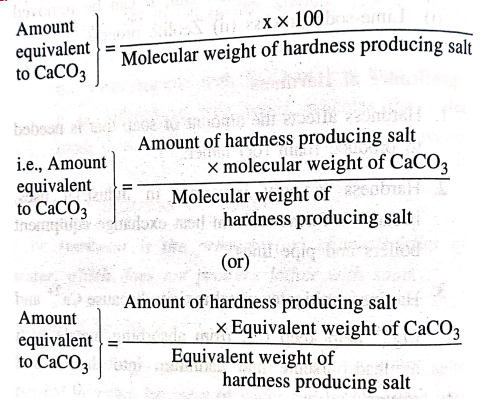
Amount equivalent to
CaCO3 = [ x × 100 ] / Molecular weight of hardness producing salt
i.e., Amount equivalent
to CaCO3 = [Amount of hardness producing salt × molecular weight of
CaCO3 ] / Molecular weight of hardness producing salt
(or)
Amount equivalent to
CaCO3 = [ Amount of hardness producing salt × Equivalent weight of
CaCO3 ] / Equivalent weight of hardness producing salt
Example
If the concentration
(or) weight of CaSO4 is 43 mgs/lit, then weight equivalent to CaCO3
= 43×100 / 136 (mgs/lit)
Applied Chemistry I: UNIT 1: Water Technology : Tag: Applied Chemistry : - Problems Caused by Various Impurities in Water
Applied Chemistry I: UNIT 1: Water Technology
Under Subject

Applied Chemistry I
CY25C01 1st Semester | 2025 Regulation | 1st Semester 2025 Regulation
Related Subjects

English Essentials I
EN25C01 1st Semester | 2025 Regulation | 1st Semester 2025 Regulation

தமிழர் மரபு - Heritage of Tamils
UC25H01 1st Semester | 2025 Regulation | 1st Semester 2025 Regulation

Applied Calculus
MA25C01 Maths 1 M1 - 1st Semester | 2025 Regulation | 1st Semester 2025 Regulation
Applied Physics I
PH25C01 1st Semester | 2025 Regulation | 1st Semester 2025 Regulation
Applied Chemistry I
CY25C01 1st Semester | 2025 Regulation | 1st Semester 2025 Regulation

Makerspace
ME25C04 1st Semester | 2025 Regulation | 1st Semester 2025 Regulation

Computer Programming C
CS25C01 1st Semester | 2025 Regulation | 1st Semester 2025 Regulation

Computer Programming Python
CS25C02 1st Semester | 2025 Regulation | 1st Semester 2025 Regulation

Fundamentals of Electrical and Electronics Engineering
EE25C03 1st Semester | 2025 Regulation | 1st Semester 2025 Regulation

Introduction to Mechanical Engineering
ME25C03 1st Semester | 2025 Regulation | 1st Semester 2025 Regulation

Introduction to Civil Engineering
CE25C01 1st Semester Civil Department | 2025 Regulation | 1st Semester 2025 Regulation

Essentials of Computing
CS25C03 1st Semester - AID CSE IT Department | 2025 Regulation | 1st Semester 2025 Regulation

Applied Physics I Laboratory
PH25C01 1st Semester practical Laboratory Manual | 2025 Regulation | 1st Semester Laboratory 2025 Regulation

Applied Chemistry I Laboratory
CY25C01 1st Semester practical Laboratory Manual | 2025 Regulation | 1st Semester Laboratory 2025 Regulation

Computer Programming C Laboratory
CS25C01 1st Semester practical Laboratory Manual | 2025 Regulation | 1st Semester Laboratory 2025 Regulation

Computer Programming Python Laboratory
CS25C02 1st Semester practical Laboratory Manual | 2025 Regulation | 1st Semester Laboratory 2025 Regulation

Engineering Drawing
ME25C01 EEE Mech Dept | 2025 Regulation | 2nd Semester 2025 Regulation

Basic Electronics and Electrical Engineering
EE25C04 1st Semester ECE Dept | 2025 Regulation | 2nd Semester 2025 Regulation