Applied Chemistry I: UNIT 1: Water Technology
Water Technology: Important Two Marks Questions and Answers
Important part-A 2 marks Short Questions and Answers - Applied Chemistry I: UNIT 1: Water Technology
Applied Chemistry I:
UNIT 1: Water
Technology
Two Marks Questions and Answers
1.
Give some important suspended impurities present in water
Sand, oil droplets,
vegetable and animal matter, impart turbidity to water
2.
Name any four chemical impurities present in water.
Bicarbonates, sulphates
and chlorides of Ca and Mg and carbonates, bicarbonates of Na and K.
3.
What are the biological impurities present in water?
Fungi, bacteria and
other microorganisms cause diseases.
4.
Give any four important sources of water.
The main sources of
water are
(i) rain
(ii) rivers and lakes
(surface water)
(iii) wells and springs
(underground water)
(iv) sea water.
5.
Define Taste and Odour.
Taste
Taste is the sensation
of flavour perceived in the mouth and throat on contact with a substance.
Odour
Odour is a smell (or)
scent caused by one (or) more volatilized chemical compounds that are generally
found in low concentration.
6.
What is meant by turbidity?
Turbidity is the
reduction of clarity of natural water due to the presence of finely divided,
insoluble impurities suspended in water.
7.
What is the significance of pH in water?
(i) pH determines the
solubility (amount that can be dissolved in water).
(ii) It also determines
the biological availability (amount that can be utilized by aquatic life).
(iii) A rise (or) fall
in pH can indicate chemical pollution (or) acid rain. Many animals cannot live
in water at rat a pH level below 5 (or) above 9.
8.
Define hardness.
Hardness is the
property (or) characteristics of water, which does not produce lather with
soap.
9.
Why do we express hardness of water in terms of calcium carbonate equivalent?
CaCO3 is
chosen as a standard because
(i) Its molecular
weight (100) and equivalent weight (50) is a whole number, so the calculations
in water analysis can be simplified.
(ii) It is the most
insoluble salt, that can be precipitated in water treatment.
Amount equivalent to
CaCO3 = [ Amount of hardness producing salt × Equivalent weight of
CaCO3 ] / Equivalent weight of hardness producing salt
10.
What is temporary hardness and permanent hardness. How are they removed?
(i) Temporary hardness
This is due to the
presence of bicarbonates of calcium and magnesium.
It can be removed by,
(i) boiling the water (ii) adding lime to the water.
(ii) Permanent hardness
This is due to the
presence of chlorides and sulphates of calcium and magnesium. It cannot be
removed by boiling the water.
But, it can be removed
by (i) Lime‒soda process (ii) Zeolite process.
11.
What is BOD?
BOD is defined as,
"the amount of free oxygen required by bacteria for the biological
oxidation of the organic matter under aerobic conditions at 20°C for a period
of 5 days".
12.
What is the significance of BOD?
(i) It indicates the
amount of decomposable organic matter present in the sewage.
(ii) It enables us to
determine the degree of pollution at any time in the sewage stream.
(iii) Lesser the BOD,
better is the quality of water. ie. the water sample with BOD of less than 3
ppm is considered as pure water, whereas the water more than 4 ppm is
considered as polluted water.
13.
Define COD.
COD is defined as,
"the measure of amount of oxygen required to chemically oxidise all the
oxidisable impurities present in the sewage using an oxidising agent like
acidified K2Cr2O7".
14.
What are the advantages of COD?
(i) Determination of
COD is carried out only in 3 hours, but determination of BOD is carried out
after 5 days.
(ii) It measures both
the biologically oxidisable and biologically inert organic matter.
15.
Give a brief note on BOD and COD.
(i) BOD
BOD is defined as,
"the amount of free oxygen required by bacteria for the biological
oxidation of the organic matter under aerobic conditions at 20°C for a period
of 5 days".
It indicates the amount
of decomposable organic matter present in the sewage.
(ii) COD
COD is defined as,
"the measure of amount of oxygen required to chemically oxidise all the
oxidisable impurities present in the sewage using an oxidising agent like
acidified K2Cr2O7".
It measures both the
biologically oxidisable and biologically inert organic matter.
16.
What is chlorination?
The process of adding
chlorine to water is called chlorination. Chlorination can be done by the
following methods.
(a) By adding chlorine
gas
(b) By adding
chloramine
(c) By adding bleaching
powder
17.
What is sterilisation.
The process of
destroying the harmful bacterias is known as sterilisation or disinfection. The
chemicals used for this purpose are called disinfectants.
18.
What is break‒point chlorination? Explain.
It is the point where
all the bacterias, reducing substances, organic compounds and ammonia are
completely removed and the applied chlorine begins to act as a powerful
disinfectant.
19.
What is blow‒down operation?
Blow‒down operation is
a process of removing a portion of concentrated water by fresh water frequently
from the boiler during steam production.
20.
What is brackish water?
The water containing
dissolved salts with a peculiar salty (or) brackish taste is called brackish
water.
Brackish water - Contains
> 1000 but < 35,000 ppm of dissolved solids.
21.
Define desalination.
The process of removing
common salt (sodium chloride) from the water is known as desalination. The
water containing dissolved salts with a peculiar salty or brackish taste is
called brackish water.
22.
Write the principle involved in the desalination of water by reverse osmosis.
(or)
What
is meant by 'Reverse osmosis"? How is it applied in the desalination of
water?
If pressure in excess
of osmotic pressure is applied on the higher concentration side, the solvent
flow is reversed ie., solvent flows from higher concentration to lower
concentration. This process is called reverse osmosis.
Salt water is taken as
higher concentration and water is taken as solvent. If pressure is applied on
the salt water, the water flows from salt water to water side.
23.
Name the method which separate both ionic and non‒ionic impurities from water.
Reverse osmosis
process.
24.
Name some of the membranes employed in reverse osmosis process. State the
advantages of this process.
Example:
Cellulose acetate, cellulose butrate.
Advantages
(i) It removes ionic as
well as non‒ionic, colloidal impurities.
(ii) The life time of
the membrane is high and it can be replaced within few minutes.
25.
What are the advantages of reverse osmosis method.
(i) The life time of
the membrane is high, and it can be replaced within few minutes.
(ii) It removes ionic
as well as non‒ionic, colloidal impurities.
(iii) Due to low
capital cost, simplicity, low operating, this process is used for converting
sea water into sea water into drinking water.
26.
Why is water softened before using in boiler?
If hard water obtained
from natural sources is fed directly into the boilers, the following troubles
may arise.
1. Scale and sludge
formation.
2. Priming and foaming
(carry over).
3. Caustic
embrittlement.
4. Boiler corrosion.
27.
What are scales and sludges?
(i) Sludge
If the precipitate is
loose and slimy it is called sludge. Sludges are formed by substances like MgCl2,
MgCO3, MgSO4 and CaCl2. They have greater
solubilities in hot water than cold water.
(ii) Scale
On the other hand, if
the precipitate forms hard and adherent coating on the inner walls of the
boiler, it is called scale. Scales are formed by substances like Ca(HCO3)2,
CaSO4 and MgCl2.
28.
What are the differences between scales and sludges?

Scales
1. Hard and adherent deposit.
2. Difficult to remove
3. Formed by Ca(HCO3)2
CaSO4, Mg(OH)2
4. Acts as thermal insulator
Sludges
1. Loose and non‒adherent
deposit
2. Easy to remove.
3. Formed by MgCl2,
MgCO3, CaCl2.
4. Acts as poor
conductor of heat.
29.
Mention any two disadvantages of formation of deposits in steam boilers
(or)
What
are the disadvantages of scale formation.
Scales act as thermal
insulators. It decreases the efficiency of boiler. Any crack developed on the
scale, leads to explosion.
30.
What is meant by priming and foaming? How can they be prevented.
(i) Priming
It is the process of
production of wet steam. Priming can be prevented by controlling the velocity
of steam and keeping the water level lower.
(ii) Foaming
It is the formation of
stable bubbles above the surface of water. Foaming can be prevented by adding
coagulants like sodium aluminate and antifoaming agents like synthetic
polyamides.
31.
What is meant by priming and mention its causes.
Priming is the process
of production of wet steam. Priming is caused by
1) High steam velocity.
(ii) Very high water
level in the boiler.
(iii) Sudden boiling of
water.
(iv) Very poor boiler
design.
32.
List two disadvantages of using hard water in boilers.
(i) Scale and sludge
formation
(ii) Priming and
foaming (carry over)
(iii) Caustic
embrittlement
(iv) Boiler corrosion
33.
What is the reasons for the caustic embrittlement in boilers? Give examples.
Presence of alkali
metal carbonates and bicarbonates like Na2CO3, K2CO3,
NaHCO3, KHCO3 (or) NaOH cause caustic embrittlement.
34.
What is caustic embrittlement? Mention any one method to prevent it.
Caustic embrittlement
means intercrystalline cracking of boiler metal.
Prevention
Caustic embrittlement
can be prevented by
(i) using sodium
phosphate as softening agent instead of sodium carbonate.
(ii) by adding tannin,
lignin to the boiler water, which blocks the hair cracks.
35.
Indicate the reasons for boiler corrosion
Boiler corrosion arises
due to the presence of
(i) dissolved oxygen,
(ii) dissolved carbon
dioxide,
(iii) dissolved salts.
36.
What are the requisites of drinking and boiler feed water?
(i) Boiler feedwater
Must have zero hardness
and free from dissolved gases like O2, CO2, suspended
matter, TDS and turbidity.
(ii) Drinking water
. H of water should be
in the range of 7.0‒8.5.
. Total hardness and
dissolved solids of water should be less than 500 ppm.
37.
State the harmful effect of silica present in boiler feed water.
. Formation of silicate
scale on the boiler acts as thermal insulator.
. It forms heavy
deposit on the blades and nozzles of turbines.
38.
Define softening of water. How is it caried out.
The process of removing
hardness producing salts from water is known as softening (or) conditioning of water.
Softening of water can
be done in two methods
(i) External treatment.
(ii) Internal treatment.
39.
Soft water is not DM water whereas DM water is soft water Justify.
(or)
Distinguish
between soft water and demineralised water,
The soft water,
produced by lime‒soda and zeolite processes, does not contain hardness
producing Ca2+ and Mg2+ ions, but it will contain other
ions like Na+, K+, SO42‒, Cl‒
etc., On the other hand D.M. (Demineralised) water does not contain both anions
and cations.
40.
What are the advantages of ion‒exchange process.
(1) Highly acidic or
alkaline water can be treated by this process.
(ii) The water obtained
by this process will have be very low hardness (nearly 2 ppm).
41.
How is exhausted resin regenerated in ion‒exchange process.
When the cation
exchange resin is exhausted, it can be regenerated by passing a solution of dil
HCl or dil H2SO4
RCa + 2HC1 → RH2+
CaCl2
RNa + HCl → RH + NaCl
Similarly, when the
anion exchange resin is exhausted, it can be regenerated by passing a solution
of dil NaOH.
R'Cl2 +
2NaOH → R'(OH)2 + 2NaCl.
42.
Give some examples for cation exchange resin.
(i) Sulphonated coals.
(ii) Sulphonated
polystyrene.
43.
Give some examples for anion exchange resin.
(i) Cross - linked
quaternary ammonium salts.
(ii) Urea - formaldehyde
resin.
44.
How is boiler corrosion, due to dissolved oxygen, removed.
Sodium sulphite,
hydrazine are some of the chemicals used for removing dissolved oxygen from water.
2Na2SO3 + O2 →
2Na2SO4
N2H4 + O2 → N2
+ 2H2O
45.
Name the gases dissolved in water that cause corrosion?
(i) Dissolved oxygen
(DO)
DO in water attacks the
boiler material at higher temperature.
4Fe + 6H2O +
3O2 → 4Fe(OH)3↓
(ii) Dissolved carbon
dioxide
Dissolved CO2
in water produces carbonic acid, which is acidic and corrosive in nature.
CO2 + H2O
‒‒‒‒> H2CO3
46.
How does carbon dioxide cause boiler corrosion.
Dissolved carbon
dioxide in water produces carbonic acid, which is acidic and corrosive in
nature.
CO2 + H2O
→ H2CO3
Carbon dioxide gas is
also produced from the decomposition of bicarbonate salts present in water.
Ca(HCO3)2
---Δ→ CaCO3↓ + H2O + CO2↑
47.
What are ion exchange resins?
Ion exchange resins are
long chain, cross linked. insoluble organic polymers with a microporous
structure. The functional groups attached chains are responsible for the ion
exchanging properties.
48.
What are the disadvantages of ion‒exchange process.
(i) Water containing
turbidity, Fe and Mn cannot be treated, because turbidity reduces the output
and Fe, Mn form stable compound with the resin.
(ii) The equipment is
costly and more expensive chemicals are needed.
49.
How is water demineralised in an ion‒exchanger?
When the water
containing ions (both anion and cation) are passed through ion exchange
columns, it absorbs all the ions (anions and cations) as shown below.
Cation exchanger: R(H)2
+ CaCl2 → RCa + 2HC1.
Anion exchanger: R(OH)2
+ 2HCl → RC12 + 2H2O.
50.
Distinguish between the Zeolite process and the ion exchange process.
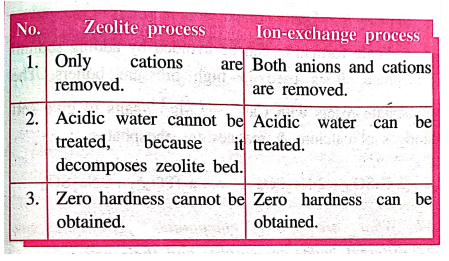
Zeolite process
1. Only cations are removed.
2. Acidic water cannot
be treated because it decomposes zeolite bed.
3. Zero hardness cannot
be obtained.
Ion‒exchange process
1. Both anions and
cations are removed.
2. Acidic water can be
treated,
3. Zero hardness can be
obtained.
51.
What is meant by internal conditioning of water.
Internal conditioning
is the process which involves the removal of scale forming substance by adding
chemicals directly into the boiler.
52.
Explain the function of a coagulant with example.
When the coagulant is
added to water, it gets hydrolysed to form a gelatinous precipitate of
coagulatant Al(OH)3. The gelatinous precipitate, Al(OH)3,
entraps the finely divided and colloidal impurities, settles to the bottom and
can be removed easily.
53.
What is phosphate conditioning
(or)
What
is the role of phosphates in the internal treatment of water?
Scale formation can be
avoided by adding sodium phosphate. It is used in high pressure boilers. The phosphate
reacts with Ca2+ and Mg2+ salts to give soft sludges of
calcium & magnesium phosphates.
3CaSO4 + 2Na3PO4
→ Ca3(PO4)2
+ 3Na2SO4
54.
What are boiler compounds? Mention two different boiler compounds and their
actions.
Scale forming
substances can be removed by adding chemicals directly to the boiler. These
chemicals are called boiled compounds.
Examples: Sodium
carbonate and sodium phosphate.
(i) CaSO4 +
Na2CO3 → CaCO3 + Na2SO4
(ii) 3CaSO4 +
2Na3PO4 → Ca3(PO4)2 +
3Na2SO4
55.
What is calgon conditioning? How is it functioning in water treatment?
(or)
Write
the chemical reaction involved in calgon conditioning.
Calgon is sodim hexa
meta phosphate Na2[Na4(PO3)6]. This
substance interacts with calcium ions forming a highly soluble complex and thus
prevents the precipation of scale forming salt.
2CaSO4 + Na2[Na4(PO3)6]
→ Na2[Ca2(PO3)6] + 2Na2SO4
56.
Distinguish between internal and external conditioning of water.
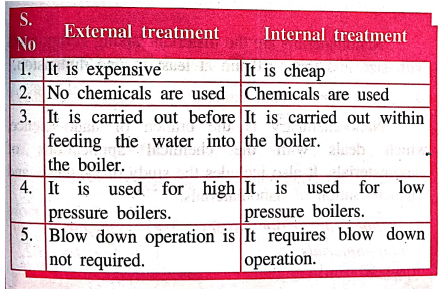
External treatment
1. It is expensive
2. No chemicals are
used
3. It is carried out
before feeding the water into the boiler.
4. It is used for high pressure
boilers.
5. Blow down operation
is not required.
Internal treatment
1. It is cheap
2. Chemicals are used
3. It is carried out
within the boiler.
4. It is used for low pressure
boilers.
5. It requires blow
down operation.
57.
Why calgon conditioning is better than phosphate conditioning?
In calgon conditioning
calgon forms highly soluble complex, but in phosphate conditioning, it gives
sludge. So periodical disposal of sludge is important in phosphate
conditioning, but in calgon conditioning no problem of disposal.
Applied Chemistry I: UNIT 1: Water Technology : Tag: Applied Chemistry : - Water Technology: Important Two Marks Questions and Answers
Applied Chemistry I: UNIT 1: Water Technology
Under Subject

Applied Chemistry I
CY25C01 1st Semester | 2025 Regulation | 1st Semester 2025 Regulation
Related Subjects

English Essentials I
EN25C01 1st Semester | 2025 Regulation | 1st Semester 2025 Regulation

தமிழர் மரபு - Heritage of Tamils
UC25H01 1st Semester | 2025 Regulation | 1st Semester 2025 Regulation
Applied Calculus
MA25C01 Maths 1 M1 - 1st Semester | 2025 Regulation | 1st Semester 2025 Regulation
Applied Physics I
PH25C01 1st Semester | 2025 Regulation | 1st Semester 2025 Regulation
Applied Chemistry I
CY25C01 1st Semester | 2025 Regulation | 1st Semester 2025 Regulation
Makerspace
ME25C04 1st Semester | 2025 Regulation | 1st Semester 2025 Regulation
Computer Programming C
CS25C01 1st Semester | 2025 Regulation | 1st Semester 2025 Regulation

Computer Programming Python
CS25C02 1st Semester | 2025 Regulation | 1st Semester 2025 Regulation
Fundamentals of Electrical and Electronics Engineering
EE25C03 1st Semester | 2025 Regulation | 1st Semester 2025 Regulation
Introduction to Mechanical Engineering
ME25C03 1st Semester | 2025 Regulation | 1st Semester 2025 Regulation

Introduction to Civil Engineering
CE25C01 1st Semester Civil Department | 2025 Regulation | 1st Semester 2025 Regulation
Essentials of Computing
CS25C03 1st Semester - AID CSE IT Department | 2025 Regulation | 1st Semester 2025 Regulation

Applied Physics I Laboratory
PH25C01 1st Semester practical Laboratory Manual | 2025 Regulation | 1st Semester Laboratory 2025 Regulation

Applied Chemistry I Laboratory
CY25C01 1st Semester practical Laboratory Manual | 2025 Regulation | 1st Semester Laboratory 2025 Regulation

Computer Programming C Laboratory
CS25C01 1st Semester practical Laboratory Manual | 2025 Regulation | 1st Semester Laboratory 2025 Regulation

Computer Programming Python Laboratory
CS25C02 1st Semester practical Laboratory Manual | 2025 Regulation | 1st Semester Laboratory 2025 Regulation
Engineering Drawing
ME25C01 EEE Mech Dept | 2025 Regulation | 2nd Semester 2025 Regulation

Basic Electronics and Electrical Engineering
EE25C04 1st Semester ECE Dept | 2025 Regulation | 2nd Semester 2025 Regulation