Python for Data Science: Laboratory Programs in Python
Python Programs using strings and files
Laboratory Programs in Python
Python for Data Science: Laboratory Programs in Python : Functions and Files : Python Programs using strings and files
Python Programming examples based on string
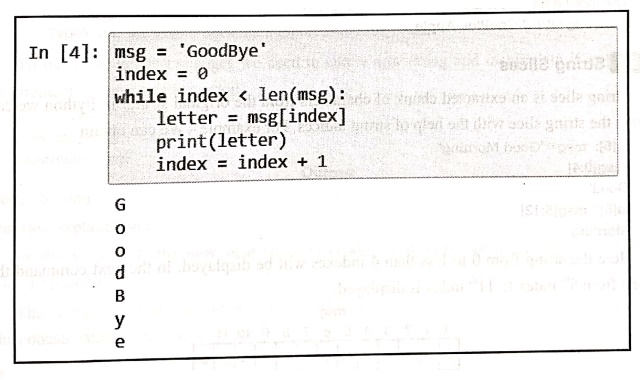
Ex 1 ‒ Traversing a string using while string.
In [4]: msg = 'GoodBye'
index = 0
while index < len(msg):
letter = msg[index]
print(letter)
index = index + 1
G
o
o
d
B
y
e
Ex 2 ‒ The string can be traversed using for loop.
msg = 'GoodBye'
for index in range(0, len(msg)):
letter = msg[index]
print(letter)
index index + 1
Output
G
o
o
d
B
y
е
Ex:3
Write a program to display a set of strings using range() function.
Solution :
handsets = ['Samsung', 'OPPO', 'OnePlus', 'Apple']
print("The mobile handsets are...")
for i in range(len(handsets)):
print(handsets[i], end ="")
Output
The mobile handsets are...
Samsung OPPO OnePlus Apple
Ex. 4
Write a Python program to find the length of a string.
Solution:
def str_length(str):
len=0
for ch in str:
len+=1
return len
print("\t\t Program to find the length of a string")
print("Enter some string: ")
str=input()
print("Length of a string is: ",str_length(str))
Output
Program to find the length of a string
Enter some string:
python
Length of a string is: 6
Ex. 5
Write a Python program to count occurrences of each word in given sentence.
Solution:
def count_occur(str):
data=dict()
words=str.split()
for word in words:
if word in data:
data[word]+=1
else:
data[word]=1
return data
print("Enter some string: ")
str=input()
print(count_occur(str))
Output
Enter some string :
A big black bear sat on a big black rug
{'A': 1, 'big': 2, 'black': 2, 'bear': 1, 'sat': 1, 'on': 1, 'a': 1, 'rug': 1}
Ex. 6
Write a Python program to copy one string to another.
Solution :
print("Enter some string: ")
str1=input()
str2="
for i in range (len(str1)):
str2=str2+str1[i]
print("The copied string is: ",str2)
Output
Enter some string:
Technical
The copied string is: Technical
Ex. 7
Write a Python program to check if a substring is present in the given string or not.
Solution :
print("Enter some string: ")
str1=input()
print("Enter a word: ")
str2=input()
if(str1.find(str2)= = ‒1):
print("The substring ",str2," is not present in ",str1)
else:
print("The substring ",str2," is present in ",str1)
Output
Enter some string:
sky blue
Enter a word:
blue
The substring blue is present in sky blue
Ex. 8
Write a Python program to count number of digits and letters in a string.
Solution :
print("Enter some string: ")
str=input()
digit_count = 0
letter_count = 0
for i in str:
if(i.isdigit()):
digit_count+=1
else:
letter count+=1
print("Total number of digits in ",str," are ",digit_count)
print("Total number of letters in ",str," are ",letter_count)
Output
Enter some string :
Python123Program
Total number of digits in Python123Program are 3
Total number of letters in Python123Program are 13
Ex. 9
Write a Python program to count number of vowels in a string.
Solution :
print("Enter some string: ")
str=input()
vowel_count=0
for i in str:
if((i= ='a' or i= ='e' or i= ='i' or i= ='o' or i= ='u')
or((i= ='A' or i= ='E' or i= ='I' or i= ='0' or i= ='U'))):
vowel_count + =1
print("Total number of vowels in ",str," are ",vowel_count)
Output
Enter some string:
India
Total number of vowels in India are 3
Ex. 10
Write a Python program to check if the string is palindrome or not.
Solution :
print("Enter some string: ")
str=input()
rev_str=reversed(str)
if(list(str)==list(rev_str)):
print("The string ",str," is palindrome")
else:
print("The string ",str," is not palindrome")
Output
Enter some string :
madam
The string madam is palindrome
Ex. 11
Write a Python program to sort the word in a sentence in an alphabetic order.
Solution :
print("Enter some string: ")
str=input()
words_list=str.split()
words_list.sort()
print("The words in sorted order are...")
for word in words_list:
print(word)
Output
Enter some string :
I like python program very much
The words in sorted order are...
I
like
much
program
python
very
Ex. 1
Write a Python program to read the contents of the file named 'test.txt.
Solution :
ReadFile.py
inf = open('D:\\test.txt','rt')
print(inf.read())
inf.close()
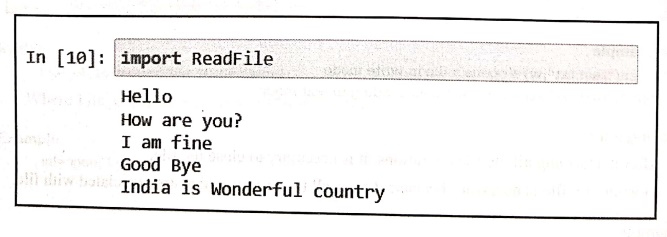
Output
In [10]: import ReadFile
Hello
How are you?
I am fine
Good Bye
Ex. 2
Write a Python program to read and display first two lines of the text file.
Solution :
ReadLineDemo.py
inf = open('D:\\test.txt','rt')
print(inf.readline())
print(inf.readline())
inf.close()
Output
Hello
How are you?
Program explanation: In above program,
1) The file is opened using open statement.
2) The we call readline() statements inside two subsequent print statement. After reading from the file using the readline() method, the control automatically passes to the next line. Hence we call readline() inside the print statement again.
3) Finally we must not forget to close the file using close() method.
Ex. 3
Write a program to display the contents of the file using for loop.
Solution :
DisplayFile.py
inf = open('D:\\test.txt','rt')
for line in inf:
print(line)
inf.close()
Output
Hello
How are you?
I am fine
Good Bye
India is Wonderful country
Ex. 4
Write a Python program to find the line that starts with the word "This" from the following text which is stored in a file.
Test.txt
This is a Python program
Python is superb.
This is third line of program
this Python program is nice
Solution :
FileDemo1.py
fh=open('d:\\test.txt')
i=0
for line in fh:
line=line.rstrip()
if line.find("This')= = ‒1:continue
print(line)
Output
This is a python program
This is third line of program
Ex. 5
Write a program in Python to split the text line written in the file into words.
Solution :
with open('d:\\test.txt','rt') as inf:
line=inf.readline()
word_list=line.split()
print(word_list)
Output
['This', 'is', 'a', 'python', 'program']
Ex. 6
Write a Python program to write multiple lines to a text file using writelines() method.
Solution :
fo=open('d:\\test.txt', 'wt')
lines=["Welcome to the Python programming\n","It is fun\n",
"Python is easy\n", "But it is powerful programming language"]
fo.writelines (lines)
fo.close()
Output
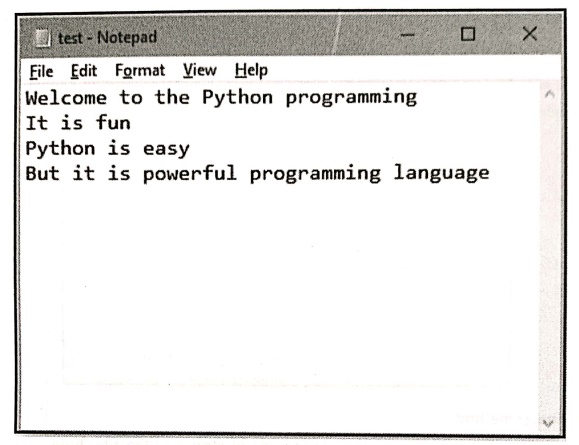
Now open the Notepad and open the test.txt file in it. It will be something like this ‒
Ex. 7
Write a Python program to write n number of lines to the file and display all these lines as output.
Solution :
print("How many lines you want to write")
n=int(input())
outFile=open("d:\\test.txt","wt")
for i in range(n):
print("Enter line")
line=input()
outFile.write("\n"+line)
outFile.close()
print("The Contents of the file 'test.txt' are ...")
inFile=open("d:\\test.txt", 'rt')
print(inFile.read())
inFile.close()
Ex. 8
Write a Python program to write the contents in 'one.txt' file. Read these contents and write them to another file named 'two.txt'.
Solution :
print("How many lines you want to write")
n=int(input())
outFile=open("d:\\one.txt", 'wt')
for i in range(n):
print("Enter line")
line=input()
outFile.write("\n"+line)
outFile.close()
inFile=open("d:\\one.txt", 'rt')
outFile=open("d:\\two.txt","wt")
i=0
for i in range(n+1):
line‒inFile.readline()
outFile.write("\n"+line)
inFile.close()
outFile.close()
print("The Contents of the file 'two.txt' are...")
inFile=open("d:\\two.txt","rt')
print(inFile.read())
inFile.close()
Ex. 9
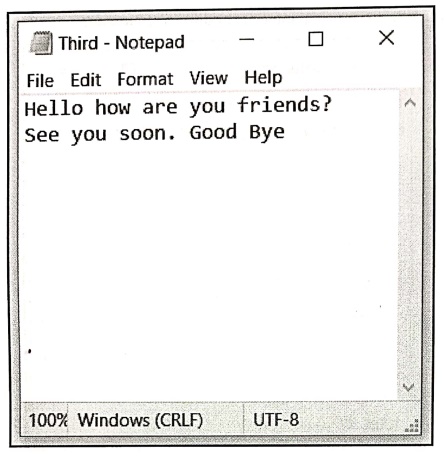
How to merge multiple files into a new file using Python.
Solution :
one = two ="'
fp=open('d:\\first.txt','rt')
one = fp.read()
fp=open('d:\\second.txt','rt')
second = fp.read()
one+= "\n"
one+= second
fp = open('d:\\third.txt','wt')
fp.write(one)
fp.close()
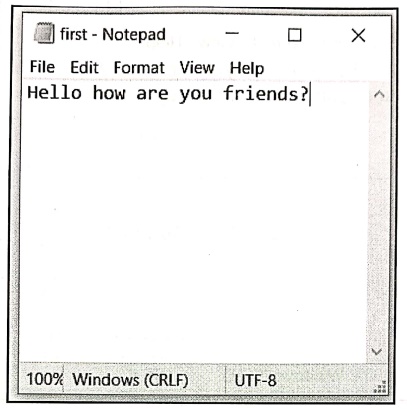
Step 1: Create a first.txt file using some text‒editor like Notepad.
Step 2: Create a second.txt file using some text‒editor like Notepad.
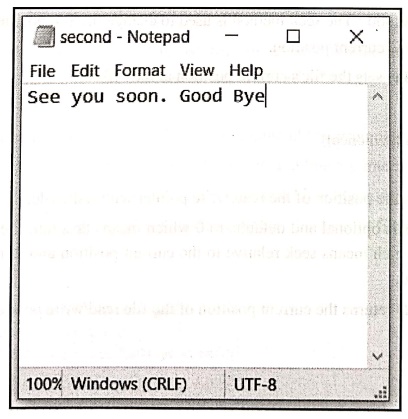
Step 3: Now open the third.txt file using some text‒editor. It will be as follows ‒
Python for Data Science: Laboratory Programs in Python : Tag: Computer Programming, Python, Data Science : Laboratory Programs in Python - Python Programs using strings and files
Python for Data Science: Laboratory Programs in Python
Under Subject
Python for Data Science
AD25201 2nd Semester AIDS Dept | 2025 Regulation | 2nd Semester 2025 Regulation
Python for Data Science - Laboratory
AD25201 2nd Semester AIDS Dept | 2025 Regulation | 2nd Semester 2025 Regulation
Related Subjects
English Essentials II
EN25C02 2nd Semester | 2025 Regulation | 2nd Semester 2025 Regulation

Tamils and Technology தமிழர்களும் தொழில்நுட்பமும்
UC25H02 2nd Semester | 2025 Regulation | 2nd Semester 2025 Regulation
Linear Algebra
MA25C02 2nd Semester | 2025 Regulation
Applied Physics (CSIE) II
PH25C03 2nd Semester AIDS, CSE, IT, CSE(CY) Dept | 2025 Regulation | 2nd Semester 2025 Regulation
Digital Principles and Computer Organization
CS25C06 2nd Semester AIDS, CSE, IT, CSE(CY) Dept | 2025 Regulation | 2nd Semester 2025 Regulation

Basic Electrical and Electronics Engineering
EE25C01 2nd Semester | 2025 Regulation | 2nd Semester 2025 Regulation
Python for Data Science
AD25201 2nd Semester AIDS Dept | 2025 Regulation | 2nd Semester 2025 Regulation

Re-Engineering for Innovation
ME25C05 2nd Semester | 2025 Regulation | 2nd Semester 2025 Regulation
Python for Data Science - Laboratory
AD25201 2nd Semester AIDS Dept | 2025 Regulation | 2nd Semester 2025 Regulation